
Angle Bisector Theorem: Definition, Formula, Proof, and Examples
Math Expert
Geometry
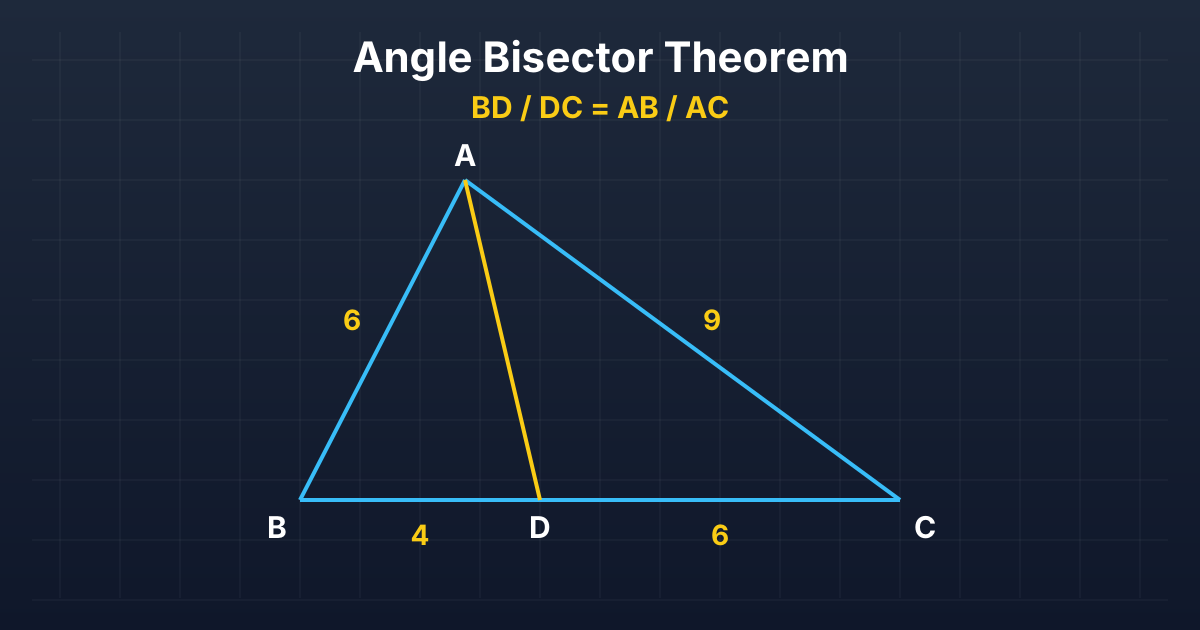
Draw a line from one vertex of a triangle that splits its angle into two equal parts. Does that line also split the opposite side into two equal lengths? It is tempting to say yes, but the answer is not always yes. The Angle Bisector Theorem explains what happens instead: an internal angle bisector divides the opposite side in the same ratio as the two sides that form the angle. If one forming side is longer than the other, the segment next to it is longer too, in the same proportion.
This rule matters because it turns a fact about angles into a fact about lengths. It lets you find missing side lengths, solve proportions, write proofs, and answer examination questions that would otherwise take much longer. In this guide you will learn the definition, the formula, two proofs of why it works, the converse, the external version, common mistakes, and how to solve problems step by step.
What Is the Angle Bisector Theorem?
Featured snippet answer: The Angle Bisector Theorem states that when an internal angle bisector of a triangle meets the opposite side, it divides that side into two segments proportional to the two adjacent sides. In triangle ABC, if AD bisects angle A and meets BC at D, then BD / DC = AB / AC.
Take triangle ABC. Let D be a point on side BC such that AD bisects angle BAC. That means angle BAD equals angle DAC: the ray AD cuts angle A into two congruent angles. The Angle Bisector Theorem then says:
BD / DC = AB / AC
Each symbol has a clear meaning. AB and AC are the sides adjacent to angle A, the two sides that form the angle being bisected. AD is the internal angle bisector, the segment from vertex A to the opposite side. BD and DC are the two segments of the opposite side BC, created where the bisector lands. The proportion pairs each segment with the side on the same side of the triangle: BD, next to vertex B, pairs with AB, and DC, next to vertex C, pairs with AC.
This is why the bisector does not generally cut the opposite side in half. Equal halves would require BD = DC, which the proportion only gives when AB = AC. When the adjacent sides differ, the segments differ in the same ratio. A bisector of a 6 cm side and a 9 cm side splits the opposite side in the ratio 6 to 9, or 2 to 3, not 1 to 1.
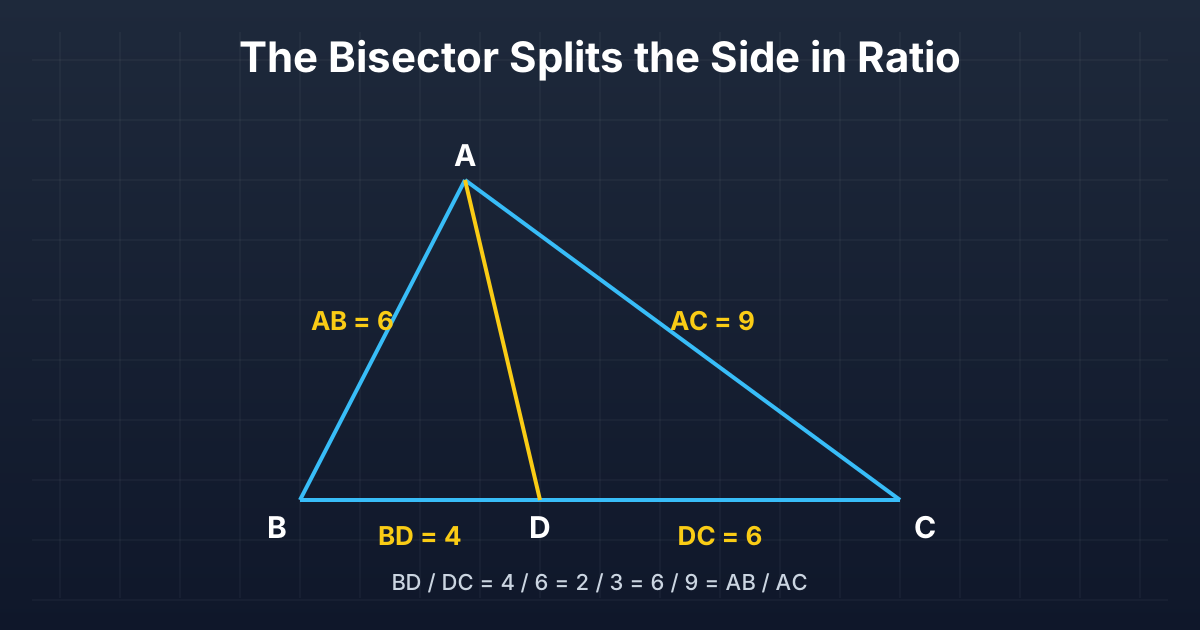
Caption: Triangle ABC with AD bisecting angle A. The equal angle marks at A show angle BAD equals angle DAC, and the bisector divides BC into segments BD and DC in the ratio AB to AC.
Understanding Angle Bisectors in Geometry
What Is an Angle Bisector?
An angle bisector is a ray, line, or segment that divides an angle into two congruent angles, meaning two angles of equal measure. If an angle measures 80 degrees, its bisector creates two angles measuring 40 degrees each. Inside a triangle, the bisector is usually drawn as a segment from a vertex to the opposite side, and that segment is what the Angle Bisector Theorem is about.
Internal Angle Bisector
An internal angle bisector divides an interior angle of a triangle into two equal angles and meets the opposite side at a point between its endpoints. Every triangle has three internal angle bisectors, one from each vertex, and all three meet at a single point called the incenter. The Angle Bisector Theorem in its standard form is about these internal bisectors.
External Angle Bisector
An external angle bisector divides an exterior angle of a triangle into two equal angles. The exterior angle at a vertex is the angle between one side of the triangle and the extension of the adjacent side. The external bisector meets the line containing the opposite side at a point outside the segment, provided the two adjacent side lengths are unequal. If the adjacent sides are equal, the external bisector runs parallel to the opposite side and never meets its line. The external version of the theorem is covered in its own section below.
Angle Bisector vs. Median vs. Altitude
Three segments leave a vertex and meet the opposite side, and each does a different job. Confusing them is one of the most common errors in triangle geometry.
| Triangle Segment | Definition | Main Property |
|---|---|---|
| Angle bisector | Divides an angle into two equal angles | Creates proportional opposite-side segments |
| Median | Connects a vertex to the midpoint of the opposite side | Divides the opposite side into equal lengths |
| Altitude | Perpendicular segment from a vertex to the opposite side or its extension | Forms a right angle |
An angle bisector is also a median in certain triangles. When the bisector is drawn from the apex of an isosceles triangle to its base, the two adjacent sides are equal, so the proportion gives equal segments, and the bisector hits the midpoint. That special case is the only one where the two jobs coincide by the theorem itself. The median to the hypotenuse guide compares these segments in a right triangle setting.
Angle Bisector Theorem Formula Explained
The standard formula is:
BD / DC = AB / AC
BD is the segment of BC next to vertex B, and DC is the segment next to vertex C. AB is the side next to vertex B, and AC is the side next to vertex C. The pairing rule is the whole theorem: the segment near B goes with the side near B, and the segment near C goes with the side near C.
Cross-multiplication turns the proportion into forms that are easier to solve:
BD × AC = DC × AB
BD = (AB × DC) / AC
DC = (AC × BD) / AB
Cross-multiplication is the main tool for missing-length problems. If three of the four lengths in the proportion are known, the fourth follows from one multiplication and one division. The examples below use this step repeatedly.
Finding the Two Segments When the Entire Side Is Known
Often the whole opposite side is known but neither segment is. Let AB = c, AC = b, BC = a, BD = x, and DC = a − x. The theorem gives:
x / (a − x) = c / b
Cross-multiply: bx = c(a − x), so bx = ac − cx. Bring the x terms together: bx + cx = ac, so x(b + c) = ac. Therefore:
BD = ac / (b + c)
DC = ab / (b + c)
Check that the segments add up: BD + DC = ac / (b + c) + ab / (b + c) = a(b + c) / (b + c) = a, which is BC. The derivation holds together, and it gives a fast route to both segments at once.
A numerical example makes it concrete. Let AB = 6 cm, AC = 9 cm, and BC = 10 cm. Then BD = (10 × 6) / (9 + 6) = 60 / 15 = 4 cm, and DC = (10 × 9) / (9 + 6) = 90 / 15 = 6 cm. Check: 4 + 6 = 10, which matches BC, and 4 / 6 = 2 / 3, which matches 6 / 9 = 2 / 3.
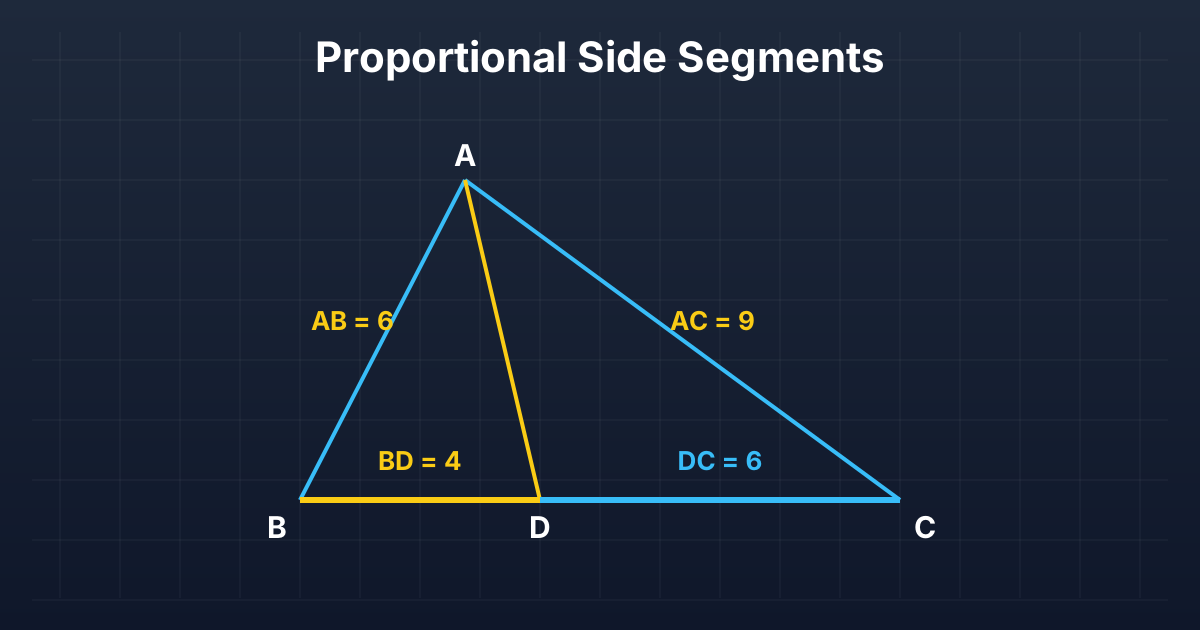
Caption: The segments BD and DC stand in the same ratio as the adjacent sides AB and AC. When the whole side BC is known, both segments follow from the ratio.
How to Use the Angle Bisector Theorem Step by Step
Follow these eight steps in order. Most errors come from skipping a step, especially the pairing step.
Step 1: Identify the Triangle
Label the vertices correctly and write down which triangle you are working with. Consistent labeling prevents most correspondence errors.
Step 2: Locate the Angle Bisector
Identify which angle is divided into two equal angles. Look for equal angle marks at a vertex or a statement that a segment bisects an angle. Do not assume a segment is a bisector just because it meets the opposite side.
Step 3: Identify the Opposite Side
Determine which side is divided into two segments. It is the side opposite the bisected angle, not one of the sides forming the angle.
Step 4: Match the Corresponding Segments
Pair each segment with the side on the same side of the triangle: BD with AB, and DC with AC. Say the pairing out loud if it helps: the segment near B goes with the side near B.
Step 5: Write the Correct Proportion
Use BD / DC = AB / AC. Writing the proportion before substituting numbers keeps the pairing visible and checkable.
Step 6: Substitute the Given Values
Insert the known side lengths into the proportion, keeping units consistent throughout.
Step 7: Solve the Equation
Use cross-multiplication or algebraic simplification to find the unknown. Show each step so an arithmetic slip is easy to catch.
Step 8: Verify the Answer
Check that all lengths are positive, that the segment lengths add up to the full opposite side, that the ratios match, and that the answer is geometrically reasonable. A negative length or a segment longer than the whole side signals an error.
Here is a complete beginner example. In triangle ABC, AD bisects angle A, with AB = 6 cm, AC = 9 cm, and BC = 10 cm. Find BD and DC. The proportion is BD / DC = 6 / 9 = 2 / 3. Let BD = 2k and DC = 3k. Then 2k + 3k = 10, so 5k = 10 and k = 2. Therefore BD = 4 cm and DC = 6 cm. Verify: 4 + 6 = 10, which matches BC, and 4 / 6 = 2 / 3, which matches 6 / 9. The answer checks out on both counts.
Angle Bisector Theorem Examples With Step-by-Step Solutions
The examples below progress from basic to advanced. Every triangle satisfies the triangle inequality, and every answer is checked two ways: the segments add to the whole side, and the ratios match.
Example 1: Finding a Missing Segment
In triangle ABC, AD bisects angle A. Given AB = 8 cm, AC = 12 cm, and BD = 6 cm, find DC.
Write the proportion BD / DC = AB / AC and substitute: 6 / DC = 8 / 12. Cross-multiply: 8 × DC = 6 × 12 = 72, so DC = 72 / 8 = 9 cm. Check: BD / DC = 6 / 9 = 2 / 3, and AB / AC = 8 / 12 = 2 / 3. The ratios agree, so DC = 9 cm is correct.
Example 2: Dividing a Side in a Given Ratio
Triangle ABC has AB = 6 cm, AC = 9 cm, and BC = 20 cm. AD bisects angle A. Find BD and DC.
The ratio is BD : DC = 6 : 9 = 2 : 3. Let BD = 2k and DC = 3k. Then 2k + 3k = 20, so 5k = 20 and k = 4. Therefore BD = 8 cm and DC = 12 cm. Verify the sum: 8 + 12 = 20 cm, which equals BC. Verify the ratio: 8 / 12 = 2 / 3, which equals 6 / 9. Both checks pass.
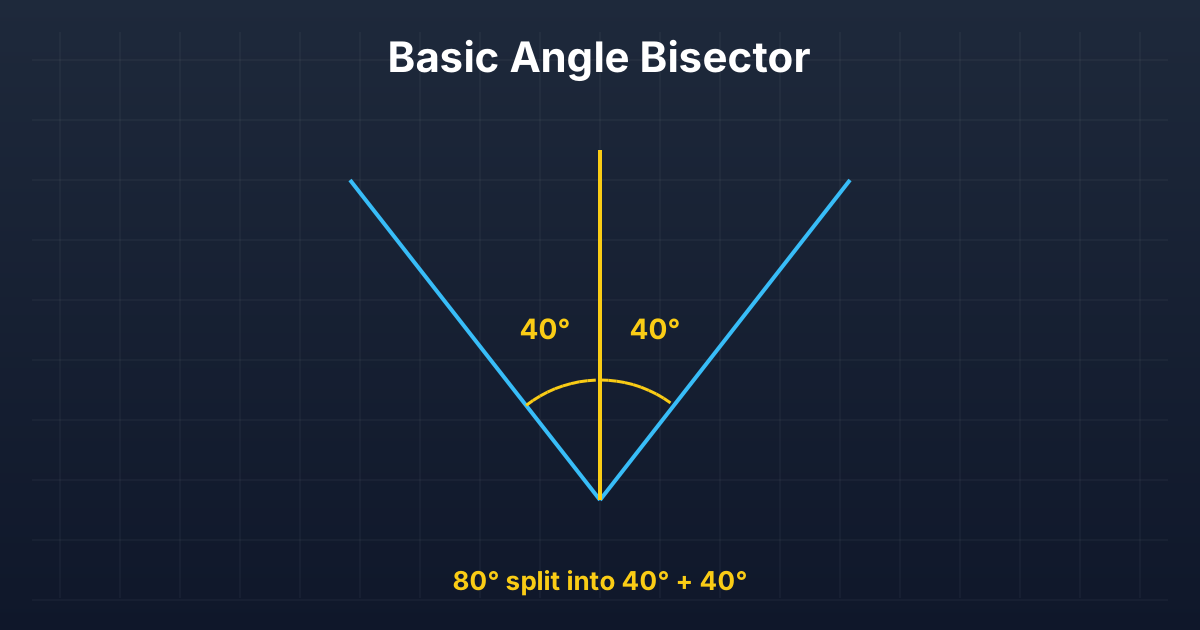
Caption: An angle bisector splits one angle into two congruent angles. The Angle Bisector Theorem then controls where the bisector meets the opposite side.
Example 3: Solving an Algebraic Equation
In triangle ABC, AD bisects angle A. Given AB = 9 cm, AC = 12 cm, BD = x + 2, and DC = 2x − 1, find x.
Set up the proportion: (x + 2) / (2x − 1) = 9 / 12 = 3 / 4. Cross-multiply: 4(x + 2) = 3(2x − 1), so 4x + 8 = 6x − 3. Subtract 4x from both sides: 8 = 2x − 3. Add 3: 11 = 2x, so x = 5.5. Then BD = 5.5 + 2 = 7.5 cm and DC = 2(5.5) − 1 = 10 cm, giving BC = 17.5 cm.
Verify the triangle is valid. Check the triangle inequality: 9 + 12 = 21, which is greater than 17.5; 9 + 17.5 = 26.5, which is greater than 12; and 12 + 17.5 = 29.5, which is greater than 9. All three checks pass, so the triangle is genuine. Verify the ratio: 7.5 / 10 = 3 / 4, which equals 9 / 12. Both checks pass.
A warning belongs here. It is easy to write down algebraic segment expressions that look reasonable but describe an impossible triangle. If the numbers had been AB = 10 cm, AC = 15 cm, BD = x + 2, and DC = 2x − 1, the algebra would give x = 8, BD = 10 cm, DC = 15 cm, and BC = 25 cm, but 10 + 15 = 25, which equals BC instead of exceeding it. That is a degenerate triangle, a straight line rather than a triangle, so those numbers must never be presented as a valid triangle. Always run the triangle inequality check before accepting an algebraic answer.
Example 4: Finding an Unknown Adjacent Side
In triangle ABC, AD bisects angle A. The opposite-side segments are BD = 4 cm and DC = 6 cm, and one adjacent side is AB = 8 cm. Find AC.
The proportion is BD / DC = AB / AC, so 4 / 6 = 8 / AC. Cross-multiply: 4 × AC = 6 × 8 = 48, so AC = 48 / 4 = 12 cm. The whole opposite side is BC = 4 + 6 = 10 cm. Check the triangle inequality for sides 8, 12, and 10: 8 + 10 = 18, which is greater than 12; 8 + 12 = 20, which is greater than 10; and 10 + 12 = 22, which is greater than 8. The triangle is valid, and the ratio check gives 4 / 6 = 2 / 3 and 8 / 12 = 2 / 3. This example shows the theorem working in reverse: when the split and one adjacent side are known, the other adjacent side follows from the same proportion.
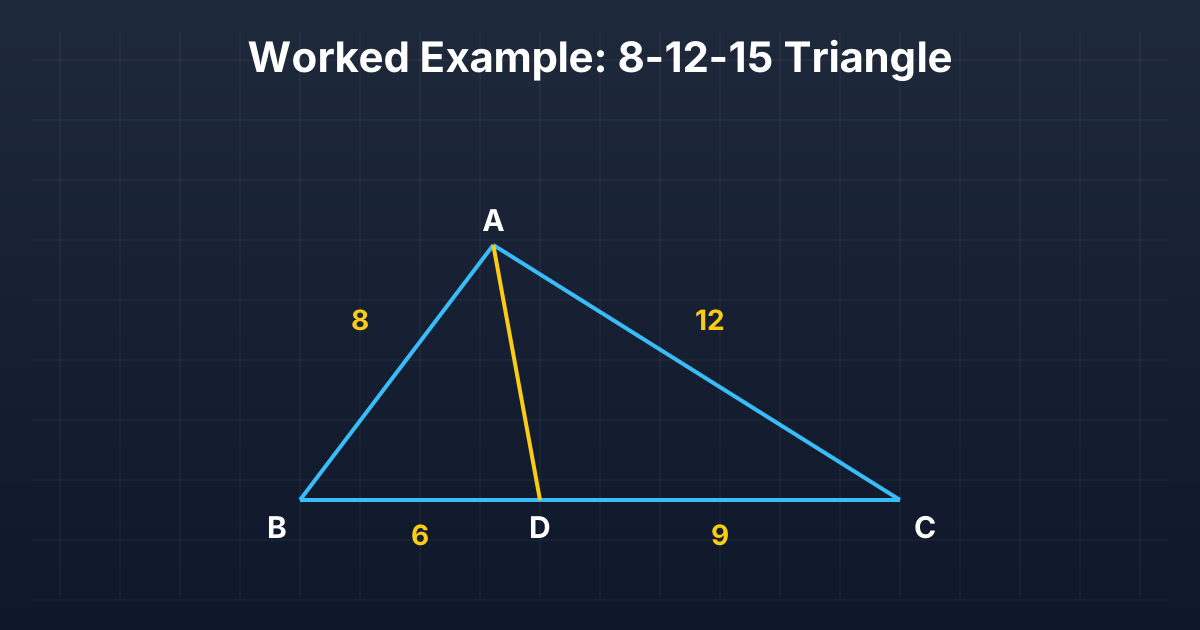
Caption: A labeled triangle with known and unknown lengths. The proportion pairs each segment with the adjacent side on the same side of the triangle.
Example 5: Using the Converse of the Angle Bisector Theorem
In triangle ABC, point D lies on segment BC with BD = 4 cm and DC = 6 cm. The adjacent sides are AB = 6 cm and AC = 9 cm. Does AD bisect angle A?
Check the ratios: AB / AC = 6 / 9 = 2 / 3, and BD / DC = 4 / 6 = 2 / 3. The ratios are equal. By the converse of the Angle Bisector Theorem, AD bisects angle A. The assumptions matter: D must lie on the segment BC itself, not on its extension, and the triangle must be nondegenerate, meaning its three sides satisfy the triangle inequality. Here BC = 10 cm, and 6 + 9 = 15 is greater than 10, 6 + 10 = 16 is greater than 9, and 9 + 10 = 19 is greater than 6, so the triangle is valid and the conclusion holds. The converse is proved in its own section below.
Example 6: Advanced Multi-Step Geometry Problem
In triangle ABC, AD bisects angle A. The adjacent sides are AB = 2x cm and AC = 3x cm, the opposite side is BC = 20 cm, and the perimeter is 50 cm. Find BD and DC.
First find x from the perimeter: 2x + 3x + 20 = 50, so 5x = 30 and x = 6. Therefore AB = 12 cm and AC = 18 cm. The ratio is BD : DC = 12 : 18 = 2 : 3. Let BD = 2k and DC = 3k. Then 2k + 3k = 20, so 5k = 20 and k = 4. Therefore BD = 8 cm and DC = 12 cm.
Verify everything. Segment sum: 8 + 12 = 20, which matches BC. Ratio: 8 / 12 = 2 / 3, which matches 12 / 18 = 2 / 3. Triangle inequality: 12 + 18 = 30, which is greater than 20; 12 + 20 = 32, which is greater than 18; and 18 + 20 = 38, which is greater than 12. All checks pass, so the multi-step solution is complete and valid.
Proof of the Angle Bisector Theorem
A theorem earns trust when it is proved, not just stated. Here are two rigorous proofs. Each one starts from facts learned earlier in geometry and ends exactly at BD / DC = AB / AC, without assuming the result along the way.
Proof 1: Using Triangle Areas
Consider triangle ABC, with AD bisecting angle BAC. Compare the areas of triangles ABD and ACD.
Both triangles stand on the same line BC, and both have the same perpendicular height from A to line BC, since they share vertex A and their bases lie on the same line. Triangles with equal heights have areas in the same ratio as their bases. Therefore:
Area(ABD) / Area(ACD) = BD / DC
Now compute the same ratio a second way, using the area formula with two sides and the included angle. For triangle ABD, the sides around angle BAD are AB and AD, so Area(ABD) = ½ × AB × AD × sin(angle BAD). For triangle ACD, the sides around angle DAC are AC and AD, so Area(ACD) = ½ × AC × AD × sin(angle DAC).
Because AD bisects angle A, angle BAD equals angle DAC, so their sines are equal. Dividing the two area formulas, the factors ½, AD, and the equal sines cancel, leaving:
Area(ABD) / Area(ACD) = AB / AC
The first argument gave BD / DC for this same ratio, and the second gave AB / AC. Therefore BD / DC = AB / AC, which is exactly the Angle Bisector Theorem. The proof works because one quantity, the area ratio, can be computed two ways, and equating the two computations forces the proportion.
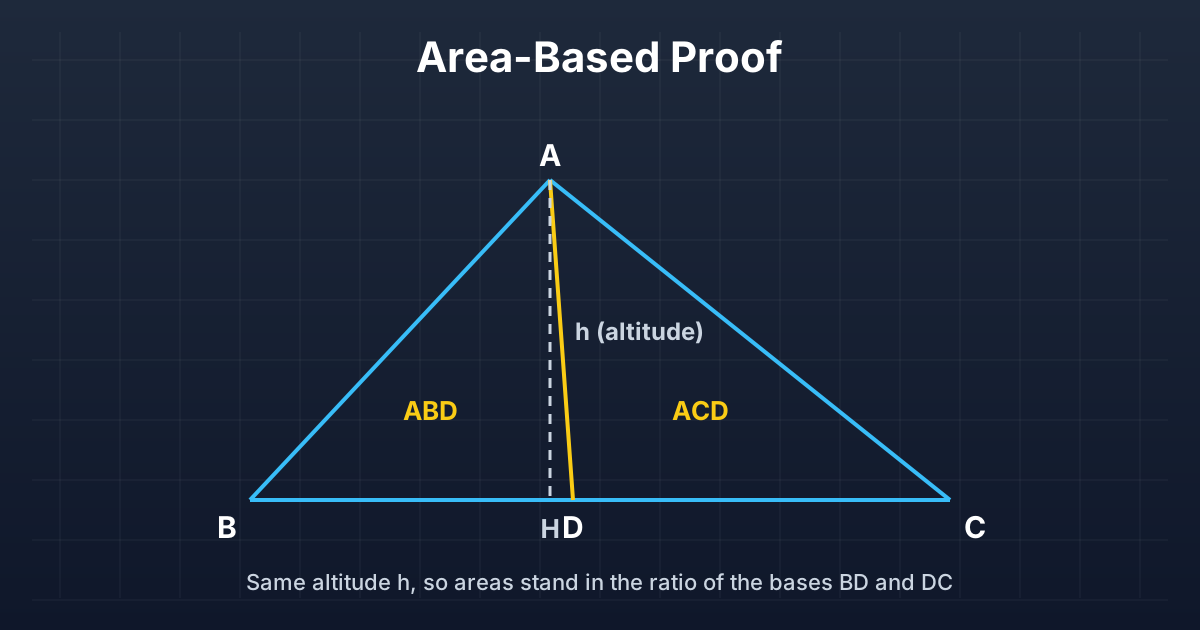
Caption: Triangles ABD and ACD share the same altitude from A to line BC, so their areas stand in the same ratio as their bases BD and DC.
Proof 2: Using Similar Triangles
This proof builds an auxiliary construction. Start with triangle ABC, where AD bisects angle A and meets BC at D. Through point C, draw a line parallel to AD. Extend side BA beyond A until this new line meets it at a point E. Now CE is parallel to AD, and E lies on the extension of BA past A.
Match the angles. Because CE is parallel to AD, angle BAD and angle BEC are corresponding angles, so angle BAD = angle BEC. Also, angle DAC and angle ACE are alternate interior angles, so angle DAC = angle ACE. Since AD bisects angle A, angle BAD = angle DAC. Combining these equalities gives angle BEC = angle ACE. In triangle ACE, the angles at E and C are equal, so the sides opposite them are equal: AC = AE. Triangle ACE is isosceles with AC = AE.
Now apply proportionality. Look at triangle BCE. The segment AD is parallel to CE, and AD cuts sides BC and BE. By the basic proportionality theorem, AD divides those sides in the same ratio: BD / DC = BA / AE. But AC = AE, so substitute AC for AE: BD / DC = BA / AC. Since BA is the same length as AB, the result is BD / DC = AB / AC. That is exactly the Angle Bisector Theorem, proved without assuming it.
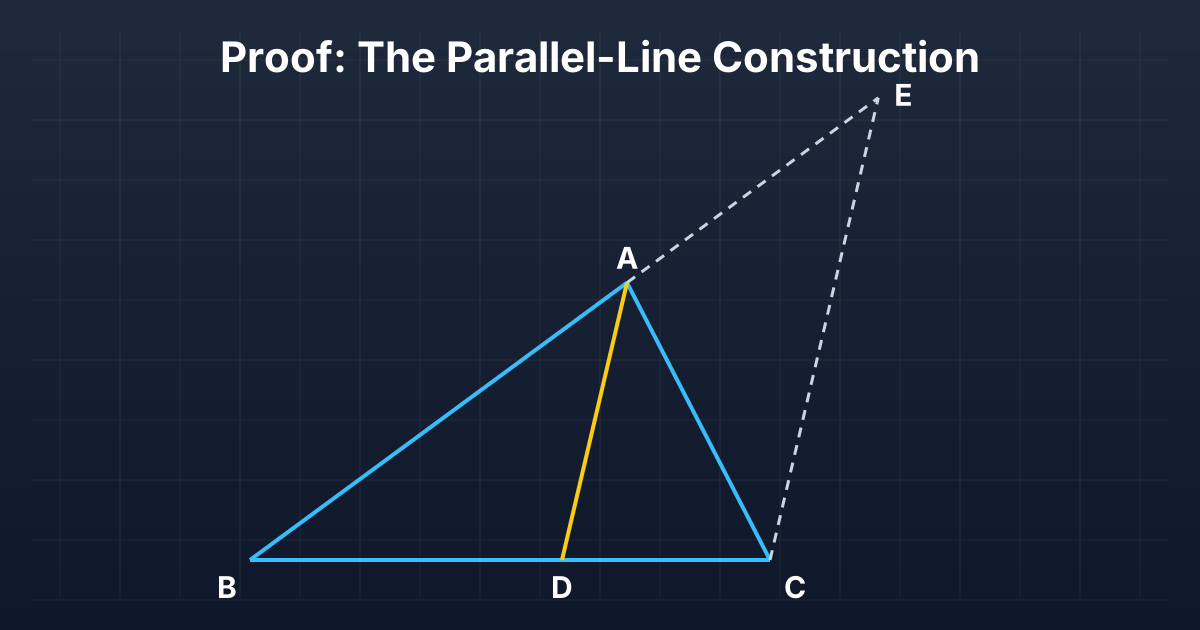
Caption: The auxiliary construction for the similar-triangle proof. CE is parallel to AD, triangle ACE is isosceles with AC = AE, and proportionality in triangle BCE gives the theorem.
Converse of the Angle Bisector Theorem
The converse reverses the implication. It states: if a point D lies on side BC of triangle ABC and BD / DC = AB / AC, then AD bisects angle BAC.
The difference matters. The original theorem starts from a known bisector and concludes a proportion. The converse starts from a known proportion and concludes a bisector. Neither direction follows automatically from the other; each needs its own justification.
A short justification runs as follows. Suppose D lies on BC with BD / DC = AB / AC. Let the true bisector of angle A meet BC at a point D’. By the original theorem, BD’ / D’C = AB / AC, which equals BD / DC. A point on a segment that divides it in a given ratio is unique, so D’ must be the same point as D. Therefore AD is the bisector, since it is the same segment as AD’. That uniqueness argument is the whole proof.
A numerical example: in triangle ABC, D lies on BC with BD = 4 cm and DC = 6 cm, and AB = 6 cm, AC = 9 cm. Then BD / DC = 4 / 6 = 2 / 3 and AB / AC = 6 / 9 = 2 / 3. The ratios match, so by the converse, AD bisects angle A. Example 5 above works through this same case in full.
External Angle Bisector Theorem
The theorem has an external version. Let the external angle bisector from A meet the line BC at E, outside segment BC. Then:
BE / CE = AB / AC
This relationship uses ordinary positive segment lengths, not signed lengths. The point E lies outside the segment, on the side of the shorter adjacent side: if AB is shorter than AC, E lies beyond B; if AC is shorter, E lies beyond A. The adjacent sides must have unequal lengths for the external bisector to meet the line BC at a finite point. When AB = AC, the external bisector is parallel to BC and never meets it.
A worked example: in triangle ABC, AB = 8 cm, AC = 12 cm, and BC = 10 cm. The external bisector from A meets line BC at E beyond B, since AB is the shorter side. Let BE = y. Then CE = CB + BE = 10 + y. The theorem gives y / (10 + y) = 8 / 12 = 2 / 3. Cross-multiply: 3y = 2(10 + y) = 20 + 2y, so y = 20. Therefore BE = 20 cm and CE = 30 cm. Check: 20 / 30 = 2 / 3, which matches 8 / 12, and CE − BE = 30 − 20 = 10, which matches BC. The external division is consistent.
The key difference from internal division is location. Internal division splits the segment itself, so the two parts add to the whole side. External division places the point outside, so the difference of the two lengths equals the whole side. Confusing addition with subtraction is the most common error with the external theorem.
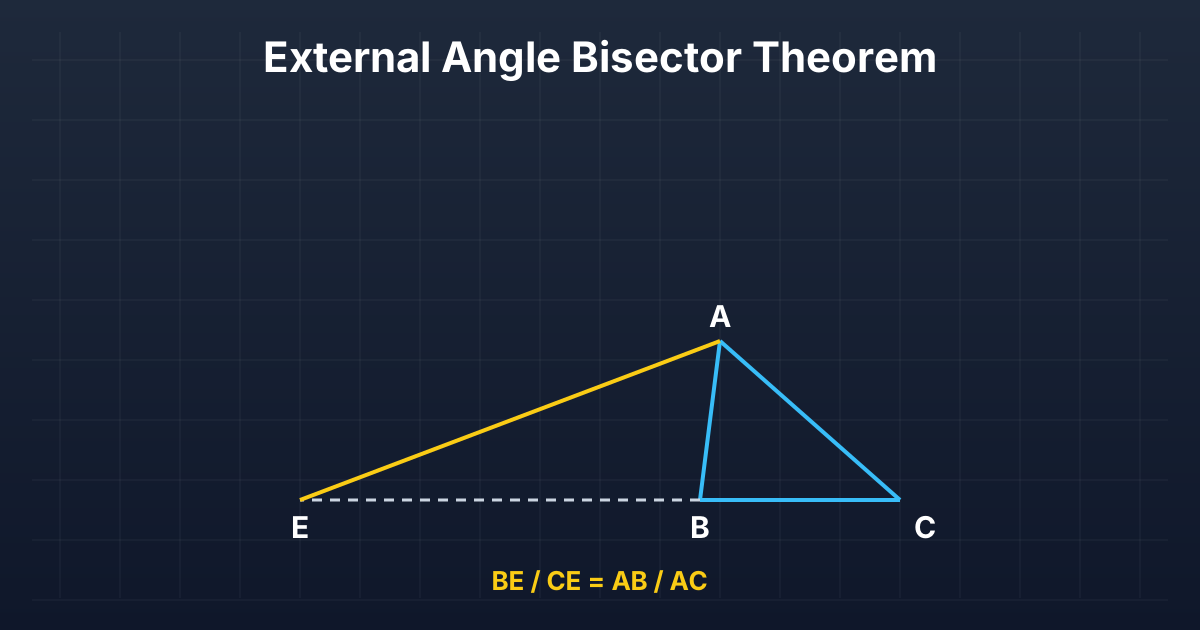
Caption: The external angle bisector from A meets the extended line BC at E, outside the segment. The proportion BE / CE = AB / AC still holds with positive lengths.
Internal vs. External Angle Bisector Theorem
| Feature | Internal Angle Bisector Theorem | External Angle Bisector Theorem |
|---|---|---|
| Angle being bisected | Interior angle of the triangle | Exterior angle at the vertex |
| Location of intersection | Point D on segment BC, between B and C | Point E on line BC, outside segment BC |
| Proportionality relationship | BD / DC = AB / AC | BE / CE = AB / AC |
| Typical applications | Finding missing segments and adjacent sides | Extended-side problems and harmonic division |
| Important restrictions | Triangle must be nondegenerate | Adjacent sides must be unequal, or no finite meeting point exists |
Angle Bisector Theorem in an Isosceles Triangle
When AB = AC, the theorem gives BD / DC = 1, so BD = DC. The internal angle bisector from the apex of an isosceles triangle therefore hits the midpoint of the base, which means it is also a median. The symmetry of the isosceles triangle explains this: reflecting the triangle across the bisector swaps the two equal sides and swaps the two segments, so the segments must be equal.
This special case is worth remembering because it is the one situation where the bisector, the median, and the altitude from the apex all coincide. In a general triangle they are three different segments. Students who first meet bisectors inside isosceles triangles sometimes assume the midpoint property always holds. It does not. It holds exactly when the adjacent sides are equal, which is precisely what the proportion says.
Angle Bisector Theorem and Similar Triangles
Triangle similarity and proportional side relationships help justify the theorem, and the similar-triangle proof above is one example. The parallel construction creates genuinely similar triangles: triangle BAD is similar to triangle BEC, since they share angle B and have equal angles at A and E from the parallel lines. That similarity is what produces the proportion.
One warning is essential. The two smaller triangles formed directly by an angle bisector, ABD and ACD, are not necessarily similar. Take the 6, 9, 10 triangle with BD = 4 and DC = 6. Triangle ABD has sides 6, 4, and AD. Triangle ACD has sides 9, 6, and AD. The ratios 6 / 9 and 4 / 6 both equal 2 / 3, but the shared side AD gives a ratio of 1, which breaks the pattern. Similarity would require all three ratios to match, and they do not. The bisector creates proportional segments, not similar triangles. Similarity enters through the auxiliary construction, not through the two pieces themselves.
Angle Bisector Theorem vs. Triangle Proportionality Theorem
These two theorems both involve proportions, but they apply to different situations.
| Feature | Angle Bisector Theorem | Triangle Proportionality Theorem |
|---|---|---|
| Setup | A segment bisects an angle of a triangle | A line is parallel to one side of a triangle |
| What is divided | The opposite side, in the ratio of the adjacent sides | The other two sides, proportionally |
| Key condition | The segment must bisect the angle | The line must be parallel to a side |
| Formula | BD / DC = AB / AC | AD / AB = AE / AC for a line DE parallel to BC |
A short example shows when each applies. For the bisector theorem, use triangle ABC with AD bisecting angle A, AB = 6 cm, AC = 9 cm, and BC = 10 cm, giving BD = 4 cm and DC = 6 cm. For the proportionality theorem, use a triangle with AB = 12 cm and AC = 18 cm, and draw DE parallel to BC with D on AB at AD = 4 cm. Then AD / AB = 4 / 12 = 1 / 3, so AE / AC = 1 / 3, giving AE = 6 cm. The first problem needs a bisector; the second needs a parallel line. Using one theorem in the other’s situation is a category error, and the diagram usually reveals which condition is actually given.
Applications of the Angle Bisector Theorem
Geometry Problem Solving
The most direct application is calculating unknown side lengths. Given any three of the four lengths in BD / DC = AB / AC, the fourth follows by cross-multiplication. This turns many triangle problems into one proportion and one equation, which is why the theorem appears so often in geometry exercises.
Geometric Constructions
Angle bisectors are constructed with a compass and straightedge, and the theorem explains what those constructions achieve inside a triangle. A constructed bisector from a vertex lands at a point that divides the opposite side proportionally, which lets constructions solve division problems without measurement.
Triangle Design and Symmetry
Proportional relationships govern idealized geometric designs. When a design requires a side to be divided in a given ratio, an angle bisector from the opposite vertex with suitably chosen adjacent sides produces exactly that division. The isosceles case, where the division is equal, is the symmetric special case of this idea.
Engineering and Technical Drawings
Proportional division appears in mathematical models used for design, where a length must be split in a specified ratio. The theorem describes how such a division behaves in a triangular framework. This is a statement about the mathematics of the model, not a claim about any specific engineering practice, and real design work involves tolerances and materials that pure geometry does not cover.
Advanced Geometry
The three internal bisectors of a triangle meet at the incenter, the center of the circle inscribed in the triangle. The Angle Bisector Theorem controls where each bisector lands, and the incenter’s equal distances to all three sides follow from the fact that every point on a bisector is equidistant from the sides forming the angle. This connection leads into deeper triangle geometry, including angle bisector concurrency and the incenter’s role in triangle centers.
Common Mistakes When Using the Angle Bisector Theorem
Mistake 1: Assuming the Opposite Side Is Divided Equally
Incorrect approach: In a triangle with AB = 6 cm, AC = 9 cm, and BC = 10 cm, a student marks D as the midpoint of BC and writes BD = DC = 5 cm.
Explanation of the error: Equal angles do not generally produce equal opposite-side segments. The bisector controls a ratio, not a midpoint, and the ratio here is 6 to 9, not 1 to 1.
Correct approach: Apply the theorem: BD / DC = 6 / 9 = 2 / 3, so BD = 4 cm and DC = 6 cm. Check that the segments add to 10 and that the ratio matches.
Mistake 2: Matching the Wrong Sides
Incorrect approach: With BD = 4 cm, DC = 6 cm, and AB = 8 cm, a student writes BD / DC = AC / AB and computes AC = 8 × 4 / 6, which is about 5.33 cm.
Explanation of the error: The proportion pairs each segment with the side on the same side of the triangle. BD pairs with AB, and DC pairs with AC. The incorrect setup flips one pair.
Correct approach: Write BD / DC = AB / AC, so 4 / 6 = 8 / AC, giving AC = 12 cm. Always check the pairing by asking which vertex each segment sits next to.
Mistake 3: Confusing an Angle Bisector With a Median
Incorrect approach: A student sees a segment from a vertex to the midpoint of the opposite side and applies the Angle Bisector Theorem to it.
Explanation of the error: A median hits the midpoint by definition, but it bisects the angle only in special cases, such as the apex of an isosceles triangle. Without a bisected angle, the proportion does not apply.
Correct approach: Verify the bisector condition first: look for equal angle marks at the vertex or a statement that the segment bisects the angle. Only then use the proportion.
Mistake 4: Incorrect Cross-Multiplication
Incorrect approach: From 6 / DC = 8 / 12, a student writes DC = 6 × 8 / 12 = 4 cm.
Explanation of the error: Cross-multiplication gives 8 × DC = 6 × 12 = 72, so DC = 72 / 8 = 9 cm. The incorrect version multiplied the wrong pair and divided by the wrong number.
Correct approach: Cross-multiply diagonally: the numerator on one side times the denominator on the other. Write 8 × DC = 6 × 12, then divide 72 by 8 to get DC = 9 cm. Check the ratio afterward: 6 / 9 = 2 / 3 and 8 / 12 = 2 / 3.
Mistake 5: Forgetting the Whole-Side Relationship
Incorrect approach: A student finds BD = 4 cm and DC = 6 cm for a triangle with BC = 12 cm and stops, without noticing the inconsistency.
Explanation of the error: The segments are parts of the whole side, so BD + DC must equal BC. Here 4 + 6 = 10, not 12, so at least one value is wrong.
Correct approach: Always check BD + DC = BC before finishing. If the sum fails, rework the proportion instead of reporting an inconsistent answer.
Mistake 6: Applying the Theorem Without an Angle Bisector
Incorrect approach: A diagram shows a segment AD meeting BC at D, and a student applies BD / DC = AB / AC without checking whether AD bisects angle A.
Explanation of the error: The theorem requires a true bisector. If AD is a median, an altitude, or just an arbitrary segment, the ratio does not hold, and any answer built on it is wrong.
Correct approach: Confirm the bisector condition from the diagram or the problem statement. Equal angle marks or an explicit bisection statement must be present before the proportion is used.
Mistake 7: Ignoring Geometric Restrictions
Incorrect approach: A student solves an algebraic proportion, gets BD = 10 cm and DC = 15 cm for a triangle with AB = 10 cm and AC = 15 cm, and reports the answer without checking.
Explanation of the error: BC would be 25 cm, but 10 + 15 = 25, which equals BC instead of exceeding it. That is a degenerate triangle, not a valid one. Side lengths must also be positive: a negative or zero segment signals an algebra error.
Correct approach: Check the triangle inequality for every answer: each pair of sides must sum to more than the third side. Reject degenerate or impossible answers and rework the problem.
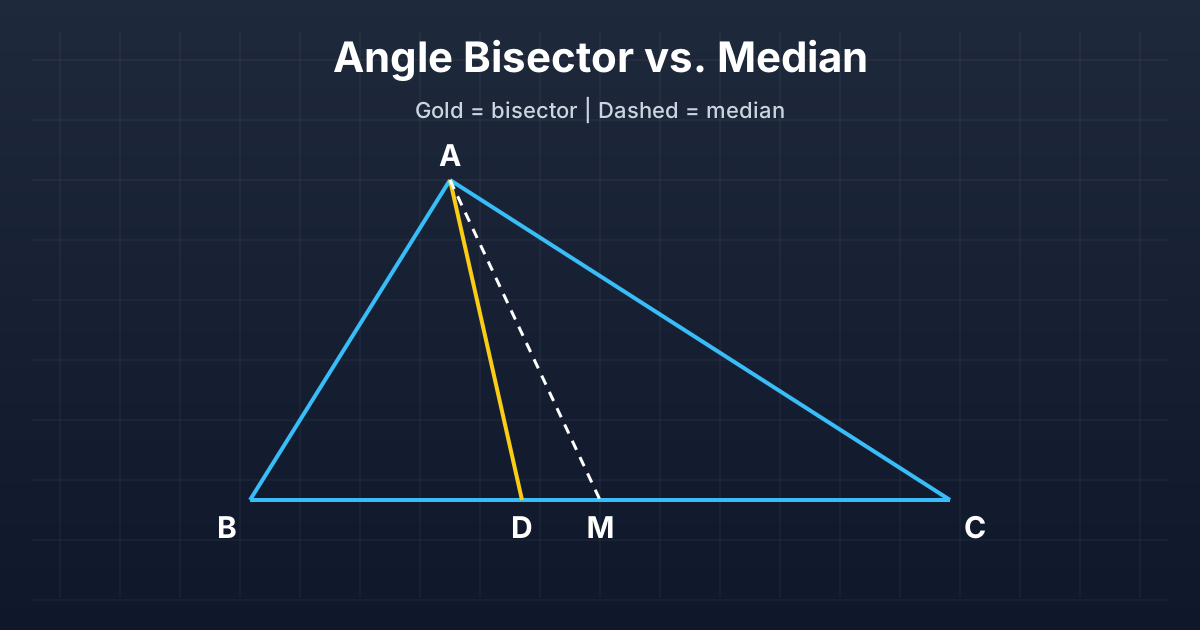
Caption: An angle bisector and a median from the same vertex are different segments in a general triangle. They coincide only in special cases such as the apex of an isosceles triangle.
Angle Bisector Theorem Practice Problems
Beginner
1. In triangle ABC, AD bisects angle A. Explain in words what AD does to angle A and what it does to side BC.
2. In triangle ABC, AD bisects angle A and meets BC at D. Write the correct proportion from the Angle Bisector Theorem in symbols, and state which segment pairs with which side.
3. Triangle ABC has AB = 6 cm, AC = 9 cm, and BD = 4 cm. AD bisects angle A. Find DC.
4. Triangle ABC has AB = 8 cm, AC = 12 cm, and BC = 25 cm. AD bisects angle A. Find BD and DC.
Intermediate
5. A bisector AD meets BC at D, with BD = 6 cm and DC = 9 cm. Side AB = 10 cm. Find AC.
6. In triangle ABC, AD bisects angle A. Given AB = 9 cm, AC = 12 cm, BD = x + 1, and DC = 2x − 2, find x, BD, DC, and BC.
7. Triangle ABC has AB = 15 cm, AC = 20 cm, and BC = 28 cm. AD bisects angle A. Find BD and DC.
8. Point D lies on BC with BD = 5 cm and DC = 7.5 cm. The sides are AB = 8 cm and AC = 12 cm. Does AD bisect angle A? Justify your answer using the converse of the Angle Bisector Theorem.
Advanced
9. In triangle ABC, AD bisects angle A. The adjacent sides are AB = 3x cm and AC = 5x cm, the opposite side is BC = 24 cm, and the perimeter is 56 cm. Find x, AB, AC, BD, and DC.
10. In triangle ABC, AB = 6 cm, AC = 9 cm, and BC = 12 cm. The external angle bisector from A meets line BC at E. Find BE and CE.
11. In triangle ABC, AB = AC = 10 cm and BC = 12 cm. AD bisects angle A. Find BD and DC, and explain why AD is also a median in this triangle.
12. Prove that the internal angle bisector from the apex of an isosceles triangle is also a median, using the Angle Bisector Theorem.
Answer Key
1. AD divides angle A into two congruent angles, so angle BAD equals angle DAC. It meets side BC at D, dividing BC into segments BD and DC in the ratio AB to AC, not generally into equal halves.
2. The proportion is BD / DC = AB / AC. BD, the segment next to vertex B, pairs with AB, the side next to vertex B. DC, the segment next to vertex C, pairs with AC, the side next to vertex C.
3. BD / DC = AB / AC gives 4 / DC = 6 / 9. Cross-multiply: 6 × DC = 4 × 9 = 36, so DC = 36 / 6 = 6 cm. Check: 4 / 6 = 2 / 3 and 6 / 9 = 2 / 3.
4. BD : DC = 8 : 12 = 2 : 3. Let BD = 2k and DC = 3k. Then 5k = 25, so k = 5. Therefore BD = 10 cm and DC = 15 cm. Check: 10 + 15 = 25, which matches BC, and 10 / 15 = 2 / 3, which matches 8 / 12.
5. BD / DC = AB / AC gives 6 / 9 = 10 / AC. Cross-multiply: 6 × AC = 9 × 10 = 90, so AC = 90 / 6 = 15 cm. Check: 6 / 9 = 2 / 3 and 10 / 15 = 2 / 3.
6. (x + 1) / (2x − 2) = 9 / 12 = 3 / 4. Cross-multiply: 4(x + 1) = 3(2x − 2), so 4x + 4 = 6x − 6. Subtract 4x: 4 = 2x − 6. Add 6: 10 = 2x, so x = 5. Then BD = 6 cm, DC = 8 cm, and BC = 14 cm. Check the triangle: 9 + 12 = 21, which is greater than 14; 9 + 14 = 23, which is greater than 12; and 12 + 14 = 26, which is greater than 9. Check the ratio: 6 / 8 = 3 / 4, which equals 9 / 12.
7. BD : DC = 15 : 20 = 3 : 4. Let BD = 3k and DC = 4k. Then 7k = 28, so k = 4. Therefore BD = 12 cm and DC = 16 cm. Check: 12 + 16 = 28, which matches BC; 12 / 16 = 3 / 4, which matches 15 / 20; and the triangle inequality holds since 15 + 20 = 35 is greater than 28.
8. Yes. The converse states that if D lies on BC and BD / DC = AB / AC, then AD bisects angle A. Here BD / DC = 5 / 7.5 = 2 / 3 and AB / AC = 8 / 12 = 2 / 3. The ratios match, so AD bisects angle A.
9. From the perimeter: 3x + 5x + 24 = 56, so 8x = 32 and x = 4. Therefore AB = 12 cm and AC = 20 cm. The ratio is BD : DC = 12 : 20 = 3 : 5. Let BD = 3k and DC = 5k. Then 8k = 24, so k = 3. Therefore BD = 9 cm and DC = 15 cm. Check: 9 + 15 = 24, which matches BC; 9 / 15 = 3 / 5, which matches 12 / 20; and the triangle inequality holds since 12 + 20 = 32 is greater than 24.
10. The external theorem gives BE / CE = AB / AC = 6 / 9 = 2 / 3. Since AC is longer than AB, E lies beyond B, so CE = CB + BE = 12 + BE. Let BE = y. Then y / (12 + y) = 2 / 3. Cross-multiply: 3y = 2(12 + y) = 24 + 2y, so y = 24. Therefore BE = 24 cm and CE = 36 cm. Check: 24 / 36 = 2 / 3, which matches 6 / 9, and 36 − 24 = 12, which matches BC.
11. BD : DC = 10 : 10 = 1 : 1, so BD = DC. Since BD + DC = 12, BD = 6 cm and DC = 6 cm. AD is also a median because a median is defined as a segment from a vertex to the midpoint of the opposite side, and D is the midpoint of BC. This works because AB = AC makes the proportion equal, which is the isosceles special case.
12. Let ABC be isosceles with AB = AC, and let AD bisect angle A, meeting BC at D. By the Angle Bisector Theorem, BD / DC = AB / AC = 1, so BD = DC. A segment from a vertex to the midpoint of the opposite side is a median by definition. Therefore AD is a median. This proves the claim using only the theorem and the definition of a median.
Why Is the Angle Bisector Theorem Important?
The theorem develops proportional reasoning, because it converts an angle fact into a length ratio that can be computed and checked. It strengthens algebraic problem-solving skills, since most applications reduce to setting up a proportion, cross-multiplying, and solving an equation. It deepens understanding of triangle geometry by showing how angles and sides constrain each other. It teaches mathematical proof techniques through the area and similar-triangle arguments, which model how one quantity computed two ways can force a result. It also builds recognition of geometric relationships, helping students see bisectors, proportions, and similarity as connected ideas rather than isolated facts. These skills transfer directly to school geometry examinations and to more advanced mathematics, where proportionality arguments appear throughout geometry, trigonometry, and beyond.
Tips for Solving Angle Bisector Theorem Questions
- Draw and label the triangle, with vertices in consistent order.
- Mark the two congruent angles at the bisected vertex.
- Identify the corresponding adjacent sides for each segment.
- Write the correct proportion before substituting numbers.
- Substitute values carefully, keeping units consistent.
- Cross-multiply correctly, diagonally, not straight across.
- Check segment sums against the whole side.
- Verify that all lengths are positive.
- Check whether the triangle is geometrically possible using the triangle inequality.
- Include appropriate units in the final answer.
Revision checklist: proportion written with correct pairing, cross-multiplication done diagonally, segments sum to the whole side, ratios match on both sides, triangle inequality checked, units included. Run through this list before submitting any answer, and most errors will surface before they cost marks.
Frequently Asked Questions
Common questions about the Angle Bisector Theorem, answered briefly.
01 What is the Angle Bisector Theorem?
The Angle Bisector Theorem states that an internal angle bisector of a triangle divides the opposite side into segments proportional to the two adjacent sides. In triangle ABC, if AD bisects angle A and meets BC at D, then BD / DC = AB / AC.
02 What is the formula for the Angle Bisector Theorem?
The formula is BD / DC = AB / AC, where D is where the bisector of angle A meets BC. Equivalent forms include BD × AC = DC × AB, BD = (AB × DC) / AC, and DC = (AC × BD) / AB, all useful for finding a missing length.
03 How do you prove the Angle Bisector Theorem?
One proof compares areas: triangles ABD and ACD share the same height to BC, so their area ratio equals BD / DC, and the area formula with two sides and the included angle gives AB / AC for the same ratio. Equating the two computations proves BD / DC = AB / AC.
04 How do you use the Angle Bisector Theorem?
Identify the bisected angle and the opposite side, pair each segment with the adjacent side on the same side of the triangle, write BD / DC = AB / AC, substitute the known lengths, solve by cross-multiplication, and verify that the segments add to the whole side and the ratios match.
05 Does an angle bisector divide the opposite side equally?
No, not generally. Equal segments require BD = DC, which the proportion BD / DC = AB / AC only gives when AB = AC. In a general triangle the segments differ in the same ratio as the adjacent sides, and equal division happens only in special cases such as isosceles triangles.
06 What is the converse of the Angle Bisector Theorem?
The converse states that if a point D lies on side BC and BD / DC = AB / AC, then AD bisects angle BAC. It reverses the original theorem: the original starts from a known bisector and concludes a proportion, while the converse starts from a proportion and concludes a bisector.
07 What is the difference between an angle bisector and a median?
An angle bisector divides an angle into two equal angles and creates proportional opposite-side segments. A median joins a vertex to the midpoint of the opposite side and creates equal segments. They coincide only in special cases, such as the apex bisector of an isosceles triangle.
08 Can the Angle Bisector Theorem be used in right triangles?
Yes. The theorem applies to all nondegenerate triangles, including right triangles. The bisected angle may be an acute angle or the right angle itself. When the right angle is bisected, the opposite side is the hypotenuse, and the theorem splits it in the ratio of the two legs.
09 What is the External Angle Bisector Theorem?
The External Angle Bisector Theorem states that an external angle bisector from A meeting line BC at E, outside the segment, satisfies BE / CE = AB / AC with positive lengths. It requires unequal adjacent sides, and the difference CE − BE equals BC rather than the sum.
10 Is the Angle Bisector Theorem related to similar triangles?
Yes. The similar-triangle proof builds an auxiliary construction: a line through C parallel to the bisector creates similar triangles and an isosceles triangle, and the resulting proportion is the theorem. Note that the two smaller triangles formed directly by a bisector are not necessarily similar.
11 How do you find missing lengths using the Angle Bisector Theorem?
Write BD / DC = AB / AC, substitute the three known lengths, and cross-multiply. For example, with BD = 4 cm, DC = 6 cm, and AB = 8 cm, the equation 4 / 6 = 8 / AC gives AC = 12 cm. Always check that the segments add to the whole side.
12 Why is the Angle Bisector Theorem important in geometry?
It connects angles to lengths through proportionality, which is a central idea in geometry. It powers missing-length problems, supports proof techniques, explains the incenter, and appears in examinations. Mastering it builds proportional reasoning that transfers to similarity, trigonometry, and advanced geometry.
Conclusion
The Angle Bisector Theorem says that an internal bisector divides the opposite side in the ratio of the adjacent sides, BD / DC = AB / AC. That single proportion finds missing segments, finds missing adjacent sides, and solves algebraic triangle problems. Correct side correspondence is the skill that makes it work: the segment near B pairs with the side near B, and the segment near C pairs with the side near C. The converse lets a matching proportion prove a bisector, and the external form extends the same idea outside the segment. Practice by drawing labeled triangles, writing the proportion before substituting numbers, and checking every answer against the segment sum and the triangle inequality. With those habits, angle bisector problems become routine, and the reasoning behind them stays clear.