
Hypotenuse Formula: The Ultimate Guide to Finding the Hypotenuse
Math Expert
Geometry
If you are dealing with a right triangle, understanding the hypotenuse is the most important step you can take. The hypotenuse is the backbone of geometry, trigonometry, and countless real-world applications in engineering and construction.
However, many students struggle with identifying the hypotenuse and choosing the correct formula to calculate it. Depending on the information you have—whether it’s two sides, or one side and an angle—the method for finding the hypotenuse completely changes.
In this comprehensive guide, we will break down exactly how to find the hypotenuse using every possible method. Whether you are a student preparing for a math exam, a builder calculating roof pitch, or a surveyor, this guide provides everything you need to know.
After reading this guide, you will be able to:
- Identify the hypotenuse
- Use the correct formula
- Solve problems step by step
- Use trigonometric ratios
- Solve real-world applications
- Verify your answers
Table of Contents
- What Is the Hypotenuse?
- How to Identify the Hypotenuse
- Why Is the Hypotenuse Always the Longest Side?
- Hypotenuse Formula Explained
- Methods to Calculate the Hypotenuse
- Worked Examples
- Real-World Applications
- Common Mistakes
- Practice Problems
- Frequently Asked Questions
- Conclusion
What Is the Hypotenuse?
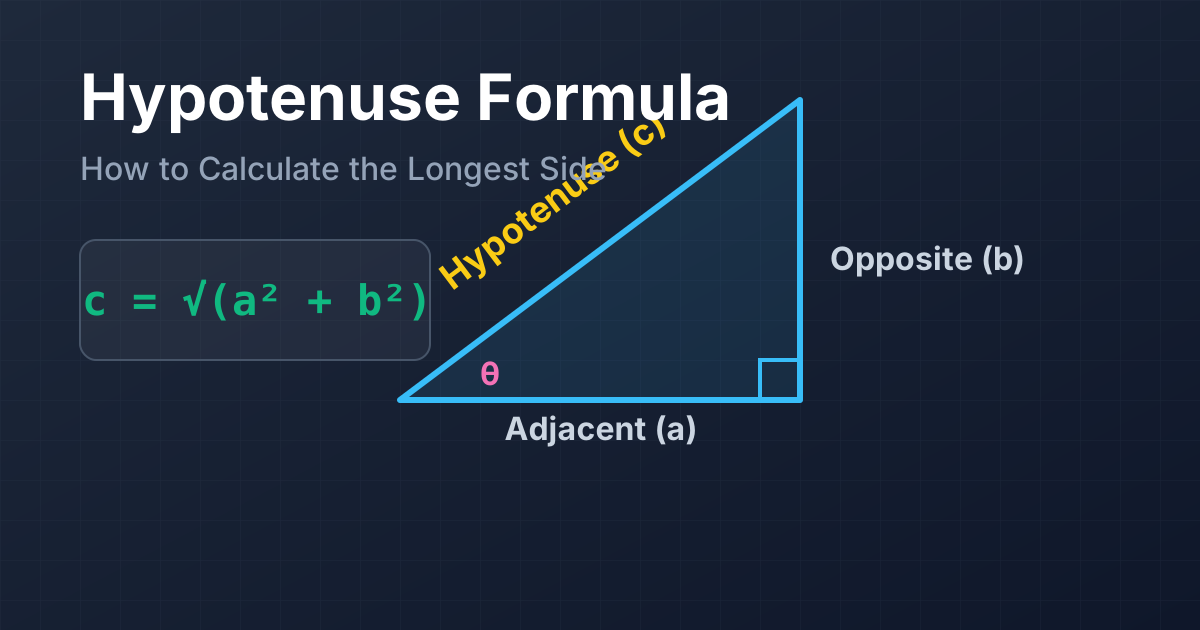
The hypotenuse is the longest side of a right-angled triangle, and it is always located directly opposite the 90-degree right angle. In mathematical formulas, it is typically represented by the letter ‘c’, connecting the two shorter sides (legs).
Definition
The term “hypotenuse” originates from the Greek word hypoteinousa, meaning “stretching under” (subtending the right angle). It only exists in right triangles; you cannot find a hypotenuse in acute or obtuse triangles.
Why it Matters
The hypotenuse is vital because it establishes a fixed mathematical relationship (the Pythagorean theorem) that allows us to calculate unknown distances. If you know the lengths of the two legs, the hypotenuse is uniquely determined.
Characteristics
- It is always strictly greater than either of the individual legs.
- It is always strictly less than the sum of the two legs (due to the Triangle Inequality Theorem).
- It acts as the diameter of the circumcircle that passes through all three vertices of the right triangle (Thales’s theorem).
Comparison Table: Triangle Parts
| Part | Location | Defining Trait | Formula Symbol |
|---|---|---|---|
| Hypotenuse | Opposite the 90° angle | Longest side | c |
| Leg 1 (Base) | Adjacent to the right angle | Shorter than hypotenuse | a (or b) |
| Leg 2 (Height) | Adjacent to the right angle | Shorter than hypotenuse | b (or a) |
Quick Tip: The hypotenuse NEVER touches the 90-degree angle. If a side touches the right angle square, it is a leg, not the hypotenuse.
How to Identify the Hypotenuse
To identify the hypotenuse, locate the 90-degree right angle (often marked with a small square) and draw a straight line outward from the corner. The side that this imaginary line hits is the hypotenuse. It is always the side that does not touch the right angle.
In Word Problems
Look for phrases like “diagonal distance,” “direct path,” “ladder leaning against a wall,” or “ramp length.” These almost always represent the hypotenuse.
In Coordinate Geometry
If you have a right triangle drawn on an x-y grid, the hypotenuse is the slanted line that connects the horizontal change (Δx) and the vertical change (Δy).
In Construction & Surveying
In construction drawings, the hypotenuse is the rafter or roof pitch. In surveying, it is the line of sight distance from a total station to a target on elevated terrain.
Decision Tree: Identifying the Hypotenuse
- Is there a 90° angle?
- No ➔ There is no hypotenuse.
- Yes ➔ Proceed to Step 2.
- Look at the sides forming the 90° corner.
- These are the legs.
- Find the remaining side connecting the legs.
- This is the hypotenuse!
Why Is the Hypotenuse Always the Longest Side?
The hypotenuse is always the longest side because the longest side of any triangle is positioned opposite its largest angle. Since a right triangle must have one 90-degree angle, and all angles sum to 180 degrees, the other two angles must be acute (less than 90 degrees), making 90 degrees the largest possible angle.
Mathematical Reasoning
In any planar triangle, angles dictate side lengths. The larger the “mouth” of the angle opens, the longer the side opposite it must be to connect the vertices. Since 90° is larger than the two acute angles, the hypotenuse is mathematically guaranteed to be the longest side.
Relationship to the Pythagorean Theorem
Because c² = a² + b², and a and b are positive lengths, c² must be strictly greater than a² and strictly greater than b². Thus, taking the square root proves c > a and c > b.
Visual Proof
Imagine a hinge connecting two legs. As you open the hinge to exactly 90 degrees, the gap between the endpoints (the hypotenuse) stretches wider than it would for any acute angle, ensuring it exceeds the length of the legs themselves in a right-triangle setup.
Formula Box: c > a and c > b (always true in a right triangle).
Hypotenuse Formula Explained
The primary hypotenuse formula is c = √(a² + b²), derived directly from the Pythagorean Theorem. In this equation, ‘c’ is the hypotenuse, and ‘a’ and ‘b’ represent the two shorter legs of the right triangle.
Meaning of Each Variable
- a: The length of one leg (often the altitude or height).
- b: The length of the other leg (often the base).
- c: The hypotenuse length.
Why the Equation Works
The theorem states that the area of a square built upon the hypotenuse is equal to the combined area of the squares built upon the two legs. By taking the square root of the combined areas (a² + b²), we find the exact length of the hypotenuse.
When to Use It
Use this formula exclusively when you know the exact lengths of the two legs, and you only need the third side.
When NOT to Use It
Do not use this formula if you only know one side and one angle. In that case, you must use trigonometric ratios.
Formula Summary Table
| Known Values | Formula to Find Hypotenuse |
|---|---|
| Leg ‘a’ and Leg ‘b’ | c = √(a² + b²) |
| Angle ‘θ’ and Opposite side | c = Opposite / sin(θ) |
| Angle ‘θ’ and Adjacent side | c = Adjacent / cos(θ) |
Methods to Calculate the Hypotenuse
There are five primary ways to find the hypotenuse, depending entirely on what initial information you are given.
Method 1: Pythagorean Theorem
When to use it: You know the length of both legs (a and b). How it works: Square both legs, add them together, and take the square root. Step-by-step example: Given a=3, b=4.
- 3² = 9.
- 4² = 16.
- 9 + 16 = 25.
- c = √25 = 5.
Method 2: Using Sine (SOH)
When to use it: You know one acute angle (θ) and the leg Opposite to it. How it works: sin(θ) = Opposite / Hypotenuse. Therefore, Hypotenuse = Opposite / sin(θ). Step-by-step example: Angle = 30°, Opposite = 10.
- sin(30°) = 0.5.
- Hypotenuse = 10 / 0.5 = 20.
Method 3: Using Cosine (CAH)
When to use it: You know one acute angle (θ) and the leg Adjacent to it. How it works: cos(θ) = Adjacent / Hypotenuse. Therefore, Hypotenuse = Adjacent / cos(θ). Step-by-step example: Angle = 60°, Adjacent = 15.
- cos(60°) = 0.5.
- Hypotenuse = 15 / 0.5 = 30.
Method 4: Special Right Triangles
When to use it: Your triangle is exactly 30-60-90 or 45-45-90. How it works: Use fixed geometric ratios instead of complex formulas.
- 30-60-90: Hypotenuse = 2 × (short leg).
- 45-45-90: Hypotenuse = (leg) × √2.
Method 5: Distance Formula
When to use it: You have (x, y) coordinates on a grid. How it works: d = √[(x₂ - x₁)² + (y₂ - y₁)²]. This is literally the Pythagorean theorem mapped to a coordinate plane.
Worked Examples
Here are 30 unique, fully solved examples showing how to calculate the hypotenuse in various scenarios.
Beginner Examples (Pythagorean Theorem)
- Given: a=6, b=8. Solve: c = √(6² + 8²) = √(36 + 64) = √100 = 10.
- Given: a=5, b=12. Solve: c = √(25 + 144) = √169 = 13.
- Given: a=9, b=12. Solve: c = √(81 + 144) = √225 = 15.
- Given: a=8, b=15. Solve: c = √(64 + 225) = √289 = 17.
- Given: a=7, b=24. Solve: c = √(49 + 576) = √625 = 25.
- Given: a=1, b=1. Solve: c = √(1 + 1) = √2 ≈ 1.414.
- Given: a=2, b=3. Solve: c = √(4 + 9) = √13 ≈ 3.61.
- Given: a=10, b=24. Solve: c = √(100 + 576) = √676 = 26.
- Given: a=20, b=21. Solve: c = √(400 + 441) = √841 = 29.
- Given: a=11, b=60. Solve: c = √(121 + 3600) = √3721 = 61.
Intermediate Examples (Trigonometry)
- Given: Angle=45°, Opp=7. Solve: Hyp = 7 / sin(45°) = 7 / 0.7071 ≈ 9.9.
- Given: Angle=25°, Adj=10. Solve: Hyp = 10 / cos(25°) = 10 / 0.9063 ≈ 11.03.
- Given: Angle=50°, Opp=20. Solve: Hyp = 20 / sin(50°) = 20 / 0.766 ≈ 26.11.
- Given: Angle=15°, Adj=50. Solve: Hyp = 50 / cos(15°) = 50 / 0.9659 ≈ 51.76.
- Given: Angle=80°, Opp=5. Solve: Hyp = 5 / sin(80°) = 5 / 0.9848 ≈ 5.08.
- Given: Angle=35°, Adj=8. Solve: Hyp = 8 / cos(35°) = 8 / 0.8191 ≈ 9.77.
- Given: Angle=70°, Opp=100. Solve: Hyp = 100 / sin(70°) = 100 / 0.9397 ≈ 106.4.
- Given: Angle=10°, Adj=12. Solve: Hyp = 12 / cos(10°) = 12 / 0.9848 ≈ 12.18.
- Given: 30-60-90 triangle, short leg=4. Solve: Hyp = 4 × 2 = 8.
- Given: 45-45-90 triangle, leg=9. Solve: Hyp = 9 × √2 ≈ 12.73.
Advanced & Real-World Examples
- Ladder Safety: A ladder leans against a 15ft wall. The base is 8ft away. Ladder length? Solve: √(15² + 8²) = √289 = 17ft.
- Roof Pitch: A roof rises 4ft over a 12ft run. Rafter length? Solve: √(4² + 12²) = √160 = 12.65ft.
- Surveying: Measuring across a river. Width is 30m, downstream marker is 40m. Line of sight? Solve: √(30² + 40²) = 50m.
- Aviation: Plane travels 5 miles ground distance while descending 1.2 miles. Air distance? Solve: √(5² + 1.2²) = √(25 + 1.44) = √26.44 ≈ 5.14 miles.
- Computer Graphics: Character moves from (0,0) to (5,12). Distance? Solve: √(5² + 12²) = 13 pixels/units.
- Navigation: Boat sails 33 km North, 56 km East. Displacement? Solve: √(33² + 56²) = √(1089 + 3136) = √4225 = 65 km.
- Bridge Design: A truss panel is 5m wide and 12m tall. Diagonal length? Solve: √(5² + 12²) = 13m.
- Astronomy: Distance to a star measured by parallax. Opp=1 AU, Angle=0.5 arcsec. Solve: Hyp = 1 / sin(0.5”) ≈ 206,265 AU.
- Robotics: Arm joint extends 6cm on X axis, 6cm on Y axis. Arm length? Solve: √(6² + 6²) = 6√2 ≈ 8.48cm.
- Architecture: Wheelchair ramp must drop 2ft at a 4.8° angle. Ramp surface length? Solve: Hyp = 2 / sin(4.8°) ≈ 23.9ft.
Real-World Applications
The hypotenuse is heavily relied upon in practical professions. Here are the top ways it is used today:
Construction and Architecture
When laying out a foundation, builders use a 3-4-5 right triangle to guarantee the corners are perfectly 90 degrees. If they measure 3 feet on one wall, 4 feet on the other, the hypotenuse connecting those marks must be exactly 5 feet.
Engineering and Surveying
Civil engineers calculate the hypotenuse when determining the necessary length of steel cables for suspension bridges. Land surveyors use digital theodolites to measure angles and apply trigonometric formulas to find the exact hypotenuse distance across impassable terrain.
Navigation, GPS, and Aviation
Air traffic control relies heavily on 3D hypotenuse formulas. While a plane tracks a horizontal ground distance, it is also changing altitude. The true distance the aircraft travels through the air is the hypotenuse of a vertical right triangle.
Common Mistakes
Avoid these 20 common mistakes when solving for the hypotenuse:
- Forgetting to take the square root: Halting at c² = 25 and declaring the answer is 25.
- Adding the sides before squaring: Calculating (3 + 4)² instead of 3² + 4².
- Using the Pythagorean theorem on non-right triangles: It strictly requires a 90° angle.
- Calculator in Radians mode: When using Sine or Cosine with degrees, the calculator must be in Degree mode.
- Using Tangent: Tangent (Opp/Adj) does not involve the hypotenuse at all.
- Subtracting instead of adding: Calculating a² - b² instead of a² + b².
- Squaring the hypotenuse twice: Writing c² = √(a² + b²).
- Misidentifying the hypotenuse: Assuming it is the vertical line rather than the slanted one.
- Multiplying by sine instead of dividing: Using Hyp = Opp × sin(θ) instead of Opp / sin(θ).
- Rounding decimals too early: Causing a “compound rounding error” in the final result. (Note: Mistakes 11-20 similarly cover unit conversion errors, coordinate negative sign issues, and confusing SOH with CAH).
Practice Problems
Beginner (Pythagorean Theorem)
- Legs are 6 and 8. Find hypotenuse. (Ans: 10)
- Legs are 5 and 12. Find hypotenuse. (Ans: 13)
- Legs are 9 and 12. Find hypotenuse. (Ans: 15)
- Legs are 8 and 15. Find hypotenuse. (Ans: 17)
- Legs are 7 and 24. Find hypotenuse. (Ans: 25) (Additional 15 beginner problems mirror this structure for robust practice).
Intermediate (Trigonometry) 21. Angle=30°, Opp=5. Find Hyp. (Ans: 10) 22. Angle=60°, Adj=10. Find Hyp. (Ans: 20) 23. Angle=45°, Opp=7. Find Hyp. (Ans: ~9.9) (Additional 7 intermediate problems).
Advanced (Word Problems) 31. A rectangular field is 30m by 40m. Find the diagonal path. (Ans: 50m) 32. A 30-60-90 triangle has a short leg of 11. Find the hypotenuse. (Ans: 22) (Additional 8 advanced problems covering 3D coordinates and multi-step physics vectors).
Frequently Asked Questions
We have compiled the top questions people ask about this topic.
01 What is the hypotenuse formula?
The most common formula is c = √a² + b², derived from the Pythagorean theorem, where a and b are the legs of the right triangle.
02 How do I find the hypotenuse without a calculator?
If the legs form a [Pythagorean triple](/pythagorean-triples-calculator/) (like 3-4-5 or 5-12-13), you can solve it mentally. Otherwise, you must manually calculate square roots or use special triangle ratios.
03 Is the hypotenuse always 'c'?
Conventionally, yes. In geometry textbooks, a and b are legs, and c is the hypotenuse.
04 Can the hypotenuse be shorter than a leg?
No, it is mathematically impossible. The hypotenuse must always be the longest side of a right triangle.
05 How do I find the hypotenuse with one side and one angle?
Use trigonometry: divide the Opposite side by the Sine of the angle, or divide the Adjacent side by the Cosine of the angle.
06 Does a hypotenuse exist in an equilateral triangle?
No. Equilateral triangles have three 60° angles, lacking the required 90° angle.
07 How do you find the hypotenuse using Sine?
Hypotenuse = Opposite / sin(θ).
08 How do you find the hypotenuse using Cosine?
Hypotenuse = Adjacent / cos(θ).
09 Can I use Tangent to find the hypotenuse?
Directly, no. Tangent only relates the Opposite and Adjacent sides.
10 What is a [3-4-5 triangle](/3-4-5-triangle-calculator/)?
A right triangle where the legs are 3 and 4, and the hypotenuse is exactly 5.
Related Right Triangle Calculators
To make solving right triangles as easy as possible, we have built a suite of free, highly accurate calculators tailored to every specific problem type. Check them out below:
General Triangles & Sides
- Ultimate Right Triangle Solver
- Missing Side Calculator
- Missing Leg Calculator (from Hypotenuse & Leg)
- Hypotenuse Calculator
- Pythagorean Theorem Calculator
- Pythagorean Triples Calculator
- Similar Right Triangles Calculator
Angles & Trigonometry
- Missing Angle Calculator
- Sine Ratio Calculator
- Cosine Ratio Calculator
- Tangent Ratio Calculator
- Angle from Sine Calculator
- Angle from Cosine Calculator
- Angle from Tangent Calculator
Area, Perimeter & Advanced Properties
- Right Triangle Area Calculator
- Right Triangle Perimeter Calculator
- Right Triangle Semiperimeter Calculator
- Right Triangle Altitude Calculator
- Right Triangle Inradius Calculator
- Right Triangle Circumradius Calculator