
Hypotenuse-Leg (HL) Theorem: Proving Right Triangles Congruent
Math Expert
Geometry
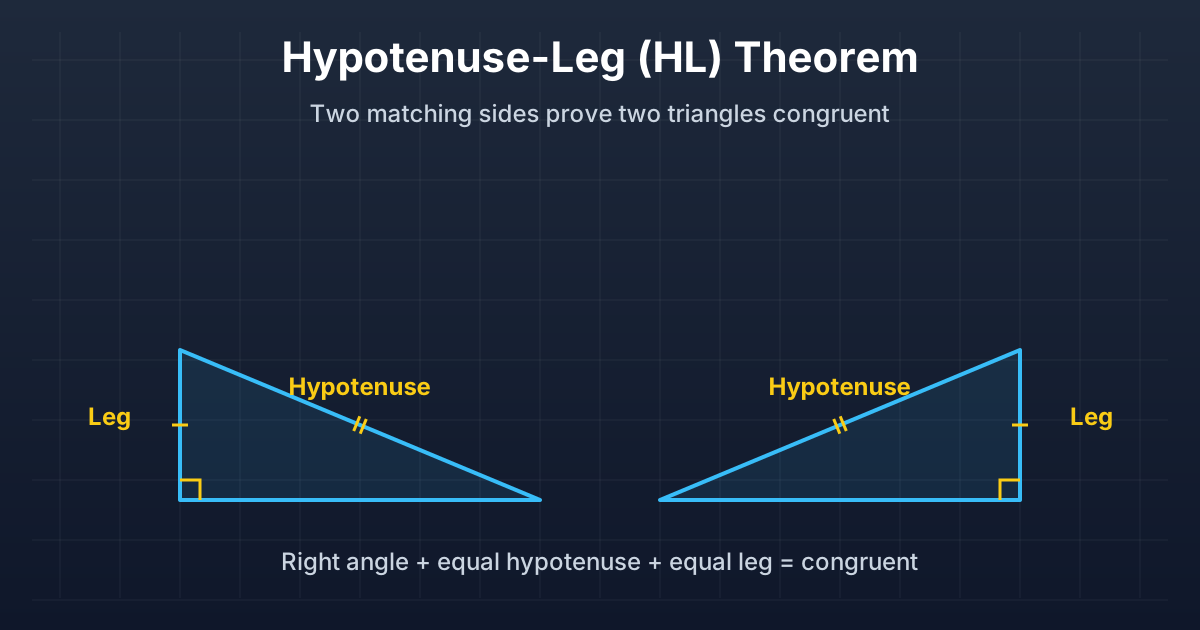
Picture two right triangles drawn in different positions on a worksheet. One points left, the other points right. Their shapes look different at first glance, yet every side of the first matches a side of the second exactly. A geometry student does not need to measure all three sides of both triangles to prove they are identical. Two matching pieces are enough, as long as they are the right two pieces. That shortcut is the Hypotenuse-Leg (HL) Theorem, and it works only for right triangles.
This guide explains what the Hypotenuse-Leg (HL) Theorem means, when it applies, how to use it in a proof, how to solve HL problems step by step, and which mistakes to avoid. You will also find worked examples, a comparison with the other congruence rules, and practice problems with a full answer key.
Featured snippet answer: The Hypotenuse-Leg (HL) Theorem states that if the hypotenuse and one corresponding leg of one right triangle are congruent to the hypotenuse and one corresponding leg of another right triangle, then the two triangles are congruent. HL applies only to right triangles, and the matching leg must correspond in both triangles.
What Is the Hypotenuse-Leg (HL) Theorem?
The Hypotenuse-Leg (HL) Theorem gives a shortcut for proving that two right triangles are congruent:
If the hypotenuse and one corresponding leg of one right triangle are congruent to the hypotenuse and one corresponding leg of another right triangle, then the two right triangles are congruent.
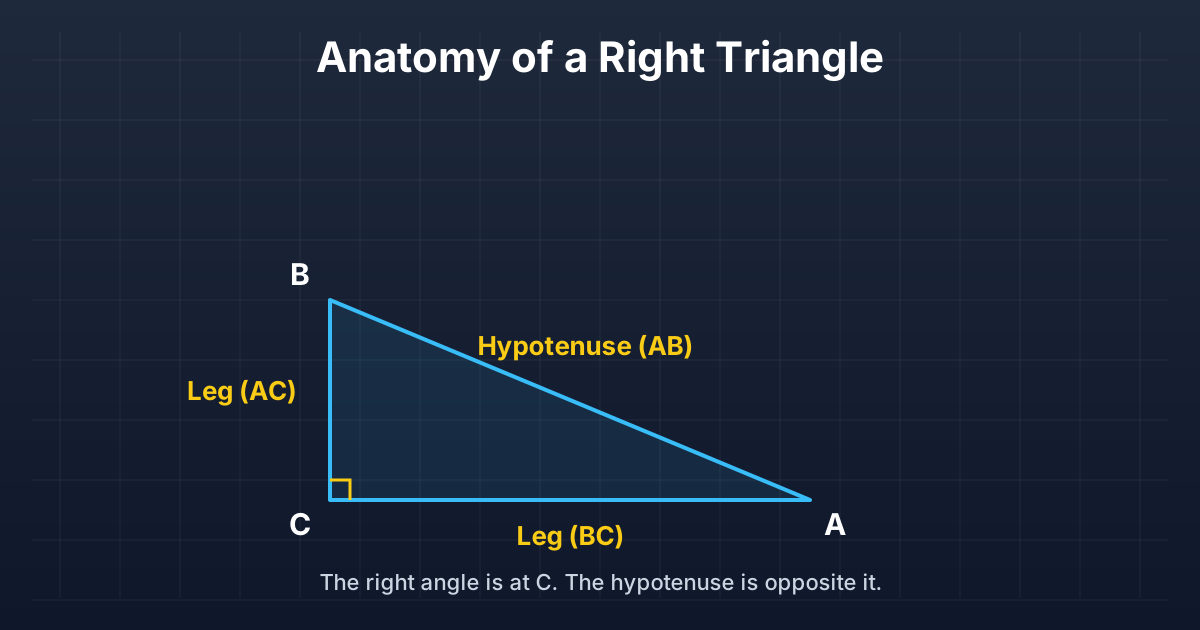
In symbols, take two right triangles, △ABC and △DEF, where ∠C = ∠F = 90°:
- AB ≅ DE (the hypotenuses are congruent)
- AC ≅ DF (one pair of corresponding legs is congruent)
Therefore:
△ABC ≅ △DEF by HL.
Vertex order matters in that final statement. The vertices are listed so that corresponding vertices match: A matches D, B matches E, and C matches F. Writing the vertices in the wrong order is one of the most common errors in congruence proofs, and it appears in the mistakes section below.
HL is a theorem, not a definition. It can be proved from the Pythagorean theorem, and that proof appears later in this article. For now, the key idea is simple: a right angle plus a matching hypotenuse plus a matching leg locks the whole triangle into place. Nothing else can vary.
Understanding the Parts of a Right Triangle
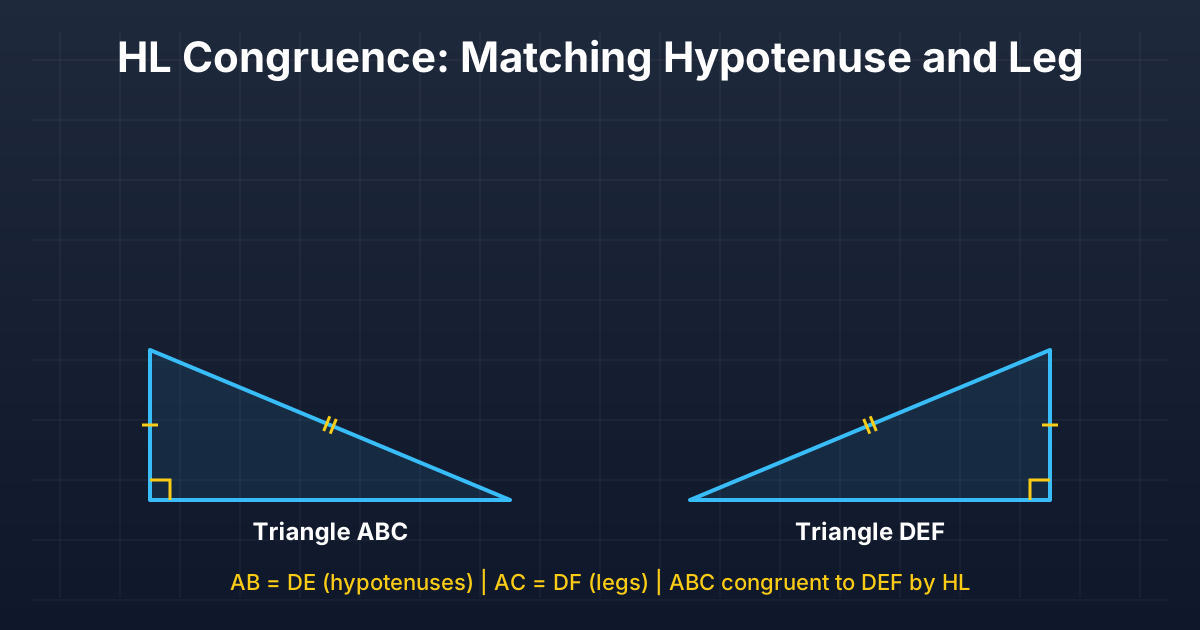
HL mentions three parts of a triangle: the hypotenuse, a leg, and the right angle. Each term needs a clear meaning before the theorem can be used safely.
What Is the Hypotenuse?
The hypotenuse is the side opposite the 90° angle in a right triangle. It is the longest side of the triangle, and it never touches the right-angle vertex. In △ABC with ∠C = 90°, the hypotenuse is AB. Students often confuse the hypotenuse with a leg, especially when a triangle is rotated so the hypotenuse sits at the bottom or on the side. Position does not change which side is the hypotenuse. The side opposite the right angle is always the hypotenuse, no matter how the triangle is turned.
What Are the Legs of a Right Triangle?
The legs are the two sides that form the right angle. They meet at the right-angle vertex. In △ABC with ∠C = 90°, the legs are AC and BC. HL requires only one pair of corresponding legs to match, not both. If the hypotenuses match and one leg pair matches, the other leg pair is forced to match too, as the proof section shows.
What Does Triangle Congruence Mean?
Two triangles are congruent when they have exactly the same size and shape. Every pair of corresponding sides has equal length, and every pair of corresponding angles has equal measure. Congruence is written with the symbol ≅. Note the difference between congruent segments and equal numbers: segments are congruent (AB ≅ DE), while their lengths are equal (AB = DE). Both statements say the same thing in different language, and geometry proofs use the ≅ form for segments.
Conditions Required to Use the HL Theorem
HL works only when all three of its conditions hold at the same time. Missing even one condition breaks the argument.
- Both triangles must be right triangles. Each triangle must have a marked or proven 90° angle. A triangle that merely looks like a right triangle does not qualify.
- Their corresponding hypotenuses must be congruent. The longest side of the first triangle must match the longest side of the second.
- One pair of corresponding legs must be congruent. One leg from the first triangle must match the corresponding leg of the second. The legs must correspond under the same vertex matching used in the final congruence statement.
| Condition | Meaning | Why It Matters |
|---|---|---|
| Right triangles | Both have 90° angles | HL applies only to right triangles |
| Equal hypotenuses | Corresponding hypotenuses match | Establishes a required side equality |
| Equal corresponding legs | One leg from each triangle matches | Determines the remaining triangle dimensions |
Example where HL applies: △PQR and △STU are both right triangles. Their hypotenuses are both 13 units, and one leg pair is 5 units in both. All three conditions hold, so △PQR ≅ △STU by HL. The remaining legs are both 12 units, since 5² + 12² = 13².
Example where HL cannot be used: △PQR and △STU have hypotenuses of 13 units each, but no leg pair is known to match. HL cannot be applied yet. The triangles might still be congruent, but HL is not the argument that proves it without a matching leg.
How to Prove Right Triangles Congruent Using HL
Follow these six steps in order. Skipping the right-angle check is the step students most often rush past, and it is the step that invalidates the most proofs.
Step 1: Identify the two right triangles in the diagram or problem statement.
Step 2: Locate and verify the right angles. Each triangle needs a marked right angle or a given statement that it is a right triangle.
Step 3: Identify the hypotenuse of each triangle: the side opposite the right angle.
Step 4: Check whether the hypotenuses are congruent.
Step 5: Identify one pair of congruent corresponding legs, making sure the legs correspond under the same vertex matching.
Step 6: State triangle congruence using HL with the vertices in matching order.
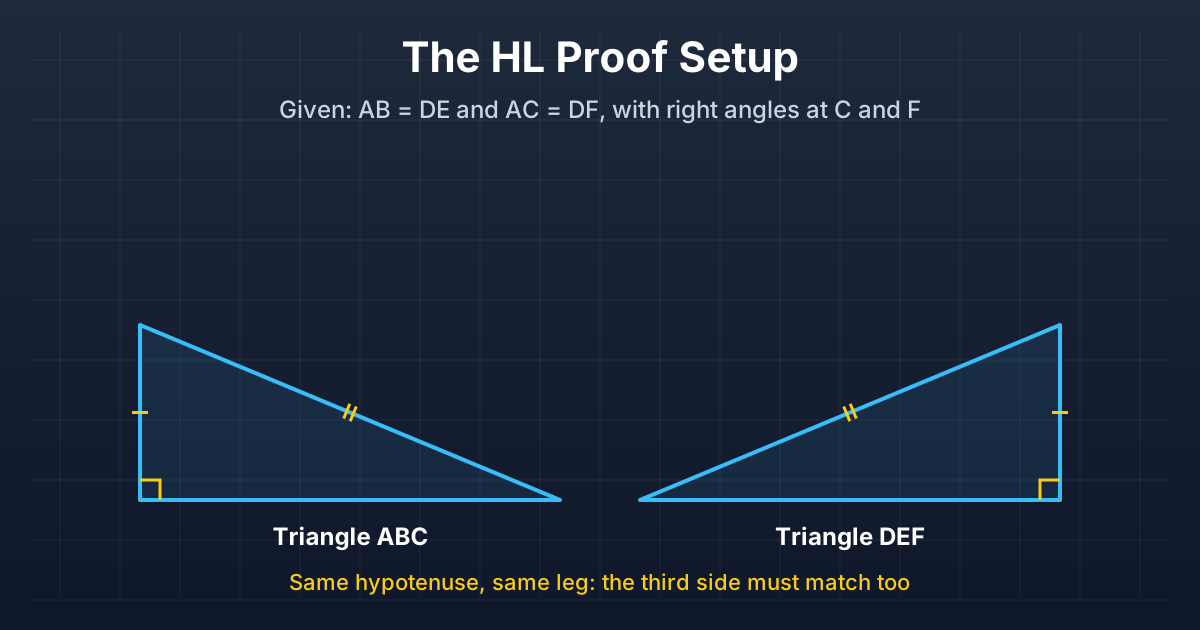
Worked example. Given △ABC and △DEF, with ∠C = ∠F = 90°, AB ≅ DE = 17 units, and AC ≅ DF = 8 units. Prove △ABC ≅ △DEF.
- Both triangles are right triangles, with right angles at C and F.
- The hypotenuses AB and DE are congruent, both 17 units.
- The corresponding legs AC and DF are congruent, both 8 units.
- Therefore, △ABC ≅ △DEF by HL.
As a check, the remaining legs are both 15 units, since 8² + 15² = 64 + 225 = 289 = 17². The check confirms the result but is not required for the HL argument itself.
HL Theorem Proof Using the Pythagorean Theorem
HL is true because the Pythagorean theorem leaves no room for the triangles to differ. Take two right triangles with hypotenuse length c and a corresponding leg of length a. Call the remaining leg b in each triangle.
Apply the Pythagorean theorem to each triangle:
a² + b² = c²
Rearrange to solve for the remaining leg:
b² = c² − a²
b = √(c² − a²)
Both triangles have the same hypotenuse c and the same corresponding leg a, so both give the same value for b. The square root is nonnegative because side lengths are positive, so there is exactly one possible value for the remaining leg. All three pairs of corresponding sides are therefore congruent: the hypotenuses match, the given legs match, and the remaining legs match. The triangles are congruent by SSS.
This is a genuine justification, not a circular argument. It uses the Pythagorean theorem, which is proved independently, to show that the HL conditions force all three sides to match. HL is then a convenient shortcut: once the theorem is established, a proof can cite HL directly instead of repeating the Pythagorean calculation every time.
HL Theorem Examples With Step-by-Step Solutions
Example 1: Identifying Congruent Right Triangles
Two right triangles have hypotenuses of 13 units and corresponding legs of 5 units. Are the triangles congruent?
Both triangles are right triangles, so the first condition holds. The hypotenuses match at 13 units, and one leg pair matches at 5 units. All three HL conditions hold, so the triangles are congruent by HL. The remaining legs are both 12 units, since 5² + 12² = 25 + 144 = 169 = 13². The triangles are 5-12-13 triangles, and they match exactly.
Example 2: Finding a Missing Side
Two right triangles have hypotenuses of 10 cm and corresponding legs of 6 cm. Find the remaining leg.
HL first establishes that the triangles are congruent, so solving one triangle solves both. Apply the Pythagorean theorem to either triangle:
6² + b² = 10²
36 + b² = 100
b² = 100 − 36 = 64
b = √64 = 8 cm
The remaining leg is 8 cm in both triangles. The triangles are 6-8-10 triangles. Note the units: the answer carries cm because the given lengths are in cm.
Example 3: Writing a Two-Column HL Proof
Given: △ABC and △DEF, with ∠C = ∠F = 90°, AB ≅ DE, and AC ≅ DF.
Prove: △ABC ≅ △DEF.
| Statements | Reasons |
|---|---|
| ∠C and ∠F are right angles | Given |
| AB ≅ DE | Given (hypotenuses) |
| AC ≅ DF | Given (corresponding legs) |
| △ABC ≅ △DEF | HL Congruence Theorem |
Every statement follows from its reason. The first three rows record exactly what is given, and the final row applies the HL theorem to those facts. No step assumes anything the diagram merely suggests.
Example 4: HL Theorem With Shared Sides
Two right triangles sometimes share a side, and the shared side can supply the matching leg. Consider △PQR and △SQR, both right-angled at Q, sharing leg QR. Suppose QR = 9 units, and the hypotenuses PR and SR are both 15 units. Prove the triangles congruent.
- Both triangles are right triangles, with right angles at Q.
- The hypotenuses PR and SR are congruent, both 15 units.
- The leg QR is shared, so QR ≅ QR by the reflexive property of congruence. A segment is always congruent to itself, and that fact counts as a legitimate reason in a proof.
- Therefore, △PQR ≅ △SQR by HL.
As a check, the remaining legs are PQ = SQ = 12 units, since 9² + 12² = 81 + 144 = 225 = 15². Shared sides appear often in geometry diagrams, so always check whether a side belongs to both triangles before concluding that a leg pair is missing.
HL vs. SSS, SAS, ASA, and AAS Congruence
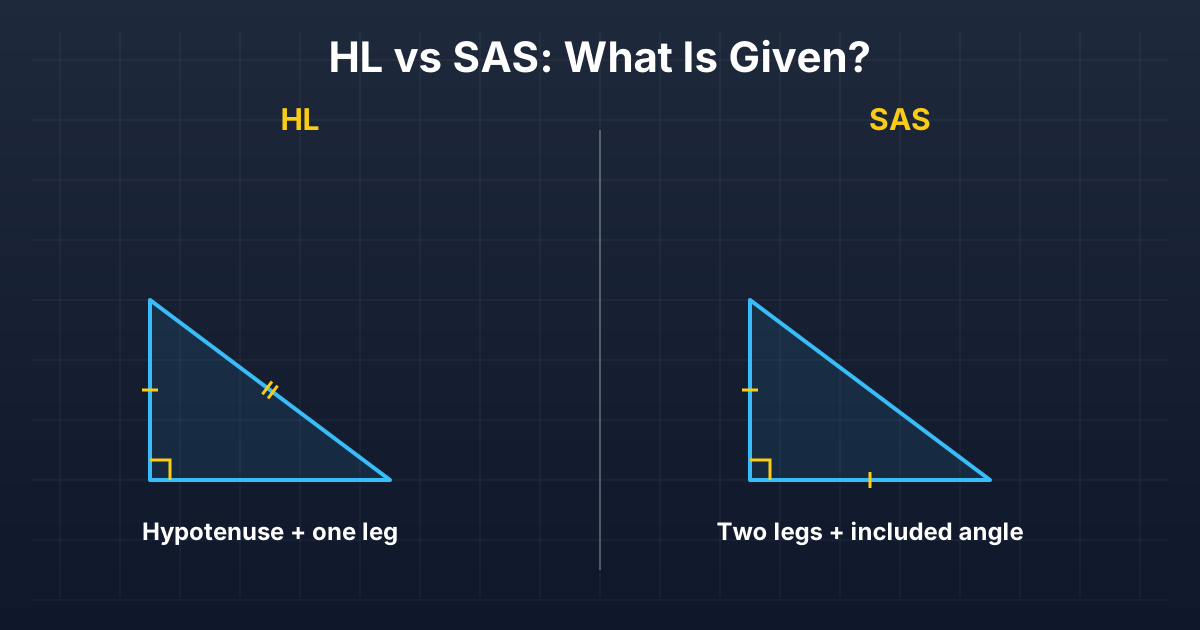
HL is one of five standard congruence rules. The table shows what each rule requires and whether it is restricted to right triangles.
| Congruence Rule | Required Information | Applies to Right Triangles Only? |
|---|---|---|
| HL | Hypotenuse and one leg | Yes |
| SSS | Three corresponding sides | No |
| SAS | Two sides and included angle | No |
| ASA | Two angles and included side | No |
| AAS | Two angles and a non-included side | No |
The important comparison is HL versus SAS. In a right triangle, the two legs and the included right angle satisfy SAS, so two right triangles with both leg pairs congruent are congruent by SAS directly. HL is the rule for the case where only one leg pair plus the hypotenuse is known. HL is also the rule that explains why SSA, which fails in general, works here: SSA does not establish congruence for ordinary triangles, because a given side-side-angle combination can describe two different triangles. When the known angle is a right angle and the known side opposite it is the hypotenuse, the Pythagorean theorem removes that ambiguity, as the proof section showed. So HL is not an exception that breaks the SSA rule. It is the special case where the right angle makes SSA determinate.
Common Mistakes When Using the HL Theorem
Mistake 1: Applying HL to Triangles That Are Not Right Triangles
Incorrect approach: Two triangles have a hypotenuse-length side of 10 units and a matching side of 6 units, so the student claims HL congruence.
Why it is incorrect: Neither triangle has a marked or proven right angle. Without right angles, there is no hypotenuse at all, only a longest side, and HL does not apply.
Correct approach: First confirm both triangles are right triangles from given information or a marked right angle. Only then check the hypotenuse and leg conditions.
Mistake 2: Confusing a Leg With the Hypotenuse
Incorrect approach: A student labels the side of length 12 as the hypotenuse of a 5-12-13 triangle because it sits at the bottom of the diagram.
Why it is incorrect: The hypotenuse is the side opposite the right angle, and in a 5-12-13 triangle it is 13, the longest side. Diagram position never decides which side is the hypotenuse.
Correct approach: Find the right angle first, then take the side opposite it as the hypotenuse, regardless of where it sits in the diagram.
Mistake 3: Using Two Congruent Legs Without Identifying the Correct Rule
Incorrect approach: Two right triangles have both leg pairs congruent, and the student writes “by HL” without mentioning the hypotenuses.
Why it is incorrect: The given information matches SAS: two sides and the included right angle. HL requires a hypotenuse pair, which was not stated as given.
Correct approach: Cite SAS for two leg pairs and their included right angle. HL becomes available after the hypotenuses are shown congruent, for example by the Pythagorean theorem, but the direct justification is SAS.
Mistake 4: Matching Noncorresponding Sides
Incorrect approach: The first triangle has legs 5 and 12, the second has legs 12 and 5 in the opposite correspondence, and the student pairs the 5-unit leg of the first with the 12-unit leg of the second.
Why it is incorrect: HL requires corresponding legs to match under one consistent vertex correspondence. Pairing a 5-unit leg with a 12-unit leg fails the leg condition, even though both triangles are 5-12-13 triangles.
Correct approach: Fix the vertex correspondence first, then check that the legs matched by that correspondence are the ones that are congruent.
Mistake 5: Writing Triangle Congruence Statements in the Wrong Vertex Order
Incorrect approach: Given △ABC and △DEF with ∠C = ∠F = 90°, AB ≅ DE, and AC ≅ DF, the student writes △ABC ≅ △FED.
Why it is incorrect: The order △FED pairs A with F, but F is the right angle while A is not. The correspondence is broken, so the statement claims matchings that were never established.
Correct approach: List vertices so corresponding vertices match: A with D, B with E, and C with F, giving △ABC ≅ △DEF by HL.
HL Theorem Practice Problems
Beginner
1. A right triangle has sides of 3 units, 4 units, and 5 units. Which side is the hypotenuse, and how do you know?
2. Two right triangles have hypotenuses of 17 units each and one corresponding leg pair of 8 units each. Can HL be applied? If so, what is the remaining leg in each triangle?
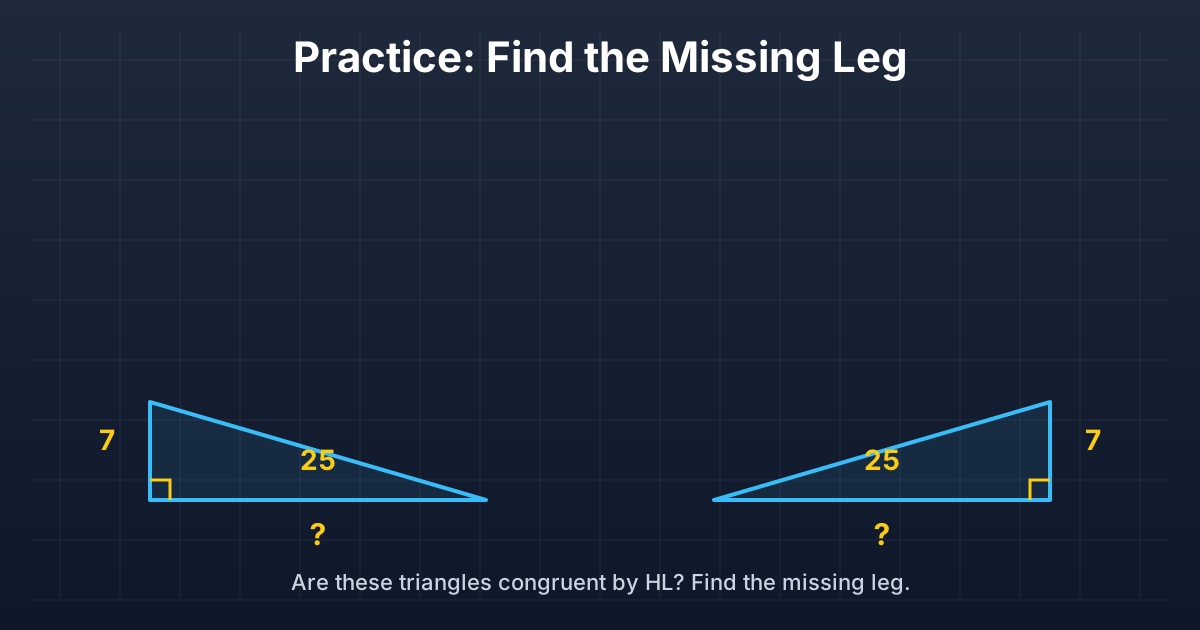
3. △ABC and △DEF are right triangles with ∠C = ∠F = 90°. The hypotenuses AB and DE are both 25 units, and legs AC and DF are both 7 units. Which sides are the corresponding legs, and what is the length of the remaining leg in each triangle?
Intermediate
4. Two right triangles have hypotenuses of 25 cm and corresponding legs of 7 cm. Find the remaining leg, with units.
5. Right triangle A has a hypotenuse of 20 units and one leg of 12 units. Right triangle B has a hypotenuse of 20 units and one leg of 16 units. Are the triangles congruent by HL? Explain.
6. △MNP and △XYZ are right triangles with ∠P = ∠Z = 90°. The hypotenuses MN and XY are congruent, and legs MP and XZ are congruent. Write the congruence statement with correct vertex order.
Advanced
7. Write a two-column proof. △ABC and △DBC are both right-angled at B and share leg BC. BC = 5 units, and the hypotenuses AC and DC are both 13 units. Prove △ABC ≅ △DBC.
8. A diagram shows two triangles that look like right triangles, with hypotenuses of 10 units each and one leg pair of 6 units each, but neither triangle has a marked right angle. Can HL be applied? Explain.
9. Two right triangles have hypotenuses of 15 units each. No leg lengths are given for either triangle. Can HL prove the triangles congruent? Explain.
10. Two right triangles have both leg pairs congruent: 6 units and 8 units. Which congruence rule applies most directly, HL or SAS? Explain.
Answer Key
1. The hypotenuse is the side of 5 units. It is the side opposite the right angle, and it is the longest side. Check: 3² + 4² = 9 + 16 = 25 = 5².
2. Yes, HL applies. Both triangles are right triangles, the hypotenuses match at 17 units, and one leg pair matches at 8 units. The remaining leg in each triangle is 15 units, since 8² + 15² = 64 + 225 = 289 = 17².
3. The corresponding legs are AC and DF, both 7 units. The remaining legs are BC and EF, each 24 units, since 7² + 24² = 49 + 576 = 625 = 25². Therefore, △ABC ≅ △DEF by HL.
4. Apply the Pythagorean theorem: 7² + b² = 25², so b² = 625 − 49 = 576, and b = √576 = 24 cm. The remaining leg is 24 cm.
5. Yes. Triangle A has legs 12 units and √(20² − 12²) = √(400 − 144) = √256 = 16 units. Triangle B has a leg of 16 units, which matches triangle A’s second leg. Both triangles are right triangles with congruent hypotenuses (20 units) and a congruent leg pair (16 units), so they are congruent by HL. Both are 12-16-20 triangles.
6. △MNP ≅ △XYZ by HL. The correspondence is M with X, N with Y, and P with Z: the hypotenuses MN and XY match, the legs MP and XZ match, and the right angles P and Z match.
7. Two-column proof:
| Statements | Reasons |
|---|---|
| ∠B is a right angle in both triangles | Given |
| AC ≅ DC | Given (hypotenuses, both 13 units) |
| BC ≅ BC | Reflexive property (shared leg) |
| △ABC ≅ △DBC | HL Congruence Theorem |
As a check, AB = DB = 12 units, since 5² + 12² = 25 + 144 = 169 = 13².
8. No, HL cannot be applied. A triangle that looks like a right triangle is not necessarily one. HL requires verified right angles, from given information or a marked right angle. Without that, there is no hypotenuse to match, and the argument fails at the first condition.
9. No. HL requires three conditions, and only two are known here: both triangles are right triangles, and their hypotenuses match. With no leg pair given, the third condition is missing, so HL cannot prove congruence.
10. SAS applies most directly. The two leg pairs are known, and the included angle between them is the right angle in each triangle, so the triangles are congruent by SAS. HL would also work after computing the hypotenuses (both 10 units, since 6² + 8² = 100), but SAS is the direct justification from the given information.
Real-World Applications of the HL Theorem
HL proves that ideal geometric models match exactly. It is used wherever identical right triangles must be confirmed from limited measurements.
- Construction and structural layouts: Roof trusses and stair stringers are built as repeated right triangles. Checking one hypotenuse and one leg against the plan confirms each truss matches the design without measuring every side.
- Engineering and design: Brackets, supports, and frames often repeat the same right triangle. HL lets an engineer confirm that two manufactured parts are congruent from two measurements.
- Surveying and measurement: Surveyors work with right triangles formed by sight lines and baselines. Matching a hypotenuse and a leg confirms that two surveyed triangles describe the same ground shape.
- Architectural planning: Floor plans repeat right triangles in ramps, roofs, and partitions. HL checks that mirrored or rotated copies of a triangle in the plan are truly identical.
- Geometry and technical drawing: Drafting relies on congruence to copy shapes exactly. HL gives a two-measurement test for right triangles in a drawing.
One distinction matters in every application. HL proves that ideal geometric models are congruent. Real-world measurements always contain small errors, so a physical check confirms that two objects match within tolerance. It does not prove mathematical congruence the way a diagram proof does.
Tips for Remembering the HL Congruence Theorem
Right angle + equal hypotenuse + equal leg = HL congruence.
That single line is the whole theorem. Before writing a proof, mark the diagram: put a square on each right angle, put matching ticks on the two hypotenuses, and put matching ticks on one leg pair. If all three marks are present, HL is available. If any mark is missing, HL is not.
Exam checklist:
- Are both triangles right triangles, verified, not assumed?
- Is the side opposite each right angle the hypotenuse?
- Do the hypotenuses match?
- Does one pair of corresponding legs match, under one consistent vertex order?
- Is the congruence statement written with matching vertices in matching order?
Frequently Asked Questions
Short answers to the questions students ask most about the Hypotenuse-Leg Theorem.
01 What is the Hypotenuse-Leg Theorem?
The Hypotenuse-Leg (HL) Theorem states that if the hypotenuse and one corresponding leg of one right triangle are congruent to the hypotenuse and one corresponding leg of another right triangle, then the two triangles are congruent. It is a shortcut that proves congruence from two matching sides instead of all three.
02 Why does HL only work for right triangles?
HL depends on the right angle in two ways. The right angle defines which side is the hypotenuse, and it lets the Pythagorean theorem force the remaining leg to match. Without a right angle, a matching hypotenuse and leg leave the third side free to vary, so congruence is not guaranteed.
03 Is HL the same as SSA?
No. SSA, two sides and a non-included angle, does not prove congruence in general, because it can describe two different triangles. HL is the special case where the known angle is a right angle and the side opposite it is the hypotenuse. In that case the Pythagorean theorem removes the ambiguity, so congruence follows.
04 How do you prove triangles congruent using HL?
First verify both triangles are right triangles. Then confirm the hypotenuses are congruent and one pair of corresponding legs is congruent. Finally, state the congruence with vertices in matching order, for example △ABC ≅ △DEF by HL. Each condition must be established from given information, not from how the diagram looks.
05 What is the difference between HL and SAS?
SAS requires two sides and the angle between them, and it applies to any triangle. HL requires a hypotenuse and one leg, and it applies only to right triangles. In a right triangle, two matching leg pairs give SAS directly, because the included angle is the right angle. HL is for the case where a hypotenuse and one leg are known instead.
06 Can you use HL if both legs are congruent?
The direct rule is SAS, because the two legs and their included right angle are known. HL becomes available after the hypotenuses are shown congruent, for example by computing them with the Pythagorean theorem. Either path reaches the same conclusion, but SAS matches the given information more directly.
07 Does HL prove triangles are similar or congruent?
HL proves congruence, which is stronger than similarity. Congruent triangles have the same size and shape, with all corresponding sides equal and all corresponding angles equal. Similar triangles share only shape, with sides in proportion. Every congruent pair is also similar, but similar triangles are not necessarily congruent.
08 What happens if only the hypotenuses are equal?
Nothing can be concluded yet. HL needs a matching leg pair in addition to matching hypotenuses. Two right triangles with equal hypotenuses but different legs are not congruent. Until a leg pair is established, the triangles might match or might differ, and no congruence rule applies.
09 Is the HL theorem the same as RHS congruence?
Yes. RHS stands for Right angle-Hypotenuse-Side, and it is the same criterion under a different name. RHS is the name commonly used in British and several international curricula, while HL is the name used in American geometry courses. Both require a right angle, a matching hypotenuse, and a matching side.
10 How is the Pythagorean theorem related to HL?
The Pythagorean theorem is what makes HL true. If two right triangles share a hypotenuse c and a leg a, the remaining leg in each is √c² − a², the same value in both. All three sides therefore match, giving congruence by SSS. HL packages that reasoning into a single citable theorem for proofs.
Conclusion
The Hypotenuse-Leg (HL) Theorem states that two right triangles are congruent when their hypotenuses and one pair of corresponding legs are congruent. Its three conditions are strict: both triangles must be right triangles, the hypotenuses must match, and the legs must correspond under one consistent vertex order. The theorem works because the Pythagorean theorem leaves the remaining leg no freedom to differ, which is why HL succeeds where ordinary SSA fails. That two-measurement shortcut makes HL one of the most practical tools in geometry, from classroom proofs to construction checks.
Practice is what turns the theorem into a habit. Work through the examples above with diagrams of your own, mark the right angles, hypotenuses, and legs before writing any proof, and test yourself against the practice problems. When HL becomes automatic, congruence proofs stop feeling like guesswork and start feeling like checking three boxes.