
Midpoint Formula: How to Find the Midpoint Between Two Points
Math Expert
Geometry
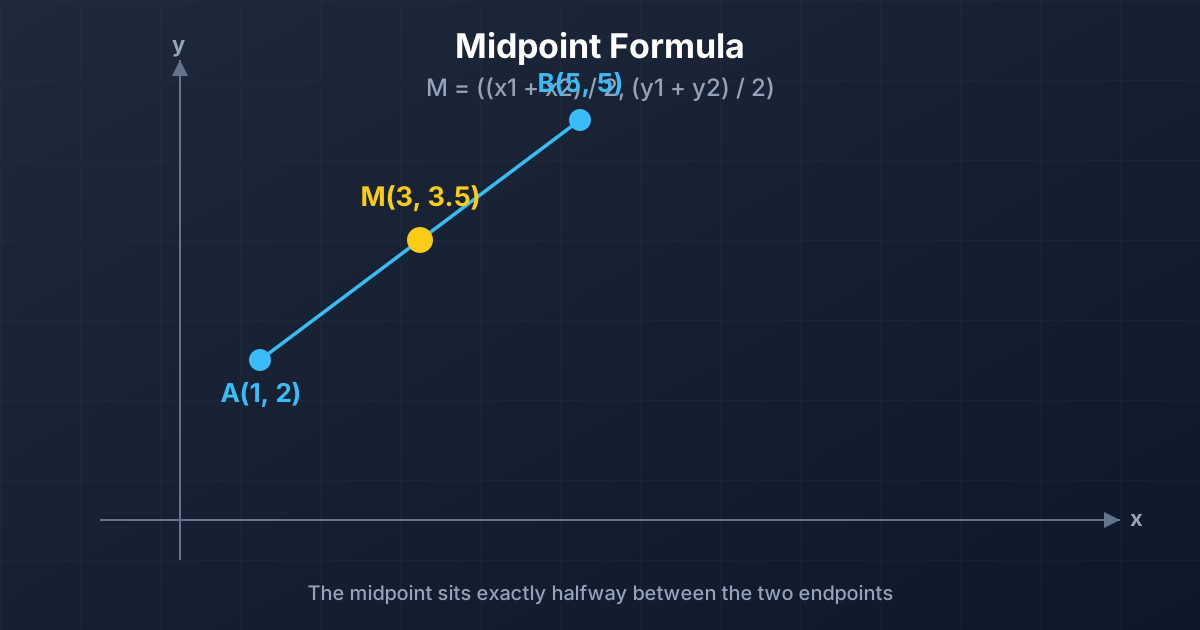
The midpoint formula finds the exact middle of a line segment on a coordinate plane. Give it the two endpoints and it returns the point sitting halfway between them, no measuring and no guessing. Students meet it in coordinate geometry, then use it again in triangles, circles, and graphing, because so many problems come down to finding a centre point. This guide explains the formula in plain language, works through every kind of example you will meet in class, and flags the mistakes that cost marks.
What Is the Midpoint Formula?
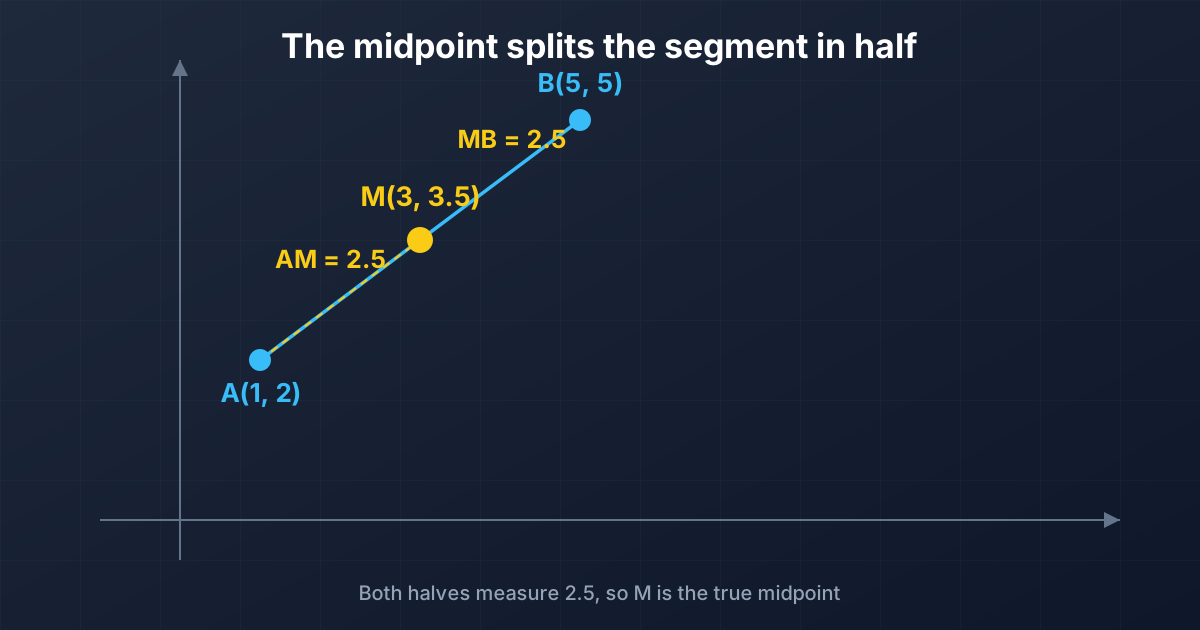
Take any two points on a coordinate plane and join them with a straight line segment. The midpoint is the point on that segment exactly halfway between the two ends. It splits the segment into two equal lengths, so the distance from the first endpoint to the midpoint equals the distance from the midpoint to the second endpoint.
The midpoint formula calculates that point from the coordinates of the endpoints:
M = ((x₁ + x₂) / 2, (y₁ + y₂) / 2)
Here is what each symbol means:
- M is the midpoint you are finding.
- (x₁, y₁) is the first endpoint of the segment.
- (x₂, y₂) is the second endpoint of the segment.
- x₁ and x₂ are the x-coordinates of the two endpoints.
- y₁ and y₂ are the y-coordinates of the two endpoints.
The formula does two separate averages. It averages the x-coordinates to get the x-coordinate of the midpoint, and it averages the y-coordinates to get the y-coordinate of the midpoint. That is the whole idea: the middle of a segment sits at the average position on each axis.
Featured snippet answer: The midpoint formula is M = ((x₁ + x₂) / 2, (y₁ + y₂) / 2). It finds the point exactly halfway between two endpoints (x₁, y₁) and (x₂, y₂) by averaging their x-coordinates and averaging their y-coordinates separately.
Why does averaging work? Think of a number line first. The midpoint of 2 and 8 is 5, because 5 sits exactly in the middle, and (2 + 8) / 2 = 5. A coordinate plane is two number lines crossed at right angles, one for x and one for y. The midpoint formula simply repeats that number-line average on both axes at once. Once you see that, the formula stops being something to memorise and becomes something obvious.
One more point before calculating: the midpoint is a point, so the answer is always an ordered pair in brackets, like (4, 5). If a calculation ends with a single number, something has gone wrong. Both coordinates must be averaged, and both must appear in the answer.
How to Find the Midpoint Between Two Points
Follow these six steps in order and the method never changes, whatever the numbers look like:
- Identify the coordinates of both endpoints. Label the first point (x₁, y₁) and the second point (x₂, y₂).
- Add the two x-coordinates: x₁ + x₂.
- Divide that sum by two. This is the x-coordinate of the midpoint.
- Add the two y-coordinates: y₁ + y₂.
- Divide that sum by two. This is the y-coordinate of the midpoint.
- Write the midpoint as an ordered pair: (x, y).
Here is the method in action. Find the midpoint of the segment joining A(2, 3) and B(6, 7).
First, label the endpoints: x₁ = 2, y₁ = 3, x₂ = 6, y₂ = 7. Next, average the x-coordinates: (2 + 6) / 2 = 8 / 2 = 4. Then average the y-coordinates: (3 + 7) / 2 = 10 / 2 = 5. So the midpoint is M = (4, 5).
Check that the answer makes sense. The x-coordinate 4 sits between 2 and 6, and the y-coordinate 5 sits between 3 and 7. A midpoint coordinate must always fall between the two endpoint coordinates on the same axis. If it falls outside that range, the arithmetic needs a second look. Here both coordinates sit neatly in the middle, so (4, 5) passes the check.
That range check is worth building into your habit. It catches sign errors and swapped coordinates in seconds, before they cost marks on an exam. Every example in this guide ends with the same kind of sense check, because a correct method plus a quick check beats a correct method alone.
Midpoint Formula Examples
Example 1: Positive Whole-Number Coordinates
Find the midpoint of the segment joining A(1, 2) and B(5, 5).
Label the endpoints: x₁ = 1, y₁ = 2, x₂ = 5, y₂ = 5. Substitute into the formula:
M = ((1 + 5) / 2, (2 + 5) / 2) = (6 / 2, 7 / 2) = (3, 3.5)
The midpoint is (3, 3.5). The answer makes sense: 3 sits between 1 and 5, and 3.5 sits between 2 and 5. Notice the midpoint can have a decimal coordinate even when both endpoints are whole numbers. That happens whenever the sum of two coordinates is odd, and it is perfectly normal. Do not round 3.5 to 4; the exact halfway point is 3.5, and rounding it would move the point off the true middle.
This is the most common example type in schoolwork, and it is the one to master first. If positive whole numbers feel comfortable, the rest of this section only changes the kind of numbers, never the method.
Example 2: Negative Coordinates
Find the midpoint of the segment joining A(-3, 4) and B(5, -2).
Label the endpoints: x₁ = -3, y₁ = 4, x₂ = 5, y₂ = -2. Substitute into the formula:
M = ((-3 + 5) / 2, (4 + (-2)) / 2) = (2 / 2, 2 / 2) = (1, 1)
The midpoint is (1, 1). The sense check still holds: 1 sits between -3 and 5, and 1 sits between -2 and 4.
Negative numbers cause most of the errors in this topic, and nearly all of them happen at the adding step. The rule is simple: adding a negative number is the same as subtracting its positive value, so 4 + (-2) = 4 - 2 = 2. The dangerous version of this example is -3 + 5, where students sometimes write -8 by adding the numbers and keeping the minus sign. That is wrong. A negative plus a larger positive gives a positive result: -3 + 5 = 2. Write the brackets in, as in 4 + (-2), and the sign stays visible through the whole calculation.
Example 3: Fractional Coordinates
Find the midpoint of the segment joining A(1/2, 1/4) and B(7/2, 9/4).
Label the endpoints: x₁ = 1/2, y₁ = 1/4, x₂ = 7/2, y₂ = 9/4. Substitute into the formula:
M = ((1/2 + 7/2) / 2, (1/4 + 9/4) / 2) = ((8/2) / 2, (10/4) / 2) = (4 / 2, (5/2) / 2) = (2, 5/4)
The midpoint is (2, 5/4), which is (2, 1.25) in decimal form. Check it: 2 sits between 1/2 and 7/2, and 5/4 sits between 1/4 and 9/4.
Fractions look harder than they are, because the denominators here match. When denominators match, add the numerators and keep the denominator: 1/2 + 7/2 = 8/2 = 4. Then halve the result: 4 / 2 = 2. If the denominators ever differ, convert to a common denominator before adding, exactly as in ordinary fraction addition. Alternatively, convert every fraction to a decimal first and work in decimals throughout: 0.5 and 3.5 average to 2, and 0.25 and 2.25 average to 1.25. Both routes give the same midpoint, so pick the one you find more reliable and stay with it.
Example 4: Horizontal and Vertical Line Segments
Find the midpoint of the horizontal segment joining A(2, 4) and B(8, 4).
Label the endpoints: x₁ = 2, y₁ = 4, x₂ = 8, y₂ = 4. Substitute into the formula:
M = ((2 + 8) / 2, (4 + 4) / 2) = (10 / 2, 8 / 2) = (5, 4)
The midpoint is (5, 4). On a horizontal segment both endpoints share the same y-coordinate, so the midpoint keeps that y-coordinate and only the x-coordinate is averaged. The answer (5, 4) sits on the same horizontal line, halfway between x = 2 and x = 8, which is exactly what a picture would show.
The vertical case mirrors it. Find the midpoint of the vertical segment joining A(3, 1) and B(3, 9):
M = ((3 + 3) / 2, (1 + 9) / 2) = (6 / 2, 10 / 2) = (3, 5)
The midpoint is (3, 5). Here the x-coordinate stays at 3 and only the y-coordinate is averaged. Horizontal and vertical segments are the easiest midpoint problems on a test, and they are also a useful check on understanding: if the method is clear, it should be obvious before calculating that one coordinate stays unchanged.
Understanding the Midpoint of a Line Segment
A picture makes the definition concrete. Plot A(1, 2) and B(5, 5) on a coordinate plane and join them. The midpoint M(3, 3.5) sits on that segment, and it divides the segment into two pieces of exactly equal length. Measuring from A to M gives the same length as measuring from M to B.
The numbers confirm it. Using the distance formula, the length from A(1, 2) to M(3, 3.5) is the square root of (3 - 1) squared plus (3.5 - 2) squared, which is the square root of 4 + 2.25, which is the square root of 6.25, which is 2.5. The length from M(3, 3.5) to B(5, 5) is the square root of (5 - 3) squared plus (5 - 3.5) squared, which is also the square root of 4 + 2.25, which is 2.5. Both pieces measure 2.5, so M genuinely bisects the segment.
This equal-halves property is why the midpoint matters beyond coordinate geometry exercises. In a triangle, the segment joining a vertex to the midpoint of the opposite side is a median, and medians meet at the centroid. In a circle, the midpoint of a diameter is the centre. In data and graphing, the midpoint between two values is the natural centre for an interval. Every one of these uses rests on the same fact: the midpoint is the point that cuts a segment into two equal parts.
When a problem gives you a diagram instead of coordinates, the same idea applies visually. Look for the point on the segment that appears to split it evenly, then confirm with the formula once coordinates are known. Diagrams can mislead when they are not drawn to scale, so the formula is the final judge, but a labelled diagram is the fastest way to understand what the formula is doing.
How to Find the Midpoint Without Memorising the Formula
If the formula slips your mind in an exam, rebuild it from the averaging idea. The midpoint of two numbers is their average, and a point has two numbers, so average each one.
Start on a single number line. The numbers 4 and 10 have a midpoint of 7, because (4 + 10) / 2 = 7, and 7 sits exactly halfway between them. Now do the same thing twice, once for x and once for y, and you have the midpoint formula. There is nothing else in it.
Try it on A(2, 6) and B(8, 10). Average the x-values: (2 + 8) / 2 = 5. Average the y-values: (6 + 10) / 2 = 8. The midpoint is (5, 8). No formula was recalled, only the idea that a midpoint is an average applied to each coordinate in turn.
This way of thinking also explains the fractional answers from Example 1. Averaging 2 and 5 gives 3.5, because the exact middle of 2 and 5 is not a whole number. Students who expect every answer to be whole sometimes force a rounded answer, but the average is the answer, whole or not.
One caution: averaging only works coordinate by coordinate. Averaging all four numbers together into a single value, or averaging an x-coordinate with a y-coordinate, gives a meaningless number. Keep the axes separate from start to finish and the method stays sound.
Common Mistakes When Using the Midpoint Formula
Subtracting Instead of Adding
The formula adds the coordinates. Subtracting them gives a different point entirely. For A(2, 3) and B(6, 7), the subtraction version gives ((6 - 2) / 2, (7 - 3) / 2) = (2, 2), which is not on the segment at all. The correct addition gives (4, 5). If an answer falls outside the range between the endpoint coordinates, subtraction is the first suspect.
Forgetting to Divide by Two
Adding without dividing gives a point far outside the segment. For A(2, 3) and B(6, 7), skipping the division gives (8, 10), which is beyond B itself. The division by two is what turns a sum into an average. After every midpoint calculation, ask whether the answer sits between the endpoints. (8, 10) does not, so it fails instantly.
Mixing x-Coordinates with y-Coordinates
Each average uses matching coordinates only: x with x, y with y. For A(2, 3) and B(6, 7), mixing them gives ((2 + 7) / 2, (3 + 6) / 2) = (4.5, 4.5), which looks plausible but is wrong. Labelling x₁, y₁, x₂, y₂ before substituting, as in the worked examples, is the practical defence. It takes five seconds and removes this whole class of error.
Handling Negative Numbers Incorrectly
Sign errors cluster around negative coordinates. For A(-3, 4) and B(5, -2), the x-sum is -3 + 5 = 2, not -8, and the y-sum is 4 + (-2) = 2, not 6. The fix is to write negative numbers in brackets when substituting, so 4 + (-2) stays visible as a subtraction of 2 rather than quietly becoming an addition. Slow down on exactly the step where a minus sign appears.
Writing the Ordered Pair in the Wrong Order
The midpoint is written (x, y), x first, y second. For A(2, 3) and B(6, 7), the answer is (4, 5), not (5, 4). Swapping the two gives a different point on the plane, and markers count it wrong even when the arithmetic was right. A quick habit helps: after calculating, read the pair back as “x equals, y equals” and check each against its own axis range.
Midpoint Formula vs Distance Formula
Students often confuse these two formulas because both take two points as input. They answer different questions, and keeping the questions separate keeps the formulas separate.
| Feature | Midpoint formula | Distance formula |
|---|---|---|
| Question it answers | Which point sits halfway between the two points? | How far apart are the two points? |
| Result | A point, written as an ordered pair | A length, written as a single number |
| Formula | M = ((x₁ + x₂) / 2, (y₁ + y₂) / 2) | d = √((x₂ - x₁)² + (y₂ - y₁)²) |
| Operation on coordinates | Add, then halve | Subtract, square, add, square root |
| Example with A(1, 2) and B(5, 5) | (3, 3.5) | 5 |
The contrast is clearest on the same pair of points. For A(1, 2) and B(5, 5), the midpoint formula returns the point (3, 3.5), while the distance formula returns the length 5: the square root of (5 - 1) squared plus (5 - 2) squared, which is the square root of 16 + 9, which is the square root of 25, which is 5. One answer is a place, the other is a length.
A memory aid: midpoint uses addition because it averages positions, while distance uses subtraction because it measures a gap. If a question asks “where is the middle”, reach for the midpoint formula. If it asks “how long”, reach for distance. Our distance formula guide covers the second formula in the same teaching style.
Practice Questions on the Midpoint Formula
Try these five questions in order. They get harder as they go, and they cover every number type from the examples above. Work each one fully before looking at the answers.
- Find the midpoint of the segment joining A(2, 4) and B(6, 8).
- Find the midpoint of the segment joining A(-4, 2) and B(4, -6).
- Find the midpoint of the vertical segment joining A(3, 5) and B(3, 11).
- Find the midpoint of the segment joining A(1/2, 3) and B(7/2, 5).
- Find the midpoint of the segment joining A(-2.5, 1.5) and B(3.5, -4.5).
Answers
- M = ((2 + 6) / 2, (4 + 8) / 2) = (8 / 2, 12 / 2) = (4, 6).
- M = ((-4 + 4) / 2, (2 + (-6)) / 2) = (0 / 2, -4 / 2) = (0, -2).
- M = ((3 + 3) / 2, (5 + 11) / 2) = (6 / 2, 16 / 2) = (3, 8). The x-coordinate stays at 3, as expected on a vertical segment.
- M = ((1/2 + 7/2) / 2, (3 + 5) / 2) = ((8/2) / 2, 8 / 2) = (2, 4).
- M = ((-2.5 + 3.5) / 2, (1.5 + (-4.5)) / 2) = (1 / 2, -3 / 2) = (0.5, -1.5).
If any answer disagrees with yours, redo it with the range check: each midpoint coordinate must sit between the two endpoint coordinates on the same axis. That check alone locates most errors without reworking the whole problem.
Frequently Asked Questions
Short answers to the questions students ask most about the midpoint formula.
01 What is the midpoint formula in maths?
The midpoint formula is M = ((x₁ + x₂) / 2, (y₁ + y₂) / 2). It finds the point exactly halfway between two endpoints (x₁, y₁) and (x₂, y₂) on a coordinate plane by averaging their x-coordinates and their y-coordinates separately.
02 How do you find the midpoint between two points?
Label the endpoints (x₁, y₁) and (x₂, y₂). Add the x-coordinates and divide by two for the midpoint's x-value, then add the y-coordinates and divide by two for its y-value. Write the result as an ordered pair, x first and y second.
03 What is the midpoint of a line segment?
It is the point on the segment exactly halfway between its two endpoints. It divides the segment into two pieces of equal length, so the distance from either endpoint to the midpoint is the same.
04 Can the midpoint formula work with negative numbers?
Yes. Add the coordinates exactly as usual, keeping the signs visible by writing negatives in brackets, as in 4 + (-2) = 2. A negative plus a larger positive gives a positive result, so take care at the adding step.
05 How do you find the midpoint of a horizontal line?
On a horizontal segment both endpoints share the same y-coordinate, so the midpoint keeps that y-coordinate and only the x-coordinate is averaged. For A(2, 4) and B(8, 4), the midpoint is (5, 4).
06 Is the midpoint formula the same as the distance formula?
No. The midpoint formula returns a point, the halfway location, using addition and halving. The distance formula returns a length, how far apart the points are, using subtraction, squaring, and a square root.
07 Can the midpoint have decimal or fractional coordinates?
Yes, and it often does. Averaging two whole numbers with an odd sum gives a .5 decimal, as in (3, 3.5) for A(1, 2) and B(5, 5). Keep the exact value rather than rounding it, or the point moves off the true middle.
Conclusion
The midpoint formula is one idea used twice: average the x-coordinates, average the y-coordinates, and the result is the point exactly halfway between two endpoints. It works for positive numbers, negative numbers, fractions, and decimals, and it simplifies neatly on horizontal and vertical segments where one coordinate stays unchanged. The habits that protect your marks are labelling the endpoints before substituting, writing negative numbers in brackets, and checking that each answer coordinate falls between the endpoint coordinates on the same axis. Work through the five practice questions above until the method feels automatic, then try it on a triangle problem, where the midpoint of a side is the starting point for medians and centroids.