
Pythagorean Theorem Formula: The Ultimate Guide
Math Expert
Geometry
1. Introduction
The Pythagorean Theorem is one of the most famous and widely used formulas in all of mathematics. Discovered over two millennia ago, it fundamentally describes the relationship between the three sides of a right triangle.
But why is it so important? This theorem bridges the gap between geometry and algebra. It allows us to calculate distances, design buildings, navigate the globe, and even program modern 3D computer graphics. Whenever you need to find the shortest path between two points, or Find the hypotenuse, this formula is your go-to tool.
2. What Is the Pythagorean Theorem Formula?
Formula Overview:
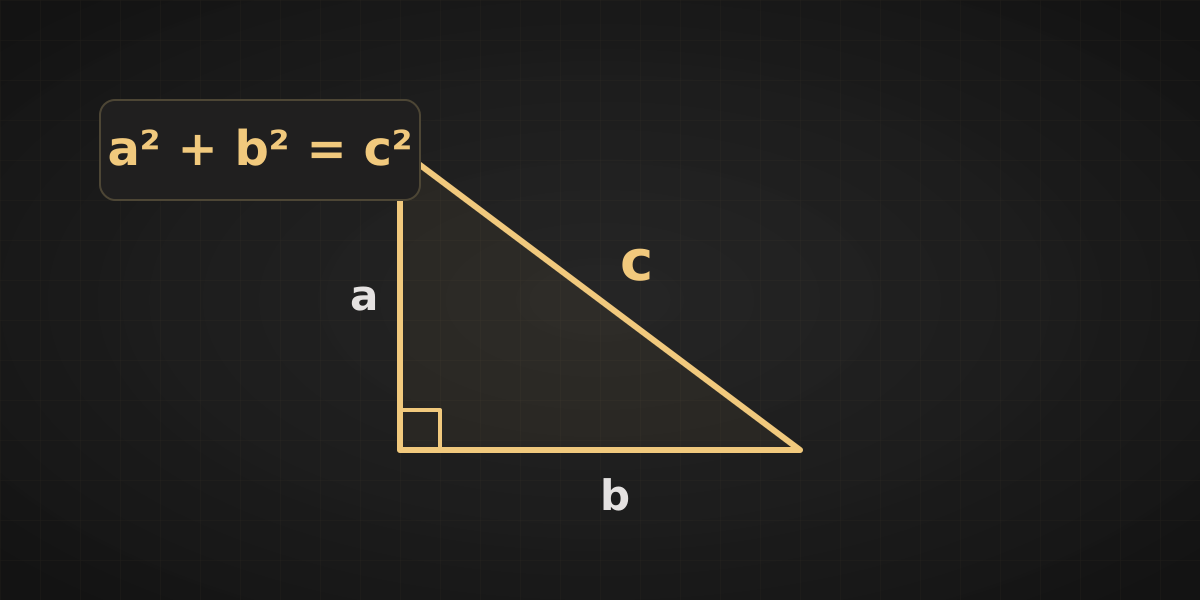
The formula is written as a² + b² = c², where and are the legs of the right triangle, and is the hypotenuse.
Breaking Down the Formula
- (Leg 1): One of the sides that form the 90-degree right angle.
- (Leg 2): The other side that forms the 90-degree right angle.
- (Hypotenuse): The longest side of the right triangle, located directly opposite the right angle.
Why must always be the hypotenuse?
In any triangle, the longest side is always opposite the largest angle. Since a right triangle has a 90-degree angle (which must be the largest angle since the sum of all angles is 180 degrees), the side opposite to it is invariably the longest. If you plug the longest side into or , the math will fail.
[SVG showing a right triangle with a, b, c labeled]
3. When Can You Use the Formula?
When to use it:
You can only use the Pythagorean theorem formula on right triangles (triangles with a 90-degree angle).
Examples of When to Use It:
- A triangle with angles 90°, 45°, and 45° (45-45-90 Triangle).
- A triangle with angles 90°, 30°, and 60° (30-60-90 Triangle).
- Finding the diagonal of a rectangle or square.
Non-Examples (When NOT to Use It):
- Equilateral triangles (all angles are 60°).
- Acute or obtuse triangles that lack a 90° angle. (For non-right triangles, you must use the Law of Sines or Law of Cosines instead!)
4. How to Use the Formula
Step-by-Step Guide:
Identify the known sides, substitute them into , and solve for the unknown variable using basic algebra and square roots.
Finding the Hypotenuse ()
When you know both legs ( and ):
- Square side .
- Square side .
- Add the two squared numbers together.
- Take the square root of the sum to find . (Shortcut: use our Hypotenuse Calculator)
Finding a Missing Leg ( or )
When you know the hypotenuse () and one leg ():
- Square side .
- Square side .
- Subtract from .
- Take the square root of the result to find . (Shortcut: use our Missing Side Calculator)
Checking if a Triangle is a Right Triangle
If you have all three sides, plug them into the formula. Make sure is the largest number. If the left side equals the right side, it is a perfect right triangle!
5. Worked Examples
Mastering the Formula:
Review these 13 solved examples to understand how to apply the Pythagorean theorem formula across different difficulty levels and real-world scenarios.
Example 1: Very Easy
Problem: A right triangle has legs and . Find the missing side .
Known values: ,
Formula:
Calculation:
Answer:
Explanation: Square each leg, add the results, then take the square root. This is the classic 3-4-5 triple, worth memorizing.
Example 2: Very Easy
Problem: A right triangle has legs and . Find the missing side .
Known values: ,
Formula:
Calculation:
Answer:
Explanation: Squaring 5 and 12 gives 25 and 144. Their sum, 169, is a perfect square, so the hypotenuse is exactly 13.
Example 3: Easy
Problem: A right triangle has hypotenuse and leg . Find leg .
Known values: ,
Formula:
Calculation:
Answer:
Explanation: To find a leg, rearrange the formula and subtract: square the hypotenuse, subtract the known leg’s square, then take the square root.
Example 4: Easy
Problem: A right triangle has hypotenuse and leg . Find leg .
Known values: ,
Formula:
Calculation:
Answer:
Explanation: Here the two known sides are almost equal, so the answer is small: , and .
Example 5: Medium
Problem: A right triangle has legs and . Find the missing side .
Known values: ,
Formula:
Calculation:
Answer:
Explanation: Notice this is just the 7-24-25 triple doubled: , , . Scaling a triple keeps it a triple.
Example 6: Medium
Problem: A right triangle has legs and . Find the missing side .
Known values: ,
Formula:
Calculation:
Answer:
Explanation: A larger pair of legs still lands on a perfect integer: , the 9-40-41 triple.
Example 7: Hard
Problem: A right triangle has hypotenuse and leg . Find leg .
Known values: ,
Formula:
Calculation:
Answer:
Explanation: A quick sanity check: the answer 20 is less than the hypotenuse 29, as it must be. This is the 20-21-29 triple.
Example 8: Hard
Problem: A right triangle has hypotenuse and leg . Find leg .
Known values: ,
Formula:
Calculation:
Answer:
Explanation: When the known leg is almost as long as the hypotenuse, the missing leg is short. Here , so .
Example 9: Word Problem
Problem: A ladder is 13 feet long and leans against a wall. The base of the ladder is 5 feet away from the wall. How high up the wall does the ladder reach?
Known values: hypotenuse , leg
Formula:
Calculation:
Answer: The height is 12.
Explanation: Drawing a diagram reveals a right triangle. Applying the Right Triangle Formula gives the missing dimension.
Example 10: Construction Example
Problem: You are building a rectangular deck that is 8 meters wide and 15 meters long. To ensure the corners are perfectly square, what should the diagonal measurement be?
Known values: leg , leg
Formula:
Calculation:
Answer: The diagonal (hypotenuse) is 17.
Explanation: Drawing a diagram reveals a right triangle. Applying the Right Triangle Formula gives the missing dimension.
Example 11: Engineering Example
Problem: A suspension bridge needs a support cable. The tower is 40 meters tall, and the cable anchors to the ground 9 meters from the base of the tower. How long is the cable?
Known values: leg , leg
Formula:
Calculation:
Answer: The cable (hypotenuse) is 41.
Explanation: Drawing a diagram reveals a right triangle. Applying the Right Triangle Formula gives the missing dimension.
Example 12: Navigation Example
Problem: A ship sails 24 miles South, then turns exactly West and sails 7 miles. How far is the ship from its starting point in a straight line?
Known values: leg , leg
Formula:
Calculation:
Answer: The distance (hypotenuse) is 25.
Explanation: Drawing a diagram reveals a right triangle. Applying the Right Triangle Formula gives the missing dimension.
Example 13: Word Problem
Problem: A flat-screen TV is sold by its diagonal length. If a TV is 60 inches wide and 11 inches tall, what is the diagonal measurement advertised?
Known values: leg , leg
Formula:
Calculation:
Answer: The diagonal (hypotenuse) is 61.
Explanation: Drawing a diagram reveals a right triangle. Applying the Right Triangle Formula gives the missing dimension.
6. Pythagorean Triples
What are Pythagorean Triples?
Pythagorean triples are sets of three positive integers that perfectly fit the formula . Memorizing them saves immense calculation time!
The Famous 3-4-5 Triangle
The 3-4-5 triangle is the most fundamental triple. If a triangle’s sides are 3, 4, and 5, it is guaranteed to be a right triangle. Builders use this constantly to square corners.
The 5-12-13 Triangle
The 5-12-13 triangle is another extremely common integer ratio found in math exams and architectural designs.
[Infographic of Pythagorean triples]
Table of 30 Common Pythagorean Triples
| Multiple Of | |||
|---|---|---|---|
| 3 | 4 | 5 | Primitive |
| 6 | 8 | 10 | 3-4-5 |
| 9 | 12 | 15 | 3-4-5 |
| 5 | 12 | 13 | Primitive |
| 10 | 24 | 26 | 5-12-13 |
| 15 | 36 | 39 | 5-12-13 |
| 8 | 15 | 17 | Primitive |
| 16 | 30 | 34 | 8-15-17 |
| 24 | 45 | 51 | 8-15-17 |
| 7 | 24 | 25 | Primitive |
| 14 | 48 | 50 | 7-24-25 |
| 21 | 72 | 75 | 7-24-25 |
| 9 | 40 | 41 | Primitive |
| 18 | 80 | 82 | 9-40-41 |
| 27 | 120 | 123 | 9-40-41 |
| 20 | 21 | 29 | Primitive |
| 40 | 42 | 58 | 20-21-29 |
| 60 | 63 | 87 | 20-21-29 |
| 12 | 35 | 37 | Primitive |
| 24 | 70 | 74 | 12-35-37 |
| 36 | 105 | 111 | 12-35-37 |
| 11 | 60 | 61 | Primitive |
| 22 | 120 | 122 | 11-60-61 |
| 33 | 180 | 183 | 11-60-61 |
| 16 | 63 | 65 | Primitive |
| 32 | 126 | 130 | 16-63-65 |
| 48 | 189 | 195 | 16-63-65 |
| 33 | 56 | 65 | Primitive |
| 66 | 112 | 130 | 33-56-65 |
| 99 | 168 | 195 | 33-56-65 |
7. Real Life Applications
How is the formula used in real life?
From construction to game development, the Pythagorean theorem is everywhere.
Construction and Architecture
- Roof Pitch: Carpenters calculate the diagonal rafter lengths using the rise and run of the roof.
- Stairs & Ladders: Determining the exact length of a stringer or ladder needed to reach a certain height.
- Squaring Rooms: Using the 3-4-5 rule to ensure walls meet at a perfect 90-degree angle.
Engineering and Surveying
- Surveying: Calculating the steepness of slopes and the distance between topological points.
- Civil Engineering: Designing support cables for suspension bridges.
Tech and Navigation
- Navigation & GPS: Calculating the shortest straight-line distance between two coordinates.
- Computer Graphics & Gaming: Rendering 3D environments, calculating distances between entities, and ray tracing.
- Astronomy & Physics: Measuring distances between celestial bodies and calculating vector magnitudes.
[Illustration of roof pitch]
Application Table
| Industry | Use Case | Variable Usually Solved For |
|---|---|---|
| Construction | Squaring walls (3-4-5 rule) | Checking Hypotenuse () |
| Navigation | Straight line distance | Hypotenuse () |
| Architecture | Rafter length | Hypotenuse () |
| Painting | Ladder placement | Leg ( or ) |
| UI/UX Design | Screen diagonals | Hypotenuse () |
8. Common Mistakes
Avoiding Pitfalls:
Even advanced students make mistakes. Here are 20 common errors to watch out for.
| Mistake | Explanation | How to Avoid |
|---|---|---|
| 1. Forgetting to square root | Finding and stopping. | Always apply as the final step. |
| 2. Adding instead of subtracting | Using when finding a leg. | Remember legs are subtracted from the hypotenuse. |
| 3. Using on non-right triangles | Applying it to acute/obtuse triangles. | Verify the 90° angle first. |
| 4. Identifying incorrectly | Plugging the longest side into or . | is always opposite the right angle. |
| 5. Squaring incorrectly | Thinking . | Remember . |
| 6. Adding before squaring | . | Square first, then add! |
| 7. Negative distances | Writing for a side length. | Lengths are strictly positive. |
| 8. Mixing units | Inches for , feet for . | Convert all units to match first. |
| 9. Rounding too early | Rounding intermediate squares. | Keep exact numbers until the final answer. |
| 10. Forgetting it’s | Using . | Always square the values! |
| 11. Assuming a triangle is right | Just because it looks 90° doesn’t mean it is. | Look for the square symbol or prove it. |
| 12. Misreading the prompt | Finding the area instead of the perimeter. | Read carefully! Use our Triangle Area Calculator. |
| 13. Confusing legs | It doesn’t matter which leg is or . | and are interchangeable. |
| 14. Sloppy algebra | Moving terms across the sign incorrectly. | Subtract carefully: . |
| 15. Forgetting 3-4-5 multiples | Doing long math for 6, 8, 10. | Check if sides share a common factor! |
| 16. SOHCAHTOA confusion | Using trigonometry when sides are given. | See our SOHCAHTOA Guide for when to use angles. |
| 17. Writing the formula backwards | is the sum of the legs squared. | |
| 18. Calculator errors | Not using parentheses in the calculator. | Enter sqrt(a^2 + b^2) carefully. |
| 19. Ignoring word problem context | Ladder length vs height on wall. | Draw a picture every single time. |
| 20. Guessing the hypotenuse | Assuming the missing side is . | If the missing side is adjacent to 90°, it’s a leg. |
9. Practice Questions
Test your knowledge with these 30 practice questions!
Q1: In a right triangle, and . What is ? Answer: .
Q2: In a right triangle, and . What is ? Answer: .
Q3: In a right triangle, and . What is ? Answer: .
Q4: In a right triangle, and . What is ? Answer: .
Q5: In a right triangle, and . What is ? Answer: .
Q6: In a right triangle, and . What is ? Answer: .
Q7: In a right triangle, and . What is ? Answer: .
Q8: In a right triangle, and . What is ? Answer: .
Q9: In a right triangle, and . What is ? Answer: .
Q10: In a right triangle, and . What is ? Answer: .
Q11: In a right triangle, and . What is ? Answer: .
Q12: In a right triangle, and . What is ? Answer: .
Q13: In a right triangle, and . What is ? Answer: .
Q14: In a right triangle, and . What is ? Answer: .
Q15: In a right triangle, and . What is ? Answer: .
Q16: In a right triangle, and . What is ? Answer: .
Q17: In a right triangle, and . What is ? Answer: .
Q18: In a right triangle, and . What is ? Answer: .
Q19: In a right triangle, and . What is ? Answer: .
Q20: In a right triangle, and . What is ? Answer: .
Q21: In a right triangle, and . What is ? Answer: .
Q22: In a right triangle, and . What is ? Answer: .
Q23: In a right triangle, and . What is ? Answer: .
Q24: In a right triangle, and . What is ? Answer: .
Q25: In a right triangle, and . What is ? Answer: .
Q26: In a right triangle, and . What is ? Answer: .
Q27: In a right triangle, and . What is ? Answer: .
Q28: In a right triangle, and . What is ? Answer: .
Q29: In a right triangle, and . What is ? Answer: .
Q30: In a right triangle, and . What is ? Answer: .
Related Right Triangle Calculators
To make solving right triangles as easy as possible, we have built a suite of free, highly accurate calculators tailored to every specific problem type. Check them out below:
General Triangles & Sides
- Ultimate Right Triangle Solver
- Missing Side Calculator
- Missing Leg Calculator (from Hypotenuse & Leg)
- Hypotenuse Calculator
- Pythagorean Theorem Calculator
- Pythagorean Triples Calculator
- Similar Right Triangles Calculator
Angles & Trigonometry
- Missing Angle Calculator
- Sine Ratio Calculator
- Cosine Ratio Calculator
- Tangent Ratio Calculator
- Angle from Sine Calculator
- Angle from Cosine Calculator
- Angle from Tangent Calculator
Area, Perimeter & Advanced Properties
- Right Triangle Area Calculator
- Right Triangle Perimeter Calculator
- Right Triangle Semiperimeter Calculator
- Right Triangle Altitude Calculator
- Right Triangle Inradius Calculator
- Right Triangle Circumradius Calculator
Special Right Triangles
10. Frequently Asked Questions
Pythagorean Theorem FAQs
We have compiled the top questions people ask about the Pythagorean theorem.
01 What is the Pythagorean theorem formula?
The formula is $a² + b² = c²$, where $c$ is the hypotenuse.
02 How do you find the hypotenuse?
Square the two legs, add them together, and take the square root.
03 Can the Pythagorean theorem be used on any triangle?
No, it exclusively applies to right-angled triangles.
04 Who invented the Pythagorean theorem?
Named after Pythagoras (c. 570-495 BCE), though Babylonians and Indian mathematicians knew the relationship centuries earlier.
05 What is a Pythagorean triple?
Three positive integers (a, b, c) that satisfy $a² + b² = c²$, such as 3-4-5 or 5-12-13.
06 Is 3 4 5 a right triangle?
Yes. Since $3² + 4² = 9 + 16 = 25 = 5²$, sides of 3, 4, and 5 form a right triangle.
07 How do I find a missing leg?
Rearrange the formula to $b = sqrt{c² - a²}$. Square the hypotenuse, subtract the known leg squared, then take the square root.
08 What does a2 + b2 = c2 mean?
The square built on the hypotenuse has exactly the same area as the two squares on the legs combined.
09 Why is the hypotenuse always the longest side?
It sits opposite the 90-degree angle, the largest angle in the triangle, and larger angles always face longer sides.
10 What happens if c2 is greater than a2 + b2?
The triangle is obtuse. The side c faces an angle larger than 90 degrees.
11 What happens if c2 is less than a2 + b2?
The triangle is acute. All three of its angles measure less than 90 degrees.
12 How do you use SOHCAHTOA?
It is a memory aid for sine, cosine, and tangent ratios. It complements the theorem whenever angles are involved.
13 What is the distance formula?
It is the Pythagorean theorem applied to coordinates: $d = sqrt{(x_2-x_1)² + (y_2-y_1)²}$.
14 Can hypotenuse be a decimal?
Yes. Sides can be any positive real number, so hypotenuses like 7.5 or $sqrt{2}$ are completely normal.
15 Are there negative lengths in right triangles?
No. Length is always positive, so a negative result signals an error in the setup.
16 How is this used in real life?
Builders, navigators, surveyors, and game developers use it to find distances from perpendicular measurements.
17 Is the diagonal of a square a right triangle?
A square's diagonal splits it into two right triangles, each with legs equal to the square's side length.
18 What are the most common Pythagorean triples?
3-4-5, 5-12-13, 8-15-17, 7-24-25, and 20-21-29, plus scaled versions like 6-8-10.
19 How do you calculate roof pitch?
Treat the rise and run as the legs of a right triangle. Rafter length is the hypotenuse: $sqrt{rise² + run²}$.
20 How do I use a [Pythagorean theorem calculator](/pythagorean-theorem-calculator/)?
Enter any two known sides and it solves for the third, showing each step of the working.
21 Can you prove the Pythagorean theorem?
Yes, hundreds of proofs exist. The classic one rearranges four identical right triangles inside a larger square.
22 What is the formula for right triangles?
$a² + b² = c²$, where $a$ and $b$ are the legs and $c$ is the hypotenuse.
23 Does it work for 3D shapes?
The 3D version is $d² = x² + y² + z²$, which gives the space diagonal of a rectangular box.
24 What is the converse of the Pythagorean theorem?
If $a² + b² = c²$ holds for three side lengths, the triangle must contain a right angle.
25 Is the hypotenuse always c?
By convention yes, but the letters are arbitrary. The hypotenuse is always the side opposite the right angle.
26 How do I teach the Pythagorean theorem?
Start by drawing squares on grid paper along each side, then introduce the 3-4-5 triangle before the algebra.
27 What is the relationship between area and the theorem?
Each squared term is the area of a square built on that side. The theorem states these areas balance.
28 Can a right triangle have two right angles?
No. Two 90-degree angles already sum to 180 degrees, leaving nothing for a third angle.
29 What is an isosceles right triangle?
A right triangle with two equal legs. Its angles are 90, 45, and 45 degrees, with hypotenuse equal to leg times $sqrt{2}$.
30 How does a [45-45-90 triangle](/45-45-90-triangle-calculator/) relate to this?
It is the isosceles right triangle. The theorem shows its hypotenuse equals the leg times $sqrt{2}$.
31 How does a [30-60-90 triangle](/30-60-90-triangle-calculator/) relate to this?
Its sides follow the ratio $1 : sqrt{3} : 2$, which satisfies $1² + (sqrt{3})² = 2²$.
32 What are irrational hypotenuses?
Hypotenuses like $sqrt{2}$ or $sqrt{5}$ that never terminate as decimals. They come from non-triple side combinations.
33 Why do we square the sides?
Squaring turns each side into the area of its square, and the theorem states that those areas balance.
34 Is the Pythagorean theorem on the SAT?
Yes, it appears regularly in SAT and ACT geometry questions and word problems.
35 How do I remember the formula?
Picture squares on each side: the two smaller squares exactly fill the largest one. Legs squared add to hypotenuse squared.