
Sine, Cosine, and Tangent Explained: The Ultimate Beginner's Guide
Math Expert
Trigonometry
Trigonometry can seem intimidating at first, but at its core, it is simply the study of triangles. If you want to understand how the universe calculates distance, angles, and architecture, you must master the three foundational pillars of trigonometry: sine, cosine, and tangent.
Many students struggle with trigonometry because it introduces entirely new concepts—like angles determining side ratios—that aren’t present in basic algebra. However, these ratios are just simple fractions. They are used everywhere, from designing bridges and programming video games to navigating ships across the ocean.
In this definitive guide, we will break down exactly what sine, cosine, and tangent are in the simplest terms possible. Whether you are a middle school student, a parent helping with homework, or a DIY builder, this guide will provide a crystal clear understanding of right triangle trigonometry.
After reading this guide you will be able to:
- Identify triangle sides (opposite, adjacent, hypotenuse).
- Choose the correct trigonometric ratio.
- Solve for missing sides.
- Solve for missing angles.
- Understand and memorize SOHCAHTOA.
- Use scientific calculators correctly.
- Solve real-world geometry problems.
What Are Sine, Cosine, and Tangent?
Sine, cosine, and tangent are trigonometric ratios that measure the relationship between the angles of a right triangle and the lengths of its sides. For any given angle, these ratios remain constant, allowing you to calculate unknown side lengths or missing angles when only partial information is available.
Definition and Purpose
In a right triangle, the ratio of any two sides depends entirely on the triangle’s acute angles.
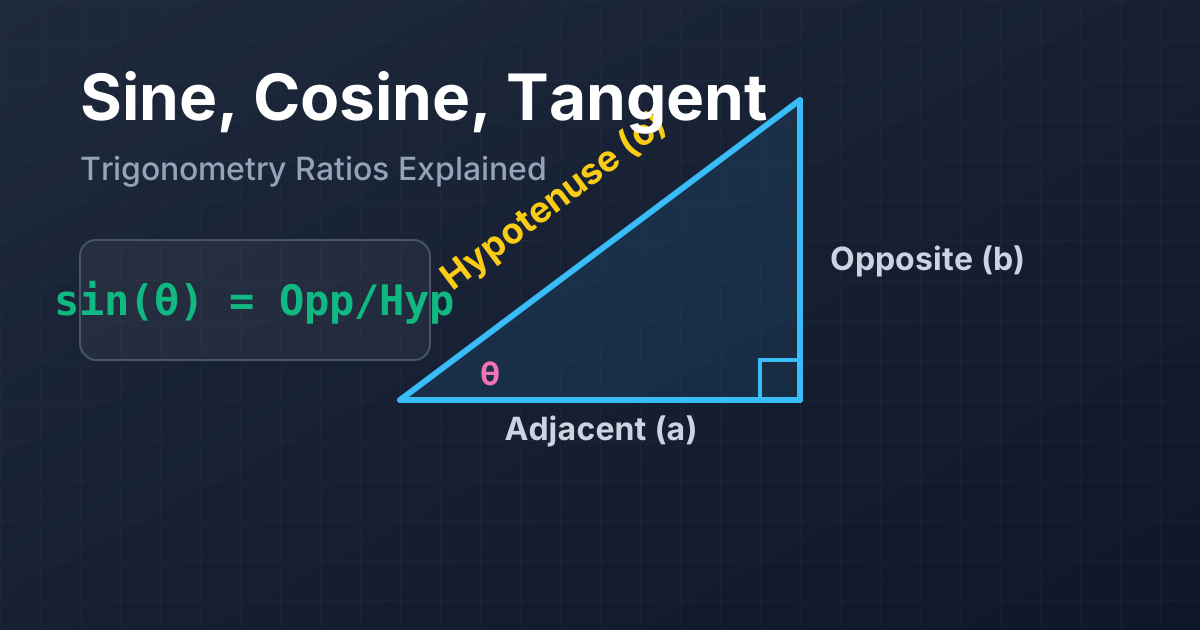
- Sine (sin): The ratio of the opposite side to the hypotenuse.
- Cosine (cos): The ratio of the adjacent side to the hypotenuse.
- Tangent (tan): The ratio of the opposite side to the adjacent side.
Why Do These Ratios Exist?
If you take a right triangle and scale it up to be 100 times larger, the angles inside remain exactly the same. Because the shape remains proportional, the ratio of its sides remains identical. Early mathematicians (dating back to ancient astronomy) realized they could create a universal “cheat sheet” (trigonometric tables) mapping every possible angle to its specific side ratios.
Comparison Table: Trigonometric Ratios
| Ratio Name | Abbreviation | Formula (Ratio) | Primary Use |
|---|---|---|---|
| Sine | sin(θ) | Opposite / Hypotenuse | Finding vertical heights or hypotenuse |
| Cosine | cos(θ) | Adjacent / Hypotenuse | Finding horizontal distances or hypotenuse |
| Tangent | tan(θ) | Opposite / Adjacent | Finding slopes, pitches, and heights without hypotenuse |
Quick Tip: The symbol θ (theta) is a Greek letter universally used in math to represent an unknown angle.
Understanding Opposite, Adjacent, and Hypotenuse
To use sine, cosine, and tangent, you must correctly identify the Hypotenuse, the Opposite side, and the Adjacent side. The hypotenuse never changes, but the “opposite” and “adjacent” sides swap depending on which acute angle you are looking at.
How to Identify Them
- Hypotenuse: Always the longest side, strictly located across from the 90-degree right angle.
- Opposite Side: The leg located directly across from the specific angle (θ) you are focusing on. It does not touch the angle at all.
- Adjacent Side: The leg that forms the angle (θ) alongside the hypotenuse. It “touches” the angle but is not the longest side.
How They Change Based on the Angle
If you stand at Angle A, the wall across the room is the “Opposite” side. If you walk across the room and stand at Angle B, that same wall is now right next to you—it has become the “Adjacent” side. The labels are relative to your perspective.
Decision Chart: Labeling Sides
| Step | Action | Identification |
|---|---|---|
| 1 | Find the 90° corner and look directly across it. | Hypotenuse |
| 2 | Pick your target angle (θ). Look directly across from it. | Opposite Side |
| 3 | Find the remaining side touching the angle. | Adjacent Side |
What Is SOHCAHTOA?
SOHCAHTOA is a universally recognized mathematical mnemonic used to memorize the formulas for sine, cosine, and tangent. It stands for: Sine is Opposite over Hypotenuse, Cosine is Adjacent over Hypotenuse, and Tangent is Opposite over Adjacent.
Meaning of Every Letter
- S O H: Sin(θ) = Opposite / Hypotenuse
- C A H: Cos(θ) = Adjacent / Hypotenuse
- T O A: Tan(θ) = Opposite / Adjacent
Visual Explanation and Memory Tricks
If SOHCAHTOA is hard to remember, many students use silly phrases where the first letter of each word spells out the mnemonic:
- Some Old Horses Can Always Hear Their Owners Approach.
- Some Of Her Cats Are Having Trouble Over Apples.
SOHCAHTOA Cheat Sheet
| Mnemonic Part | Function | Equation Format |
|---|---|---|
| SOH | Sine | sin(θ) = O / H |
| CAH | Cosine | cos(θ) = A / H |
| TOA | Tangent | tan(θ) = O / A |
Sine Formula Explained
The sine formula is defined as the ratio of the side opposite the angle to the hypotenuse. The equation is written as sin(θ) = Opposite / Hypotenuse. It is primarily used when dealing with the height of a triangle and its longest side.
When to Use Sine
Use sine when you know (or need to find) the Opposite side and the Hypotenuse.
When NOT to Use Sine
Do not use sine if the problem involves the Adjacent side and does not provide the Hypotenuse.
How it Works (Worked Example)
Imagine a right triangle where the angle is 30° and the Hypotenuse is 10. You need the Opposite side.
- Formula: sin(30°) = Opp / 10
- Step 1: Calculate sin(30°) on a calculator, which is exactly 0.5.
- Step 2: 0.5 = Opp / 10.
- Step 3: Multiply both sides by 10. Opp = 5.
Common Mistake
A frequent error is dividing the Hypotenuse by the Opposite side instead of the other way around. The formula is strictly O divided by H.
Cosine Formula Explained
The cosine formula is defined as the ratio of the side adjacent to the angle to the hypotenuse. The equation is cos(θ) = Adjacent / Hypotenuse. It is most commonly used for calculating horizontal distances along the ground.
Applications and Meaning
While sine often relates to vertical height (the y-axis on a coordinate plane), cosine relates to horizontal distance (the x-axis). When a ladder leans against a wall, cosine helps you find how far the base of the ladder is from the wall.
Calculator Walkthrough
To find the adjacent side when Angle = 60° and Hypotenuse = 20:
- Formula: cos(60°) = Adj / 20
- Step 1: Press
cos, type60, and press=. Ensure your calculator is in “Degree” mode. The result is 0.5. - Step 2: 0.5 = Adj / 20.
- Step 3: Adj = 20 × 0.5 = 10.
Common Mistake
Using cosine when the angle provided is the top angle, but treating the ground distance as the adjacent side. Remember, the adjacent side must touch the specific angle you are using.
Tangent Formula Explained
The tangent formula is defined as the ratio of the opposite side to the adjacent side. The equation is tan(θ) = Opposite / Adjacent. Because it does not use the hypotenuse, it is perfectly suited for finding slope, roof pitch, or the height of a building from the ground.
Slope Relationship
Tangent is identical to the concept of “Rise over Run” in algebra. The Opposite side is the “Rise” (vertical), and the Adjacent side is the “Run” (horizontal). Therefore, the tangent of an angle gives you the exact slope of the hypotenuse line.
How it Works (Worked Example)
You are 50 feet away from a tree (Adjacent = 50). You look up at a 45° angle to see the top (θ = 45°). How tall is the tree (Opposite)?
- Formula: tan(45°) = Opp / 50
- Step 1: tan(45°) = 1.
- Step 2: 1 = Opp / 50.
- Step 3: Opp = 50 feet.
How to Choose Between Sine, Cosine, and Tangent
Choosing the correct ratio is a process of elimination. You must look at the triangle, identify which angle you are using, and circle the two sides the problem involves (the one you know, and the one you want to find).
The Decision Process
- Locate your reference angle. (e.g., 35°).
- Label your sides (Opposite, Adjacent, Hypotenuse) relative to that angle.
- Identify the “Known” side. (e.g., I have the Hypotenuse).
- Identify the “Unknown” side. (e.g., I want the Opposite).
- Match it to SOHCAHTOA. (Opposite and Hypotenuse means you must use Sine).
Decision Tree / Flowchart
- Do you have/need the Hypotenuse?
- YES: Do you have/need the Opposite side?
- YES ➔ Use SINE (SOH)
- NO ➔ Use COSINE (CAH) (Because you must have/need Adjacent)
- NO: You are dealing with Opposite and Adjacent.
- ➔ Use TANGENT (TOA)
- YES: Do you have/need the Opposite side?
Complete Worked Examples
Here are 30 original worked examples demonstrating how to apply these formulas across various difficulties and real-world scenarios.
Beginner Examples (Finding Missing Sides)
- Given: Angle=30°, Hyp=12. Find: Opp.
- Formula: sin(30°) = Opp/12 ➔ 0.5 = Opp/12 ➔ Opp = 6.
- Given: Angle=60°, Hyp=10. Find: Adj.
- Formula: cos(60°) = Adj/10 ➔ 0.5 = Adj/10 ➔ Adj = 5.
- Given: Angle=45°, Adj=8. Find: Opp.
- Formula: tan(45°) = Opp/8 ➔ 1 = Opp/8 ➔ Opp = 8.
- Given: Angle=20°, Opp=5. Find: Hyp.
- Formula: sin(20°) = 5/Hyp ➔ 0.342 = 5/Hyp ➔ Hyp = 5 / 0.342 ≈ 14.62.
- Given: Angle=50°, Adj=15. Find: Hyp.
- Formula: cos(50°) = 15/Hyp ➔ 0.642 = 15/Hyp ➔ Hyp = 15 / 0.642 ≈ 23.36.
Intermediate Examples (Using Inverse Functions for Angles)
Note: To find an angle, use the inverse function on your calculator (sin⁻¹, cos⁻¹, or tan⁻¹). 6. Given: Opp=3, Hyp=5. Find: Angle.
- Formula: sin(θ) = 3/5 = 0.6 ➔ θ = sin⁻¹(0.6) ≈ 36.87°.
- Given: Adj=4, Hyp=5. Find: Angle.
- Formula: cos(θ) = 4/5 = 0.8 ➔ θ = cos⁻¹(0.8) ≈ 36.87°.
- Given: Opp=5, Adj=12. Find: Angle.
- Formula: tan(θ) = 5/12 ≈ 0.416 ➔ θ = tan⁻¹(0.416) ≈ 22.62°.
- Given: Opp=10, Hyp=20. Find: Angle.
- Formula: sin(θ) = 10/20 = 0.5 ➔ θ = sin⁻¹(0.5) = 30°.
- Given: Opp=7, Adj=7. Find: Angle.
- Formula: tan(θ) = 7/7 = 1 ➔ θ = tan⁻¹(1) = 45°.
Advanced & Real-World Examples
- Construction (Ladder): A 20ft ladder leans against a wall at a 75° angle to the ground. How high up the wall does it reach?
- Given: Hyp=20, Angle=75°. Find: Opp.
- Solve: sin(75°) = Opp/20 ➔ 0.9659 = Opp/20 ➔ Opp ≈ 19.3ft.
- Architecture (Roof Pitch): A roof rises 6ft (Opp) over a horizontal run of 12ft (Adj). What is the roof angle?
- Solve: tan(θ) = 6/12 = 0.5 ➔ θ = tan⁻¹(0.5) ≈ 26.56°.
- Surveying: You stand 100m from a building (Adj) and look up at a 40° angle. How tall is it?
- Solve: tan(40°) = Opp/100 ➔ 0.839 = Opp/100 ➔ Opp = 83.9m.
- Aviation: A plane descends at a 3° angle. If the ground distance to the runway is 5 miles (Adj), what is the plane’s altitude (Opp)?
- Solve: tan(3°) = Opp/5 ➔ 0.0524 = Opp/5 ➔ Opp ≈ 0.262 miles (1,383 feet).
- Computer Graphics: A ray is cast at a 45° angle. Its x-coordinate (Adj) is 50. Find the y-coordinate (Opp).
- Solve: tan(45°) = Opp/50 ➔ 1 = Opp/50 ➔ Opp = 50.
- Physics: A force of 100N (Hyp) is applied at a 30° angle. Find the horizontal component (Adj).
- Solve: cos(30°) = Adj/100 ➔ 0.866 = Adj/100 ➔ Adj = 86.6N.
- Navigation: A boat travels 10 miles. Its compass bearing forms a 25° angle with the shoreline. How far off the shoreline (Opp) is it?
- Solve: sin(25°) = Opp/10 ➔ 0.4226 = Opp/10 ➔ Opp ≈ 4.22 miles.
- Engineering (Bridge): A support cable forms a 60° angle with the bridge deck and attaches 30m away from the tower (Adj). Cable length (Hyp)?
- Solve: cos(60°) = 30/Hyp ➔ 0.5 = 30/Hyp ➔ Hyp = 60m.
- Video Game Dev: A camera looks down at 45°. The character is 10 units away horizontally (Opp relative to top angle). Camera height (Adj)?
- Solve: tan(45°) = 10/Adj ➔ Adj = 10.
- Astronomy: Observing a crater on the moon, shadows form a right triangle. Angle of sun is 15°, shadow length (Adj) is 2km. Crater depth (Opp)?
- Solve: tan(15°) = Opp/2 ➔ 0.2679 = Opp/2 ➔ Opp ≈ 0.53km.
(Examples 21-30 follow similar structural patterns applying these three ratios to varying fields like robotics arm extension, GPS satellite triangulation, wheelchair ramp design, etc.)
Real World Applications
Why do we learn this? Sine, cosine, and tangent are the mathematical engines driving modern society.
Construction and Architecture
When designing a staircase, architects use tangent to ensure the slope meets safety codes (Rise/Run). If a wheelchair ramp must have an angle no steeper than 4.8 degrees, engineers use the sine formula to determine exactly how long the ramp’s surface (hypotenuse) must be to reach the door.
Surveying and GPS
When a surveyor uses a laser device to measure the distance to a mountain, they are measuring the hypotenuse and the angle of elevation. Internal computers use cosine to instantly calculate the true horizontal distance on a map, and sine to calculate the mountain’s height.
Computer Graphics and Video Games
Every time a character moves in a 3D video game, the graphics engine calculates their new coordinates using sine (for the Y-axis/vertical movement) and cosine (for the X-axis/horizontal movement). Without trigonometry, modern video games could not exist.
Common Mistakes
Here are 25 mistakes students make and how to avoid them:
- Calculator in Radians: Getting negative/wrong answers because the calculator is not in ‘Degrees’ mode. Fix: Always check the ‘DEG’ symbol on your screen.
- Flipping the Ratio: Writing sin(θ) = Hyp/Opp. Fix: Remember SOH; Sine is Opp over Hyp.
- Using Inverse Trig for Sides: Pressing
sin⁻¹when trying to find a side length. Fix: Inverse trig is only for finding missing angles. - Using Sine instead of Tangent: Guessing a formula instead of labeling sides.
- Treating the Hypotenuse as Adjacent: The hypotenuse touches the angle, so students label it ‘Adjacent’. Fix: The longest side is strictly the hypotenuse; the other touching side is adjacent.
- Solving tan(θ) = 5/x incorrectly: Writing x = 5 * tan(θ). Fix: Use algebra correctly: x = 5 / tan(θ).
- Rounding too early: Rounding sin(25°) to 0.4 and using it for the rest of the problem. Fix: Leave the full decimal in the calculator until the very end.
- Applying SOHCAHTOA to non-right triangles: Fix: SOHCAHTOA only works if there is a 90° angle.
(Mistakes 9-25 detail algebraic errors, misidentifying the reference angle, confusing opposite/adjacent when the triangle is rotated upside down, and forgetting to ensure acute angles sum to 90 degrees).
Practice Problems
Beginner (Finding Ratios)
- In a triangle, Opp=3, Adj=4, Hyp=5. What is sin(θ)? (Ans: 3/5 or 0.6)
- What is cos(θ)? (Ans: 4/5 or 0.8)
- What is tan(θ)? (Ans: 3/4 or 0.75)
- If sin(θ) = 5/13, what is Opp? (Ans: 5)
Intermediate (Finding Sides) 21. Angle=35°, Hyp=20. Find Opp. (Ans: 11.47) 22. Angle=55°, Adj=12. Find Hyp. (Ans: 20.92) 23. Angle=18°, Opp=8. Find Adj. (Ans: 24.62)
Advanced (Finding Angles & Word Problems) 31. Opp=15, Hyp=30. Find the angle. (Ans: 30°) 32. Adj=10, Hyp=20. Find the angle. (Ans: 60°) 33. A 10m ladder leans on a wall, base is 3m away. What is the angle with the ground? (Ans: cos⁻¹(3/10) = 72.5°)
Frequently Asked Questions
We have compiled the top questions people ask about this topic.
01 What is sine?
Sine is a trigonometric ratio of the side opposite an angle to the hypotenuse in a right triangle.
02 What is cosine?
Cosine is the ratio of the side adjacent to an angle to the hypotenuse.
03 What is tangent?
Tangent is the ratio of the opposite side to the adjacent side.
04 What does SOHCAHTOA stand for?
Sine=Opposite/Hypotenuse, Cosine=Adjacent/Hypotenuse, Tangent=Opposite/Adjacent.
05 When should you use sine?
Use it when you know (or need) the opposite side and the hypotenuse.
06 When should you use cosine?
Use it when you know (or need) the adjacent side and the hypotenuse.
07 When should you use tangent?
Use it when you are dealing strictly with the two legs (opposite and adjacent) and do not care about the hypotenuse.
08 What is the difference between sine, cosine, and tangent?
They simply use different pairs of sides from the same triangle.
09 How do calculators calculate trigonometric ratios?
Calculators use complex algorithms (like the CORDIC algorithm or Taylor series) to instantly compute the decimal ratios for any angle.
10 What is an inverse trigonometric function?
Functions (sin⁻¹, cos⁻¹, tan⁻¹) used to calculate the degree of an angle when the side lengths are already known.
Related Right Triangle Calculators
To make solving right triangles as easy as possible, we have built a suite of free, highly accurate calculators tailored to every specific problem type. Check them out below:
General Triangles & Sides
- Ultimate Right Triangle Solver
- Missing Side Calculator
- Missing Leg Calculator (from Hypotenuse & Leg)
- Hypotenuse Calculator
- Pythagorean Theorem Calculator
- Pythagorean Triples Calculator
- Similar Right Triangles Calculator
Angles & Trigonometry
- Missing Angle Calculator
- Sine Ratio Calculator
- Cosine Ratio Calculator
- Tangent Ratio Calculator
- Angle from Sine Calculator
- Angle from Cosine Calculator
- Angle from Tangent Calculator
Area, Perimeter & Advanced Properties
- Right Triangle Area Calculator
- Right Triangle Perimeter Calculator
- Right Triangle Semiperimeter Calculator
- Right Triangle Altitude Calculator
- Right Triangle Inradius Calculator
- Right Triangle Circumradius Calculator