
Right Triangle Word Problems: Solutions and Examples
Math Expert
Geometry
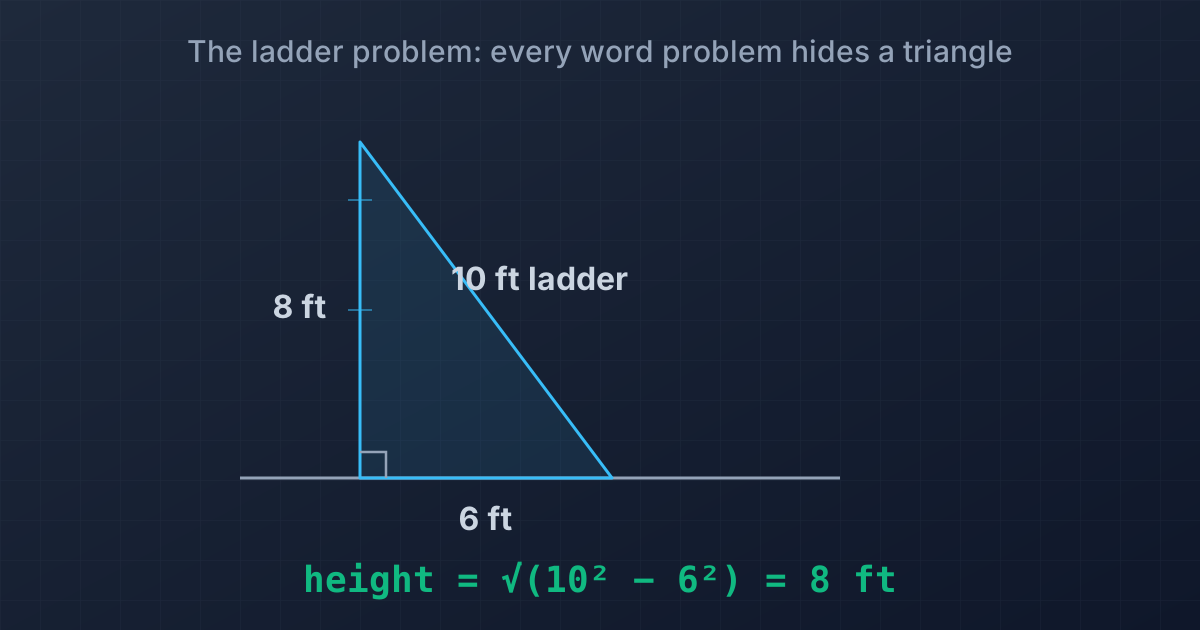
Right triangle word problems hide a triangle inside a story: a ladder against a wall, a ramp up to a door, a shadow on the ground, a cable holding a pole. The maths is rarely the hard part. The hard part is translating the words into a labelled triangle, choosing the one formula that fits, and only then calculating. This guide teaches that translation. You will get a repeatable eight-step method, worked examples for the Pythagorean theorem and for trigonometry, problems on angles of elevation and depression, area and perimeter stories, special triangles, and a 12-question practice worksheet with full answers.
What Are Right Triangle Word Problems?
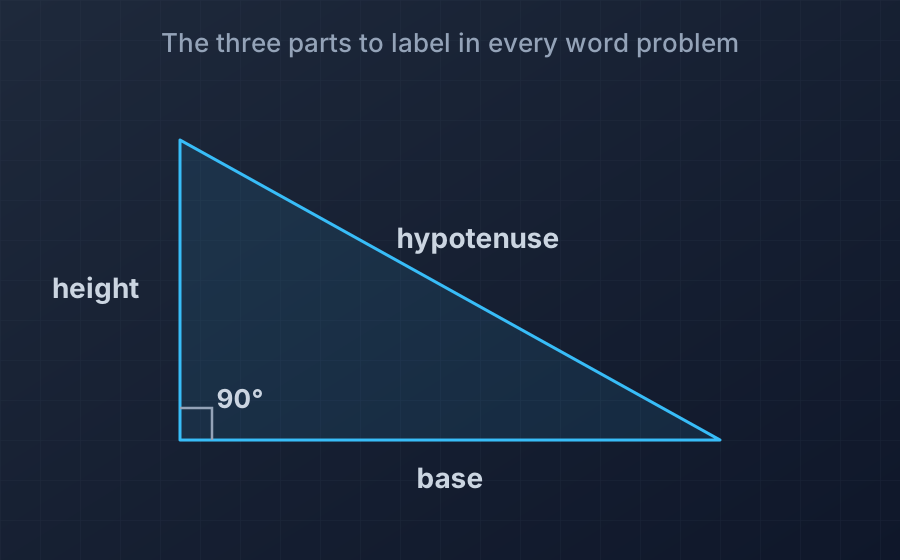
A right triangle word problem describes a real situation in words and asks for a length or an angle that you cannot measure directly. Hidden inside the description is a right triangle: something vertical (a wall, a pole, a building), something horizontal (the ground, a shadow, a distance paced out), and a slanted line joining their ends (a ladder, a cable, a line of sight). The vertical and horizontal meet at 90 degrees, and the slanted line is the hypotenuse.
Three habits make these problems manageable. First, find the right angle: it is almost always where a vertical object meets flat ground. Second, separate the known values from the unknown; the question’s last sentence usually names the unknown. Third, draw the triangle before touching a formula. A ten-second sketch settles which side is which, and most wrong answers in this topic are labelling errors, not calculation errors.
Important Right Triangle Formulas for Word Problems
You need eight formulas for nearly every problem in this guide. They are collected in our right triangle formulas reference; here they are in problem-solving form. The legs are a and b, the hypotenuse is c, and θ is the acute angle you are working with.
| Formula | Equation | When to Use |
|---|---|---|
| Pythagorean theorem | a² + b² = c² | Two sides known, third side wanted, no angles given |
| Hypotenuse | c = √(a² + b²) | Both legs known |
| Missing leg | a = √(c² − b²) | Hypotenuse and one leg known |
| Area | A = ½ × b × h | The story asks for surface covered |
| Perimeter | P = a + b + c | The story asks for total boundary or fencing |
| Sine | sin θ = Opposite / Hypotenuse | An angle plus the hypotenuse or opposite side |
| Cosine | cos θ = Adjacent / Hypotenuse | An angle plus the hypotenuse or adjacent side |
| Tangent | tan θ = Opposite / Adjacent | An angle plus the two legs, no hypotenuse involved |
The dividing line is simple. If the problem gives only sides, it is a Pythagorean problem. If an angle appears anywhere in the story, it is a trigonometry problem.
How to Solve Right Triangle Word Problems Step by Step
- Read the question twice. The second read is where the numbers settle.
- Find the right angle. Vertical against horizontal, in almost every story.
- Draw and label the triangle. Mark the right angle with its small square.
- List the knowns and the unknown. Write them on the diagram, not in your head.
- Choose the formula that contains exactly those knowns and that unknown.
- Substitute and solve, keeping units attached to every number.
- Check the answer makes sense: hypotenuse longest, angles under 90 degrees, sizes believable for the story.
- Write the final answer with its unit. A bare number is an unfinished answer.
The method at work. A rectangular garden gate is 9 ft wide and 12 ft tall, and it sags. How long must a diagonal brace be? Step 1: the gate’s corner is the right angle. Step 2: the sides are the legs, 9 and 12; the brace is the hypotenuse. Step 3: no angles appear, so this is the theorem: c = √(9² + 12²) = √(81 + 144) = √225 = 15. Step 4: check, 15 is longer than both legs, and a 15 ft brace fits a 9 by 12 gate. Answer: 15 ft.
Pythagorean Theorem Word Problems With Solutions
When a story gives you two sides of the triangle and asks for the third, the theorem does everything. Watch for its disguises: diagonals, cables, and straight-line distances are all hypotenuses.
Example 1: Ladder Against a Wall
A 10 ft ladder rests against a vertical wall with its base 6 ft from the wall. How high does it reach? The wall and ground form the right angle, the ladder is the hypotenuse. height = √(10² − 6²) = √(100 − 36) = √64 = 8. Answer: 8 ft. Our missing side guide works more ladder variants.
Example 2: Diagonal of a Rectangular Field
A rectangular field measures 30 m by 40 m. How far is it between opposite corners? The diagonal splits the rectangle into two right triangles, and it is the hypotenuse: √(30² + 40²) = √(900 + 1600) = √2500 = 50. Answer: 50 m. Notice the 3-4-5 pattern scaled by ten; recognizing Pythagorean triples saves the calculation entirely.
Example 3: Length of a Support Cable
A pole stands 12 m tall. A cable runs from its top to an anchor 5 m from its base. How long is the cable? cable = √(12² + 5²) = √(144 + 25) = √169 = 13. Answer: 13 m.
Example 4: Shortest Straight-Line Distance
A hiker walks 9 km east, then 12 km north. How far is she from her starting point, as the crow flies? East and north are perpendicular, so the displacement is the hypotenuse: √(9² + 12²) = √225 = 15. Answer: 15 km, even though she walked 21 km to get there.
Right Triangle Trigonometry Word Problems
The theorem goes silent the moment a story mentions an angle, because angles are not sides. Then the trig ratios take over: sin θ = Opposite/Hypotenuse, cos θ = Adjacent/Hypotenuse, tan θ = Opposite/Adjacent, the SOH CAH TOA set from our sine, cosine, tangent guide. Fix the reference angle first; opposite and adjacent are named from it.
Example 5: Height of a Building
You stand 25 m from a building and measure a 40° angle of elevation to the roof. The instrument is at ground level. How tall is the building? Your distance is the adjacent side, the height is the opposite, and tangent links them: height = 25 × tan 40° ≈ 25 × 0.8391 ≈ 20.98. Answer: about 21.0 m.
Example 6: Length of a Ramp
A ramp rises 1.5 m and makes a 12° angle with the ground. How long is its sloping surface? The rise is opposite the angle and the surface is the hypotenuse, so sine: length = 1.5 / sin 12° ≈ 1.5 / 0.2079 ≈ 7.21. Answer: about 7.21 m of ramp surface to climb 1.5 m of height.
Example 7: Height of a Tree
A student stands 18 m from a tree and measures a 35° angle of elevation to its top, eye level effectively at ground level. How tall is the tree? height = 18 × tan 35° ≈ 18 × 0.7002 ≈ 12.60. Answer: about 12.6 m. In fieldwork you would add the observer’s eye height at the end; these textbook versions state the ground-level assumption out loud.
Example 8: Angle of a Ladder
An 8 m ladder has its base 3 m from a wall. What angle does it make with the ground? The base distance is the adjacent side, the ladder the hypotenuse, so cosine runs backwards: θ = cos⁻¹(3/8) = cos⁻¹(0.375) ≈ 67.98°. Answer: about 68.0°. Finding an angle always means an inverse trig key, never a plain ratio.
Angles of Elevation and Depression Word Problems
The angle of elevation is measured upward from a horizontal line to an object above you. The angle of depression is measured downward from a horizontal line to an object below you. Both are measured from the horizontal, never from the vertical, which is the mistake this topic is built on. A useful fact: the angle of depression from a height equals the angle of elevation from the object below, because the two horizontal lines are parallel.
Example A: tower height. From a point 60 m from a tower’s base, the angle of elevation to the top is 32°. Height = 60 × tan 32° ≈ 60 × 0.6249 ≈ 37.49. Answer: about 37.5 m.
Example B: distance from a platform. From a viewing platform 45 m above the ground, a boat is seen at a 28° angle of depression. How far is the boat from the platform’s base? The depression angle sits at the top of the triangle, but the triangle’s own top angle is 90 − 28 = 62°, or equivalently you can work from the boat’s elevation angle of 28°. Using tangent from the boat: distance = 45 / tan 28° ≈ 45 / 0.5317 ≈ 84.63. Answer: about 84.6 m of horizontal distance. The sloping line of sight is longer; the question asked for horizontal distance, and reading which one is wanted is half the problem.
Right Triangle Word Problems With Missing Sides
Before calculating, classify the problem. Only three situations occur:
Both legs known. Use c = √(a² + b²). A guy rope triangle has legs of 7 m and 24 m: hypotenuse = √(49 + 576) = √625 = 25 m.
One leg and the hypotenuse known. Use a = √(c² − b²), with subtraction. A triangle has a hypotenuse of 20 and one leg of 12: missing leg = √(400 − 144) = √256 = 16.
One angle and one side known. Use a trig ratio. An angle of 50° with adjacent side 10: hypotenuse = 10 / cos 50° ≈ 15.56, and opposite = 10 × tan 50° ≈ 11.92.
In every situation the same guard applies: the hypotenuse is the longest side. If a missing leg comes out longer than the given hypotenuse, the formula or the labelling is wrong, not the arithmetic. The right triangle side calculator checks any of the three.
Right Triangle Word Problems With Area and Perimeter
Some stories ask about the triangle itself rather than a missing side: how much ground it covers, or how much fencing its edge needs.
Example 1: garden area. A triangular garden has perpendicular sides of 6 m and 8 m. Area = ½ × 6 × 8 = 24 m².
Example 2: the same garden’s perimeter. First the slanted side: √(6² + 8²) = 10 m. Perimeter = 6 + 8 + 10 = 24 m. Same number, different unit and different meaning, which is exactly why units matter.
Example 3: material offcut. A triangular piece of fabric has perpendicular sides of 9 cm and 12 cm. Hypotenuse = √(81 + 144) = 15 cm. Area = ½ × 9 × 12 = 54 cm², perimeter = 9 + 12 + 15 = 36 cm. The area calculator and perimeter calculator handle decimal versions.
Special Right Triangle Word Problems
When a story’s angle is exactly 45° or 30°/60°, the special ratios beat the calculator for speed.
45-45-90 Problems
Ratio 1 : 1 : √2, equal legs. Example: a square garden plot has sides of 10 m, and a path crosses it corner to corner. The path is the hypotenuse of a 45-45-90 triangle: 10√2 ≈ 14.14 m. Any diagonal-of-a-square story is this problem in disguise, as our isosceles right triangle guide shows.
30-60-90 Problems
Ratio 1 : √3 : 2, short leg : long leg : hypotenuse. Example: a triangular shelf bracket has a 30° angle at the wall, and its vertical side (the short leg, opposite the 30°) is 20 cm. The horizontal side is 20√3 ≈ 34.64 cm, and the slanted edge is exactly double the short leg, 40 cm. No trig keys were needed, just the ratio.
How to Choose the Correct Formula
Work through the story and match what it gives you to this table:
| The Problem Gives | You Must Find | Use | Why |
|---|---|---|---|
| Two legs | Hypotenuse | c = √(a² + b²) | The theorem connects sides only |
| Hypotenuse and one leg | The other leg | a = √(c² − b²) | Same theorem, rearranged with subtraction |
| An angle and the hypotenuse | A leg | sin or cos | The ratio must contain the angle and the hypotenuse |
| An angle and one leg | The other leg | tan | Tangent is the ratio of the two legs |
| Two sides | An angle | Inverse sin, cos, or tan | Angles come from ratios run backwards |
| Two perpendicular sides | Area | A = ½bh | The legs serve as base and height |
| All three sides (or two plus the theorem) | Perimeter | P = a + b + c | Perimeter is a sum, nothing more |
| A 45° or 30°/60° angle pattern | Any side | Special ratios 1:1:√2 or 1:√3:2 | The ratio replaces the calculator |
The decision takes five seconds once the diagram is labelled. If no angle is mentioned, stay with Pythagoras. If an angle is mentioned, ask which two sides the problem connects to it, and the ratio chooses itself.
Real-Life Applications
Construction. Builders square a foundation with the 3-4-5 rule: measure 3 m along one string line and 4 m along the other, and the diagonal must read 5 m before concrete is poured.
Stairs and ramps. A staircase with a 7 inch rise and 11 inch tread climbs at tan⁻¹(7/11) ≈ 32.47°, and wheelchair ramps are checked the same way against a maximum allowed angle.
Surveying. Land measurers chain two perpendicular distances and compute the diagonal across a plot instead of clearing a path through it, the field diagonal of Example 2 at work.
Navigation. Displacement problems like Example 4 are how pilots and sailors combine a north leg and an east leg into a single distance and heading.
Roof work. A roof’s pitch is a tangent ratio, its rise over its run, and rafter lengths are hypotenuses cut before anyone climbs up.
Common Mistakes in Right Triangle Word Problems
- Skipping the diagram. Every other mistake on this list starts here. Draw the triangle, every time.
- Misidentifying the hypotenuse. It is the slanted side, opposite the right angle: the ladder itself, the cable, the line of sight. Never a leg.
- Measuring elevation or depression from the vertical. Both angles are taken from a horizontal line.
- Picking the wrong trig ratio. Name the sides relative to your chosen angle first, then pick the ratio containing the known and the unknown.
- Forgetting the square root, or squaring when you should subtract. Finding a leg uses c² minus the known square.
- Calculator left in radian mode. Degree answers like 0.71 in an angle problem are the giveaway.
- Mixing units. A ladder in feet against a wall measured in inches poisons the whole substitution. Convert first.
- Forgetting eye height. Real surveying adds the observer’s eye or instrument height to the computed height. Textbook problems state when to skip it; field problems never skip it.
- Rounding mid-calculation. Keep full precision until the final step.
- Forcing a right triangle where none exists. If nothing in the story guarantees a 90° angle, these methods do not apply.
Right Triangle Word Problems Practice Worksheet
Beginner
- A right triangle has legs of 6 and 8. Find the hypotenuse.
- A hypotenuse is 25 and one leg is 7. Find the other leg.
- A rectangular screen is 24 inches wide and 18 inches tall. Find its diagonal.
- A 13 ft ladder’s base is 5 ft from a wall. How high does it reach?
Intermediate
- A 15 ft ladder’s base is 9 ft from a wall. How high does it reach?
- Standing 40 m from a building, you measure a 38° angle of elevation to its roof (instrument at ground level). Find the height.
- A ramp rises 0.9 m at a 10° angle to the ground. Find the length of its sloping surface.
- A guy wire 20 m long is attached to a pole 16 m above the ground. Find the angle the wire makes with the ground.
Advanced
- From a cliff 80 m above the sea, a boat is seen at a 25° angle of depression. Find the horizontal distance from the cliff base to the boat.
- A 12 m ladder makes a 70° angle with the ground. Find how high it reaches and how far its base sits from the wall.
- A plane flies 80 km north, then 60 km east. Find its distance from the start and the angle its displacement makes with north.
- A kite string is 50 m long and flies at a 45° angle of elevation. Find the kite’s height and its horizontal distance from the flyer.
Right Triangle Word Problems With Answers
- c = √(6² + 8²) = √100 = 10.
- √(25² − 7²) = √576 = 24.
- √(24² + 18²) = √900 = 30 inches.
- √(13² − 5²) = √144 = 12 ft.
- √(15² − 9²) = √144 = 12 ft.
- height = 40 × tan 38° ≈ 31.25 m.
- length = 0.9 / sin 10° ≈ 5.18 m.
- θ = sin⁻¹(16/20) = sin⁻¹(0.8) ≈ 53.13°.
- distance = 80 / tan 25° ≈ 171.56 m.
- height = 12 × sin 70° ≈ 11.28 m; base distance = 12 × cos 70° ≈ 4.10 m.
- distance = √(80² + 60²) = 100 km; angle = tan⁻¹(60/80) ≈ 36.87° east of north.
- height = 50 × sin 45° ≈ 35.36 m; horizontal distance = 50 × cos 45° ≈ 35.36 m (equal, because 45° makes the legs equal).
Any you missed, redo with the Right Triangle Calculator open beside the worksheet and compare step by step.
Frequently Asked Questions
Short answers to the questions students ask most about right triangle word problems.
01 What are right triangle word problems?
Right triangle word problems are real-life situations described in words that conceal a right triangle: a ladder against a wall, a shadow on the ground, a cable holding a pole. You translate the story into a labelled triangle, identify the known sides or angles and the unknown, then apply the Pythagorean theorem or a trigonometric ratio to find it.
02 How do you solve right triangle word problems?
Work in a fixed order. Read the problem twice, find the right angle, usually where a vertical object meets the ground, and draw a labelled triangle. List the known values and the unknown. Choose the formula containing exactly those values, substitute, and calculate. Finish by checking the answer against the story and writing it with its unit, because a bare number is incomplete.
03 How do you know when to use the Pythagorean theorem?
Use the Pythagorean theorem when the problem involves sides only: two sides are given, directly or through the story, and the third is wanted, with no angle mentioned anywhere. The moment an angle appears in the wording, the theorem alone is not enough, because it says nothing about angles, and a trigonometric ratio or an inverse ratio takes over instead.
04 How do you identify the hypotenuse in a word problem?
In a word problem, the hypotenuse is the slanted object: the ladder itself, the support cable, the ramp surface, the line of sight to a roof. It is always opposite the right angle and always the longest of the three sides. If the story involves a diagonal across a rectangle, that diagonal is a hypotenuse too, splitting the rectangle into two right triangles.
05 What is SOH CAH TOA used for?
SOH CAH TOA is the memory aid for the three trigonometric ratios: sine equals opposite over hypotenuse, cosine equals adjacent over hypotenuse, and tangent equals opposite over adjacent. It is used whenever a word problem connects an angle to two sides, either to find a side from an angle or, through the inverse functions, to find an angle from two sides.
06 How do you solve ladder word problems?
Treat the wall as one leg, the ground distance as the other leg, and the ladder as the hypotenuse. If you know the ladder and the base distance, the height is the square root of their squares subtracted: height = √ladder² − base². If an angle is given instead, use sine for the height. Always check that the height comes out shorter than the ladder.
07 How do you find the height of a building using trigonometry?
Measure the horizontal distance from where you stand to the building, then measure the angle of elevation from that point to the roof. The height is the distance multiplied by the tangent of the angle: height = distance × tan θ. Standing 25 metres away with a 40 degree angle gives 25 × tan 40°, about 21 metres, plus eye height in real fieldwork.
08 What are angles of elevation and depression?
The angle of elevation is the angle between a horizontal line and your line of sight when you look up at something. The angle of depression is the matching angle when you look down from a height. Both are measured from the horizontal, never from the vertical, and the depression angle from a platform equals the elevation angle from the object below it.
09 How do you find a missing side in a right triangle?
Decide which side is missing first. If both legs are known, the hypotenuse is √a² + b². If the hypotenuse and one leg are known, the missing leg is √c² − known², using subtraction. If an angle is involved, use the sine, cosine, or tangent ratio that contains the known side and the missing one, as the formulas reference in this guide shows.
10 What are the most common mistakes in right triangle problems?
The most common mistakes are skipping the diagram, mistaking a leg for the hypotenuse, measuring elevation from the vertical instead of the horizontal, and choosing a trig ratio before naming the sides. Calculation slips follow close behind: forgetting the square root, adding squares when finding a leg, mixing units, rounding too early, and leaving the calculator in radian mode.
Conclusion
Right triangle word problems stop being intimidating once the routine is fixed: find the right angle, draw the triangle, label what the story gives you, and let the givens choose the formula. Sides only means Pythagoras; an angle means SOH CAH TOA; a request for surface or boundary means area or perimeter. The stories change (ladders, ramps, towers, kites) but the triangles underneath repeat, and each solved problem makes the next translation faster. Work through the worksheet above, check every answer, and redo the ones you missed. That loop, more than any shortcut, is what turns word problems into routine marks.