
What Is a Right Triangle: The Definitive Guide
Math Expert
Geometry
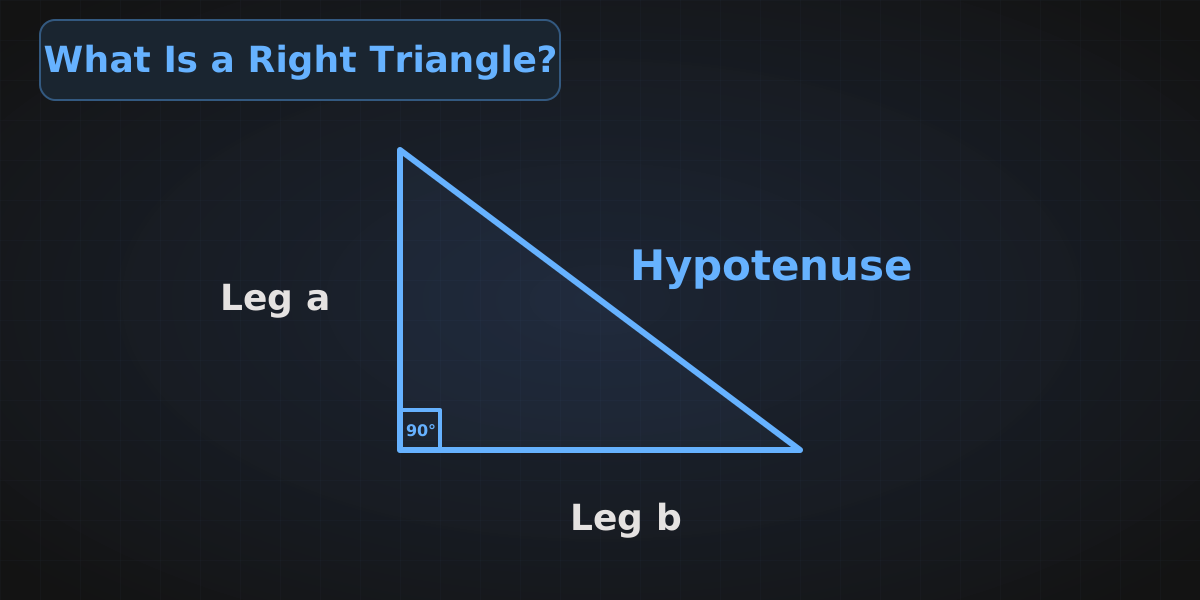
A right triangle is one of the most fundamental and important shapes in all of mathematics, geometry, and trigonometry. It is a specific type of triangle that has exactly one 90-degree angle, commonly known as a “right angle.” This single feature unlocks a universe of mathematical properties, formulas, and real-world applications.
Why is the right triangle so important? Millions of students learn about right triangles every year because they form the foundation of our understanding of space, distance, and engineering. Without the right triangle, we would not have modern architecture, GPS navigation, computer graphics, or advanced physics. The right triangle bridges the gap between simple geometry and complex algebra, allowing us to calculate distances that are impossible to measure manually.
In this definitive guide, you will learn everything there is to know about right triangles. We will start with the basic definition and parts, move on to the core properties and formulas like the Pythagorean theorem, and explore real-life applications. Whether you are a student, teacher, parent, engineer, architect, surveyor, or builder, this comprehensive guide will answer every question you have.
Definition of a Right Triangle
The formal definition of a right triangle is simple: A right triangle (or right-angled triangle) is a polygon with three sides and three vertices, where exactly one of the interior angles measures 90 degrees (a right angle).
Because the sum of the interior angles of any planar triangle is always exactly 180 degrees, the presence of one 90-degree angle dictates that the other two angles must add up to exactly 90 degrees. These two remaining angles are strictly “acute angles,” meaning each of them must be greater than 0 degrees and less than 90 degrees. It is geometrically impossible for a right triangle to have more than one right angle, as this would violate the 180-degree rule.
The right angle is typically denoted in geometric drawings by a small square drawn at the vertex where the two perpendicular sides meet. Whenever you see this square symbol, you instantly know you are looking at a right triangle and can apply all right-triangle-specific formulas.
Only a triangle with exactly one 90-degree angle can be classified as a right triangle.
Parts of a Right Triangle
To understand and solve problems involving right triangles, you must first master its anatomy. A right triangle consists of several distinct parts, each with a specific name and function.
Hypotenuse
The hypotenuse is the longest side of a right triangle. It is always located directly opposite the 90-degree right angle. In the famous Pythagorean theorem formula (), the hypotenuse is represented by the letter . It is the most critical side to identify correctly when solving trigonometry problems or calculating distances.
Tip: The hypotenuse never touches the 90-degree angle. If a side forms part of the right angle, it is not the hypotenuse.
Legs (or Catheti)
The other two sides of the right triangle are called the legs (or mathematically, catheti; singular: cathetus). These are the two sides that intersect to form the 90-degree angle. In formulas, they are typically labeled as and . The lengths of the legs determine the length of the hypotenuse and the measure of the acute angles.
Adjacent Side
In trigonometry, the “adjacent side” is a relative term. It refers to the leg that forms part of a specific acute angle you are analyzing. “Adjacent” simply means “next to.” If you are focusing on angle , the adjacent side is the leg that touches angle (but is not the hypotenuse).
Opposite Side
Similarly, the “opposite side” is also a relative term used in trigonometry. It refers to the leg that is directly across from the specific acute angle you are analyzing. The opposite side does not touch the angle in question.
Right Angle
The right angle is the defining feature of the triangle. It measures exactly 90 degrees ( radians). It is the angle formed by the intersection of the two legs. This perpendicular intersection is what makes the right triangle so structurally sound in architecture.
Acute Angles
The remaining two angles are acute angles. Because the total degrees in a triangle is 180, and the right angle takes up 90, the two acute angles must sum up to exactly 90 degrees. This relationship makes them “complementary angles.”
In trigonometry, the opposite and adjacent sides change depending on which acute angle you are looking at.
Properties of a Right Triangle
Right triangles possess a unique set of properties that distinguish them from all other types of triangles. Memorizing these properties is essential for mastering geometry.
Longest Side Property
In any triangle, the longest side is always opposite the largest angle. Since a right triangle contains a 90-degree angle, and the other two angles must be less than 90 degrees, the 90-degree angle is always the largest. Therefore, the hypotenuse (the side opposite the 90-degree angle) is universally the longest side.
Angle Relationships
- Sum of Angles: The interior angles always sum to 180°.
- Complementary Acute Angles: The two non-right angles always add up to 90°. For example, if one angle is 30°, the other must be 60°.
- One Right Angle: There can only be one 90° angle.
Side Relationships (Pythagorean Theorem)
The most famous property is that the square of the hypotenuse is equal to the sum of the squares of the other two legs: .
Area Property
The area of a right triangle is remarkably simple to calculate. Because the two legs are perpendicular to each other, one leg can act as the base () and the other leg can act as the height (). The formula is: Area = .
Perimeter Property
The perimeter is simply the sum of all three sides: Perimeter = .
Altitude
An altitude is a line segment drawn from a vertex perpendicular to the opposite side. In a right triangle, the two legs themselves are altitudes. The third altitude is drawn from the right angle to the hypotenuse, dividing the triangle into two smaller, similar right triangles.
Median
The median drawn from the right angle to the hypotenuse has a special property: its length is exactly half the length of the hypotenuse. Furthermore, the midpoint of the hypotenuse is the center of the triangle’s circumcircle (the circle that passes through all three vertices).
Congruence (HL Theorem)
While standard triangles use SSS (Side-Side-Side) or SAS (Side-Angle-Side) for congruence, right triangles have a unique shortcut: the Hypotenuse-Leg (HL) Theorem. If the hypotenuse and one leg of a right triangle are congruent to the hypotenuse and one leg of another right triangle, the two triangles are perfectly identical (congruent).
Similarity
If you draw an altitude from the right angle to the hypotenuse, it splits the right triangle into two smaller triangles. A fascinating property of right triangles is that these two smaller triangles are mathematically similar to each other, and both are similar to the original large triangle.
Quick Formula: Circumradius of a right triangle = (where is the hypotenuse).
The altitude drawn to the hypotenuse creates three similar right triangles.
Types of Right Triangles
While all right triangles share a 90-degree angle, they are further classified into specific types based on their side lengths and acute angles.
Isosceles Right Triangle
An isosceles right triangle is a triangle where the two legs are exactly equal in length. Because the sides opposite equal angles must also be equal, the two acute angles in an isosceles right triangle are always exactly 45 degrees. This is why it is also known as a 45-45-90 Triangle.
- The ratio of the sides is always .
- If a leg has length , the hypotenuse is always .
Scalene Right Triangle
A scalene right triangle is a right triangle where all three sides have different lengths, and consequently, all three angles have different measures. The vast majority of right triangles are scalene. The famous 3-4-5 triangle is an example of a scalene right triangle.
Special Right Triangle: 30-60-90 Triangle
The 30-60-90 Triangle is an extremely important type of scalene right triangle frequently tested in geometry and physics. The angles are precisely 30°, 60°, and 90°.
- The ratio of the sides is always .
- The shortest leg (opposite the 30° angle) is .
- The longer leg (opposite the 60° angle) is .
- The hypotenuse is exactly twice the shortest leg: .
Comparison Table: Right Triangle Types
| Feature | Isosceles Right (45-45-90) | Scalene Right (e.g. 30-60-90) | General Scalene Right |
|---|---|---|---|
| Angles | 45°, 45°, 90° | 30°, 60°, 90° | , , 90° (where ) |
| Leg Lengths | Equal length | Unequal length | Unequal length |
| Side Ratio | Varies | ||
| Hypotenuse | |||
| Use Case | Squares cut in half, diagonals | Equilateral triangles cut in half | General geometry problems |
Did You Know? The 3-4-5 triangle was used by ancient Egyptian builders. They tied 12 equally spaced knots on a rope to form a 3-4-5 triangle, ensuring their pyramids had perfect 90-degree corners!
Memorizing the side ratios of special right triangles will save you hours of calculation time in trigonometry.
How to Identify a Right Triangle
Not every triangle with three sides is a right triangle. To solve problems, you must first prove or identify that the triangle possesses a 90-degree angle. Here are the five definitive methods:
1. Using Angles
If you know the measure of two angles, simply add them together and subtract from 180. If the remaining angle is exactly 90 degrees, it is a right triangle. (Example: A triangle has angles of 40° and 50°. 180 - (40 + 50) = 90. Therefore, it is a right triangle.)
2. Using the Pythagorean Theorem (The Converse)
If you know all three side lengths, you can use the converse of the Pythagorean theorem. Square the lengths of the two shorter sides and add them together. Square the length of the longest side. If the two totals are perfectly equal, it is a right triangle. (Example: Sides are 5, 12, 13. Does ? 25 + 144 = 169. Yes! It is a right triangle.)
3. Visual Inspection (The Square Symbol)
In geometric diagrams, a right triangle is universally indicated by a small square drawn in the corner of the intersecting legs. If you see this symbol, you do not need to do any math to prove it; you can assume it is exactly 90 degrees.
4. Measurement
In real-life applications like carpentry or construction, you can identify a right angle using tools like a try square, a framing square, a protractor, or a laser level.
5. Vectors / Slopes (Coordinate Geometry)
If you are looking at a triangle on a Cartesian coordinate plane (x,y graph), you can find the slopes of the lines. If the slope of one line multiplied by the slope of the other line equals , the lines are perpendicular, proving it is a right triangle.
Common Mistake: Never assume a triangle is a right triangle just because it “looks like one” in a drawing. Drawings are often not to scale. Always look for the square symbol or prove it mathematically.
Always use mathematical proof or official diagram symbols to identify a right triangle, rather than relying on visual guesswork.
Formulas Used in Right Triangles
Right triangles are a goldmine of formulas. Having a solid grasp of these formulas will allow you to solve almost any geometry or trigonometry problem.
Basic Formulas
| Metric | Formula | Explanation |
|---|---|---|
| Area | Multiply the two legs and divide by two. | |
| Perimeter | Add the lengths of all three sides together. | |
| Hypotenuse () | Used when both legs are known. | |
| Missing Leg () | Used when the hypotenuse and one leg are known. | |
| Missing Angle | Angle | The two acute angles always sum to 90 degrees. |
Trigonometric Formulas (SOHCAHTOA)
Trigonometry was essentially invented to study right triangles. The acronym SOHCAHTOA is the ultimate cheat sheet for right triangle trigonometry. It defines the three primary trigonometric functions: Sine, Cosine, and Tangent.
- SOH:
- CAH:
- TOA:
These formulas allow you to find a missing side if you have one angle and one side, or find a missing angle if you have two sides.
(For instant calculations, use our Missing Side Calculator or Missing Angle Calculator)
SOHCAHTOA is the most important acronym in trigonometry, relating angles directly to side ratios.
Pythagorean Theorem
We cannot discuss right triangles without diving deep into the Pythagorean Theorem Formula. Named after the ancient Greek mathematician Pythagoras, this theorem is the cornerstone of geometry.
The Formula
The Meaning
In simple English, the theorem states: If you take a right triangle and build a perfect square on each of its three sides, the area of the biggest square (the one on the hypotenuse) will be exactly equal to the combined area of the two smaller squares (the ones on the legs).
Examples in Action
Let’s look at how this works with the classic 3-4-5 triangle.
- Leg . Area of square on .
- Leg . Area of square on .
- Hypotenuse . Area of square on . Does ? Yes, it does perfectly.
Pythagorean Triples
A “Pythagorean triple” is a set of three positive integers that perfectly fit the theorem. Memorizing common triples allows you to solve problems instantly without using a calculator. Common triples include:
- 3, 4, 5
- 5, 12, 13
- 8, 15, 17
- 7, 24, 25
- Any multiple of these (e.g., 6, 8, 10 is just 3, 4, 5 multiplied by 2).
Remember: You can only use the Pythagorean theorem on triangles that have a 90-degree angle. If the triangle does not have a 90-degree angle, the formula will fail completely.
The area of the squares on the two legs will always equal the area of the square on the hypotenuse.
Real-Life Uses of Right Triangles
Right triangles are not just abstract concepts found in math textbooks. They are heavily utilized in almost every scientific, technical, and engineering field. Here is how right triangles power the modern world:
1. Construction and Carpentry
Builders use the 3-4-5 rule every single day to ensure corners are perfectly square (90 degrees). If they measure 3 feet down one wall, 4 feet down the connecting wall, the diagonal between those points must be exactly 5 feet. If it is, the corner is a perfect right angle.
2. Architecture
Architects use right triangles to design stable structures. Triangles distribute weight evenly, and right triangles are specifically used for structural supports, trusses, and calculating dimensions of rooms.
3. Surveying and Map Making
Land surveyors use trigonometric formulas derived from right triangles to calculate distances across impassable terrain, such as rivers or mountains, without actually crossing them.
4. Navigation and Aviation
Pilots and ship captains use right triangles to calculate their true speed and direction when dealing with crosswinds or ocean currents. The intended path forms one leg, the wind/current forms another, and the actual path of the vehicle is the hypotenuse.
5. Calculating Roof Pitch
The steepness of a roof (pitch) is calculated using right triangles. The “rise” is one leg, the “run” is the other leg, and the roof surface itself forms the hypotenuse.
6. Ladders and Safety
When leaning a ladder against a wall, it forms a right triangle. Safety guidelines dictate the safe angle for a ladder. Using right triangle math, workers can calculate exactly how far the base of the ladder needs to be from the wall.
7. Stair Design
Every staircase is a series of right triangles. The tread (where you step) and the riser (the vertical part) form the legs, while the stringer (the supporting board) acts as the hypotenuse.
8. Computer Graphics and Video Games
Every 3D object you see in a modern video game is composed of thousands (or millions) of tiny triangles. Graphics engines use right triangle trigonometry to calculate lighting, shadows, and perspective instantly as your character moves.
9. Astronomy
Astronomers use right triangles and parallax to calculate the immense distances between Earth and distant stars.
10. GPS and Satellites
Your phone’s GPS uses triangulation. While the math involves spheres, the core principles rely heavily on right-triangle geometry to calculate distances between satellites and your phone.
11. Robotics
Robotic arms use right triangle kinematics to calculate the exact angles required for their joints to move a hand to a specific X, Y coordinate in space.
12. Physics
Physicists use right triangles to break down complex forces into X and Y components (vectors). For example, gravity acting on a car parked on a hill is calculated using right triangles.
13. Wheelchair Ramps
ADA compliance requires ramps to have a specific maximum slope. Engineers use right triangles to calculate the exact length of the ramp (hypotenuse) required to reach a specific height safely.
14. Optics and Light
Lenses, mirrors, and lasers often rely on angles of incidence and reflection, which are analyzed using right triangle geometry.
The right triangle is the fundamental geometric shape that powers modern construction and engineering.
Common Mistakes
Even advanced students make errors when dealing with right triangles. Here are 20 common mistakes, why they happen, and how to avoid them.
- Assuming a triangle is right without proof: Don’t just trust your eyes. Unless there is a square symbol or you prove it mathematically, don’t use right triangle formulas.
- Mixing up , , and : In , MUST be the hypotenuse. If you plug a leg into , your answer will be completely wrong.
- Forgetting to square root: Students often calculate and say the hypotenuse is 25. You must take the square root to get .
- Incorrect SOHCAHTOA labels: Confusing the “adjacent” and “opposite” sides. Remember, these change depending on which angle you are looking at!
- Adding instead of subtracting: When finding a missing leg, the formula is . Students mistakenly use addition ().
- Calculator in Radian mode: When doing trigonometry (sine, cosine), if your calculator is in Radian mode instead of Degree mode, your answers will be wildly incorrect.
- Assuming all right triangles are 45-45-90: Just because it has a 90-degree angle does not mean the legs are equal.
- Misidentifying the hypotenuse: The hypotenuse is always opposite the 90-degree angle, not necessarily the side that is “slanted” on the paper.
- Squaring incorrectly: Writing as 6 instead of 9. Always remember squaring is multiplying a number by itself.
- Using Pythagorean theorem on non-right triangles: It only works for right triangles. For others, use the Law of Cosines.
- Rounding too early: Don’t round decimals in the middle of your SOHCAHTOA calculations; wait until the final answer to maintain accuracy.
- Forgetting the triangle inequality theorem: Even in right triangles, the sum of the two legs must be greater than the hypotenuse ().
- Confusing area and perimeter: Area is space inside (). Perimeter is distance around ().
- Misinterpreting word problems: Drawing the right triangle incorrectly based on the text. Always sketch the problem first!
- Applying the 30-60-90 rules backwards: Multiplying by instead of dividing when going from the long leg to the short leg.
- Negative lengths: Distances and side lengths in geometry cannot be negative. If your math results in a negative side length, check your algebra.
- Ignoring units: If side is in inches and side is in feet, you must convert them to the same unit before doing any math.
- Thinking hypotenuse can be shorter than a leg: The hypotenuse is always the longest side. If your calculation makes it shorter, you made an error.
- Mixing up sine and cosine: Sine is opposite over hypotenuse. Cosine is adjacent over hypotenuse. Memorize SOH CAH TOA.
- Over-complicating Pythagorean Triples: If you see legs of 300 and 400, you don’t need a calculator. It’s a 3-4-5 triangle scaled by 100. The hypotenuse is 500.
Common Mistake Alert: The number one reason students fail right triangle tests is having their calculator in the wrong mode (Radians vs. Degrees). Always double-check your settings before starting!
Always ensure the longest side (opposite the right angle) is designated as ‘c’ in your equations.
Practice Questions
Test your knowledge with these 30 practice problems ranging from easy to difficult.
Easy (Basic Pythagorean Theorem)
- Q: Legs are 3 and 4. What is the hypotenuse? Solution: .
- Q: Legs are 6 and 8. What is the hypotenuse? Solution: .
- Q: Hypotenuse is 13, one leg is 5. Find the other leg. Solution: .
- Q: Legs are 5 and 12. What is the hypotenuse? Solution: .
- Q: Hypotenuse is 25, leg is 7. Find the other leg. Solution: .
- Q: Legs are 9 and 12. Find the hypotenuse. Solution: .
- Q: Hypotenuse is 17, leg is 8. Find the other leg. Solution: .
- Q: Legs are 10 and 24. Find the hypotenuse. Solution: .
- Q: Are sides 3, 4, 6 a right triangle? Solution: . . . No.
- Q: Are sides 9, 40, 41 a right triangle? Solution: . . Yes.
Medium (Area, Perimeter, and Trigonometry Basics)
- Q: What is the area of a right triangle with legs 6 and 8? Solution: Area = .
- Q: What is the perimeter of a right triangle with legs 5 and 12? Solution: First find hypotenuse (13). Perimeter = .
- Q: One acute angle is 42°. What is the other acute angle? Solution: .
- Q: In an isosceles right triangle, one leg is 7. What is the hypotenuse? Solution: Using 45-45-90 rules, hypotenuse is .
- Q: In a 30-60-90 triangle, the shortest leg is 4. What is the hypotenuse? Solution: Hypotenuse is .
- Q: What is the sine of angle A if opposite is 3 and hypotenuse is 5? Solution: .
- Q: What is the cosine of angle A if adjacent is 12 and hypotenuse is 13? Solution: .
- Q: What is the tangent of angle A if opposite is 7 and adjacent is 24? Solution: .
- Q: A right triangle has area 30 and base 5. What is the height (other leg)? Solution: . . .
- Q: The perimeter is 12, hypotenuse is 5. What are the legs? Solution: Sum of legs = 7. It’s a 3-4-5 triangle. Legs are 3 and 4.
Difficult (Word Problems and Real Life)
- Q: A 15-foot ladder leans against a wall. The base is 9 feet from the wall. How high does it reach? Solution: , . feet.
- Q: A TV is advertised as 50 inches (the diagonal). The height is 30 inches. What is the width? Solution: Diagonal is hypotenuse. inches.
- Q: You walk 5 miles north, then 12 miles east. How far are you from the starting point? Solution: miles.
- Q: A baseball diamond is a 90x90 foot square. How far is the throw from home plate to second base? Solution: Diagonal of a square forms a 45-45-90 triangle. Hypotenuse = feet.
- Q: Find the altitude to the hypotenuse of a 3-4-5 right triangle. Solution: Area = 6. Use hypotenuse as base: . .
- Q: A ramp needs to rise 2 meters and have a slope angle of 10 degrees. How long is the ramp surface (hypotenuse)? Solution: . meters.
- Q: A tree casts a 20-foot shadow. The angle of elevation to the sun is 45 degrees. How tall is the tree? Solution: It’s an isosceles right triangle. Tree height = shadow length = 20 feet.
- Q: What is the area of an equilateral triangle with side length 10? (Hint: use 30-60-90 rules). Solution: Draw altitude. Base becomes 5. Height is . Area = .
- Q: Two poles are 10 ft and 15 ft tall, placed 12 ft apart. A wire connects their tops. How long is the wire? Solution: Draw a horizontal line from short pole. Triangle height = . Base = 12. Wire = ft.
- Q: Find the coordinates of the midpoint of the hypotenuse of a right triangle with vertices at (0,0), (6,0), and (0,8). Solution: Hypotenuse ends at (6,0) and (0,8). Midpoint = .
(Need more help? Check out our Right Triangle Calculator to check your own practice problems!)
Practice makes perfect. Sketching word problems is the easiest way to avoid making mistakes.
Related Right Triangle Calculators
To make solving right triangles as easy as possible, we have built a suite of free, highly accurate calculators tailored to every specific problem type. Check them out below:
General Triangles & Sides
- Ultimate Right Triangle Solver
- Missing Side Calculator
- Missing Leg Calculator (from Hypotenuse & Leg)
- Hypotenuse Calculator
- Pythagorean Theorem Calculator
- Pythagorean Triples Calculator
- Similar Right Triangles Calculator
Angles & Trigonometry
- Missing Angle Calculator
- Sine Ratio Calculator
- Cosine Ratio Calculator
- Tangent Ratio Calculator
- Angle from Sine Calculator
- Angle from Cosine Calculator
- Angle from Tangent Calculator
Area, Perimeter & Advanced Properties
- Right Triangle Area Calculator
- Right Triangle Perimeter Calculator
- Right Triangle Semiperimeter Calculator
- Right Triangle Altitude Calculator
- Right Triangle Inradius Calculator
- Right Triangle Circumradius Calculator
Special Right Triangles
Frequently Asked Questions
Right Triangle FAQs
We have compiled the top questions people ask about right triangles.
01 What defines a right triangle?
A right triangle is defined by having exactly one interior angle that measures 90 degrees.
02 Can a triangle have two right angles?
No. The angles of a triangle must sum to 180 degrees. Two 90-degree angles equal 180, leaving 0 degrees for the third angle, making a triangle impossible.
03 What is the longest side of a right triangle called?
The longest side is called the hypotenuse. It is always located directly opposite the 90-degree angle.
04 What is the Pythagorean theorem?
It is a mathematical formula ($a² + b² = c²$) that states the square of the hypotenuse is equal to the sum of the squares of the two legs.
05 How do you find the area of a right triangle?
Use the formula Area = 1/2 × base × height. In a right triangle, the two legs can act as the base and height.
06 What is an isosceles right triangle?
It is a right triangle where the two legs are of equal length. This results in the two acute angles being exactly 45 degrees each.
07 What is a 3-4-5 triangle?
A 3-4-5 triangle is a right triangle whose side lengths are in the ratio of 3:4:5. It is the most common Pythagorean triple.
08 How do you find a missing angle in a right triangle?
If you know one acute angle, subtract it from 90 to find the other. If you only know side lengths, use inverse trigonometry (arcsin, arccos, or arctan).
09 What does SOHCAHTOA stand for?
It is an acronym to remember trigonometric ratios: Sine = Opposite/Hypotenuse, Cosine = Adjacent/Hypotenuse, Tangent = Opposite/Adjacent.
10 Are all right triangles similar?
No. All right triangles share a 90-degree angle, but their acute angles can vary. They are only similar if their acute angles are also identical.
11 What is the altitude of a right triangle?
A right triangle has three altitudes. Two of them are simply the legs of the triangle. The third is drawn from the right angle to the hypotenuse.
12 Can the hypotenuse be shorter than a leg?
Never. The hypotenuse is mathematically guaranteed to be the longest side of any right triangle.
13 How do you calculate the perimeter of a right triangle?
Simply add the lengths of all three sides together (Perimeter = a + b + c).
14 What is the sum of angles in a right triangle?
Like all planar triangles, the sum of all three interior angles is exactly 180 degrees.
15 How is the Pythagorean theorem used in real life?
It is heavily used in construction for squaring corners, in architecture for roof pitches, in navigation for calculating distances, and in computer graphics.
16 What is a scalene right triangle?
It is a right triangle where all three sides have different lengths, such as a 30-60-90 triangle.
17 Can a right triangle be equilateral?
No. An equilateral triangle must have three 60-degree angles. A right triangle must have a 90-degree angle.
18 What is a Pythagorean triple?
A set of three whole numbers that perfectly satisfy the a² + b² = c² equation, such as 5, 12, and 13.
19 How do you know which side is the opposite side?
In trigonometry, the opposite side is the leg that does not touch the specific acute angle you are analyzing.
20 How do you know which side is the adjacent side?
The adjacent side is the leg that forms part of the specific acute angle you are analyzing (but is not the hypotenuse).
21 What is the formula for the hypotenuse?
The formula is c = √a² + b², derived from the Pythagorean theorem.
22 What happens if a² + b² is greater than c²?
If a² + b² > c², the triangle is an acute triangle, not a right triangle.
23 What happens if a² + b² is less than c²?
If a² + b² < c², the triangle is an obtuse triangle, not a right triangle.
24 How do you find the side of a square using right triangles?
A square cut by a diagonal forms two 45-45-90 right triangles. The diagonal is the hypotenuse. Side = Diagonal / √2.
25 What is the distance formula?
The distance formula between two points on a graph is simply the Pythagorean theorem applied to coordinate geometry.
26 Can side lengths be decimals?
Yes. While Pythagorean triples use whole numbers, real-world right triangles often have decimal or irrational (square root) side lengths.
27 What is the 30-60-90 rule?
In a 30-60-90 triangle, the sides are in the ratio 1 : √3 : 2. The hypotenuse is twice the short leg.
28 What is the 45-45-90 rule?
In a 45-45-90 triangle, the legs are equal, and the hypotenuse is equal to a leg multiplied by √2.
29 Why do builders use the 3-4-5 rule?
It is an easy, tape-measure-friendly way to ensure a corner is exactly 90 degrees without needing complex math.
30 Do right triangles apply to circles?
Yes. Thales's theorem states that if a triangle's hypotenuse is the diameter of a circle, the triangle is a right triangle.
31 Can you use sine and cosine on non-right triangles?
Direct SOHCAHTOA only works on right triangles. For other triangles, you must use the Law of Sines or Law of Cosines.
32 What is a cathetus?
Cathetus is the formal geometric term for the 'leg' of a right triangle.
33 What is the converse of the Pythagorean theorem?
It states that if the side lengths of a triangle satisfy a² + b² = c², then the triangle must be a right triangle.
34 How do you find the area of a right triangle with only the hypotenuse?
You cannot. You must know at least one other side or one acute angle to determine the area.
35 Are right triangles used in 3D graphics?
Yes, right triangles and trigonometry are the mathematical foundation for rendering 3D graphics, calculating lighting, and determining perspective.
36 What is the circumcenter of a right triangle?
The circumcenter is located exactly at the midpoint of the hypotenuse.
37 What is the orthocenter of a right triangle?
The orthocenter (where the altitudes meet) is located exactly at the right angle vertex.
38 Is the Pythagorean theorem taught in high school?
Yes, it is a core component of middle school math, high school geometry, and trigonometry worldwide.
39 Can I use a right triangle calculator instead of doing the math?
Yes! Calculators are great for checking your work or quickly finding values for real-world projects like carpentry.
40 Who invented the right triangle?
No one 'invented' it; it is a natural geometric shape. However, ancient Babylonians, Egyptians, and Greeks were the first to formalize its mathematical rules.