
30-60-90 Triangle: The Complete Guide
Math Expert
Geometry
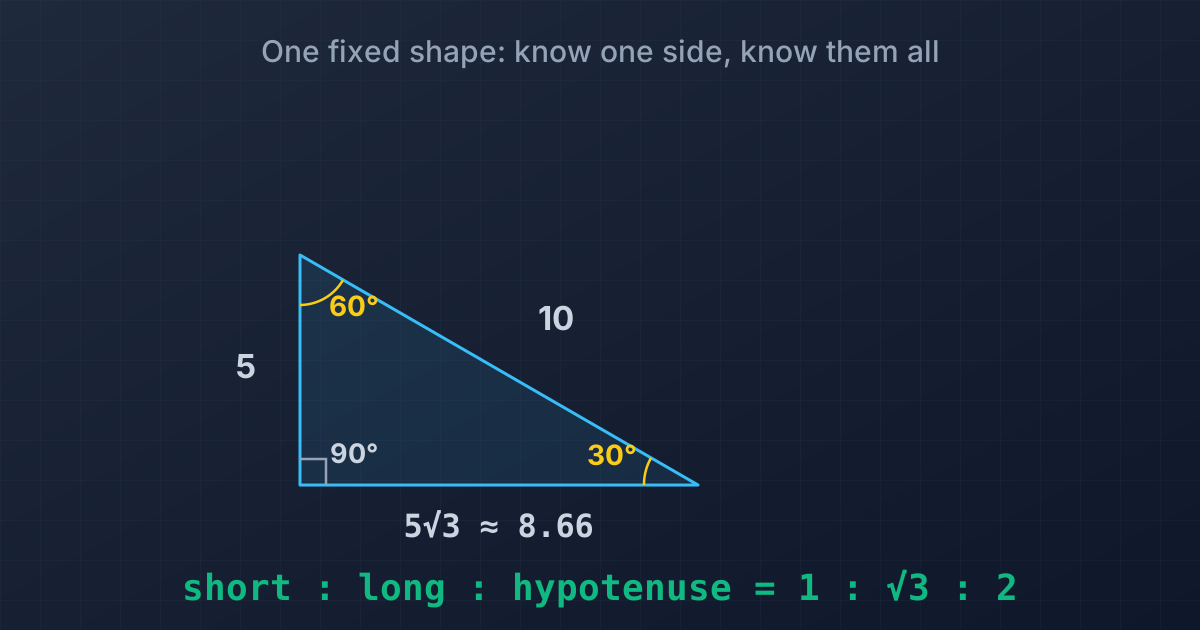
Here is a problem that looks like it needs trigonometry. A right triangle has angles of 30°, 60°, and 90°, and its shortest side measures 5 cm. Find the other two sides. With an ordinary right triangle you would reach for sine and cosine. With a 30-60-90 triangle you do not have to, because its sides always stand in the same proportion, 1 : √3 : 2. Multiply through by 5 and the answer falls out: the longer leg is 5√3 cm (about 8.66 cm) and the hypotenuse is 10 cm. This guide covers where that ratio comes from, the formulas for whichever side you are given, worked examples, diagrams, and a link to our calculator for checking your answers.
What Makes a 30-60-90 Triangle Special?
A 30-60-90 triangle is a right triangle whose three angles measure exactly 30°, 60°, and 90°. What makes it special is not the angles alone but what they force on the sides: each angle faces a side of a predictable relative length. The side opposite an angle is its measure of importance, and in this triangle the ranking never changes.
| Angle | Opposite Side | Relationship |
|---|---|---|
| 30° | Shortest leg | x |
| 60° | Longer leg | x√3 |
| 90° | Hypotenuse | 2x |
The 90° angle, being the largest, sits opposite the longest side, the hypotenuse. The 30° angle, the smallest, sits opposite the shortest leg. Once you know which angle faces which side, every formula in this guide is just that table read in a different direction. The labelled diagram at the top of this page shows the arrangement; our angles in a right triangle guide covers the angle rules behind it.
The Side Ratio You Need to Remember
The side ratio of every 30-60-90 triangle is 1 : √3 : 2.
Read the three numbers in order. The 1 is the shortest leg, opposite the 30° angle. The √3 (about 1.732) is the longer leg, opposite the 60° angle. The 2 is the hypotenuse, opposite the right angle. Call the shortest leg x and the ratio becomes three expressions you will use constantly:
- Short leg = x
- Long leg = x√3
- Hypotenuse = 2x
The ratio never changes with size, because every 30-60-90 triangle has the same shape; only the scale differs. Worked example, x = 4: the short leg is 4, the long leg is 4√3 (about 6.93), and the hypotenuse is 8. The same pattern at several sizes:
| x | Short Leg | Long Leg (x√3) | Hypotenuse (2x) |
|---|---|---|---|
| 1 | 1 | 1.73 | 2 |
| 2 | 2 | 3.46 | 4 |
| 3 | 3 | 5.20 | 6 |
| 4 | 4 | 6.93 | 8 |
| 5 | 5 | 8.66 | 10 |
| 10 | 10 | 17.32 | 20 |
Where Does the 1 : √3 : 2 Ratio Come From?
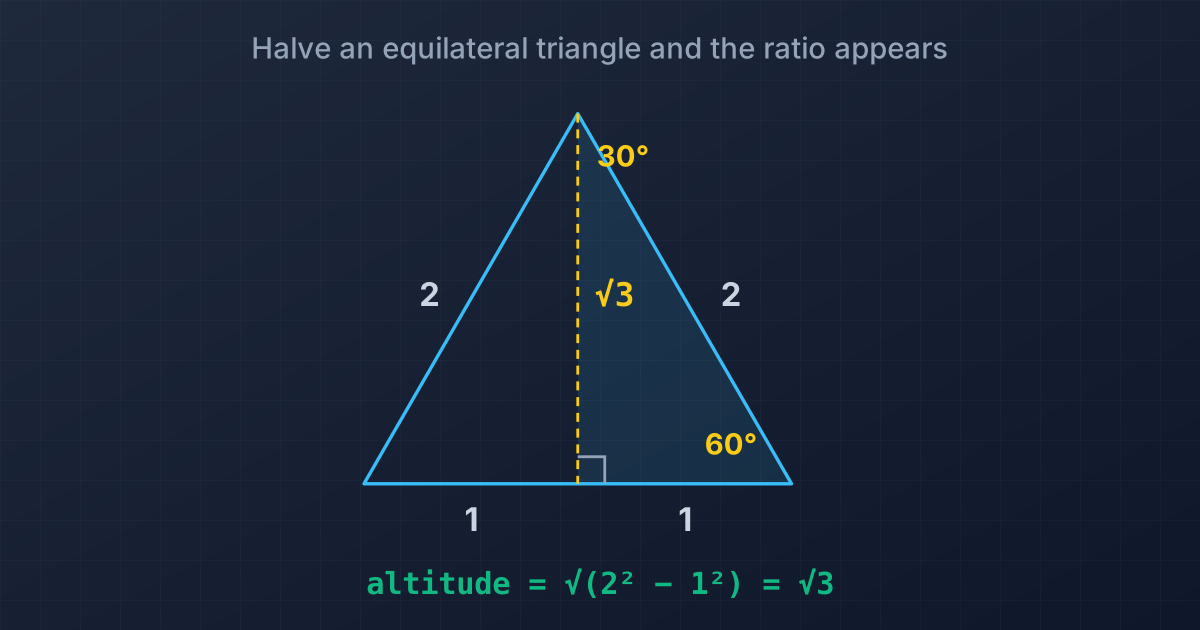
The ratio is not a rule to memorize on trust; it falls out of a shape you already know. Start with an equilateral triangle whose sides each measure 2 units. Every angle is 60°. Now draw the altitude from the top vertex straight down to the midpoint of the base.
- The altitude splits the base into two halves of 1 unit each.
- It also splits the top 60° angle into two 30° angles.
- The result is two congruent right triangles, each with angles 30°, 60°, and 90°.
- In each one, the hypotenuse is a side of the original triangle: 2.
- The short leg is half the base: 1.
- The long leg is the altitude itself. By the Pythagorean theorem, altitude² + 1² = 2², so altitude² = 4 − 1 = 3, and the altitude is √3.
There is the ratio, derived rather than declared: hypotenuse 2, short leg 1, long leg √3. Every 30-60-90 triangle is this triangle at some scale.
Three Simple Formulas for Finding Missing Sides
Every problem gives you one side and asks for the other two. The only real decision is identifying which side you have. Find it below, and the other two follow.
When You Know the Shortest Side
- Long leg = x√3
- Hypotenuse = 2x
Example: the shortest side is 7 cm. Long leg = 7√3 ≈ 12.12 cm. Hypotenuse = 2 × 7 = 14 cm. Check: 7² + (7√3)² = 49 + 147 = 196 = 14². Correct.
When You Know the Hypotenuse
- Short leg = hypotenuse / 2
- Long leg = (hypotenuse × √3) / 2
Example: the hypotenuse is 18 cm. Short leg = 18 / 2 = 9 cm. Long leg = (18 × √3) / 2 = 9√3 ≈ 15.59 cm. The hypotenuse being exactly double the short leg is the fastest check in this whole topic.
When You Know the Longer Leg
- Short leg = long leg / √3
- Hypotenuse = (2 × long leg) / √3
Example: the longer leg is 6√3 cm. Short leg = 6√3 / √3 = 6 cm. Hypotenuse = (2 × 6√3) / √3 = 12 cm. Notice how the √3 cancels both times; answers that start with a radical often end as whole numbers. The right triangle side calculator verifies any of the three cases.
How to Solve a 30-60-90 Triangle Step by Step
- Identify the angles. Confirm the triangle really is 30-60-90; the ratio applies to no other triangle.
- Find the given side. Decide whether it is the short leg, the long leg, or the hypotenuse, by checking which angle it faces.
- Match the sides to the ratio. Write the three sides as x, x√3, and 2x in the right positions.
- Choose the formula for your given side from the section above.
- Substitute and simplify. Keep √3 exact until the final step.
- Check the answer. The hypotenuse must come out longest, the long leg next, the short leg smallest.
The workflow at work: a 30-60-90 triangle has a hypotenuse of 26. Step 2: the given side is the hypotenuse, so 2x = 26 and x = 13. Step 5: short leg 13, long leg 13√3 ≈ 22.52. Step 6: 13 < 22.52 < 26, the ordering is right, and 13² + (13√3)² = 169 + 507 = 676 = 26². Solved, and the hypotenuse-longest check you just used catches most errors in this topic before they cost marks.
Worked Examples That Build Your Confidence
Example 1: Find the Hypotenuse From the Short Leg
Given: shortest leg = 9 cm. Formula: hypotenuse = 2x, long leg = x√3. Calculation: hypotenuse = 2 × 9 = 18 cm; long leg = 9√3 ≈ 15.59 cm. Answer: hypotenuse 18 cm, long leg about 15.59 cm. Why it makes sense: the hypotenuse is double the short leg, the defining shortcut of this triangle.
Example 2: Find Both Legs From the Hypotenuse
Given: hypotenuse = 24 inches. Formula: short leg = hypotenuse / 2; long leg = short leg × √3. Calculation: short leg = 24 / 2 = 12 inches; long leg = 12√3 ≈ 20.78 inches. Answer: 12 inches and about 20.78 inches. Why it makes sense: halving the hypotenuse always lands on the short leg, because 2x read backwards is division by 2.
Example 3: Find the Shortest Leg From the Longer Leg
Given: longer leg = 12√3 units. Formula: short leg = long leg / √3; hypotenuse = 2 × short leg. Calculation: short leg = 12√3 / √3 = 12 units; hypotenuse = 2 × 12 = 24 units. Answer: short leg 12 units, hypotenuse 24 units. Why it makes sense: dividing a multiple of √3 by √3 strips the radical away, leaving the clean 12, 12√3, 24 pattern of the ratio table.
Example 4: Solve a Triangle With a Decimal Length
Given: hypotenuse = 15.5 meters. Formula: short leg = hypotenuse / 2; long leg = short leg × √3. Calculation: short leg = 15.5 / 2 = 7.75 m; long leg = 7.75√3 ≈ 13.42 m. Answer: short leg 7.75 m, long leg about 13.42 m. Why it makes sense: the ratio is a proportion, not a whole-number rule, so decimals flow through it unchanged. Round only at the end.
Example 5: Find the Area and Perimeter
Given: shortest leg = 6 cm. First, the sides: long leg = 6√3 ≈ 10.39 cm; hypotenuse = 12 cm. Area: the legs are perpendicular, so area = ½ × 6 × 6√3 = 18√3 ≈ 31.18 cm². Perimeter: 6 + 6√3 + 12 = 18 + 6√3 ≈ 28.39 cm. Answer: area about 31.18 cm², perimeter about 28.39 cm. Why it makes sense: area uses only the two legs; perimeter needs all three sides, which is why the ratio had to come first.
Can You Find the Area and Perimeter?
Yes, with the legs doing double duty. In a right triangle the two legs are perpendicular, so they serve as base and height, and the general formulas collapse into the value of x alone:
- Area = (x²√3) / 2, because ½ × x × x√3.
- Perimeter = x(3 + √3), because x + x√3 + 2x gathers into one bracket.
Example, x = 8 cm: the sides are 8, 8√3 (about 13.86), and 16. Area = (64√3) / 2 = 32√3 ≈ 55.43 cm². Perimeter = 8(3 + √3) = 24 + 8√3 ≈ 37.86 cm. Exact forms first, decimals second, is the order teachers want to see. Both formulas also live in our right triangle formulas reference, and the area calculator handles non-special triangles.
30-60-90 Triangle vs. 45-45-90 Triangle
Both are special right triangles: right triangles whose angles fix the side ratio in advance. They are the two members of the family, and telling them apart at a glance is a genuine exam skill.
| Feature | 30-60-90 Triangle | 45-45-90 Triangle |
|---|---|---|
| Angles | 30°, 60°, 90° | 45°, 45°, 90° |
| Side ratio | 1 : √3 : 2 | 1 : 1 : √2 |
| Equal legs | No | Yes |
| Triangle type | Scalene | Isosceles |
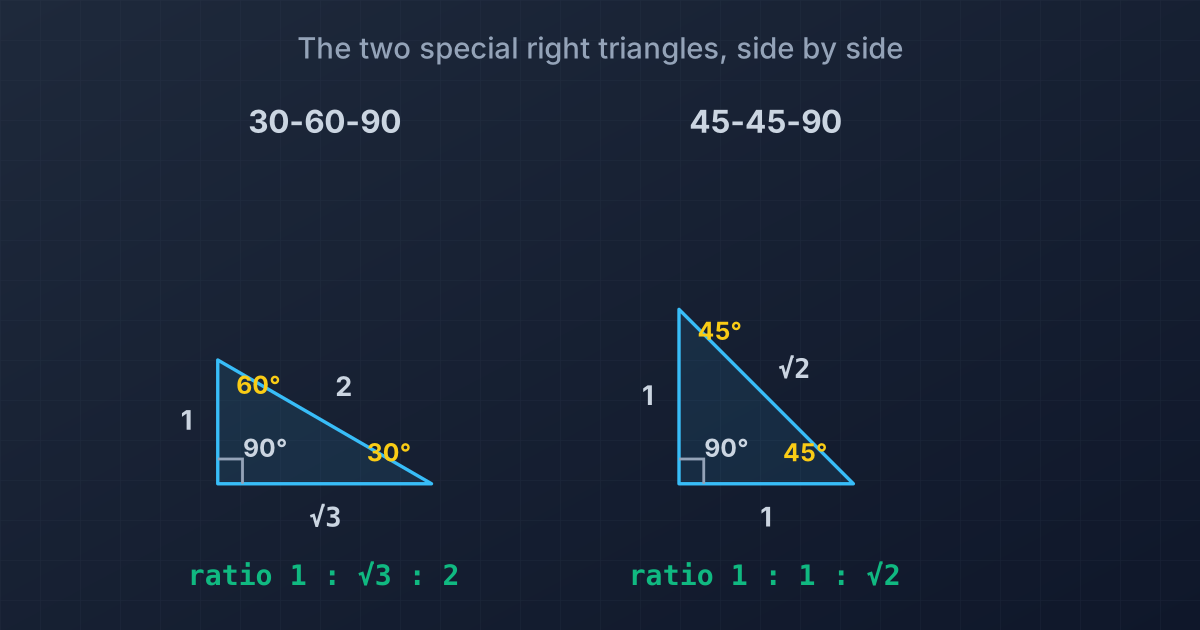
Identification is fast. Two equal acute angles, or two equal legs, means 45-45-90. A 30° or 60° angle anywhere, or a hypotenuse exactly double one leg, means 30-60-90. Our isosceles right triangle guide covers the 45-45-90 family member in the same depth as this one.
Common Mistakes Students Make
Confusing the long leg with the hypotenuse. Wrong: with a short leg of 5, calling 5√3 the hypotenuse. The hypotenuse is a separate, longer side, 2x = 10 here. The long leg is never the longest side; if your “hypotenuse” is not the biggest number on the page, it is not the hypotenuse.
Placing √3 opposite the 30° angle. Wrong: short leg = x√3. The √3 belongs to the long leg, opposite 60°. Opposite 30° is always plain x, the smallest side; attaching the bigger multiplier to the smaller angle reverses the triangle.
Multiplying by 2 when division by 2 is required. Wrong: hypotenuse 20, so short leg = 20 × 2 = 40. A part cannot exceed the whole; the short leg is half the hypotenuse, 20 / 2 = 10. Direction matters: going from x to hypotenuse multiplies, coming back divides.
Using rounded decimals too early. Wrong: taking √3 as 1.7 at the first step, so a long leg of 7√3 becomes 11.9 and every later step inherits the error. Carry the exact form, 7√3, through the work and round once at the end: about 12.12.
Forgetting to rationalize denominators. Wrong: leaving a short leg as 9/√3 when your course requires rationalized form. Multiply top and bottom by √3: 9/√3 = 9√3/3 = 3√3 ≈ 5.20. Same value, presentable form.
Assuming every right triangle uses this ratio. Wrong: applying 1 : √3 : 2 to a 3-4-5 triangle. That triangle’s angles are about 36.87° and 53.13°, not 30° and 60°, so the ratio does not apply. The angles decide; check them first, every time.
Try These Practice Questions
- The shortest leg of a 30-60-90 triangle is 3. Find the longer leg and the hypotenuse.
- The hypotenuse is 30. Find both legs.
- The longer leg is 9. Find the shortest leg and the hypotenuse, in exact form.
- The shortest leg is 2√3. Find the longer leg and the hypotenuse.
- The shortest leg is 4.5. Find the hypotenuse and the longer leg.
- The shortest leg is 10. Find the triangle’s area, in exact form and as a decimal.
- The shortest leg is 5. Find the perimeter, in exact form and as a decimal.
- A brace runs from the top of a 2.5 m wall down to the ground, meeting the ground at 30° and the wall at 60°. How long is the brace, and how far from the wall does it land?
Practice Questions With Answers
- Long leg 3√3 ≈ 5.20; hypotenuse 6. Short leg x = 3, so long leg = 3√3 and hypotenuse = 2 × 3.
- Short leg 15; long leg 15√3 ≈ 25.98. Halve the hypotenuse for the short leg, then multiply by √3.
- Short leg 3√3 ≈ 5.20; hypotenuse 6√3 ≈ 10.39. Short leg = 9/√3, rationalized to 3√3; hypotenuse is double that.
- Long leg 6; hypotenuse 4√3 ≈ 6.93. Long leg = 2√3 × √3 = 2 × 3 = 6; hypotenuse = 2 × 2√3.
- Hypotenuse 9; long leg 4.5√3 ≈ 7.79. Double the short leg for the hypotenuse; decimals use the same ratio.
- Area 50√3 ≈ 86.60 square units. Area = (x²√3)/2 with x = 10: (100√3)/2 = 50√3.
- Perimeter 15 + 5√3 ≈ 23.66 units. Perimeter = x(3 + √3) with x = 5.
- Brace 5 m; lands 2.5√3 ≈ 4.33 m from the wall. The wall is the short leg (opposite the 30° ground angle), so the brace, the hypotenuse, is double it, and the ground distance is the long leg.
More mixed practice, including stories that hide the triangle, is in our right triangle word problems guide.
Use Our Right Triangle Calculator to Check Your Work
The ratio gives you exact answers by hand; the calculator confirms them in seconds and handles the triangles that are not special. Enter any two known values of your triangle, a side and an angle, or two sides, and it solves for everything else, so you can compare your x, x√3, and 2x against its results before you commit to them.
Check Your Answer With Our Right Triangle Calculator
Frequently Asked Questions
Short answers to the questions students ask most about 30-60-90 triangles.
01 What is the 30-60-90 triangle rule?
The rule fixes the side lengths in proportion: if the shortest side, opposite the 30 degree angle, is x, then the longer leg, opposite 60 degrees, is x√3, and the hypotenuse, opposite the 90 degree angle, is 2x. Know any one side and the other two follow immediately, with no trigonometry required.
02 What is the ratio of a 30-60-90 triangle?
The ratio is 1 : √3 : 2, read in the order shortest leg, longer leg, hypotenuse. It holds for every 30-60-90 triangle at any size, because all of them are similar: same angles, same shape, different scale. Multiply each term by the shortest side's length to get the actual sides of your triangle.
03 How do you find the hypotenuse of a 30-60-90 triangle?
Double the shortest side. The hypotenuse sits opposite the 90 degree angle and is always exactly twice the side opposite the 30 degree angle, so a shortest side of 9 gives a hypotenuse of 18. If you know the longer leg instead, the hypotenuse is 2 times that leg divided by √3.
04 How do you find the longer leg of a 30-60-90 triangle?
Multiply the shortest side by √3, about 1.732. A shortest side of 7 gives a longer leg of 7√3, about 12.12. Working from the hypotenuse instead, halve it to get the shortest side first, then multiply by √3; a hypotenuse of 18 gives a longer leg of 9√3, about 15.59.
05 Can a 30-60-90 triangle have decimal side lengths?
Yes. The ratio is a proportion, not a whole-number rule, so decimal sides work exactly the same way. A hypotenuse of 15.5 metres gives a shortest side of 7.75 metres and a longer leg of 7.75√3, about 13.42 metres. Keep full precision while you calculate and round only the final answer.
06 Are all 30-60-90 triangles similar?
Yes. Similarity depends only on angles, and every 30-60-90 triangle has the same three angles, so all of them share one shape at different sizes. That is precisely why a single ratio describes all of them, and why scaling the shortest side scales the other two sides by exactly the same factor.
07 Is a 30-60-90 triangle always a right triangle?
Yes, by definition. The 90 in 30-60-90 is the right angle, so every triangle with these angles is a right triangle, with the hypotenuse opposite the 90 degree angle. The reverse also holds in practice: if a right triangle has a 30 degree angle, the third angle is 60 and the ratio applies.
08 How is a 30-60-90 triangle related to an equilateral triangle?
Cut an equilateral triangle in half and you get two 30-60-90 triangles. The altitude from one vertex lands on the midpoint of the opposite side, splitting the 60 degree corner into 30 degrees. That split is where the ratio comes from: hypotenuse 2, short leg 1, long leg √3 by Pythagoras.
A Quick Way to Remember the Rule
Three lines, in angle order:
- Opposite 30° → x
- Opposite 60° → x√3
- Opposite 90° → 2x
Small angle, small side; the hypotenuse is just the short side doubled. Keep that sentence and the whole topic stays in reach. Then prove it to yourself: take one practice question from the set above and solve it without looking, or run your numbers through the calculator and watch the ratio appear in its answers.