
Angle of Elevation and Depression: Formulas, Diagrams & Examples
Math Expert
Geometry
Imagine standing 30 meters from a building and looking up at its roof. The angle between your level, straight-ahead line of sight and the sloping line up to the roof is 40°. How tall is the building? That upward angle has a name, the angle of elevation, and its downward twin, seen when someone on a balcony looks down at the street, is the angle of depression. Both situations draw the same picture: a horizontal reference line, a line of sight, and a right triangle hiding inside. This guide defines both angles, gives the formulas, works examples step by step with diagrams, and finishes with practice problems and the mistakes to avoid. One warning before we start: the 40° angle gives the height above your eyes, not the whole building; your eye level is part of the answer, and this guide will not let you forget it.
What Is an Angle of Elevation?
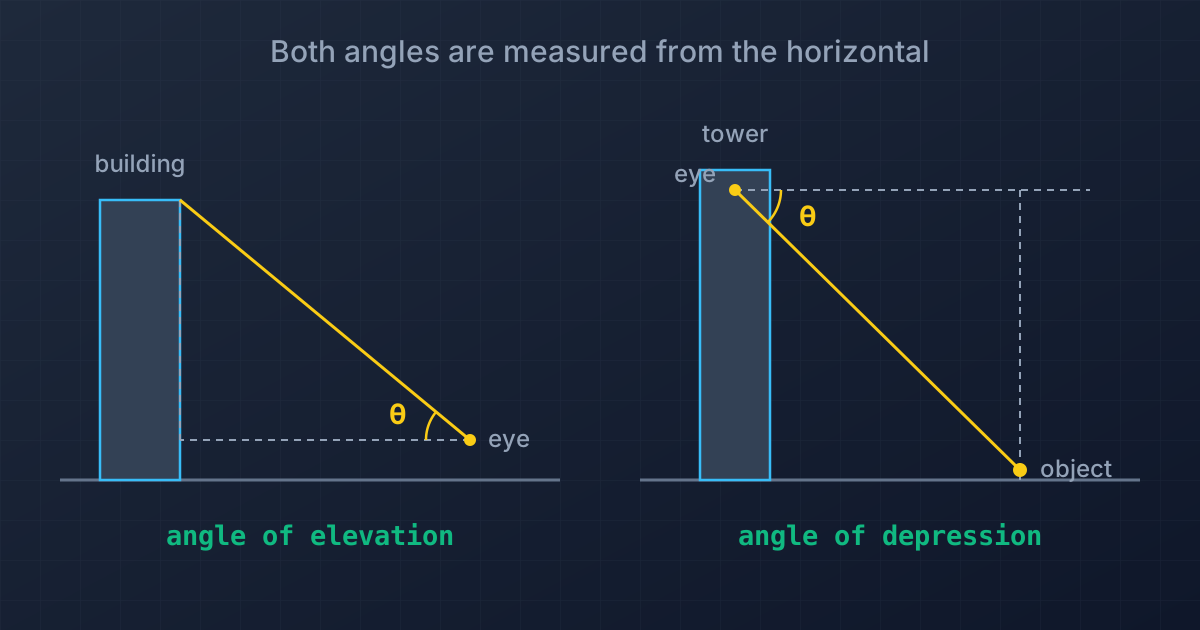
An angle of elevation is the angle measured upward from a horizontal line to a line of sight toward an object above the observer. The reference is always the horizontal through the observer’s eye: look straight ahead, that is the zero line, and the angle opens from there up to the object.
It is not measured from the ground unless your eye is on the ground, and never from a vertical wall. In the diagram at the top of this page, the horizontal dashed line, the sloping line of sight, and the vertical height difference between eye level and the object form a right triangle, and the angle of elevation sits at the observer’s corner of it.
Example: a student looks toward the top of a flagpole, and the angle between the student’s horizontal eye-level line and the line of sight to the top is 35°. That 35° is an angle of elevation, because the line of sight tilts upward from the student’s horizontal. Our angles in a right triangle guide covers the angle rules inside the triangle itself.
What Is an Angle of Depression?
An angle of depression is the angle measured downward from a horizontal line to a line of sight toward an object below the observer. Same reference, opposite direction: the horizontal runs through the upper observer’s eye, and the angle opens downward from it to the object.
Again, the angle is taken from the horizontal, not from the building wall beside the observer and not from the ground. Draw the horizontal, drop a vertical from the object up to that horizontal’s level, and the right triangle appears, with the depression angle at the observer’s corner.
Example: an observer on a 40-meter-high observation deck looks down at a parked car, and the angle of depression is 25°. That 25° is the downward tilt from the observer’s horizontal line of sight to the line of sight reaching the car, nothing more and nothing less; no distance is implied by the angle alone.
Angle of Elevation vs. Angle of Depression
The two angles are the same measurement taken in opposite directions. Both are measured from a horizontal reference line; one opens upward, the other downward.
| Feature | Angle of Elevation | Angle of Depression |
|---|---|---|
| Direction | Upward | Downward |
| Reference | Horizontal line | Horizontal line |
| Typical situation | Looking up at a building | Looking down from a building |
| Geometry | Often forms a right triangle | Often forms a right triangle |
| Common trigonometry | Sine, cosine, tangent | Sine, cosine, tangent |
Why Can an Angle of Depression Equal an Angle of Elevation?
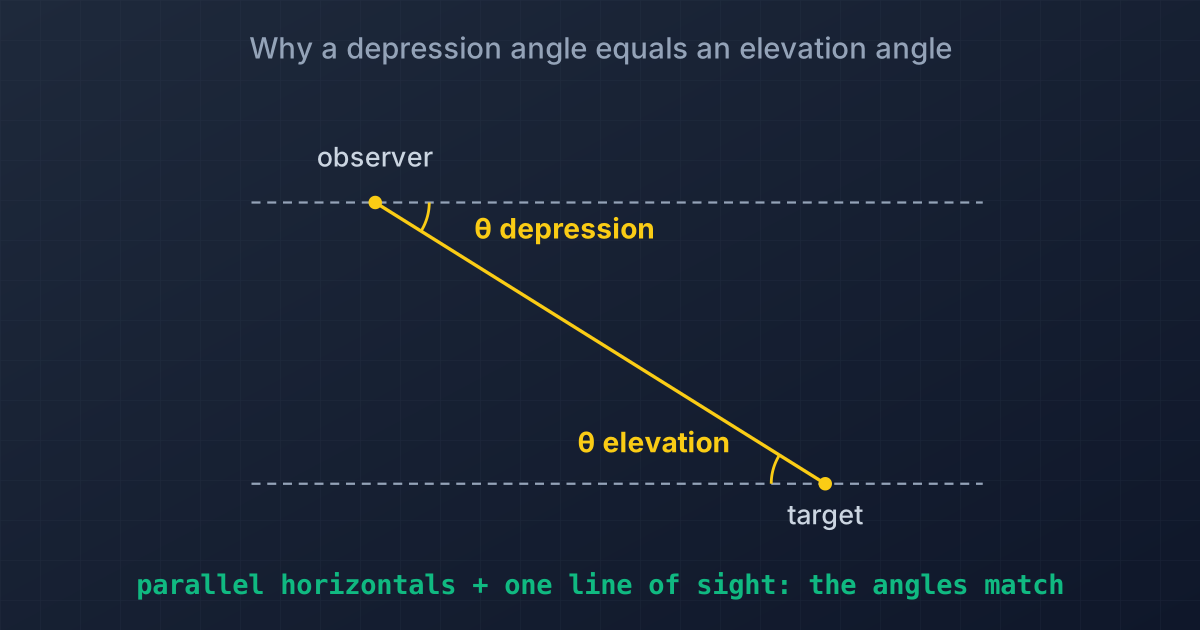
Draw the horizontal line through the upper observer and a second horizontal line through the lower target. Those horizontals are parallel. The line of sight connecting the two points cuts across them like a transversal, and the angles it makes on the inside are alternate interior angles, which are equal between parallel lines. So the depression angle measured at the top equals the elevation angle that the lower target would measure looking back up, for the same pair of points and the same line of sight. It is not a blanket rule about unrelated angles; it holds because the geometry forces it, and it is the trick that lets you move a depression angle down into the triangle and work with it there.
Angle of Elevation and Depression Formulas
There is no single formula for these problems, and anyone who hands you one is skipping the real skill. The triangle gives you three ratios, remembered as SOH-CAH-TOA, and the correct one is whichever connects the sides you know to the side or angle you want. Our sine, cosine, and tangent guide teaches the three ratios themselves; here is how they are chosen.
Sine Formula
sin θ = Opposite / Hypotenuse. Use sine when the problem involves the side facing the angle and the sloping side, the line of sight itself. If the line-of-sight distance is known or wanted, sine is usually in the work.
Cosine Formula
cos θ = Adjacent / Hypotenuse. Use cosine when the horizontal distance and the sloping line-of-sight distance are the two sides in play, and the vertical side is not involved.
Tangent Formula
tan θ = Opposite / Adjacent. This is the workhorse of height-and-distance problems, because the two sides it connects are the two you can usually measure or want: the vertical height difference and the horizontal distance. The hypotenuse, the one side nobody can stretch a tape along, stays out of it.
Formula for Finding Height
When the height difference h and the horizontal distance d are the opposite and adjacent sides for angle θ: h = d × tan θ. Read it carefully: h is the height difference between the object and the observer’s horizontal eye level, not automatically the object’s full height. When the observer’s eye is above the ground, add the eye height at the end, as the worked example below does.
Formula for Finding Horizontal Distance
d = h / tan θ, the same relationship rearranged. It assumes h is the vertical difference between the observer’s eye level and the object’s level, and that the ground between them is level enough for the triangle to hold.
Formula for Finding the Angle
θ = tan⁻¹(h / d), the inverse tangent. It answers “how steep is the sight line” when the two legs are known. One setting matters: the calculator must be in degree mode when your answer is required in degrees, which in school problems is nearly always.
| Want | Known | Formula |
|---|---|---|
| Height difference | Distance and angle | h = d × tan θ |
| Horizontal distance | Height difference and angle | d = h / tan θ |
| The angle | Height difference and distance | θ = tan⁻¹(h / d) |
| Sloping distance | Distance and angle | hypotenuse = d / cos θ |
| Sloping distance | Height difference and angle | hypotenuse = h / sin θ |
How to Solve Angle of Elevation Problems Step by Step
- Read the question carefully. What is given, and what exactly is asked: a height, a distance, or an angle?
- Draw a labelled right triangle. Horizontal line, line of sight, vertical side, even a rough sketch.
- Identify the given angle and lengths, and mark them on the sketch.
- Determine the opposite, adjacent, and hypotenuse relative to the given angle.
- Select the correct trigonometric ratio and calculate.
- Check the answer and include the correct units. Does the size make sense against the givens?
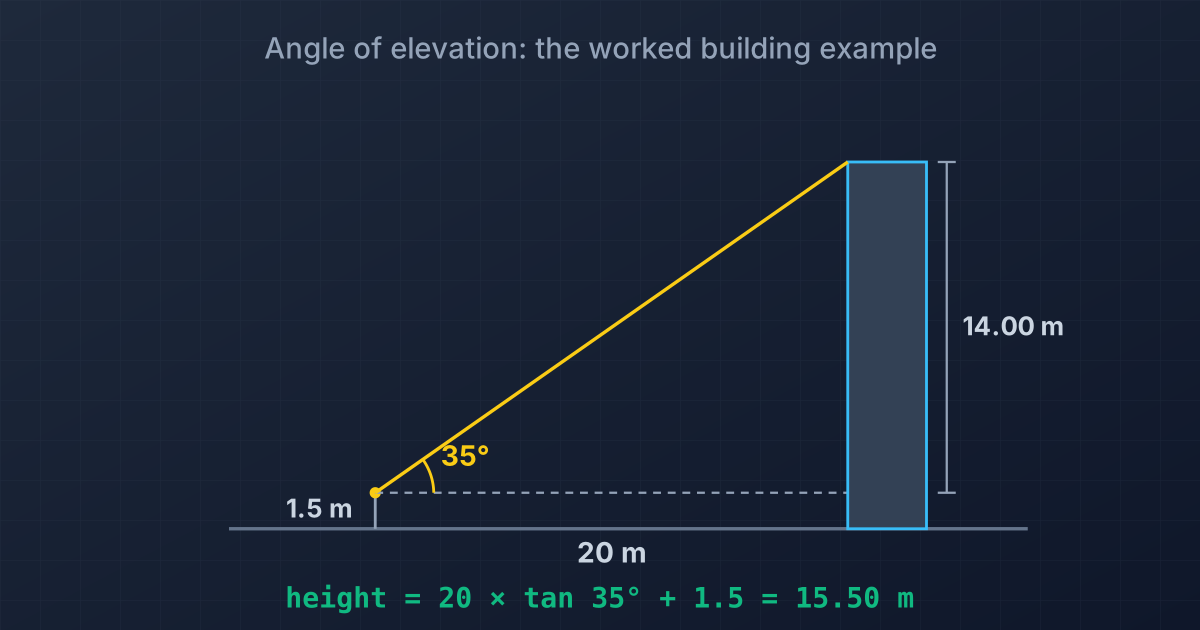
Worked example: a student stands 20 meters from a building, eye level 1.5 meters above the ground, and the angle of elevation to the roof is 35°. Step 4: relative to the 35° angle, the horizontal 20 m is adjacent, and the height difference is opposite, so tangent is the ratio. Step 5: height difference = 20 × tan 35° = 20 × 0.7002 ≈ 14.00 m. Step 6: that is the height above the student’s eyes; the building itself is 14.00 + 1.5 = 15.50 m. The two numbers answer two different questions, and mixing them up is the most common way this problem is lost.
How to Solve Angle of Depression Problems
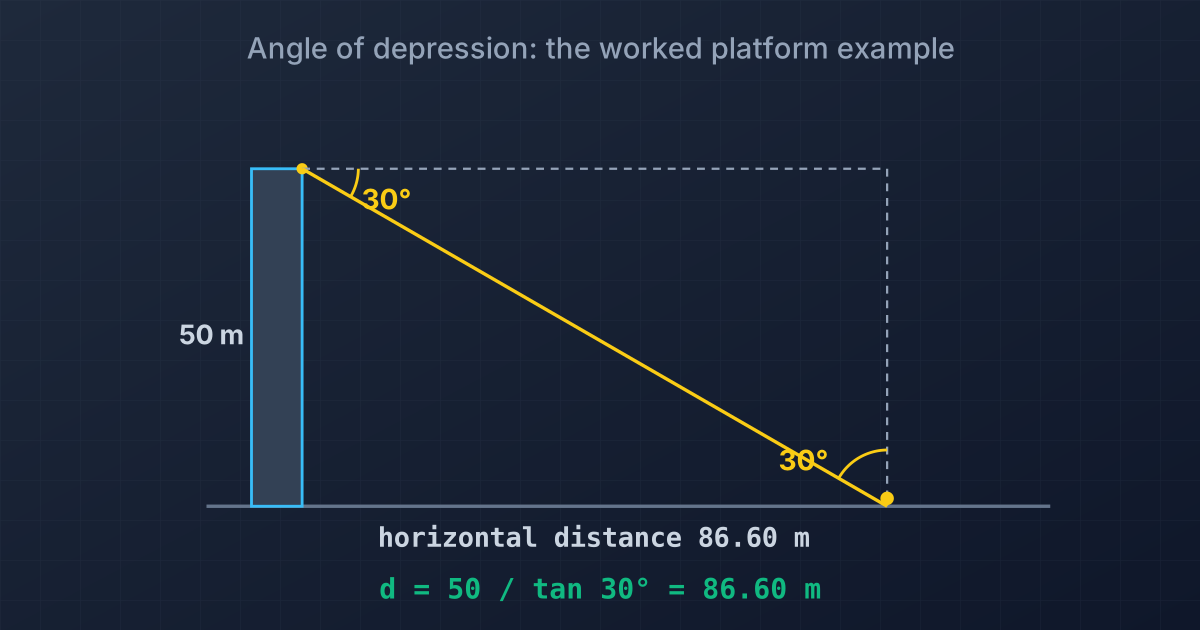
The construction is the mirror image. Draw the horizontal through the observer, the sloping line of sight down to the object, and a vertical line from the object up to the observer’s level. The depression angle sits at the top, outside the triangle’s working corner, so move it: by the alternate interior angles result, it equals the elevation angle at the object, inside the triangle, where your ratios can reach it.
Worked example: an observer stands on a 50-meter-high platform, and the angle of depression toward an object on level ground is 30°. Find the horizontal distance from the platform’s base to the object. The vertical side is 50 m; the angle inside the triangle at the object is also 30°; the distance d is adjacent to that angle and the height is opposite, so tan 30° = 50 / d, giving d = 50 / tan 30° = 50 / 0.5774 ≈ 86.60 m. The distance comes out longer than the platform is high, and it should: at a shallow 30° downward tilt, the sight line travels a long horizontal way while dropping only 50 meters. If your distance ever comes out shorter than the height at a shallow angle, the ratio was probably inverted.
Six Real-World Examples With Complete Solutions
Example 1: Measuring the Height of a Tree
Problem: you stand 15 m from a tree, your eye is 1.6 m above the ground, and the angle of elevation to the top is 40°. Formula: tangent, with the horizontal distance as adjacent. Calculation: height above eye = 15 × tan 40° = 15 × 0.8391 ≈ 12.59 m; tree height = 12.59 + 1.6 = 14.19 m. Why: the angle sees only the part of the tree above your eye line; the 1.6 m below it is yours, and it counts.
Example 2: Finding the Height of a Building
Problem: from 45 m away, the angle of elevation to a building’s top is 30°, measured from ground level (a surveyor’s instrument setup, so no eye height enters). Formula: h = d × tan θ. Calculation: h = 45 × tan 30° = 45 × 0.5774 ≈ 25.98 m. Why: with the measurement taken at ground level, the height difference and the building height are the same number, the one case where nothing is added.
Example 3: Looking Down From a Lighthouse
Problem: a lighthouse observer 60 m above the water sees a boat at an angle of depression of 20°; the boat floats at the same water level as the lighthouse base. Formula: d = h / tan θ. Calculation: d = 60 / tan 20° = 60 / 0.3640 ≈ 164.85 m. Why: a shallow 20° depression stretches the horizontal distance to nearly three times the height, which is why distant boats sit so far below a small-looking angle.
Example 4: A Drone Above a Field
Problem: a drone hovers 80 m above a field, and the angle of depression from the drone to a ground marker is 45°. Formula: d = h / tan θ. Calculation: d = 80 / tan 45° = 80 / 1 = 80 m. Why: at exactly 45°, tangent equals 1 and the two legs of the triangle are equal, a useful check on any 45° answer.
Example 5: Finding a Mountain’s Height Difference
Problem: from a viewpoint, a target point on a mountain is 300 m away horizontally, at an angle of elevation of 25°. Formula: h = d × tan θ. Calculation: h = 300 × tan 25° = 300 × 0.4663 ≈ 139.89 m. Why, and read the wording: 139.89 m is the height difference between the viewpoint and the target point. It is not the mountain’s total height, because the viewpoint itself stands somewhere above the valley floor; only an observer at the base, at the mountain’s own reference level, could claim the total.
Example 6: A Ladder Reaching a Wall
Problem: a 10 m ladder leans on a wall, making a 65° angle with level ground. How high does it reach? Formula: sine, because the ladder is the hypotenuse and the height is opposite the angle: h = 10 × sin 65°. Calculation: h = 10 × 0.9063 ≈ 9.06 m (and its foot sits 10 × cos 65° ≈ 4.23 m from the wall). Why the note: this is right-triangle trigonometry in the same family, but it is not a line-of-sight elevation problem; no observer and no horizontal reference line are involved, just a triangle and its ratios.
How to Draw Elevation and Depression Diagrams Correctly
Most wrong answers in this topic are born in the drawing, before any calculation. Build every diagram in this order:
- Draw the observer and the target, positioned as the problem describes.
- Add the horizontal reference line through the observer’s eye. This line is the one students skip, and skipping it is where the topic falls apart.
- Draw the actual line of sight from the eye to the target.
- Mark the angle at the correct vertex, between the horizontal and the line of sight, at the observer.
- Construct the right triangle by adding the vertical side.
- Label known sides and the unknown on the triangle.
- Check the relationships: the vertical is perpendicular to the horizontal, and in depression problems the two horizontals are parallel.
The two worked diagrams above are the models: Diagram A, the building, for elevation; Diagram B, the platform, for depression. The two labelling errors to burn out of your habits: marking the angle between the line of sight and the vertical (that angle is 90° minus the one you want), and labelling the sloping line-of-sight distance along the horizontal side of the triangle, which quietly swaps the hypotenuse for a leg in everything that follows.
Common Mistakes Students Make
Measuring from the vertical instead of the horizontal. Wrong: taking the angle between the wall and the line of sight as the elevation angle. Correct: elevation and depression are always measured from the horizontal; the vertical-based angle is the complement, 90° − θ.
Confusing elevation with depression. Wrong: calling a downward look from a balcony an elevation because a building is involved. Correct: the direction of the look decides, up is elevation, down is depression, whatever the setting.
Swapping opposite and adjacent. Wrong: labelling the horizontal distance as opposite because it is “across from” the observer in the drawing. Correct: opposite and adjacent are defined relative to the angle in use, and they swap when the working angle moves, as it does in depression problems.
Forgetting the eye height. Wrong: reporting 14.00 m as the building’s height in the worked example above. Correct: the angle gives the height above eye level, 14.00 m; the building is 15.50 m once the observer’s 1.5 m is added.
Reaching for sine out of habit. Wrong: using sine for a height-and-distance problem where neither side is the hypotenuse, then inventing a hypotenuse to make it fit. Correct: pick the ratio from the sides actually present; note that sine is not wrong in itself, only wrong for those givens, and it is exactly right in the ladder example.
Leaving the calculator in radian mode. Wrong: tan(35) computed in radians, returning a number near 0.47 and a building near 11 m with no alarm bell. Correct: degree mode for degree problems, and sanity-check the size of every answer.
Rounding intermediate answers early. Wrong: tan 35° written as 0.7, giving a height difference of 14.0 and drift in every later step. Correct: carry full precision, round the final answer once.
Treating the line-of-sight distance as the horizontal distance. Wrong: pacing out the sloping distance to a boat and entering it as d in h = d × tan θ. Correct: d is always the horizontal leg of the triangle; the sloping distance is the hypotenuse and belongs to sine and cosine.
Angle of Elevation and Depression Practice Problems
Round heights and distances to two decimal places and angles to two decimal places. More graded practice, including printable sets, is in our right triangle worksheets.
Beginner
- Standing on the ground, you look up at the top of a tower. The angle between your horizontal line of sight and the line of sight to the top is 28°. Is this an angle of elevation or of depression, and what is its measure?
- From a clifftop, a lifeguard looks down at a swimmer. The angle between the lifeguard’s horizontal line of sight and the line of sight down to the swimmer is 18°. Is this an angle of elevation or of depression, and what is its measure?
- A kite flies above and in front of you. Describe the three lines you would draw to set up this problem (horizontal, line of sight, vertical), and state whether the marked angle is measured from the horizontal or from the vertical.
Intermediate
- You stand 25 m from a building with an angle of elevation of 45° to the roof. Your eye level is 1.5 m. Find the building’s height.
- From ground level, 50 m from a tower, the angle of elevation to the top is 28°. Find the tower’s height.
- An observer 40 m above the ground sees a point on the ground at an angle of depression of 35°. Find the horizontal distance to the point.
- From the top of a 100 m cliff, the angle of depression to a boat is 42°. Find the horizontal distance from the cliff base to the boat.
Advanced
- A building is 40 m tall. You stand 55 m from it, with eye level 1.7 m above the ground. Find the angle of elevation from your eye to the roof.
- A ramp rises 2.4 m over a horizontal run of 9 m. Find the angle the ramp makes with the horizontal.
- From a point on level ground, the angle of elevation to the top of a tower is 30°. You walk 40 m directly toward the tower and the angle is now 45°. Find the tower’s height, measured from ground level.
Practice Problem Answers and Solutions
- Angle of elevation, 28°. The line of sight tilts upward from the horizontal.
- Angle of depression, 18°. The line of sight tilts downward from the horizontal.
- Draw a horizontal line from your eye, the line of sight from your eye up to the kite, and a vertical line from the kite down to eye level. The angle sits between the horizontal and the line of sight, so it is measured from the horizontal, and it is an angle of elevation.
- Height above eye = 25 × tan 45° = 25 × 1 = 25 m. Building height = 25 + 1.5 = 26.50 m.
- h = 50 × tan 28° = 50 × 0.5317 ≈ 26.59 m.
- d = 40 / tan 35° = 40 / 0.7002 ≈ 57.13 m.
- d = 100 / tan 42° = 100 / 0.9004 ≈ 111.06 m.
- Height difference = 40 − 1.7 = 38.3 m. θ = tan⁻¹(38.3 / 55) = tan⁻¹(0.6964) ≈ 34.85°.
- θ = tan⁻¹(2.4 / 9) = tan⁻¹(0.2667) ≈ 14.93°.
- Let d be the distance from the nearer point to the tower. Then h = d × tan 45° = d, and from the farther point h = (d + 40) × tan 30°. Setting them equal: d = (d + 40) × 0.5774, so d × (1 − 0.5774) = 23.09, d ≈ 54.64 m, and h = 54.64 m.
Using a Right Triangle Calculator to Check Your Answers
Once a problem is drawn, it is an ordinary right triangle: two facts known, the rest solvable. Solve by hand first, then enter your triangle’s known sides or angle into the calculator and compare the full solution against yours; a disagreement points at the exact step, ratio choice, or forgotten eye height to re-examine. The calculator checks triangles, so the drawing and the ratio choice remain your job, which is as it should be: they are the skill being learned.
Check Your Right Triangle Calculations
Frequently Asked Questions
Short answers to the questions students ask most about elevation and depression angles.
01 What is the angle of elevation in trigonometry?
It is the angle you measure upward from a horizontal line to your line of sight when looking at something above you. Stand level, look straight ahead, and that is your horizontal; tilt your eyes up to the object and the tilt is the angle of elevation, the starting point of most height problems.
02 What is an angle of depression?
It is the angle you measure downward from a horizontal line to your line of sight when looking at something below you, from a balcony, a cliff, or an aircraft, for example. Like elevation, it is always taken from the horizontal, never from a wall or from the sloping line itself.
03 What is the main difference between elevation and depression?
Direction, and nothing else. Elevation is measured upward from the horizontal to a line of sight aimed at something higher; depression is measured downward from the horizontal to something lower. Both use the same horizontal reference, the same right triangle, and the same three trigonometric ratios to solve.
04 What formula is used to calculate the angle of elevation?
There is no single formula; the ratio follows the sides you know. For the common height problem, tan θ = height difference ÷ horizontal distance, so θ = tan⁻¹(h ÷ d). If the sloping distance is the known side instead, sine or cosine with the hypotenuse takes the same inverse step.
05 How do you find the angle of depression?
Draw the horizontal line through the observer, then the line of sight down to the object, and complete the right triangle with a vertical drop. The depression angle at the top equals the elevation angle at the bottom, so work with the triangle: tan θ = vertical drop ÷ horizontal distance.
06 Why are angles of elevation and depression sometimes equal?
Because the two horizontal reference lines are parallel, one through the upper observer and one through the lower target, and the line of sight cuts across them like a transversal. The depression angle at the top and the elevation angle at the bottom are alternate interior angles, and alternate interior angles between parallels are equal.
07 How do you find the height of a building using an elevation angle?
Measure the horizontal distance d from the building, then the angle of elevation θ to the roof from your eye. The height above your eye is d × tan θ. Add your eye height above the ground to finish: total height = d × tan θ + eye height. Forgetting that last addition is the classic error.
08 Can you solve elevation and depression problems without a calculator?
Partly. The geometry, diagram, and formula choice never need one, and standard angles like 30, 45, and 60 degrees have exact ratio values you can use by hand. Non-standard angles and inverse tangents do need a calculator or tables, because their values are irrational decimals no short method produces exactly.
09 Is the angle of elevation always less than 90 degrees?
Yes, in ordinary height-and-distance problems. The angle is measured from the horizontal toward a line of sight that also has a horizontal component, so it sits strictly between 0 and 90 degrees. At exactly 90 the object would be directly overhead and there would be no horizontal distance and no triangle.
10 What trigonometric ratio is most commonly used in height-and-distance problems?
Tangent, by a wide margin. Height-and-distance problems usually give or ask for the two legs of the triangle, the vertical height and the horizontal distance, and tangent is the ratio built from exactly those two sides: opposite ÷ adjacent. Sine and cosine enter when the sloping line-of-sight distance is the known or wanted side.
Key Formulas and Final Takeaways
- sin θ = Opposite / Hypotenuse
- cos θ = Adjacent / Hypotenuse
- tan θ = Opposite / Adjacent
- h = d × tan θ
- d = h / tan θ
- θ = tan⁻¹(h / d)
Everything in this topic hangs on one habit: the angle is measured from the horizontal, never from a wall, a slope, or the ground at some other point. Sketch the situation before touching a calculator, draw the horizontal line first, label the known sides and the unknown, and let the sides in front of you choose between sine, cosine, and tangent. Add the observer’s eye height when the question asks for a full height, keep degrees in degree mode, and check that the answer’s size makes sense against the givens. Do those things in that order, and elevation and depression problems become some of the most mechanical marks on the paper.