
Right Triangle Worksheets: Printable Practice With Answers
Math Expert
Geometry
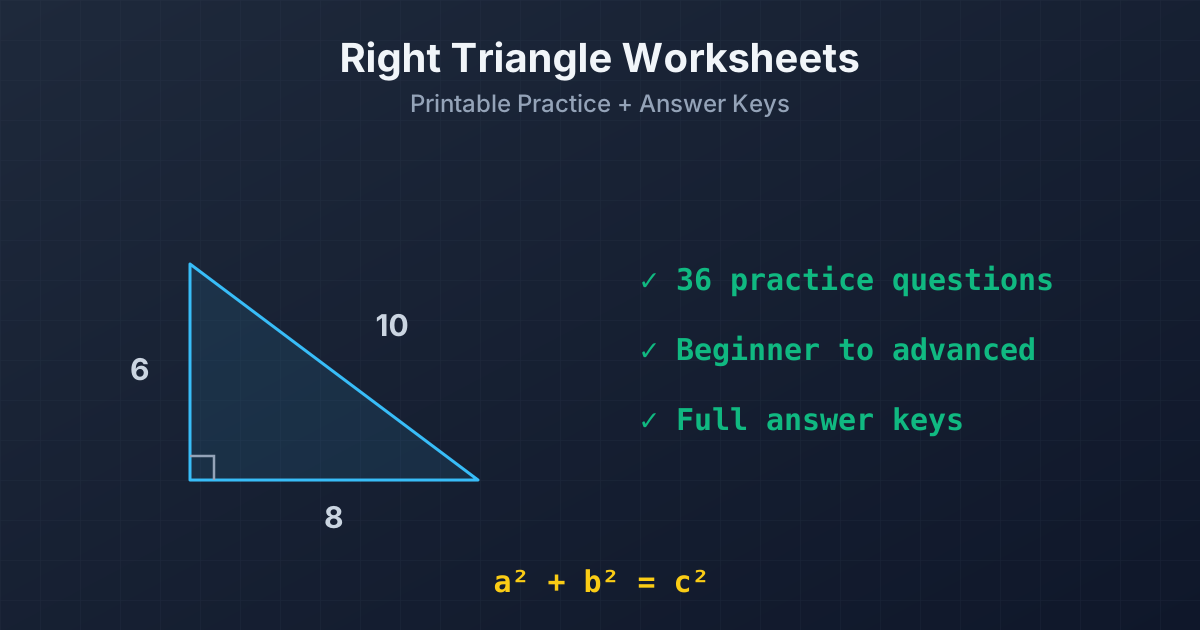
Right triangle problems get easier with practice, and they get easier fastest when the practice is organized: first recognizing the hypotenuse on sight, then finding missing sides, then the special triangles and trigonometry. These right triangle worksheets give you that ladder in three levels, 36 original questions in total, each set printable as a PDF with room to work, and every question answered in a full key further down this page. Start at the level that matches where you are, work without peeking, then check yourself against the key and redo anything that went wrong. That loop, repeated, is the whole method.
Choose the Right Triangle Worksheet for Your Level
| Worksheet | Difficulty | Main Topic | Questions |
|---|---|---|---|
| Worksheet 1 | Beginner | Right triangle basics and missing sides | 12 |
| Worksheet 2 | Intermediate | Pythagorean theorem and applications | 12 |
| Worksheet 3 | Advanced | Special right triangles and trigonometry | 12 |
Worksheet 1 is for students meeting right triangles now: naming the parts, first missing sides with friendly numbers, and simple area and perimeter. Worksheet 2 is for students who have learned the Pythagorean theorem and need fluency: missing legs, square-root answers, decimals, and word problems. Worksheet 3 assumes both of those and adds the special right triangles and sine, cosine, and tangent. Every worksheet is a free PDF, linked in the printable worksheets section below and beside its questions.
Review These Right Triangle Rules Before You Begin
Identifying the Legs and Hypotenuse
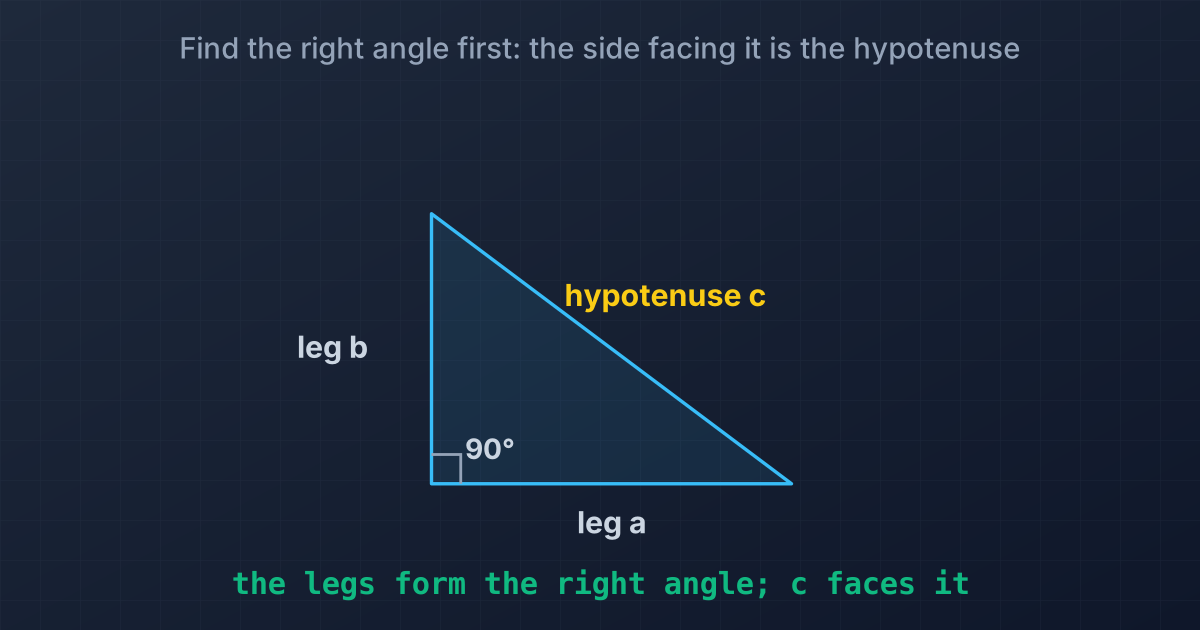
Every right triangle has exactly one 90° angle. The side opposite that angle is the hypotenuse, always the longest side. The two sides that form the right angle are the legs. On any diagram, find the right angle first; the side facing it names itself.
Pythagorean Theorem
a² + b² = c², where a and b are the legs and c is the hypotenuse. Missing hypotenuse: c = √(a² + b²). Missing leg: b = √(c² − a²). The theorem in full, with its formula family, is in our Pythagorean theorem formula guide.
Area of a Right Triangle
Area = ½ × base × height, and in a right triangle the two legs are the base and height, because they stand perpendicular to each other. No extra construction needed.
Perimeter of a Right Triangle
Perimeter = a + b + c. Add all three sides once you have them; our perimeter guide works the cases where a side is missing first.
Special Right Triangle Ratios
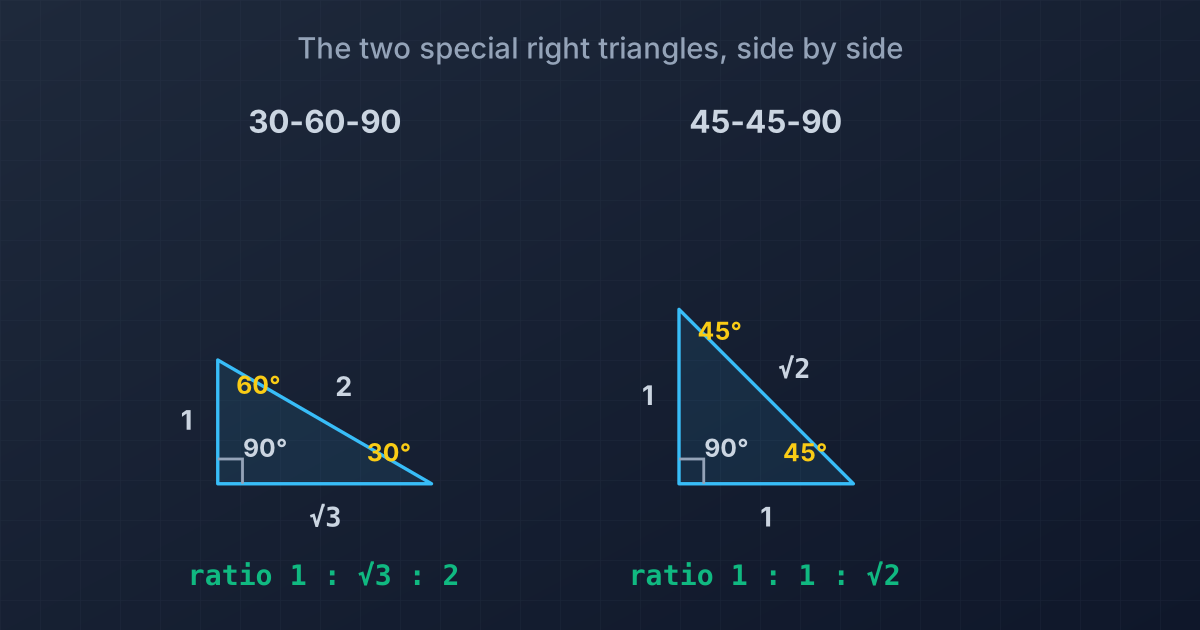
30-60-90: 1 : √3 : 2, read as short leg (opposite 30°), long leg (opposite 60°), hypotenuse (opposite 90°). 45-45-90: 1 : 1 : √2, the two legs equal, the hypotenuse leg × √2. The 30-60-90 guide and the angles guide go deeper on both.
| Need | Formula |
|---|---|
| Missing hypotenuse | c = √(a² + b²) |
| Missing leg | b = √(c² − a²) |
| Area | ½ × a × b |
| Perimeter | a + b + c |
| 30-60-90 sides | x, x√3, 2x |
| 45-45-90 sides | x, x, x√2 |
Worksheet 1: Right Triangle Basics
Difficulty: Beginner. Naming the parts, first missing sides, and simple area and perimeter, with numbers chosen to build confidence. Download the printable PDF.
Part A: Identify Triangle Parts
- In triangle PQR, the right angle is at Q. Side PR, opposite the right angle, has a special name. What is it?
- In triangle ABC, the right angle is at B. Sides AB and BC meet to form the right angle. What are these two sides called?
- A right triangle has sides of 5 cm, 12 cm, and 13 cm. What is the 13 cm side called, and which angle does it sit opposite?
- A triangle has one angle of exactly 90°. What kind of triangle is it, and how many right angles can a triangle have? Explain in one sentence.
Part B: Find the Missing Side
- The legs of a right triangle measure 3 cm and 4 cm. Find the hypotenuse.
- The legs of a right triangle measure 6 in and 8 in. Find the hypotenuse.
- A right triangle has a hypotenuse of 13 cm and one leg of 5 cm. Find the other leg.
- The legs of a right triangle measure 9 cm and 12 cm. Find the hypotenuse.
Part C: Area and Perimeter
- A right triangle has sides of 6 cm, 8 cm, and 10 cm. Find its perimeter.
- The legs of a right triangle measure 5 in and 12 in. Find its area.
- The legs of a right triangle measure 9 cm and 12 cm, and its hypotenuse is 15 cm. Find its area.
- A right triangle has sides of 7 m, 24 m, and 25 m. Find its perimeter.
Worksheet 2: Pythagorean Theorem Practice
Difficulty: Intermediate. Missing hypotenuses and missing legs, square-root answers, decimals, and two word problems. Show your working; where an exact answer is asked, give the square root first, then the decimal. Download the printable PDF.
- Find the hypotenuse of a right triangle with legs of 8 cm and 15 cm.
- Find the hypotenuse of a right triangle with legs of 20 in and 21 in.
- Find the hypotenuse of a right triangle with legs of 12 m and 35 m.
- A right triangle has a hypotenuse of 25 cm and one leg of 24 cm. Find the other leg.
- A right triangle has a hypotenuse of 26 in and one leg of 10 in. Find the other leg.
- A right triangle has a hypotenuse of 41 m and one leg of 9 m. Find the other leg.
- The legs of a right triangle measure 5 cm and 7 cm. Find the hypotenuse. Give the exact answer as a square root, then round to two decimal places.
- A right triangle has a hypotenuse of 11 cm and one leg of 6 cm. Find the other leg. Give the exact answer as a square root, then round to two decimal places.
- The legs of a right triangle measure 4.5 cm and 6 cm. Find the hypotenuse.
- A right triangle has a hypotenuse of 12.5 in and one leg of 7.5 in. Find the other leg.
- A 5 m ladder leans against a wall. The foot of the ladder stands 3 m from the wall. How high up the wall does the ladder reach? Assume the wall is vertical and the ground is flat.
- A rectangular field measures 30 m by 40 m. A path runs straight across the field from one corner to the opposite corner. How long is the path?
Worksheet 3: Special Right Triangles and Trigonometry
Difficulty: Advanced. For students solid on the Pythagorean theorem. Give exact answers first, then decimals to two decimal places where asked. In Part C, the right angle is at C in every question. Download the printable PDF.
Part A: 30-60-90 Triangle Problems
- A 30-60-90 triangle has a shortest leg of 7 cm. Find the longer leg and the hypotenuse, exactly and to two decimal places.
- A 30-60-90 triangle has a hypotenuse of 16 in. Find both legs, exactly and to two decimal places.
- A 30-60-90 triangle has a longer leg of 9√3 cm. Find the shortest leg and the hypotenuse.
- A 30-60-90 triangle has a shortest leg of 2.5 m. Find the longer leg and the hypotenuse, exactly and to two decimal places.
Part B: 45-45-90 Triangle Problems
- A 45-45-90 triangle has legs of 11 cm. Find the hypotenuse, exactly and to two decimal places.
- A 45-45-90 triangle has legs of 4√2 in. Find the hypotenuse.
- A 45-45-90 triangle has a hypotenuse of 10√2 cm. Find the length of each leg.
- A 45-45-90 triangle has legs of 13 m. Find the hypotenuse, exactly and to two decimal places.
Part C: Right Triangle Trigonometry
- In triangle ABC, angle A is 30° and the hypotenuse AB is 18 cm. Find the leg opposite angle A and the leg adjacent to angle A.
- In triangle ABC, angle B is 60° and the leg adjacent to angle B is 6 cm. Find the hypotenuse and the leg opposite angle B.
- In triangle ABC, angle A is 45° and the leg opposite angle A is 7 cm. Find the adjacent leg and the hypotenuse.
- Use a calculator. In triangle ABC, angle A is 52° and the hypotenuse is 15 cm. Find the leg opposite angle A and the leg adjacent to angle A, rounding to two decimal places.
Printable Right Triangle Worksheets (PDF)
Each worksheet above is also a free PDF, formatted for printing: a name and date line at the top, brief instructions, the same 12 questions in the same order, diagrams where the question needs one, and space under every question for working. They are black and white and easy on ink. The files are US Letter size; on A4 paper, choose “fit to page” in the print dialog and they print cleanly.
- Worksheet 1: Beginner, right triangle basics (PDF)
- Worksheet 2: Intermediate, Pythagorean theorem (PDF)
- Worksheet 3: Advanced, special right triangles and trigonometry (PDF)
- Answer keys for all three worksheets (PDF)
The answer keys live in their own file, separate from the worksheets, so a teacher or parent can hold them back until the work is done. The same keys also appear in full in the next section of this page.
Right Triangle Worksheet Answers and Solutions
Try every question before reading this section. The key is organized by worksheet and number, matching the worksheets and the PDF exactly.
Worksheet 1 Answer Key
- The hypotenuse. It is always the side opposite the right angle.
- The legs. The two sides that form the right angle are always called the legs.
- The hypotenuse. It sits opposite the 90° angle.
- A right triangle. It can have only one right angle, because two right angles would already add to 180°, leaving nothing for the third angle.
- c² = 3² + 4² = 9 + 16 = 25, so c = √25 = 5 cm.
- c² = 6² + 8² = 36 + 64 = 100, so c = √100 = 10 in.
- b² = 13² − 5² = 169 − 25 = 144, so b = √144 = 12 cm.
- c² = 9² + 12² = 81 + 144 = 225, so c = √225 = 15 cm.
- Perimeter = 6 + 8 + 10 = 24 cm.
- Area = ½ × 5 × 12 = 30 in².
- Area = ½ × 9 × 12 = 54 cm².
- Perimeter = 7 + 24 + 25 = 56 m.
Worksheet 2 Answer Key
- Given legs 8 and 15. c² = 8² + 15² = 64 + 225 = 289; c = √289 = 17 cm.
- Given legs 20 and 21. c² = 20² + 21² = 400 + 441 = 841; c = √841 = 29 in.
- Given legs 12 and 35. c² = 12² + 35² = 144 + 1,225 = 1,369; c = √1,369 = 37 m.
- Given hypotenuse 25, leg 24. b² = 25² − 24² = 625 − 576 = 49; b = √49 = 7 cm.
- Given hypotenuse 26, leg 10. b² = 26² − 10² = 676 − 100 = 576; b = √576 = 24 in.
- Given hypotenuse 41, leg 9. b² = 41² − 9² = 1,681 − 81 = 1,600; b = √1,600 = 40 m.
- Given legs 5 and 7. c² = 5² + 7² = 25 + 49 = 74; c = √74 cm ≈ 8.60 cm.
- Given hypotenuse 11, leg 6. b² = 11² − 6² = 121 − 36 = 85; b = √85 cm ≈ 9.22 cm.
- Given legs 4.5 and 6. c² = 4.5² + 6² = 20.25 + 36 = 56.25; c = √56.25 = 7.5 cm.
- Given hypotenuse 12.5, leg 7.5. b² = 12.5² − 7.5² = 156.25 − 56.25 = 100; b = √100 = 10 in.
- The ladder is the hypotenuse (5 m), the ground distance one leg (3 m). h² = 5² − 3² = 25 − 9 = 16; h = √16 = 4 m up the wall.
- The diagonal splits the field into right triangles with legs 30 and 40. d² = 30² + 40² = 900 + 1,600 = 2,500; d = √2,500 = 50 m.
Worksheet 3 Answer Key
- Short leg x = 7. Longer leg = 7√3 ≈ 12.12 cm; hypotenuse = 2 × 7 = 14 cm.
- Hypotenuse 2x = 16, so the short leg x = 8 in; longer leg = 8√3 ≈ 13.86 in.
- Longer leg = x√3 = 9√3, so the short leg x = 9√3 ÷ √3 = 9 cm; hypotenuse = 2 × 9 = 18 cm.
- Short leg x = 2.5. Longer leg = 2.5√3 ≈ 4.33 m; hypotenuse = 2 × 2.5 = 5 m.
- Hypotenuse = leg × √2 = 11√2 cm ≈ 15.56 cm.
- Hypotenuse = 4√2 × √2 = 4 × 2 = 8 in.
- Each leg = hypotenuse ÷ √2 = 10√2 ÷ √2 = 10 cm.
- Hypotenuse = 13 × √2 = 13√2 m ≈ 18.38 m.
- Opposite = hypotenuse × sin 30° = 18 × 0.5 = 9 cm. Adjacent = hypotenuse × cos 30° = 18 × (√3/2) = 9√3 ≈ 15.59 cm.
- Hypotenuse = adjacent ÷ cos 60° = 6 ÷ 0.5 = 12 cm. Opposite = adjacent × tan 60° = 6√3 ≈ 10.39 cm.
- Adjacent = opposite ÷ tan 45° = 7 ÷ 1 = 7 cm. Hypotenuse = 7√2 ≈ 9.90 cm.
- Opposite = 15 × sin 52° ≈ 11.82 cm. Adjacent = 15 × cos 52° ≈ 9.23 cm. (Check: 11.82² + 9.23² ≈ 225 ≈ 15².)
Three Solved Examples Before You Practice
Example 1: Find the Hypotenuse
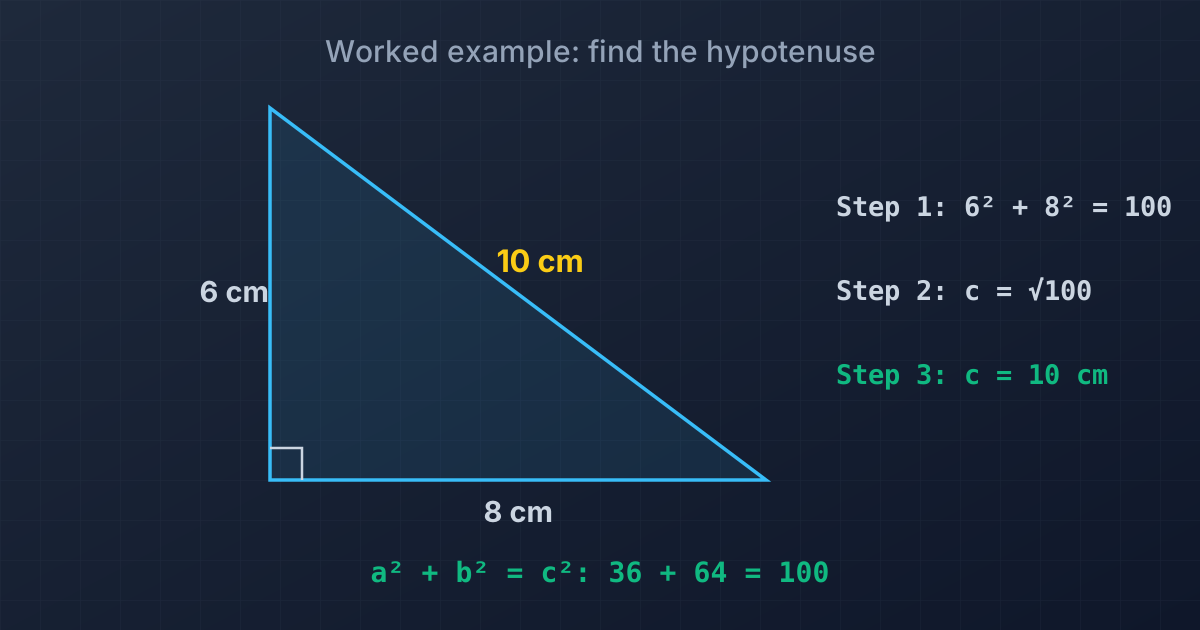
Given: legs of 6 cm and 8 cm. Method: both legs known, hypotenuse missing, so add the squares. c² = 6² + 8² = 36 + 64 = 100; c = √100 = 10 cm.
Example 2: Calculate the Missing Leg
Given: hypotenuse 17 in, one leg 8 in. Method: a leg is missing, so subtract the squares. b² = 17² − 8² = 289 − 64 = 225; b = √225 = 15 in. The answer being shorter than the hypotenuse is the first check, and it passes.
Example 3: Solve a 30-60-90 Triangle
Given: short leg 5 cm. Method: the ratio 1 : √3 : 2 does the work, no theorem needed. Longer leg = 5√3 ≈ 8.66 cm; hypotenuse = 2 × 5 = 10 cm.
How to Use These Worksheets for Better Practice
A routine that works for students, and for the teachers and parents guiding them:
- Review the key formulas at the top of this page before starting a set.
- Begin at the right difficulty. If Worksheet 1 questions cause errors, Worksheet 2 will not fix them; finish the level you are on.
- Solve without the answers open. The key teaches nothing if it is read first.
- Show every intermediate step, the substitution line especially. Most errors live there, and they are invisible in answer-only work.
- Check against the answer key and mark each question right or wrong honestly.
- Review every wrong question until you can say which step failed: wrong formula, wrong arithmetic, or rounded too early.
- Repeat similar problems a day later. A method you can reproduce cold is learned; one you recognized is not.
Teachers can assign a worksheet as classwork or homework and mark from the key PDF, which is separate for exactly that reason. Parents can use the same keys to check homework even if their own geometry is rusty, because Worksheet 2’s key shows every step.
Common Mistakes in Right Triangle Worksheets
Identifying the wrong hypotenuse. Wrong: treating a leg as c because it is drawn diagonally in a rotated diagram. Correct: the hypotenuse is defined by position, opposite the right angle, never by how the drawing happens to sit.
Using the wrong theorem direction. Wrong: finding a missing leg with b = √(c² + a²), which produces a “leg” longer than the hypotenuse. Correct: missing leg subtracts, b = √(c² − a²); missing hypotenuse adds.
Forgetting the square root. Wrong: legs 3 and 4, hypotenuse = 9 + 16 = 25. That 25 is c², not c. Correct: c = √25 = 5.
Mixing perimeter and area. Wrong: answering “area = 6 + 8 + 10 = 24 cm” for a 6-8-10 triangle. That sum is the perimeter. Correct: area = ½ × 6 × 8 = 24 cm²; same digits here, different quantity, different units.
Confusing the special ratios. Wrong: giving a 30-60-90 with short leg 5 a long leg of 5√2. The √2 belongs to the 45-45-90. Correct: long leg = 5√3, hypotenuse 10.
Rounding too early. Wrong: √74 rounded to 8.6 at the first step, then squared or added onward. Correct: keep √74 exact through the work and round the final answer, 8.60, once.
Choosing the wrong trig ratio. Wrong: using tangent when the hypotenuse is the known side. Tangent connects the two legs only. Correct: if the hypotenuse is in the problem, the ratio is sine or cosine; pick by whether the target side faces the angle (sine) or touches it (cosine).
Check Your Worksheet Answers With Our Calculator
The answer keys confirm a finished set; the calculator spot-checks a single stubborn question while you work. Enter the sides or angles you know and it solves the rest of the triangle, so you can compare against your own line of working and find the step where the two part company. Solve first, check second: the calculator’s answer teaches the most when yours is already on the page.
Check Your Right Triangle Answers
Frequently Asked Questions
Short answers about these worksheets, printing, answers, and classroom use.
01 Are these right triangle worksheets free?
Yes. All three worksheets and the answer keys are free to download and print from this page, with no account and no sign-up. They are provided for students, parents, teachers, and tutors to use for learning and classroom practice. The only thing we ask is that you do not resell them or repost the files as your own.
02 Can I print the right triangle worksheets?
Yes. Each worksheet is a PDF designed for home and classroom printers, in black and white with space for working under every question. The files are US Letter size and also print cleanly on A4 if you choose fit to page in your print dialog. The answer keys come as a separate PDF.
03 Do the worksheets include answers?
Yes. A complete answer key covers all 36 questions, organized by worksheet and question number so it matches the worksheets exactly. Worksheet 2 answers show the full calculation steps; the other two keys give the result with the key step. The keys appear in the answers section of this page and in their own PDF.
04 What grade level are these worksheets for?
Roughly grades 7 to 10, though placement varies by school and country. Worksheet 1 suits students meeting right triangles for the first time. Worksheet 2 fits students who have learned the Pythagorean theorem. Worksheet 3 is for students who have covered special right triangles and basic trigonometry, usually later in a geometry course.
05 What formulas should I memorize for right triangle problems?
Five cover almost every question: the Pythagorean theorem a² + b² = c², its rearrangement for a missing leg, area = ½ × base × height using the legs, perimeter = a + b + c, and the two special ratios, 1 : √3 : 2 and 1 : 1 : √2. Add sine, cosine, and tangent for Worksheet 3.
06 How do you solve a right triangle with two known sides?
Use the Pythagorean theorem. If both known sides are legs, the hypotenuse is √a² + b². If one is the hypotenuse, the missing leg is √c² − a²: subtract, because the hypotenuse is already the largest side. Once the third side is known, angles can follow from trigonometry if the problem asks for them.
07 What is the difference between a 30-60-90 and a 45-45-90 triangle?
The angles and the legs. A 30-60-90 has angles of 30, 60, and 90 degrees, two different legs, and the ratio 1 : √3 : 2. A 45-45-90 has two equal 45 degree angles, two equal legs, and the ratio 1 : 1 : √2. Both are right triangles; the 45-45-90 is the isosceles one.
08 Can teachers use these worksheets in classrooms?
Yes. Teachers are welcome to print these worksheets for their own classes and use the answer keys for marking, at no charge. Tutors and homeschool parents can use them the same way. Please keep the RightTriangleSolver.com credit line on the pages, and do not sell the files or upload them to other websites.
Final Review: Practice One Triangle at a Time
Right triangles stop being hard one question at a time. The pattern never really changes: find the right angle, name the sides, pick the formula that fits what is known, and keep the arithmetic exact until the last line. Begin with Worksheet 1 even if it looks easy, because its questions install the identification habits the harder sets rely on. Move up only when a full set comes back clean against the answer key. When a question resists, the calculator settles it, and the key shows the route. Print the set, put the phone away, and work the page.