
Right Triangles in Physics: Vectors, Forces, and Components
Math Expert
Physics
Picture a person pulling a box with a rope that angles upward. The pull is a single force, but it does two jobs at once: part of it drags the box forward, and part of it lifts the box slightly off the ground. Physics handles this split with a right triangle. The angled force becomes the hypotenuse, and its horizontal and vertical parts become the legs. That one idea, applied carefully, explains most of two-dimensional physics.
The direct answer: right triangles help physicists break angled vectors into perpendicular components and combine perpendicular components to find a resultant vector. An angled vector becomes the hypotenuse of a right triangle, its horizontal component becomes the adjacent side, and its vertical component becomes the opposite side. Sine and cosine then read the components straight off the triangle. This article covers vector magnitude and direction, horizontal and vertical components, sine, cosine, and tangent, force resolution, resultant vectors, worked examples, and practical applications.
What Is a Right Triangle, and Why Is It Useful in Physics?
A right triangle is a triangle containing one 90° angle. Its three sides have fixed names relative to a selected acute angle:
- Hypotenuse: the side opposite the right angle, and the longest side.
- Opposite side: the side across from the selected acute angle.
- Adjacent side: the side next to the selected acute angle, excluding the hypotenuse.
A right triangle is useful in physics whenever a vector and its perpendicular components form a geometric relationship, which is often. Any vector pointing at an angle can be drawn as the hypotenuse, with a horizontal leg and a vertical leg completing the triangle. The legs are perpendicular by construction, so they can be analyzed independently: what happens horizontally does not interfere with what happens vertically, and vice versa.
The Pythagorean theorem ties the three sides together. If the horizontal component is Vx and the vertical component is Vy, the magnitude of the original vector is V = √(Vx² + Vy²). That single equation runs in both directions: components build a magnitude, and a magnitude with an angle splits into components. The guide to the Pythagorean theorem formula covers the geometry behind it.
Understanding Vectors in Physics
What Is a Vector?
A vector is a physical quantity with both magnitude and direction. Examples include:
- Displacement: how far something moved, and in which direction.
- Velocity: how fast something moves, and in which direction.
- Acceleration: how velocity changes, and in which direction.
- Force: a push or pull, with a strength and a direction.
Contrast these with scalar quantities, which need no direction: mass, time, temperature, and distance. A distance of 10 m is complete on its own, but a displacement of 10 m is not: 10 m east and 10 m north are different displacements. The same holds for forces. A force of 10 N directed horizontally is different from a force of 10 N directed vertically, even though the magnitudes are equal, because the direction changes what the force does.
Magnitude and Direction of a Vector
Magnitude tells how large a vector is. Direction tells where it points. An angled vector can be represented as the hypotenuse of a right triangle, with perpendicular horizontal and vertical components forming the legs. This article uses consistent notation throughout:
- V: vector magnitude.
- Vx: horizontal component.
- Vy: vertical component.
- θ: angle measured from the positive horizontal axis, unless otherwise stated.
The reference axis matters more than students expect. Every angle formula in this article assumes θ is measured from the positive horizontal axis. If an angle is measured from the vertical axis instead, the sine and cosine roles switch, as the next section explains. Stating the reference axis is not pedantry; it is what makes the formulas correct.
How Right Triangle Trigonometry Helps Resolve Vectors
The three fundamental ratios, covered in the guide to sine, cosine, and tangent, are:
- Sine: opposite divided by hypotenuse.
- Cosine: adjacent divided by hypotenuse.
- Tangent: opposite divided by adjacent.
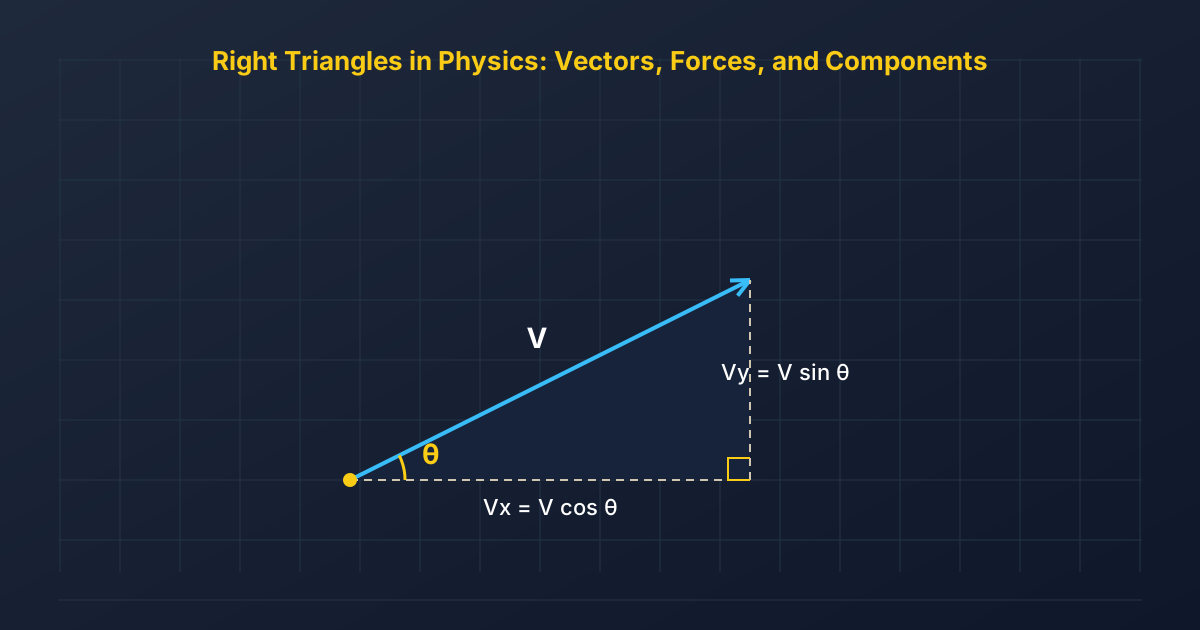
For a vector with magnitude V and angle θ measured from the positive horizontal axis, the horizontal component is the adjacent side and the vertical component is the opposite side. That gives the two formulas every physics student needs:
- Vx = V cos θ
- Vy = V sin θ
Cosine gives the horizontal component because the horizontal leg sits adjacent to the angle at the origin. Sine gives the vertical component because the vertical leg sits opposite that angle. If the angle were measured from the vertical axis instead, the labels would swap: the horizontal leg would become the opposite side and the vertical leg the adjacent side, giving Vx = V sin θ and Vy = V cos θ. The triangle does not change; only which side is called opposite and which is called adjacent changes. That is why the reference axis must be stated every time.
Formula summary: for an angle θ from the positive x-axis, Vx = V cos θ and Vy = V sin θ. In reverse, V = √(Vx² + Vy²) and θ = atan2(Vy, Vx), where atan2 is the two-argument arctangent explained below.
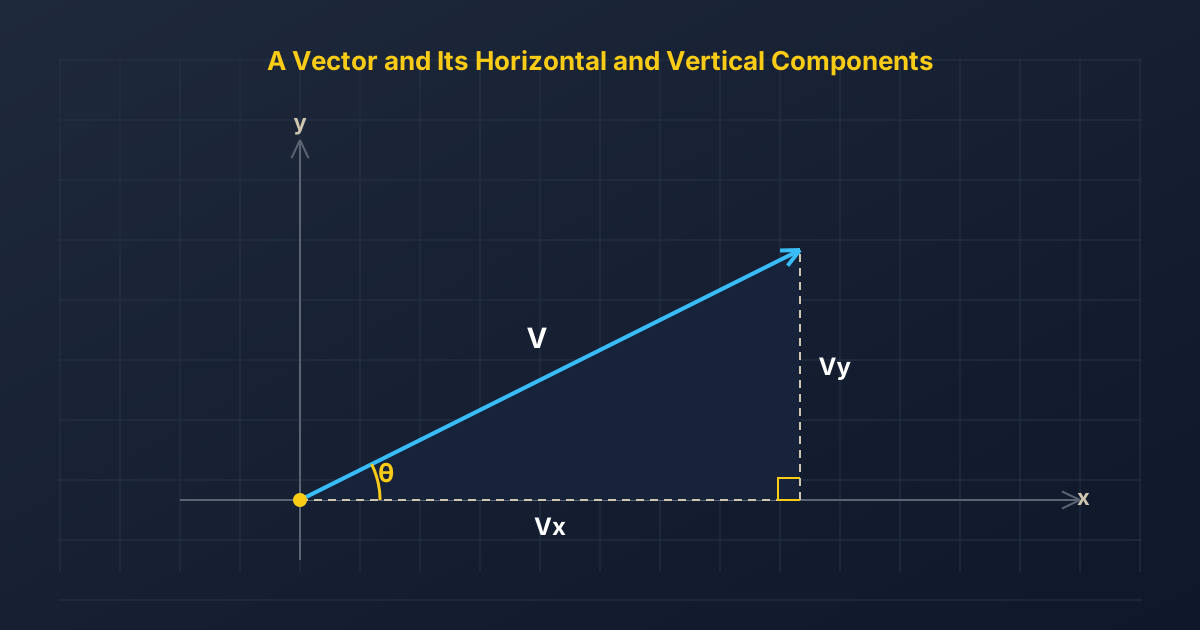
Caption: A vector as the hypotenuse, with Vx adjacent to θ and Vy opposite θ. The right angle sits between the two components.
What Are Vector Components?
Horizontal Components
The horizontal component describes the vector’s contribution along the x-axis. For an angle measured from the positive x-axis, Vx = V cos θ. A vector pointing right has a positive horizontal component, and a vector pointing left has a negative one. The size of the component depends on the angle: at θ = 0°, the vector points entirely horizontally, so Vx = V; at θ = 90°, it points entirely vertically, so Vx = 0.
Vertical Components
The vertical component describes the vector’s contribution along the y-axis. Vy = V sin θ. A vector pointing up has a positive vertical component, and a vector pointing down has a negative one. At θ = 0°, Vy = 0; at θ = 90°, Vy = V. The signs depend on the chosen coordinate system and the vector’s direction, not simply on the size of the angle: a 30° angle below the horizontal gives a negative vertical component, while the same 30° above it gives a positive one.
Finding the Original Vector from Its Components
Resolving a vector splits it into components. The reverse operation rebuilds it. When perpendicular components are known, the magnitude follows from the Pythagorean theorem:
V = √(Vx² + Vy²)
For a vector with nonzero horizontal component, its direction relative to the positive x-axis follows from:
θ = atan2(Vy, Vx)
The two-argument arctangent, atan2, identifies the correct quadrant from the signs of the components. Ordinary inverse tangent, tan⁻¹(Vy/Vx), cannot do this on its own: it returns an angle in the range −90° to 90°, which is wrong for vectors pointing left. For example, components Vx = −3 and Vy = 4 give tan⁻¹(4/−3) ≈ −53.1°, but the vector actually points into the second quadrant, at atan2(4, −3) ≈ 126.9°. If only ordinary inverse tangent is available, the signs of the components must be checked separately and 180° added when the horizontal component is negative.
Understanding Forces Through Right Triangles
What Is a Force Component?
A force component is the contribution of a force along a selected coordinate axis. A force applied at an angle can be represented by horizontal and vertical components without changing the original force’s overall effect: the components acting together do exactly what the original force does. Take a person pulling a box with a rope at an upward angle. The horizontal component drags the box forward, and the vertical component lifts it slightly, reducing how hard it presses on the ground.
Resolving a Force into Horizontal and Vertical Components
Let a force F act at an angle θ above the positive horizontal axis. Then:
- Fx = F cos θ
- Fy = F sin θ
The horizontal component may contribute to moving an object forward, while the vertical component may affect the normal force or the object’s tendency to lift, depending on the physical setup. One limit must be stated clearly: a force component is not automatically the object’s acceleration. Acceleration depends on the net force, meaning all forces combined, through Newton’s second law, F = ma. A horizontal component of 25 N does not mean the object accelerates at 25/m m/s² unless 25 N is the net horizontal force after friction and every other force are accounted for.
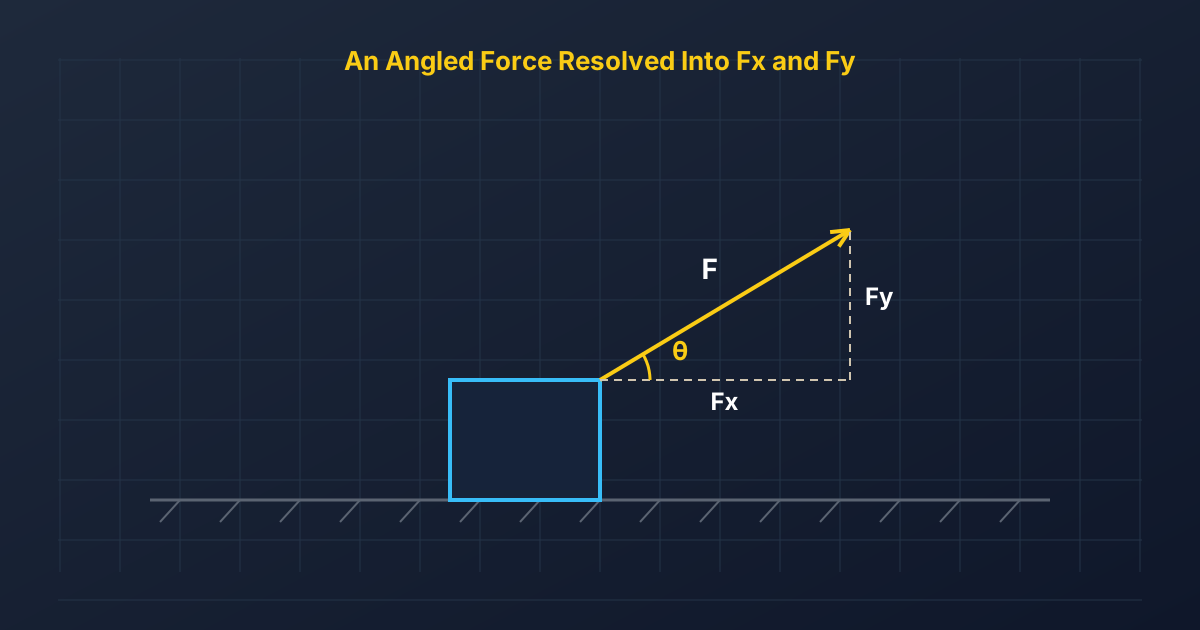
Caption: An angled pull on a box. Fx drags the box forward, and Fy lifts it slightly, reducing the normal force.
What Happens When a Force Points Downward or to the Left?
Signs follow direction under one consistent convention:
- Right: positive x.
- Left: negative x.
- Up: positive y.
- Down: negative y.
A force pointing 30° below the horizontal has a positive horizontal component and a negative vertical component, as Example 5 shows. A force pointing into the second quadrant, up and to the left, has a negative horizontal component and a positive vertical component. A force pointing into the third quadrant, down and to the left, has both components negative. The angle’s size alone never decides the signs; the direction does, which is why drawing the vector and labeling the axes comes before any calculation.
Worked Examples: Right Triangles, Vectors, and Forces
Every example states the problem, the given information, the formula, the substitution, the calculation with units, the final answer, and a short physical interpretation.
Example 1: Finding Components of a Vector
Problem: A displacement vector has magnitude 10 m and points 30° above the positive horizontal axis. Calculate the horizontal and vertical components.
Given: V = 10 m, θ = 30° from the positive x-axis.
Formulas: Vx = V cos θ, Vy = V sin θ.
Calculation: Vx = 10 × cos 30° = 10 × 0.8660 = 8.66 m. Vy = 10 × sin 30° = 10 × 0.5 = 5.00 m.
Final answer: Vx = 8.66 m, Vy = 5.00 m.
Interpretation: The displacement moves the object 8.66 m east and 5.00 m north. The horizontal part is larger because 30° is closer to the horizontal than to the vertical. Check: √(8.66² + 5.00²) = √(75 + 25) = √100 = 10 m, which recovers the original magnitude.
Example 2: Resolving an Angled Force
Problem: A 50 N force acts at 60° above the positive horizontal axis. Calculate its horizontal and vertical components.
Given: F = 50 N, θ = 60° from the positive x-axis.
Formulas: Fx = F cos θ, Fy = F sin θ.
Calculation: Fx = 50 × cos 60° = 50 × 0.5 = 25 N. Fy = 50 × sin 60° = 50 × 0.8660 = 43.30 N.
Final answer: Fx = 25 N, Fy = 43.30 N.
Interpretation: The vertical component is larger than the horizontal component because 60° is closer to the vertical than to the horizontal: most of this force lifts rather than drags. At 45° the two components would be equal; past 45°, the vertical one dominates.
Example 3: Finding the Resultant of Perpendicular Vectors
Problem: An object experiences a 6 N force to the right and an 8 N force upward. Calculate the magnitude and direction of the resultant force.
Given: Fx = 6 N, Fy = 8 N, perpendicular to each other.
Formulas: FR = √(Fx² + Fy²), θ = tan⁻¹(Fy/Fx).
Calculation: FR = √(6² + 8²) = √(36 + 64) = √100 = 10 N. θ = tan⁻¹(8/6) = tan⁻¹(1.333) ≈ 53.1°.
Final answer: 10 N at approximately 53.1° above the positive horizontal axis.
Interpretation: The two forces combine this way only because they are perpendicular: they form the legs of a right triangle, and the resultant is its hypotenuse. If the forces pointed at any other angle to each other, they would first need resolving into components before combining.
Example 4: Finding a Vector’s Magnitude and Direction from Its Components
Problem: A velocity has components Vx = 12 m/s and Vy = 5 m/s. Calculate its magnitude and direction.
Given: Vx = 12 m/s, Vy = 5 m/s.
Formulas: V = √(Vx² + Vy²), θ = tan⁻¹(Vy/Vx).
Calculation: V = √(12² + 5²) = √(144 + 25) = √169 = 13 m/s. θ = tan⁻¹(5/12) = tan⁻¹(0.4167) ≈ 22.6°.
Final answer: 13 m/s at approximately 22.6° above the positive horizontal axis.
Interpretation: The vector points above the positive horizontal axis because the vertical component is positive. Had Vy been negative, the direction would have been below the axis instead, at −22.6°.
Example 5: A Force Acting Downward at an Angle
Problem: A 20 N force points 30° below the positive horizontal axis. Calculate its components with the correct signs.
Given: F = 20 N, θ = 30° below the positive x-axis.
Formulas: Fx = F cos θ, Fy = −F sin θ (negative because the force points downward).
Calculation: Fx = 20 × cos 30° = 20 × 0.8660 = 17.32 N. Fy = −20 × sin 30° = −20 × 0.5 = −10 N.
Final answer: Fx = 17.32 N, Fy = −10 N.
Interpretation: The horizontal component is positive because the force points to the right, and the vertical component is negative because it points downward. The signs carry the direction information: dropping the minus sign would describe a different force, one pointing upward instead of downward.
Adding Vectors Using Right Triangles
Vectors add by combining their corresponding components. For two vectors A and B:
- Rx = Ax + Bx
- Ry = Ay + By
Then the resultant magnitude is R = √(Rx² + Ry²), and its direction follows from atan2(Ry, Rx). The Pythagorean theorem applies directly to the resultant’s perpendicular components, which is what makes this method work.
Example: One vector points right with magnitude 9 N, and another points upward with magnitude 12 N. The component sums are Rx = 9 + 0 = 9 N and Ry = 0 + 12 = 12 N. The resultant magnitude is R = √(9² + 12²) = √(81 + 144) = √225 = 15 N, at θ = tan⁻¹(12/9) ≈ 53.1° above the horizontal.
If components point in opposite directions, their signs must be included when adding them: a 10 N eastward component and a 6 N westward component sum to 4 N eastward, not 16 N. And one limit deserves emphasis: the Pythagorean theorem alone does not determine the resultant of arbitrary nonperpendicular vectors. Such vectors must first be resolved into perpendicular components, and only then do the component sums and the Pythagorean theorem apply.
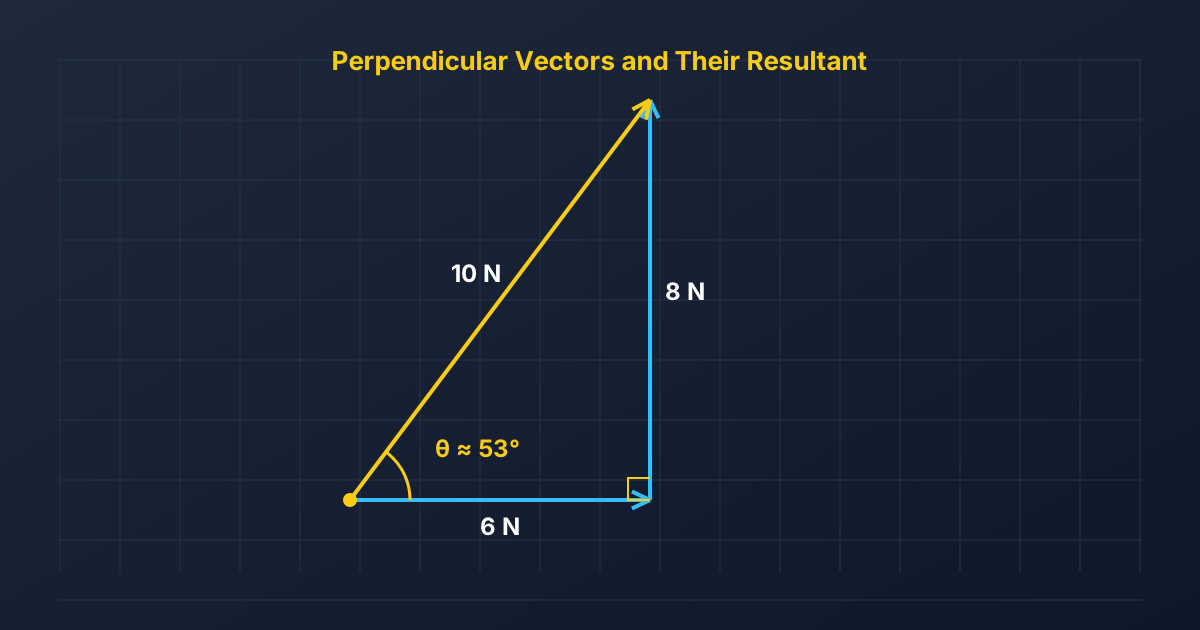
Caption: Perpendicular vectors add tip to tail. The resultant is the hypotenuse of the right triangle they form.
Real-World Applications of Right Triangles in Physics
Pulling or Pushing an Object
A force applied at an angle resolves into horizontal and vertical components, exactly as the box example showed. The horizontal component drives the motion forward, and the vertical component changes how hard the object presses on the surface. Friction and the normal force also affect the motion, so the horizontal component is not necessarily equal to the net force. The component split tells you what the applied force contributes; Newton’s second law, applied to all forces together, tells you what actually happens.
Projectile Motion
An initial velocity splits into horizontal and vertical components, and those components explain the whole flight. For ideal projectile motion without air resistance, horizontal acceleration is zero, so the horizontal component stays constant, while vertical acceleration is approximately −9.81 m/s² near Earth’s surface when upward is positive, so the vertical component decreases, passes through zero at the peak, and grows negative on the way down. The initial components, vx = v cos θ and vy = v sin θ, determine the range, the peak height, and the flight time. In real situations with significant air resistance, the horizontal velocity is not constant, and the ideal model becomes an approximation rather than an exact description.
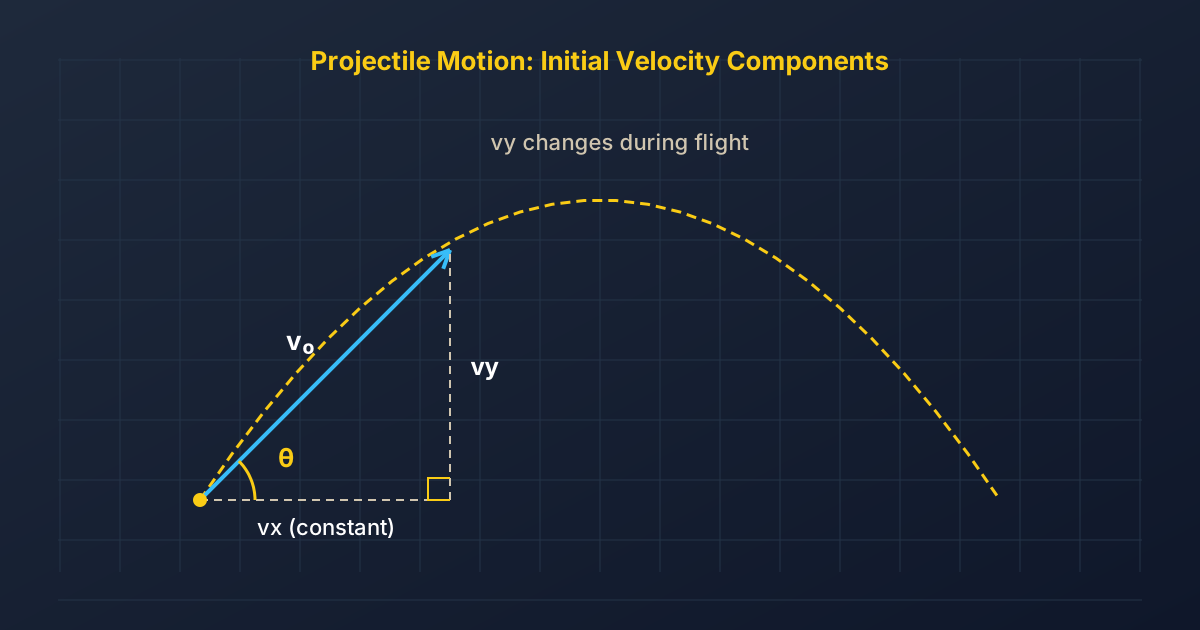
Caption: Projectile motion. The horizontal component stays constant in the ideal model, while the vertical component changes throughout the flight.
Inclined Planes
The weight of an object on an inclined plane resolves into components parallel and perpendicular to the surface. For an incline angle θ measured above the horizontal, the standard components of gravitational force are:
- F_parallel = mg sin θ, acting down the slope.
- F_perpendicular = mg cos θ, pressing into the surface.
These represent the components of gravitational force relative to the plane, not necessarily the net force: friction, applied pushes, and the normal force also act, and the normal force balances the perpendicular component when the object stays on the surface. The coordinate directions here are rotated with the plane, which is the point: components are always defined relative to chosen axes, and on an incline the sensible axes run along and into the surface.
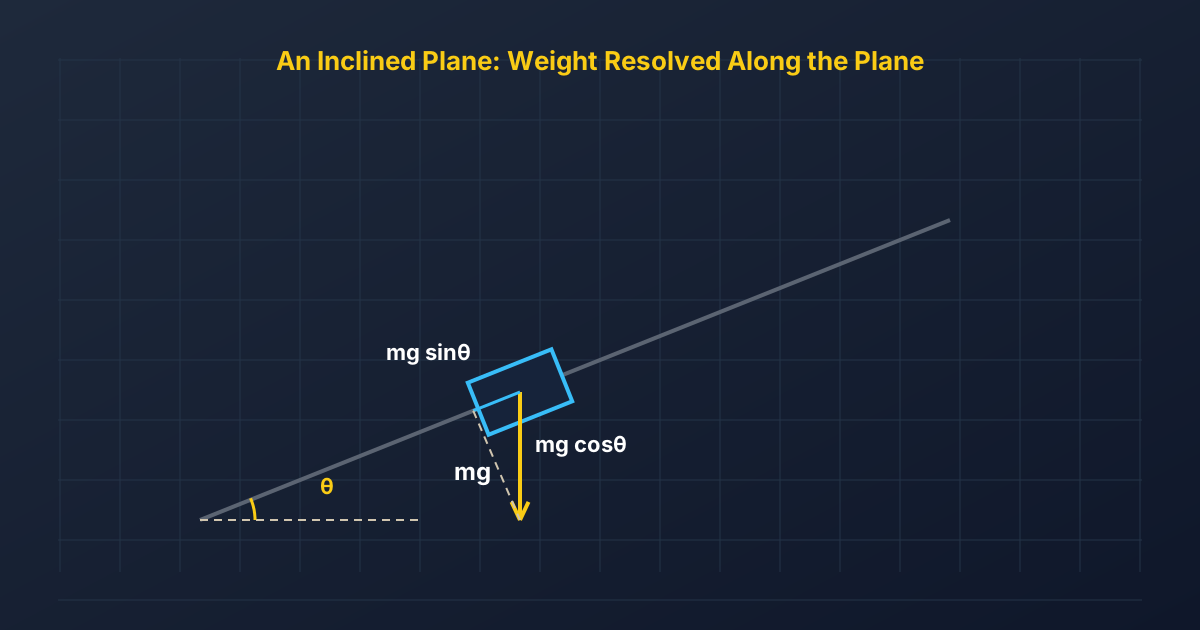
Caption: Weight on an incline. The parallel component pulls the block down the slope, and the perpendicular component presses it into the surface.
Navigation and Displacement
A diagonal displacement separates into east-west and north-south components. Walking 10 km at 30° north of east, for example, means 10 × cos 30° = 8.66 km east and 10 × sin 30° = 5 km north. The component method gives both the total displacement and the direction, and it scales to journeys with many legs: add all east-west components, add all north-south components, then rebuild the resultant exactly as the vector addition section showed.
Engineering and Mechanical Systems
Component analysis helps engineers study forces in cables, supports, structures, and moving mechanisms. A cable holding up a sign pulls at an angle, and its horizontal and vertical components tell the engineer how much sideways and upward force the support must withstand. A crane lifting a load at an angle, a bridge truss carrying diagonal members, and a robot arm reaching at an angle all reduce to the same right-triangle split. The method stays the same whatever the machine: resolve each angled force, add components axis by axis, and check the result against what the structure must hold.
Common Mistakes to Avoid
- Swapping sine and cosine without checking the reference angle. Cosine belongs to the adjacent side and sine to the opposite side, relative to the stated angle. Fix it by naming the reference axis before choosing a ratio.
- Forgetting to state whether the angle is measured from the horizontal or vertical axis. The same physical vector gets different formulas under the two conventions. Fix it by writing the reference axis next to every angle.
- Ignoring negative signs in vector components. A minus sign is direction information, not decoration. Fix it by assigning signs from the coordinate convention before calculating.
- Adding vector magnitudes directly when their directions differ. Magnitudes add only for vectors pointing the same way. Fix it by adding components instead, with signs included.
- Using the Pythagorean theorem on nonperpendicular components. The theorem needs a right angle. Fix it by resolving into perpendicular components first.
- Confusing a force component with the net force. A component is one force’s contribution along one axis. Fix it by combining all forces on each axis before applying Newton’s second law.
- Mixing units or omitting them. A component of 8.66 without a unit is not an answer. Fix it by carrying units through every step and checking that both sides of each equation match.
- Using inverse tangent without considering the vector’s quadrant. Plain tan⁻¹ returns angles between −90° and 90° only. Fix it by using atan2, or by checking the component signs and adding 180° for left-pointing vectors.
- Rounding intermediate values too early. Rounding cos 30° to 0.87 at the start of a chain shifts every later result. Fix it by keeping full precision until the final answer, then rounding once.
- Treating a vector’s direction as irrelevant when calculating its components. Direction decides which ratio applies and what signs result. Fix it by drawing the vector, labeling the axes, and marking the angle before touching a formula.
Step-by-Step Method for Solving Vector Problems
- Draw and label the physical situation.
- Choose coordinate axes.
- Identify the vector’s magnitude and direction.
- State the reference axis for the angle.
- Resolve the vector into horizontal and vertical components.
- Assign signs according to direction.
- Add components if multiple vectors are present.
- Calculate the resultant magnitude when required.
- Determine the correct direction and quadrant.
- Check units, signs, and whether the result is physically reasonable.
Concise example: A worker pulls a crate with a 60 N force at 30° above the horizontal. Draw the crate, the rope, and the angle. Choose right as positive x and up as positive y. The magnitude is 60 N and the angle is 30° from the positive x-axis. Resolve: Fx = 60 × cos 30° = 51.96 N, Fy = 60 × sin 30° = 30 N. Both signs are positive, since the force points right and up. No other vectors are present, so no addition is needed. The magnitude check recovers the original force: √(51.96² + 30²) = √(2700 + 900) = √3600 = 60 N. The direction is the stated 30° above the horizontal. Units are newtons throughout, signs are consistent, and both components are smaller than the original force, as they must be.
Practice Questions
- A velocity vector has magnitude 20 m/s and points 30° above the positive horizontal axis. Find its horizontal component.
- For the same vector as question 1, find its vertical component.
- A 100 N force acts at 30° above the positive horizontal axis. Resolve it into horizontal and vertical components.
- An object experiences a 9 N force east and a 12 N force north. Calculate the magnitude of the resultant force.
- A velocity has components Vx = 5 m/s and Vy = 12 m/s. Find the direction of the vector relative to the positive horizontal axis.
- A 25 N force points 30° below the positive horizontal axis. Calculate its components with the correct signs.
- Vector A has components 10 N east and 0 N north. Vector B has components 6 N west and 8 N north. Add them using component sums and find the resultant magnitude and direction.
- A block weighs 100 N and sits on a plane inclined at 30° above the horizontal. Calculate the components of its weight parallel and perpendicular to the plane.
Answer Key
1. Vx = 20 × cos 30° = 20 × 0.8660 = 17.32 m/s.
2. Vy = 20 × sin 30° = 20 × 0.5 = 10 m/s. Check: √(17.32² + 10²) = √(300 + 100) = √400 = 20 m/s, the original magnitude.
3. Fx = 100 × cos 30° = 86.60 N, Fy = 100 × sin 30° = 50 N.
4. R = √(9² + 12²) = √(81 + 144) = √225 = 15 N.
5. θ = tan⁻¹(12/5) = tan⁻¹(2.4) ≈ 67.4° above the positive horizontal axis. Both components are positive, so the vector points into the first quadrant and no quadrant correction is needed.
6. Fx = 25 × cos 30° = 21.65 N, Fy = −25 × sin 30° = −12.5 N. The horizontal component is positive because the force points right, and the vertical component is negative because it points downward.
7. Component sums: Rx = 10 + (−6) = 4 N, Ry = 0 + 8 = 8 N. Resultant magnitude: R = √(4² + 8²) = √80 ≈ 8.94 N. Direction: θ = atan2(8, 4) ≈ 63.4° above the positive horizontal axis. The westward part of vector B subtracts from the eastward part of vector A, which is why the signs matter.
8. Parallel component: F_parallel = 100 × sin 30° = 100 × 0.5 = 50 N down the slope. Perpendicular component: F_perpendicular = 100 × cos 30° = 100 × 0.8660 = 86.60 N into the surface. Check: √(50² + 86.60²) = √(2500 + 7500) = √10000 = 100 N, the original weight.
Frequently Asked Questions
Frequently Asked Questions
Common questions about right triangles in physics, vectors, and force components, answered briefly.
01 Why are right triangles useful in physics?
Because any angled vector can be drawn as the hypotenuse of a right triangle, with perpendicular horizontal and vertical components as the legs. That split lets each direction be analyzed independently, using sine, cosine, and the Pythagorean theorem.
02 What is a vector component?
A vector component is the vector's contribution along one coordinate axis. The horizontal component acts along the x-axis and the vertical component along the y-axis, and together they reproduce the original vector exactly.
03 How do you calculate the horizontal component of a vector?
For an angle θ measured from the positive x-axis, Vx = V cos θ. If the angle is measured from the vertical axis instead, the formula switches to Vx = V sin θ.
04 How do you calculate the vertical component of a vector?
For an angle θ measured from the positive x-axis, Vy = V sin θ. If the angle is measured from the vertical axis instead, the formula switches to Vy = V cos θ.
05 When should sine and cosine be used?
Use cosine for the component adjacent to the angle and sine for the component opposite it. For an angle from the horizontal axis, that means cosine for horizontal and sine for vertical. Always check the reference axis first.
06 How do you calculate the resultant of two perpendicular vectors?
Add their components axis by axis, then use the Pythagorean theorem: R = √Rx² + Ry². The direction follows from atan2(Ry, Rx), which gives the correct quadrant.
07 Can vector components be negative?
Yes. A component is negative when the vector points in the negative direction of that axis: left for horizontal, down for vertical. The sign carries direction information and must be kept through every calculation.
08 How are force components related to Newton's second law?
Newton's second law uses the net force, not a single component. Resolve every force into components, add the components on each axis with their signs, and then apply F = ma to the net force on each axis.
09 How are right triangles used in projectile motion?
The launch velocity splits into horizontal and vertical components. In the ideal model the horizontal component stays constant while the vertical component changes under gravity, which together produce the curved trajectory.
10 What is the difference between a vector's magnitude and its components?
The magnitude is the vector's overall size, the length of the hypotenuse. The components are its parts along each axis, the legs of the triangle. The magnitude is always at least as large as any single component.
Conclusion
Right triangles connect trigonometry to practical physics through one simple picture: an angled vector as a hypotenuse, with perpendicular components as legs. That picture turns hard two-dimensional problems into two easy one-dimensional ones. A force at an angle becomes a horizontal push and a vertical lift. A launch velocity becomes steady horizontal motion and changing vertical motion. A weight on a slope becomes a pull down the plane and a press into it. The same triangle serves all of them.
Three skills carry the whole topic. First, identify the angle and state its reference axis, because that decides which ratio gives which component. Second, apply sine and cosine correctly, with the adjacent side taking cosine and the opposite side taking sine. Third, keep component signs, units, and physical meaning consistent from the first sketch to the final answer, and check the result by rebuilding the magnitude and asking whether it makes physical sense. Practise the five worked examples without looking, then try the eight practice questions, and apply the ten-step method to the next angled force or velocity you meet. For the next step, the guide to sine, cosine, and tangent covers the ratios behind every formula here, and the guide to exact trigonometric values gives the special-angle values that make many of these calculations exact.