
Rope Stretchers of Ancient Egypt: The 3-4-5 Triangle in Construction
Math Expert
History
Imagine surveyors working along the Nile after floodwaters have receded. The water has softened the field boundaries, and the plots that fed whole villages need measuring again. The surveyors carry cords, stakes, and measuring rods. They need straight boundaries, accurate distances, and square corners, and they need them without any modern instrument. This is the world of the rope stretchers of ancient Egypt, and it is where one of geometry’s most repeated stories begins.
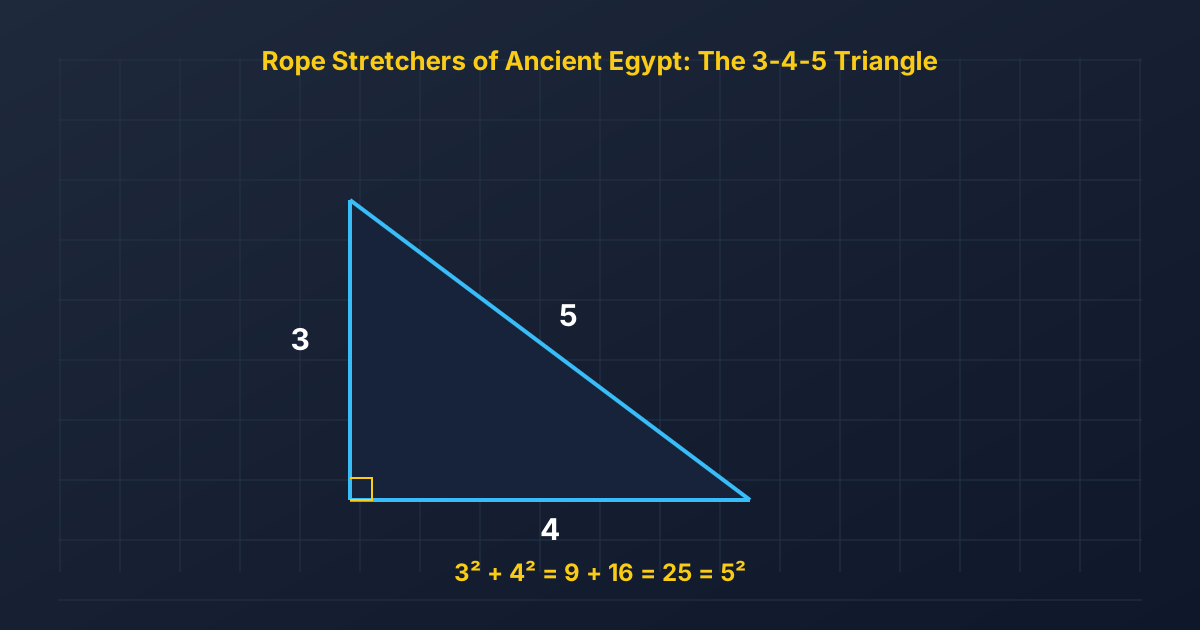
The direct answer: a triangle with side lengths 3, 4, and 5 units has a right angle opposite its longest side, because 3² + 4² = 9 + 16 = 25 = 5². That makes the 3-4-5 triangle a reliable way to construct a right angle with nothing more than a marked rope. But here is the distinction this article keeps in view throughout: the 3-4-5 triangle is a valid mathematical construction method, while the familiar claim that ancient Egyptian rope stretchers routinely used this exact method is a story that must be checked against historical evidence rather than assumed to be fact. The mathematics is certain. The history is more careful than the textbooks suggest.
Who Were the Rope Stretchers of Ancient Egypt?
The term rope stretchers refers to Egyptian surveying and land-measurement specialists. Greek sources call them harpedonaptai, literally rope stretchers, and the name stuck in later histories of mathematics. Their work was practical and constant: measuring agricultural plots, re-establishing field boundaries after the annual Nile flood, laying out straight lines, establishing building layouts, and measuring distances for construction and land administration.
Surveying mattered enormously in Egypt because agriculture depended on the Nile. Each year’s flood deposited rich silt and blurred the boundaries between fields, so plots had to be remeasured regularly. Land boundaries decided taxation, since what a farmer owed depended on the area he worked, and building projects from temples to tombs required measured ground plans. A society that lived by measured land needed measurers.
What exactly these specialists were called in Egyptian itself, how they were organized, and which instruments each one carried are matters where the evidence thins out. Tomb paintings from the Theban Necropolis, including the tomb of Menna, show ropes being used to measure fields, which confirms that cord measurement was real work, not legend. A separate and well-documented practice is the temple foundation ceremony known as stretching the cord, in which the king and the goddess Seshat drove poles into the ground and extended a rope between them to fix a temple’s orientation and its four corners. That ceremony is attested from the First Dynasty down to the Ptolemaic period. But neither the tomb paintings nor the foundation ceremony records describe a 12-interval rope arranged into a 3-4-5 triangle. That specific procedure comes from much later writers, as the evidence section below shows.
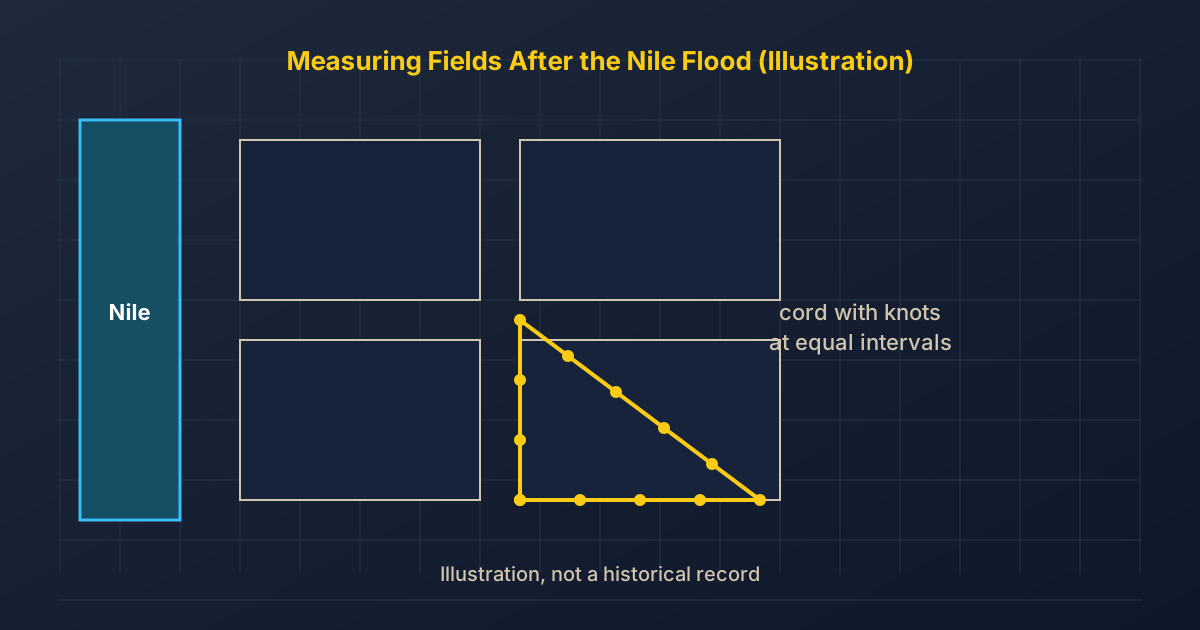
Caption: Illustration, not a historical record. Field plots beside the Nile, with a knotted cord stretched across one corner. No surviving image shows a 3-4-5 rope in use.
Why Geometry Mattered in Ancient Egypt
Practical measurement supported agriculture, architecture, and administration at every level. Straight lines and measured distances let officials record who farmed what. Right angles in rectangular layouts let builders set out temples, tombs, and storehouses square. Repeated measurements, checked against one another, kept errors small. Proportional reasoning let a slope or a scaled plan be described by ratios rather than by new measurements each time. And after every flood, the whole system of field boundaries had to be rebuilt from measurements, not from memory.
Builders and surveyors could develop such techniques through experience without writing them in modern algebraic notation. Egyptian mathematics survives mainly in scribal training documents, and the most famous is the Rhind Mathematical Papyrus, copied by a scribe named Ahmose around 1500 BC. It holds more than 80 problems: areas of fields and circles, volumes of granaries, divisions of bread and beer, and the seked, the slope of a pyramid’s face expressed as horizontal run in palms per cubit of height. The royal cubit itself, about 52 cm, was the standard unit of length. What the papyrus does not contain is a rope-stretching procedure for right angles, and it does not state a 3-4-5 triangle rule. One surviving document cannot prove what every surveyor did, but it does show what Egyptian scribal mathematics actually recorded: practical problems with worked solutions, not a surveyor’s field manual.
What Is the 3-4-5 Triangle?
The 3-4-5 triangle has three side lengths:
- One leg: 3 units.
- Second leg: 4 units.
- Hypotenuse: 5 units.
The longest side is the hypotenuse and lies opposite the right angle. The mathematical verification is short:
3² + 4² = 5²
Expanded:
9 + 16 = 25
Because the side lengths satisfy the converse of the Pythagorean theorem, the triangle is right-angled, with the 90° angle between the sides of length 3 and 4. The units can be metres, feet, cubits, or any consistent unit of length. The relationship works because the side lengths are proportional, not because the numbers refer to any particular ancient unit. And 3-4-5 is a Pythagorean triple, a set of whole numbers that fits the theorem, which means it scales cleanly: multiply every side by 2 to get 6-8-10, by 3 to get 9-12-15, and the triangle stays right-angled at every size. The guide to Pythagorean triples covers more of these sets.
How a Rope Can Create a Right Angle
The practical method uses a rope or cord with equally spaced, clearly marked intervals. What follows is a modern reconstruction of how such a rope could work, not a verified description of the exact equipment or routine used by ancient Egyptian rope stretchers.
- Prepare a cord with 12 equally spaced intervals.
- Mark three sections containing 3, 4, and 5 intervals.
- Join the cord’s ends to form a closed loop.
- Arrange the loop into a triangle so the three sides contain 3, 4, and 5 intervals respectively.
- Pull the sides taut and secure the vertices.
- Check that the angle opposite the five-interval side is 90°.
The right angle is established by the side-length relationship, not by estimating the angle visually. Once the three sides measure 3, 4, and 5 intervals, the angle between the two shorter sides must be a right angle, because no other angle fits those three lengths. That is the whole power of the method: it replaces an angle-measuring instrument with three length measurements.
A note about accuracy belongs here. Uneven markings, rope stretching under tension, loose knots, and poorly aligned vertices all reduce accuracy. A rope triangle gives a good right angle when the intervals are equal and the rope is taut, not a perfect one regardless of care. On a small garden plot the error is trivial; on a large regulated construction project it is not, which is why modern professionals use instruments rather than rope alone.
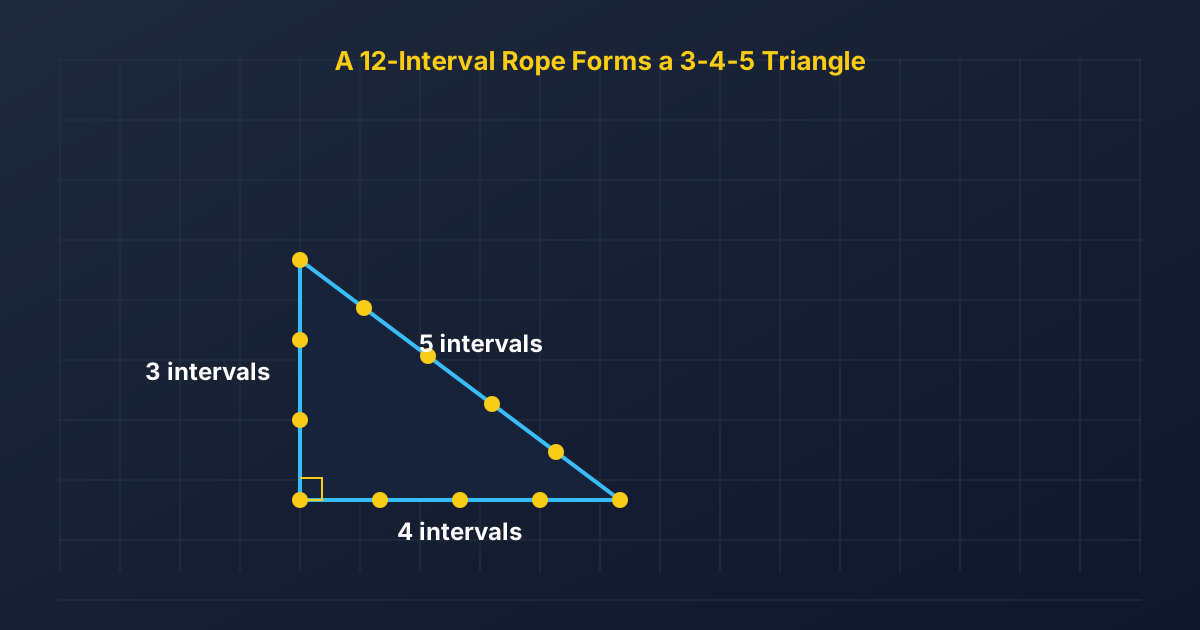
Caption: Modern reconstruction. A closed loop of 12 equal intervals, arranged into sides of 3, 4, and 5. The right angle sits opposite the five-interval side.
Why Does the 3-4-5 Method Work?
The principle is the Pythagorean theorem and its converse, kept carefully apart. The theorem states that in a right triangle with legs a and b and hypotenuse c:
a² + b² = c²
The converse runs the other way: if a triangle’s side lengths satisfy a² + b² = c², then the triangle must be right-angled, with the right angle opposite the longest side. The rope method relies on the converse. The builder does not start from a known right angle and compute sides; the builder starts from measured sides and lets the converse guarantee the angle.
For the 3-4-5 triangle:
3² + 4² = 9 + 16 = 25 = 5²
The squares on the three sides tell the same story visually: a square of area 9 and a square of area 16 together equal a square of area 25. That equality is why the angle must be 90°, and it is also why the method needs no angle measurement at all.
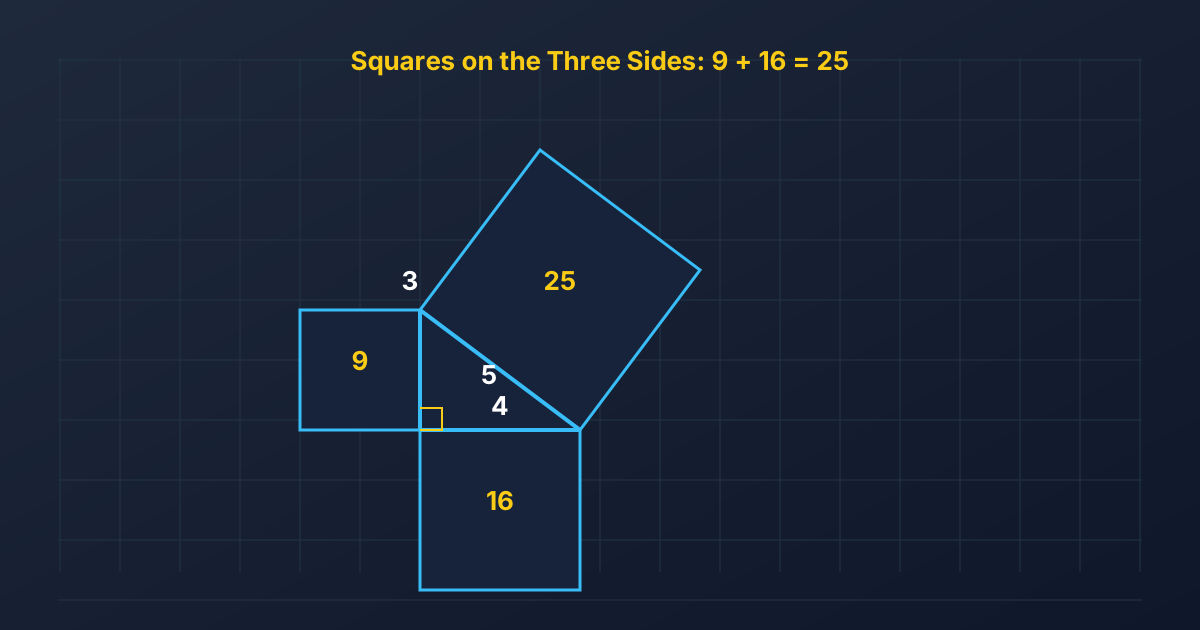
Caption: The squares on the sides. 9 + 16 = 25, which is why the triangle must contain a right angle.
A Step-by-Step Example of Using the 3-4-5 Triangle in Construction
Imagine a builder marking out a rectangular garden or foundation and needing one square corner. The process uses metres throughout, though any consistent unit works:
- Establish a starting point, the corner, and drive in a peg.
- Mark a straight baseline along one planned side.
- Measure 3 metres along one planned side from the corner peg.
- Measure 4 metres along the other planned side from the corner peg.
- Adjust the position of the third point until the distance between the two measured endpoints is 5 metres.
- Check the triangle’s geometry and secure the layout once the measurements are correct.
The resulting corner is a right angle because the three measured lengths, 3, 4, and 5 metres, satisfy the converse of the Pythagorean theorem. The caution from the previous section still applies: the corner is a right angle only when the measured sides and endpoints are arranged correctly and measurement errors are sufficiently small. Measure twice, pull the tape taut, and the method is reliable at garden scale.
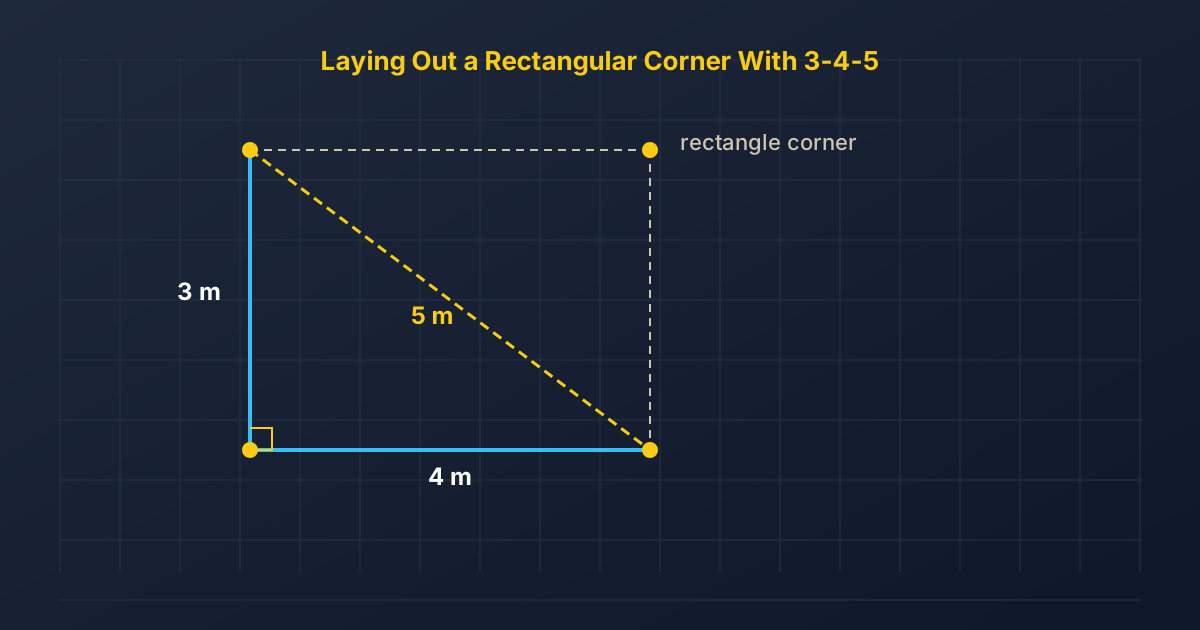
Caption: Modern construction layout. The 3 m and 4 m sides are measured first, and the 5 m diagonal confirms the corner is square.
How the Method Scales to Different Construction Projects
The 3-4-5 ratio can be multiplied by any positive scale factor, and scaling preserves the triangle’s angles because all three sides are multiplied by the same factor:
- 3 m, 4 m, and 5 m.
- 6 m, 8 m, and 10 m.
- 9 m, 12 m, and 15 m.
Each scaled version is still right-angled, since (3k)² + (4k)² = 9k² + 16k² = 25k² = (5k)² for any positive k. Modern uses include laying out garden corners, checking small construction layouts, setting out rectangular spaces, and demonstrating basic surveying principles in classrooms. Larger triangles give better accuracy over larger areas, because a fixed measurement error is a smaller fraction of a longer side.
One limit must stay attached to this enthusiasm: this simple method does not replace professional surveying instruments or precision procedures on large, regulated, or structurally critical construction projects. It is a field check and a teaching tool, not a substitute for a theodolite, a total station, or a licensed survey.
Did Ancient Egyptian Rope Stretchers Really Use the 3-4-5 Triangle?
This section is the heart of the article, because the popular story and the evidence point in different directions. The story connecting Egyptian rope stretchers with the 3-4-5 triangle is widely repeated in educational discussions of geometry, in textbooks, and on the web. The question is what actually supports it.
1. What surviving Egyptian mathematical texts describe surveying, measurement, or geometry?
The main sources are the Rhind Mathematical Papyrus and the Moscow Mathematical Papyrus, both scribal training documents. They cover areas of fields, volumes of granaries, divisions of goods, and pyramid slopes through the seked. They show a strong practical geometry of measurement. Neither describes a rope procedure for constructing right angles, and neither states a 3-4-5 rule.
2. Do the sources explicitly describe a 3-4-5 rope triangle?
No. No surviving Egyptian text describes a marked 12-interval rope arranged into a 3-4-5 triangle, and no such rope survives as an artifact. The earliest clear statement of the connection comes not from Egypt but from the historian Moritz Cantor, who in 1880, in the first volume of his history of mathematics, conjectured that the rope stretchers might have used the 3-4-5 triangle. Cantor himself presented it as a conjecture without a basis in the sources. Later writers repeated the conjecture as if it were a report, and repetition turned it into a fact in many textbooks.
3. Is there direct evidence of a marked 12-interval rope used for this purpose?
No. What is directly evidenced is different in kind: knotted measuring cords were certainly used by Egyptian surveyors, tomb paintings show ropes measuring fields, and the temple foundation ceremony of stretching the cord is documented across three thousand years. None of that evidence specifies a 3-4-5 arrangement. Two further pieces of evidence are often cited, and both need their limits stated. Plutarch, writing around 100 AD, says the Egyptians admired the 3-4-5 triangle as an image of Osiris, Isis, and Horus, but that is a philosophical report from the Roman period, some fifteen centuries after the great pyramids, not a surveying manual. And a Middle Kingdom problem in the Berlin Papyrus 6619 works with two squares whose sides turn out to be 6 and 8 with a combined area of 100, a scaled 3-4-5 triple, which suggests familiarity with the numerical relationship, though not a statement of the theorem and not a surveying procedure.
4. Which claims are documented facts, which are reasonable reconstructions, and which are later educational interpretations?
Documented facts: Egyptian surveyors measured land with cords; the cord-stretching foundation ceremony fixed temple orientations and corners; Egyptian scribes computed areas, volumes, and pyramid slopes; and Egyptian builders laid out remarkably square foundations. Reasonable reconstructions: a 12-interval rope could have produced right angles, and a culture with Egypt’s measuring skill could plausibly have known the 3-4-5 relationship from experience. Later educational interpretations: the claim that rope stretchers routinely used the 3-4-5 method as their standard technique, which is Cantor’s conjecture repeated until it sounded like history. The historian of mathematics Roger Cooke summarized the state of play plainly: there is no evidence that they used it to construct right angles.
That verdict needs its own qualification. The absence of a surviving description is not proof that no Egyptian surveyor ever used the method. Historical evidence is incomplete: field practice rarely reached the scribal documents that survive, and a technique learned by doing might never have been written down. The honest position is neither certainty nor dismissal: the method is mathematically sound and historically plausible, but it is not documented as Egyptian practice, and it should not be taught as though it were.
The Difference Between Practical Geometry and Formal Mathematical Proof
A practical technique can produce a correct result without its users expressing the reasoning in the formal language taught today. Adjusting a rope until three measured lengths form a 3-4-5 triangle is a practical construction: it works whether or not anyone writes down a proof. Demonstrating that the triangle is right-angled using the converse of the Pythagorean theorem is a mathematical explanation: it says why the construction must work, for every case, in advance.
Modern mathematics provides the formal justification for the rope method, and that justification stands on its own. It does not need Egyptian authority to be true, and Egyptian builders do not need a modern proof to have been skilled. Two cautions follow. First, do not assume ancient builders lacked mathematical understanding simply because surviving records are incomplete; their measured achievements, from square pyramid bases to consistent cubit standards, show understanding of a high order. Second, do not read a modern theorem back into their heads: knowing how to get a square corner is not the same as formulating a general theorem about right triangles, and the surviving texts show the first far more clearly than the second.
Other Pythagorean Triples and Right-Angle Methods
The 3-4-5 triangle is the smallest whole-number right triangle, but it is not the only one. Other integer triples include:
- 5-12-13: 5² + 12² = 25 + 144 = 169 = 13².
- 8-15-17: 8² + 15² = 64 + 225 = 289 = 17².
- 7-24-25: 7² + 24² = 49 + 576 = 625 = 25².
Each of these can also form a right triangle and can be used in modern demonstrations or practical measurement. A 5-12-13 rope, for instance, gives a longer, narrower right angle that suits some layouts better than 3-4-5. These triples are mathematical facts, and they do not establish that ancient Egyptian surveyors used them. They belong in this article because they show the 3-4-5 method is one case of a general pattern, not a unique trick.
Common Misconceptions About Ancient Egyptian Geometry
- The historical use of the 3-4-5 triangle is definitively documented. It is not. The claim traces to Cantor’s 1880 conjecture, and no Egyptian source describes the procedure. What is documented is cord measurement in general, not the 3-4-5 arrangement.
- The 3-4-5 triangle was the only way ancient Egyptians could construct a right angle. It was not. Egyptians demonstrably laid out accurate right angles, and several methods can produce one: the intersecting-arcs construction with two equal cords, sighting on stars for orientation, and careful repeated measurement. The 3-4-5 rope is one candidate among several, and not the documented one.
- The method proves that ancient Egyptians had already formulated the Pythagorean theorem in its modern form. It does not. Familiarity with a numerical relationship, as the Berlin Papyrus suggests, is not a general theorem with proof. The general theorem and its proof belong to the Greek tradition.
- Every Egyptian pyramid was built using the 3-4-5 method. No evidence supports this. Pyramid slopes were specified by the seked, a run in palms per cubit of height, not by triangles. Some slopes work out to a 3:4 ratio in modern terms, but that is a consequence of the seked value, not evidence of a rope triangle.
- The method works only with metres or modern measuring units. It works with any consistent unit, because it is a ratio. Cubits, feet, metres, or knots on a cord all work, provided the three sides keep the 3:4:5 proportion.
- A rope triangle automatically produces a perfectly accurate right angle regardless of measurement quality. It does not. Unequal intervals, a sagging or stretching rope, and loose vertices all introduce error. The method guarantees a right angle only to the accuracy of its measurements.
Practice Questions and Answers
- Explain why a triangle with side lengths 3, 4, and 5 is right-angled.
- A rope is marked into 12 equal intervals. Explain how it can be arranged into a 3-4-5 triangle.
- A construction worker uses lengths of 6 m and 8 m for the two legs of a triangle. Calculate the hypotenuse needed for a right triangle.
- Determine whether side lengths 5, 12, and 13 form a right triangle.
- A student claims that the 3-4-5 method proves ancient Egyptian builders used the same procedure. Explain why the mathematical result and the historical claim are different questions.
- Explain two possible sources of measurement error when using a rope to establish a right angle.
Answer Key
1. Because the side lengths satisfy the converse of the Pythagorean theorem: 3² + 4² = 9 + 16 = 25 = 5². A triangle whose sides fit a² + b² = c² must be right-angled, with the right angle opposite the longest side, 5.
2. Join the rope’s ends to form a closed loop of 12 intervals. Divide the loop into sections of 3, 4, and 5 intervals, pull the loop into a triangle with those three side lengths, and secure the vertices. The angle opposite the five-interval side is 90°, by the converse of the Pythagorean theorem.
3. The hypotenuse must satisfy c² = 6² + 8² = 36 + 64 = 100, so c = 10 m. This is the 3-4-5 triangle scaled by 2.
4. Yes. 5² + 12² = 25 + 144 = 169 = 13², so the sides satisfy the converse of the Pythagorean theorem and the triangle is right-angled, with the right angle opposite the side of length 13.
5. The mathematical result and the historical claim answer different questions. The mathematics shows that a 3-4-5 triangle must be right-angled, which is true regardless of history. The historical claim says that specific people, Egyptian rope stretchers, used this specific procedure, which needs documentary or archaeological evidence. No Egyptian source describes the procedure, so the mathematics cannot prove the history. The method is plausible as a reconstruction, not documented as their practice.
6. Any two of these: intervals marked unequally, so the sides are not truly in 3:4:5 proportion; rope stretching or sagging under tension, which changes the effective lengths; knots slipping or vertices not pinned exactly, so the triangle’s corners shift; or measuring on uneven ground, so the rope lengths do not match the ground distances. Each error moves the corner away from a true right angle.
Frequently Asked Questions
Frequently Asked Questions
Common questions about Egyptian rope stretchers and the 3-4-5 triangle, answered briefly.
01 Who were the rope stretchers of ancient Egypt?
Surveying and land-measurement specialists who measured fields, re-established boundaries after the Nile flood, and laid out building foundations using cords. Greek sources call them harpedonaptai, rope stretchers.
02 What is the 3-4-5 triangle?
A right triangle with side lengths 3, 4, and 5 units. It is the smallest Pythagorean triple, and it scales to 6-8-10, 9-12-15, and any other multiple of the same ratio.
03 Why does a 3-4-5 triangle create a right angle?
Because its sides satisfy the converse of the Pythagorean theorem: 3² + 4² = 9 + 16 = 25 = 5². Any triangle with those side lengths must be right-angled, with the right angle opposite the side of length 5.
04 Did ancient Egyptian builders definitely use the 3-4-5 method?
No, not as a documented fact. The claim comes from a conjecture by the historian Moritz Cantor in 1880, and no surviving Egyptian text describes the procedure. Cord measurement itself is well documented, but the 3-4-5 arrangement is not.
05 How can a rope be used to create a right angle?
Mark a cord into 12 equal intervals, join the ends into a loop, and arrange it into a triangle with sides of 3, 4, and 5 intervals. Pull the sides taut and pin the vertices. The angle opposite the five-interval side is 90°.
06 What is the connection between the 3-4-5 triangle and the Pythagorean theorem?
The theorem says a right triangle's sides satisfy a² + b² = c². The 3-4-5 triangle is the smallest whole-number example, and its converse lets a builder start from measured sides and guarantee the right angle.
07 Can the 3-4-5 method be used in modern construction?
Yes, for small layouts such as garden corners and rectangular foundations, and as a teaching demonstration. It does not replace professional surveying instruments on large, regulated, or structurally critical projects.
08 Why is the historical evidence for the exact method important?
Because it separates what Egyptians demonstrably did from what later writers imagined they did. Teaching an undocumented story as fact misrepresents both Egyptian skill, which needs no invented technique to impress, and how history is actually known.
09 Can the 3-4-5 triangle be scaled to larger dimensions?
Yes. Multiply all three sides by the same factor, such as 6-8-10 or 9-12-15, and the triangle stays right-angled, since (3k)² + (4k)² = (5k)² for any positive k.
10 What is the difference between a mathematical reconstruction and archaeological proof?
A reconstruction shows that a method could have worked with the tools available. Archaeological proof requires evidence that it actually was used, such as a text describing it or an artifact built for it. The 3-4-5 rope is a reconstruction, not proof.
Conclusion
The rope stretchers of ancient Egypt measured a civilization that lived by its fields, and their cords, stakes, and rods turned flooded ground back into ordered plots and temple plans. The 3-4-5 triangle belongs in that story as a beautiful piece of mathematics: three measured lengths that guarantee a right angle without any angle-measuring instrument, scalable to any size, and still useful on a building site today. What does not belong in the story as fact is the claim that those surveyors routinely used this exact rope. That claim is a nineteenth-century conjecture, repeated until it sounded like history, and the surviving Egyptian evidence supports cord measurement, temple foundation ceremonies, and practical geometry, but not the 3-4-5 procedure itself.
The broader lesson is worth keeping. Mathematical techniques can explain how historical practices could have worked, and they can even suggest what to look for in the evidence. But a technique that works is not the same as a technique that was used, and historical claims must be supported by evidence, not by repetition. The Egyptians need no borrowed story: their measured fields, square foundations, and surviving mathematics are impressive enough on their own. For the next step, the guide to the Pythagorean theorem formula covers the theorem behind the method, and the guide to constructing a right triangle shows modern straightedge-and-compass ways to get a square corner.
Sources and Further Reading
- British Museum blog, “Learn maths: Egyptian secrets of the Rhind Mathematical Papyrus.” What the Rhind Papyrus actually contains: more than 80 problems copied by Ahmose around 1500 BC, including geometry and the seked slope of pyramids, and the royal cubit of about 52 cm. British Museum
- Corinna Rossi, Architecture and Mathematics in Ancient Egypt, Chapter 4, “Foundation rituals” (Cambridge University Press). The documented stretching-the-cord ceremony: from the First Dynasty to the Ptolemaic period, the king and Seshat drove poles and extended a rope to fix a temple’s orientation and four corners. Cambridge Core
- “Knotted cord” (summary of the evidence debate). The state of the evidence in one place: no surviving evidence that the 3-4-5 triangle was used in ancient Egypt to lay out right angles, Cantor’s conjecture, Plutarch’s late report, the Berlin Papyrus 6619 problem, and Roger Cooke’s conclusion that there is no evidence it was used to construct right angles. Knotted cord
- “Traditions and Myths in the Historiography of Egyptian Mathematics” (Myth no. 3: rope stretching, right angled triangles, and Pythagoras). How Cantor’s conjecture spread through textbooks until repetition made it sound like fact, and why the pyramid batter argument does not support it. Academia.edu