
Why the Square Root of 2 Is Irrational: Proof from a Right Triangle
Math Expert
Geometry
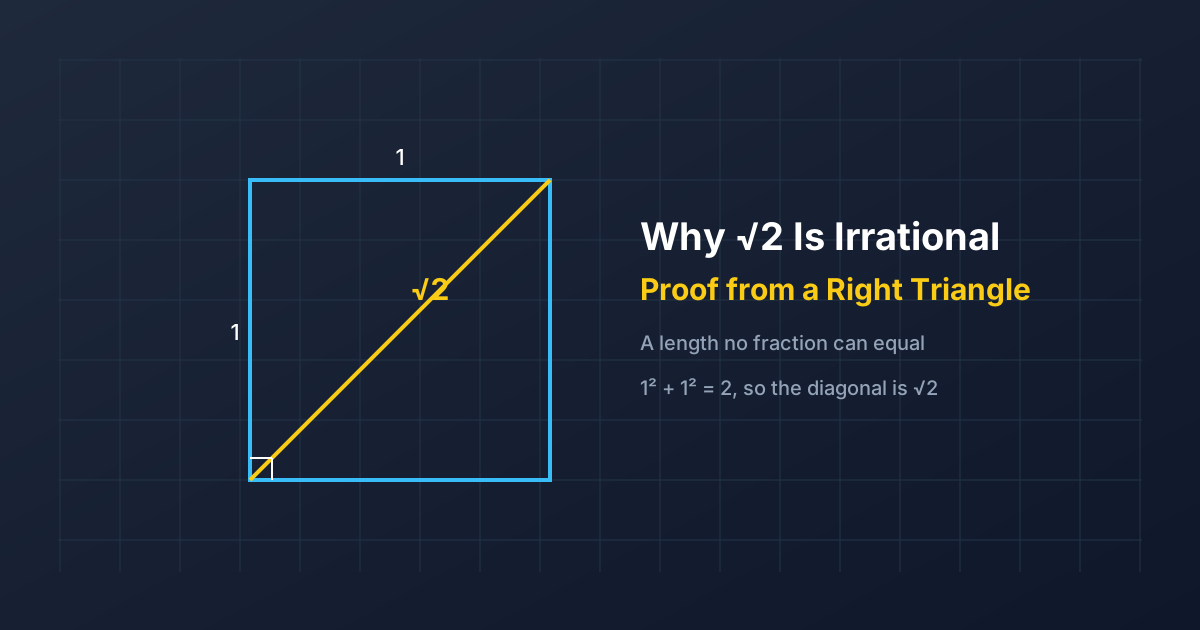
What if a perfectly ordinary right triangle could reveal a number that no fraction can ever represent exactly? Draw a square with sides of length 1, then connect two opposite corners. The diagonal is exactly √2 units long, but no matter how many fractions you try, none will equal it. Why? The answer is hidden in one of the most elegant proofs in mathematics. In this guide you will see how the diagonal of a unit square produces √2, what rational and irrational numbers really mean, and how a short step-by-step argument by contradiction proves that √2 cannot be a fraction. By the end, you will be able to explain the proof yourself, reproduce it for an exam, and tell the difference between an exact value and a decimal approximation.
Is the Square Root of 2 Irrational?
The square root of 2 is irrational because no fraction of two integers can equal it. Suppose √2 = a/b in lowest terms. Squaring gives a² = 2b², so a is even, and writing a = 2k forces b to be even too. Both being even contradicts lowest terms, so the assumption fails and √2 is irrational.
That short answer is the whole proof in miniature, and the rest of this guide unpacks it. One warning belongs at the very start. A right triangle shows where √2 comes from, but the triangle alone does not prove that √2 is irrational. Geometry gives the length. A separate logical argument, the proof by contradiction, establishes that no fraction can equal that length. Keeping those two jobs apart is the key to understanding the whole topic.
What Is the Square Root of 2?
The square root of 2, written √2, is the positive number whose square equals 2. In symbols:
√2 × √2 = 2
Its decimal expansion begins 1.41421356237, and it continues forever without settling into a repeating pattern. That string of digits is an approximation, not an exact representation. No finite decimal equals √2, because √2 is not a number with a finite decimal form at all.
Is √2 a Whole Number?
No. Whole numbers near √2 are 1 and 2, and neither works: 1² = 1 and 2² = 4, while (√2)² = 2. Since 1² is less than 2 and 2² is greater than 2, the number whose square is 2 must sit strictly between 1 and 2. So √2 is about 1.414, caught between two whole numbers but equal to neither.
Is √2 a Rational Number?
A rational number is a number that can be written as a fraction a/b, where a and b are integers and b is not zero. The question “is √2 rational?” therefore asks whether two integers exist with a/b exactly equal to √2. Trying fractions by hand cannot settle it, because failing to find one only shows you have not searched far enough. The question needs a proof, not a search, and the proof by contradiction later in this guide supplies it.
Why Does √2 Have an Infinite Decimal Expansion?
Irrational numbers have decimal expansions that never terminate and never repeat, in base 10. That is a property of irrational numbers, not a proof of irrationality. A long decimal approximation alone cannot prove that a number is irrational: the fraction 1/3 has the infinite decimal 0.333…, yet it is rational because the digit 3 repeats forever. What makes √2 irrational is not the length of its decimal, but the logical fact that no fraction equals it.
Rational vs. Irrational Numbers
A rational number is any value expressible as a/b, where a and b are integers and b is nonzero. Examples include 1/2, 3/4, −5 (which is −5/1), 0.125 (which is 1/8), and 0.333… (which is 1/3). Every terminating decimal is rational, and every repeating decimal is rational, because both kinds can be converted into fractions.
An irrational number is a real number that cannot be expressed as a fraction of two integers. Its decimal expansion never terminates and never repeats. Examples include √2, √3, π, and e. Irrational numbers are real numbers, not imaginary numbers: they sit on the ordinary number line, while imaginary numbers involve i, the number with i² = −1, which is a different idea entirely.
| Feature | Rational numbers | Irrational numbers |
|---|---|---|
| Definition | Can be written as a/b, with a and b integers and b ≠ 0 | Cannot be written as a/b for any integers a and b |
| Decimal behavior | Terminates or repeats | Never terminates and never repeats |
| Examples | 1/2, 3/4, −5, 0.125, 0.333… | √2, √3, π, e |
| Position on the number line | Real numbers | Real numbers |
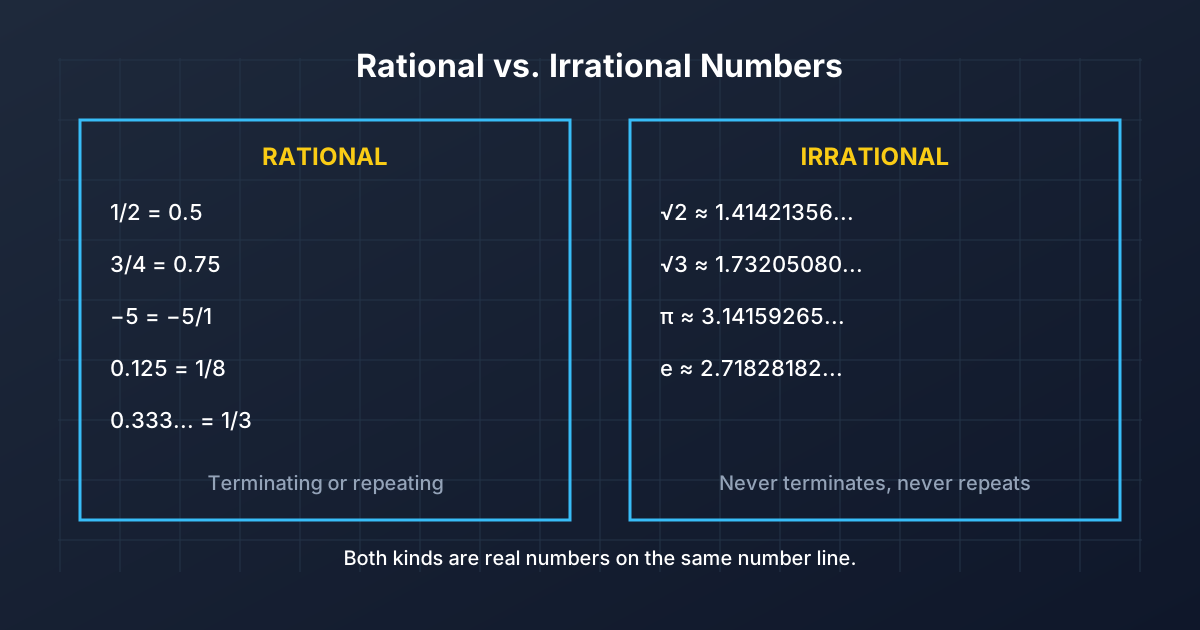
Caption: Rational numbers are fractions of integers, with terminating or repeating decimals. Irrational numbers cannot be written as fractions, and their decimals never terminate or repeat. Both kinds are real numbers.
How Does a Right Triangle Produce √2?
Take a right triangle with two perpendicular legs, each measuring 1 unit. The Pythagorean theorem relates the legs a and b to the hypotenuse c:
a² + b² = c²
Substituting a = 1 and b = 1 gives:
1² + 1² = c²
1 + 1 = c²
c² = 2
c = √2
The positive root is used because c is a geometric length, and lengths are positive. (The equation c² = 2 also has the negative solution c = −√2, but a length of −√2 units has no geometric meaning here.)
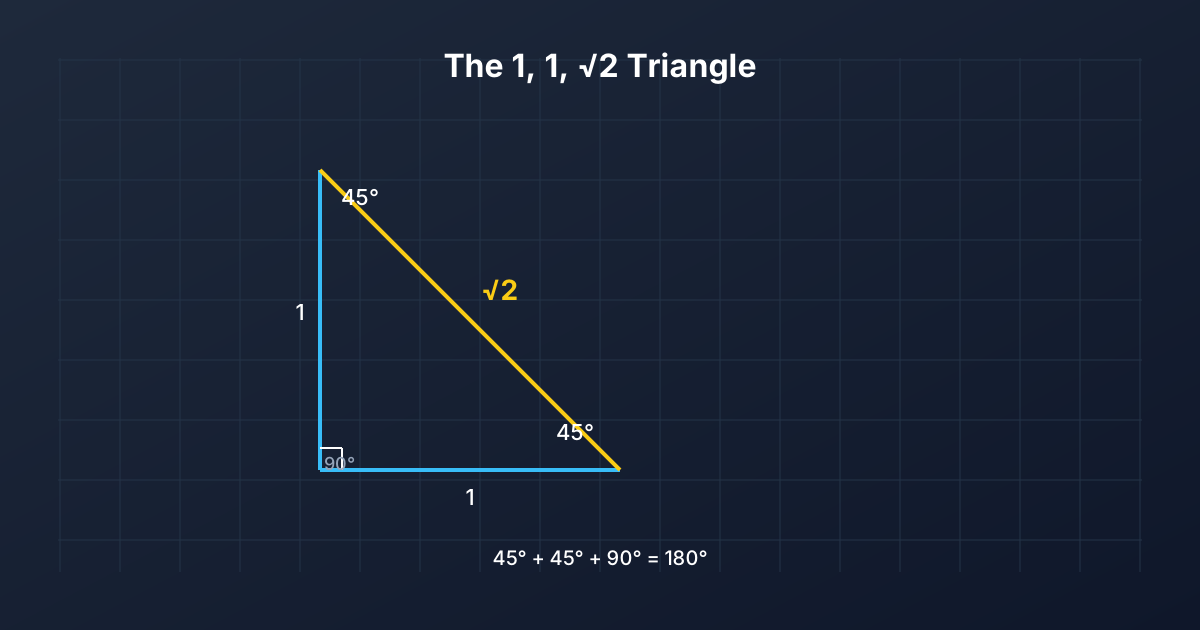
Caption: A right triangle with legs 1 and 1 has hypotenuse √2. Its angles are 45°, 45°, and 90°, and its side ratio is 1 : 1 : √2.
The 45°–45°–90° Triangle
Equal legs make an isosceles right triangle, with angles 45°, 45°, and 90°. Its side ratio is 1 : 1 : √2: the two legs are equal, and the hypotenuse is √2 times either leg. The isosceles right triangle guide explores this shape in full. For this article, the point is simple: the most symmetric right triangle you can draw already contains √2 as an exact length.
The Diagonal of a Unit Square
Draw a square with side length 1, then draw a diagonal between two opposite corners. The diagonal divides the square into two congruent right triangles, each with legs 1 and 1. By the calculation above, the diagonal has length √2. This is the classic picture of √2: a length you can draw exactly with a ruler and compass, even though no fraction names it.
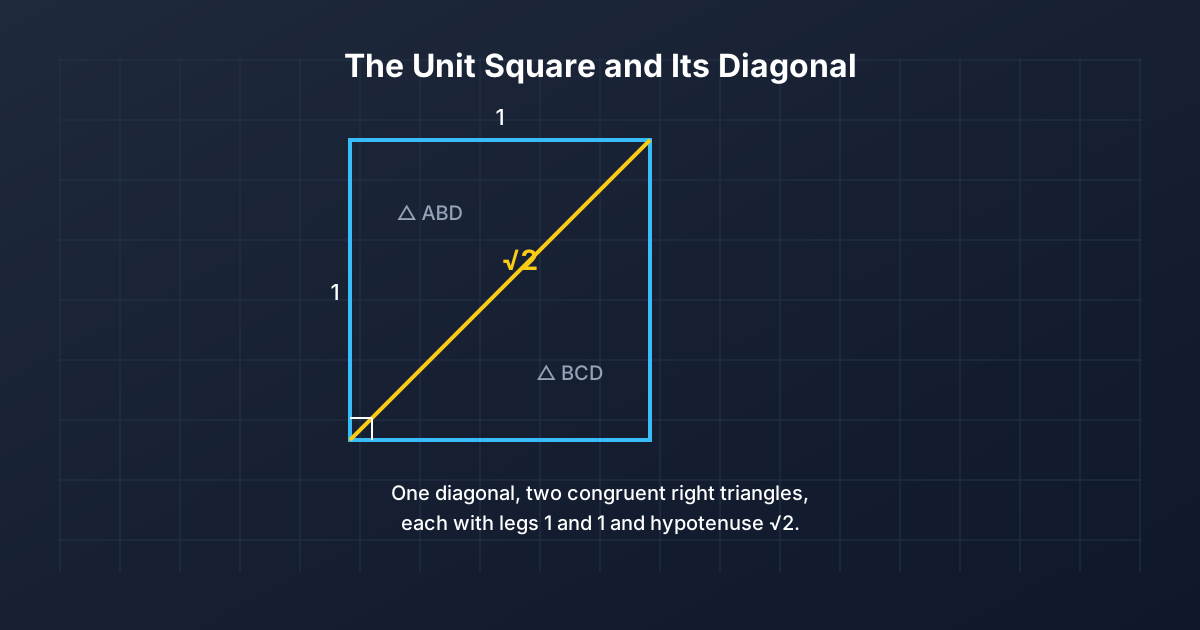
Caption: The diagonal of a unit square divides it into two congruent right triangles with legs 1 and 1. The diagonal is exactly √2 units long.
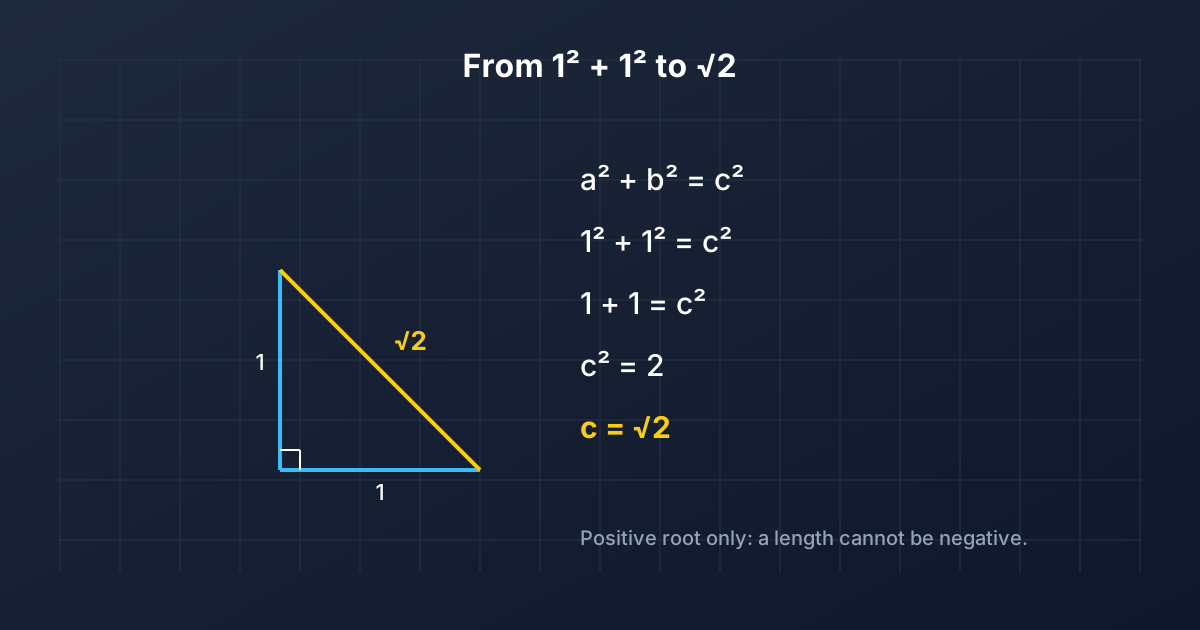
Caption: The derivation in five lines. The Pythagorean theorem turns the two unit legs into c² = 2, and the positive root gives c = √2.
Why the Geometry Matters
The geometry matters because it shows that √2 is an exact length, not a vague approximation. You can construct it, point to it, and measure against it. But constructibility is a different property from rationality. A length can be exactly constructible and still impossible to write as a fraction. That distinction is the whole story of this article: the triangle produces √2, and a separate proof shows that √2 is irrational. Neither half replaces the other.
Why Is √2 Irrational? Step-by-Step Proof by Contradiction
Proof by contradiction works by assuming the opposite of what you want to prove and showing that the assumption leads to an impossibility. Here the claim is “√2 is irrational”, so the assumption is “√2 is rational”. Follow that assumption to its end and it collapses.
Step 1: Assume √2 Is Rational
Suppose:
√2 = a/b
where a and b are integers, b ≠ 0, and the fraction a/b is in lowest terms. “Lowest terms” means a and b share no common factor greater than 1. For example, 6/10 is not in lowest terms because both numbers are divisible by 2, but 3/5 is, because 3 and 5 share no common factor greater than 1. Any fraction can be reduced to lowest terms by dividing out common factors, so assuming lowest terms costs nothing: if √2 were rational at all, some fraction in lowest terms would equal it.
Step 2: Square Both Sides
Squaring √2 = a/b gives:
2 = a²/b²
Multiplying both sides by b² gives:
a² = 2b²
This equation is the engine of the proof. Everything after it is parity reasoning: even and odd.
Step 3: Show That a Is Even
The equation a² = 2b² says a² equals twice an integer, so a² is even. A separate lemma, proved in the next section, says that if an integer’s square is even, the integer itself must be even. Applying it here: a is even.
Step 4: Substitute a = 2k
Since a is even, write a = 2k for some integer k. Substituting into a² = 2b² gives:
(2k)² = 2b²
4k² = 2b²
Dividing by 2 gives:
2k² = b²
Step 5: Show That b Is Even
Now b² = 2k², so b² is even for the same reason a² was: it equals twice an integer. Applying the same lemma again, b is even.
Step 6: Identify the Contradiction
Both a and b are even, so both are divisible by 2. But Step 1 assumed a/b was in lowest terms, meaning a and b share no common factor greater than 1. A common factor of 2 directly contradicts that assumption. The assumption has produced an impossibility.
Step 7: State the Conclusion
Since the assumption that √2 is rational leads to a contradiction, the assumption must be false. Therefore:
√2 is irrational.
The logical shape is worth naming plainly. The proof never inspects a decimal, never tries fractions one by one, and never measures anything. It shows that the very idea of a lowest-terms fraction equal to √2 destroys itself, because such a fraction would have to be reducible after all.
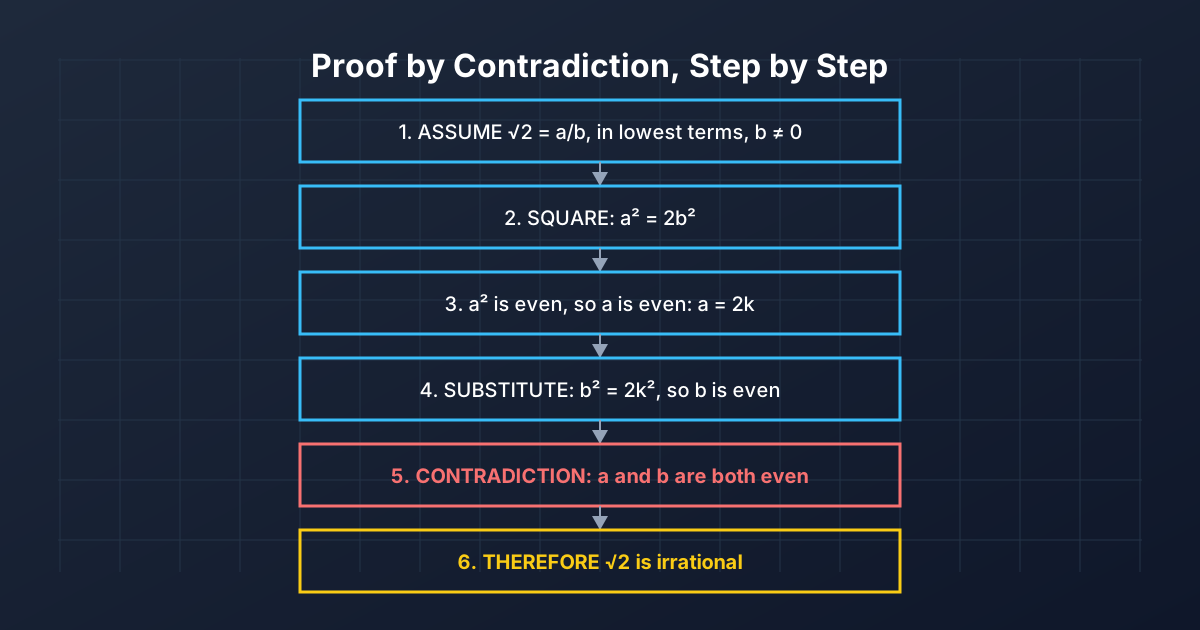
Caption: The proof in six boxes. Each step follows from the last, and the contradiction in box 5 kills the assumption in box 1.
Exam-Ready Short Proof
Suppose √2 = a/b in lowest terms, with b ≠ 0. Then a² = 2b², so a² is even, so a is even; write a = 2k. Then 4k² = 2b², so b² = 2k², so b² is even, so b is even. But then a and b share the factor 2, contradicting lowest terms. Hence √2 is irrational.
Why Does an Even Square Mean an Even Number?
Step 3 and Step 5 both lean on one lemma: if an integer’s square is even, the integer itself is even. This step cannot simply be asserted in a rigorous proof, so here it is, proved.
Start with odd integers. An odd integer can always be written as n = 2k + 1 for some integer k. Squaring gives:
n² = (2k + 1)²
n² = 4k² + 4k + 1
n² = 2(2k² + 2k) + 1
The last line shows n² is one more than twice an integer, which is exactly what it means to be odd. So every odd integer has an odd square. Contraposition finishes the job: if n² is not odd, then n is not odd. An integer is either even or odd, so if n² is even, n must be even.
A numerical illustration makes the algebra concrete. Take n = 7, so k = 3: 7² = 49, and 49 = 2(2·9 + 2·3) + 1 = 2·24 + 1. Take n = 11, so k = 5: 11² = 121, and 121 = 2(2·25 + 2·5) + 1 = 2·60 + 1. In both cases the square is odd, exactly as the formula predicts.
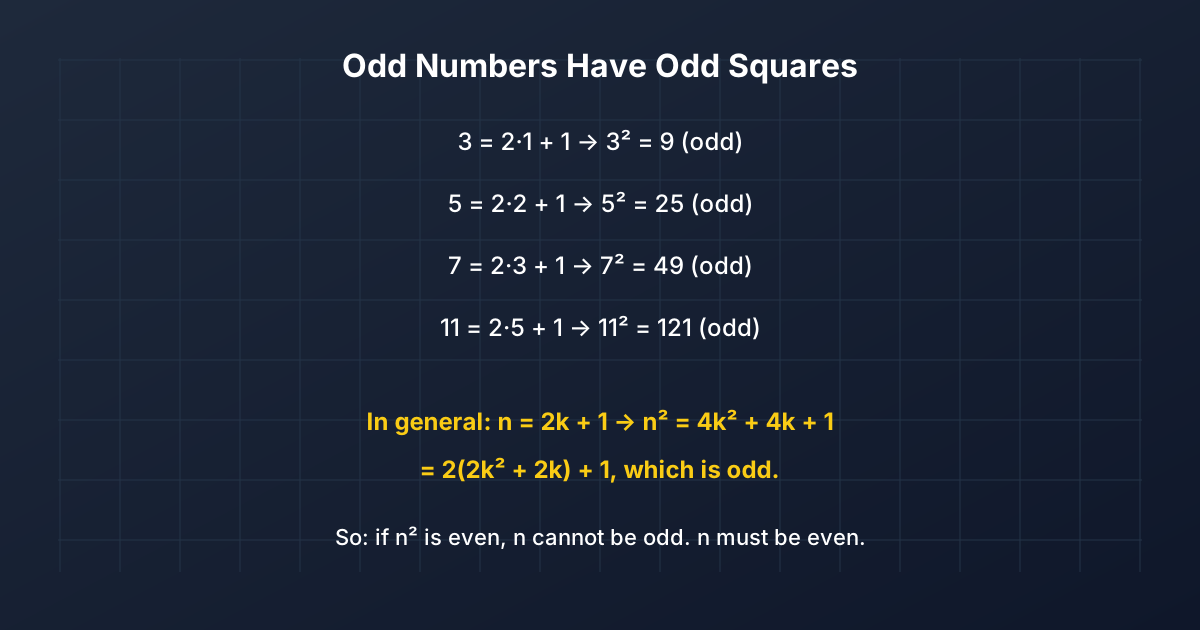
Caption: Odd squares are odd, by direct expansion. That is why an even square forces an even root, the lemma the whole proof depends on.
Geometric Intuition: Why the Diagonal Cannot Be Measured by a Common Fractional Unit
The ancient Greek way of thinking about this problem was geometric. Ask: can the side and the diagonal of a unit square both be exact whole-number multiples of one common smaller length? If such a common unit existed, say the side measured m units and the diagonal measured n units, then the ratio diagonal/side would be n/m, a fraction, and √2 would be rational. The contradiction proof says no such common unit exists: the side and the diagonal are incommensurable, meaning no single unit measures both exactly with whole numbers.
This picture is intuition, and it is honest to label it as such. It explains why the result feels surprising, and it points at the same impossibility the algebra proves. But it is not a separate rigorous proof unless every step is established, which is why this guide does not rest its case on the picture. The algebraic contradiction proof carries the rigor; the incommensurability picture carries the meaning. A complete geometric version does exist, and it appears below as the infinite-descent proof, where the minimal-triangle argument turns the picture into a proof.
Alternative Proofs That √2 Is Irrational
The contradiction proof is the standard one, but two alternatives deepen understanding. Both are complete arguments, not sketches.
Proof Using Prime Factorization
Every integer greater than 1 has a unique prime factorization, and squaring an integer doubles every exponent in that factorization. Suppose a² = 2b², with a and b positive integers. Count the exponent of the prime 2 on each side. On the left, the exponent of 2 in a² is twice the exponent of 2 in a, hence even. On the right, the exponent of 2 in 2b² is 1 plus twice the exponent of 2 in b, hence odd. An integer cannot have the exponent of 2 be both even and odd, so no such a and b exist, and √2 is irrational.
A concrete check shows the pattern. Take a = 12 = 2² × 3, so a² = 2⁴ × 3², where the exponent of 2 is 4, an even number. Take b = 6 = 2 × 3, so 2b² = 2 × 2² × 3² = 2³ × 3², where the exponent of 2 is 3, an odd number. The two sides of a² = 2b² would need matching exponents, and even can never equal odd.
Proof Using Infinite Descent
Infinite descent is the same impossibility viewed as a shrinking process. Suppose √2 were rational. Then some positive integer q exists with q√2 also an integer; call it p, so p² = 2q². Choose the smallest such q. Since √2 lies between 1 and 2, the integer p satisfies q < p < 2q: it is larger than q because p² = 2q² is larger than q², and smaller than 2q because p² = 2q² is smaller than 4q². Now consider m = p − q. It is a positive integer smaller than q, because p < 2q gives m < q, and p > q gives m > 0. Multiply by √2:
m√2 = (p − q)√2 = p√2 − q√2 = 2q − p
The last equality uses p√2 = 2q (from p = q√2, multiplying by √2) and q√2 = p. So m√2 = 2q − p, which is an integer, and m is smaller than q. That contradicts the choice of q as the smallest such integer. No smallest q exists, so no such q exists at all, and √2 is irrational.
Geometrically, this is the smaller-triangle picture made rigorous: from a hypothetical integer-sided isosceles right triangle, the construction always yields a smaller one, so a smallest one cannot exist.
Which Proof Is Easiest for Beginners?
The lowest-terms contradiction proof is the easiest for most beginners, because it needs only the even-square lemma and a few lines of algebra. The prime-factorization proof is shorter once unique factorization is available, but it leans on a heavier theorem. The infinite-descent proof is elegant and visual, but the minimality argument takes a moment longer to absorb. Learn the contradiction proof first, then use the other two as confirmation that the result does not depend on one trick.
Why Can’t √2 Be Written as a Fraction?
Fractions like 7/5, 10/7, and 99/70 are approximations of √2, never equalities. Their errors are easy to compute:
7/5 = 1.4, which is less than √2, with absolute error about 0.01421356.
10/7 ≈ 1.42857143, which is greater than √2, with absolute error about 0.01435787.
99/70 ≈ 1.41428571, which is greater than √2, with absolute error about 0.00007215.
The direction of each error can be checked without a calculator: 7/5 is less than √2 because (7/5)² = 49/25 = 1.96, which is less than 2; 99/70 is greater than √2 because 99² = 9801, which is greater than 9800 = 2 × 70². The fraction 99/70 is remarkably close, missing by less than one ten-thousandth, yet closeness is not equality. No integers a and b with b ≠ 0 satisfy a/b = √2, and that is exactly what the contradiction proof established. Checking many fractions, however many, could never prove this: a proof must rule out all fractions at once, including ones nobody has tried.
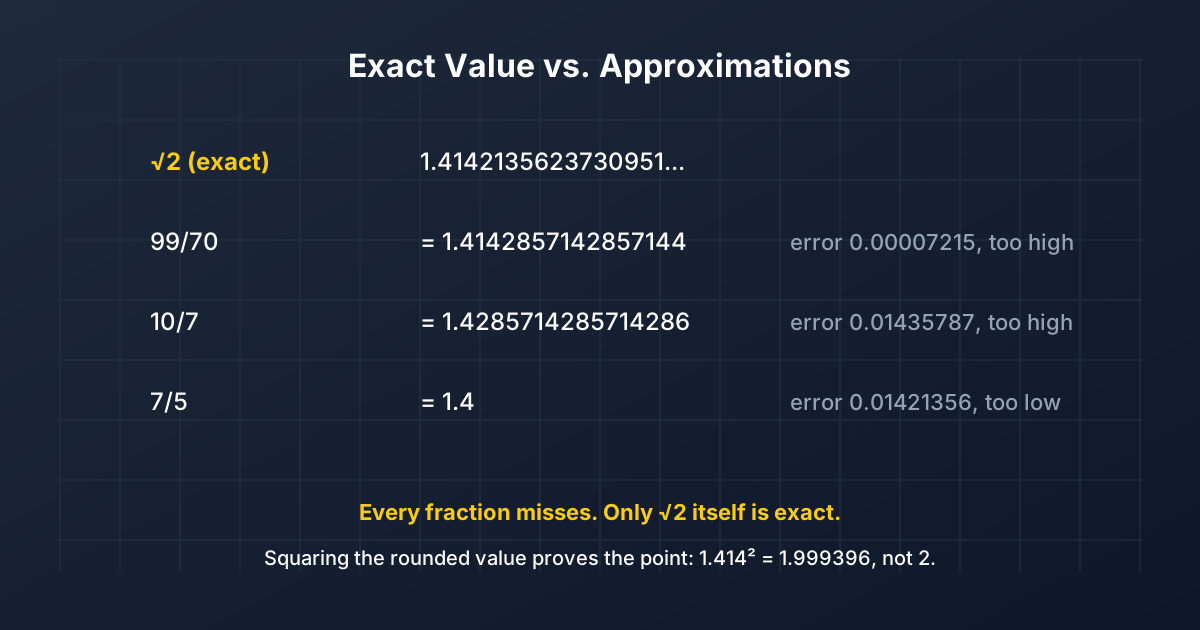
Caption: Three good approximations and their errors. Even 99/70, accurate to about four decimal places, is not equal to √2. Only √2 itself is exact.
Square Root of 2 on the Number Line
An irrational number still has an exact address on the number line, and √2 can be marked there with a compass and straightedge.
Step 1
Mark 0 and 1 on a number line.
Step 2
Construct a perpendicular segment of length 1 at the point representing 1.
Step 3
Connect its upper endpoint to 0. By the Pythagorean theorem, this hypotenuse has length √2, since 1² + 1² = 2.
Step 4
Use a compass centered at 0, opened to the hypotenuse length, to transfer that length to the number line.
Step 5
Mark the intersection on the positive number line as √2.
This is an exact construction: the marked point is √2 itself, not an approximation of it. The compass does not measure 1.414 and hope; it carries the true hypotenuse length onto the line. So √2 is a real point on the number line, sitting between 1 and 2, exactly where the construction puts it.
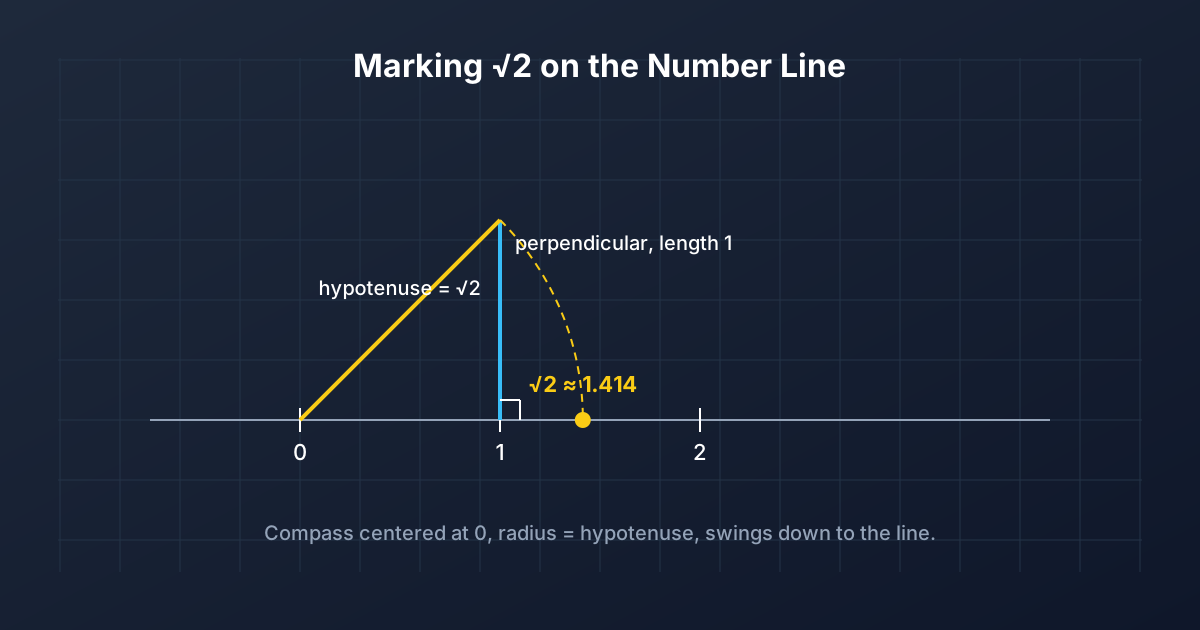
Caption: The hypotenuse of the 1, 1, √2 triangle, swung down onto the number line by a compass arc centered at 0, lands exactly on √2.
Is √2 Irrational but Constructible?
Four ideas need separating, because beginners often blur them:
| Idea | Meaning | Is √2 an example? |
|---|---|---|
| Rational | Can be written as a/b for integers a and b, b ≠ 0 | No |
| Irrational | Cannot be written as such a fraction | Yes |
| Constructible | Can be built with compass and straightedge from a unit length | Yes |
| Real | Sits on the ordinary number line | Yes |
So √2 is irrational yet constructible: it cannot be written as a fraction, but it can be built exactly with a compass and straightedge, as the number-line construction just showed. The two properties answer different questions. Rationality asks whether a number is a ratio of integers. Constructibility asks whether it can be drawn from a unit segment with classical tools.
One caution: not all irrational numbers are constructible. The numbers π and e are transcendental, meaning they are not roots of any polynomial equation with integer coefficients, and no compass-and-straightedge construction can produce them. √2 is special in being both irrational and constructible, because it is the root of the simple equation x² = 2.
Worked Examples Involving √2 and Right Triangles
Example 1: Unit Square Diagonal
Problem: Find the diagonal of a square with side length 1.
Given: Side length 1.
Formula: Diagonal² = side² + side², by the Pythagorean theorem applied to either half of the square.
Calculation: Diagonal² = 1² + 1² = 2, so diagonal = √2.
Exact answer: √2 units.
Approximation: About 1.41 units.
Explanation: This is the defining example of the article: the simplest square already produces an irrational length.
Example 2: Square With Side Length 5 cm
Problem: Find the diagonal of a square with side length 5 cm, exactly and approximately.
Given: Side length 5 cm.
Formula: Diagonal = side × √2.
Calculation: Diagonal = 5√2 cm. Since √2 ≈ 1.41421356, the diagonal is about 5 × 1.41421356 = 7.07106781 cm.
Exact answer: 5√2 cm.
Approximation: About 7.07 cm.
Explanation: Scaling the unit square by 5 scales the diagonal by 5 as well. The exact answer keeps the radical; the decimal is only an approximation.
Example 3: Isosceles Right Triangle
Problem: A 45°–45°–90° triangle has legs of 7 cm. Find the hypotenuse.
Given: Legs 7 cm and 7 cm.
Formula: Hypotenuse = leg × √2.
Calculation: Hypotenuse = 7√2 cm ≈ 7 × 1.41421356 = 9.89949494 cm.
Exact answer: 7√2 cm.
Approximation: About 9.90 cm.
Explanation: In a 45°–45°–90° triangle the hypotenuse is always √2 times either leg, so no squaring and adding is needed once the ratio is known.
Example 4: Hypotenuse to Leg
Problem: An isosceles right triangle has hypotenuse 10 cm. Find the length of each leg.
Given: Hypotenuse 10 cm, legs equal.
Formula: Leg = hypotenuse / √2.
Calculation: Leg = 10/√2 cm. Rationalizing the denominator: 10/√2 = (10√2)/2 = 5√2 cm ≈ 5 × 1.41421356 = 7.07106781 cm.
Exact answer: 5√2 cm per leg.
Approximation: About 7.07 cm per leg.
Explanation: Dividing by √2 is the reverse of Example 3. Check: (5√2)² + (5√2)² = 50 + 50 = 100 = 10², as required.
Example 5: Rational Approximation
Problem: Compare 7/5 with √2 and calculate the approximation error.
Given: The fraction 7/5 and √2 ≈ 1.41421356.
Formula: Error = |√2 − fraction|.
Calculation: 7/5 = 1.4. Error = |1.41421356 − 1.4| ≈ 0.01421356.
Exact answer: 7/5 is less than √2, since (7/5)² = 49/25 = 1.96, which is less than 2.
Approximation: 7/5 ≈ 1.4, missing √2 by about 0.0142.
Explanation: The error tells how far the fraction falls short, but it does not tell the whole story: no matter how small the error of some other fraction, that fraction still would not equal √2.
Example 6: Proof Reasoning
Problem: Explain why the equation a² = 2b² contradicts a fraction a/b being in lowest terms.
Given: Integers a and b with a² = 2b², and a/b in lowest terms.
Formula: The parity chain: a² even, so a even; a = 2k gives b² = 2k², so b even.
Calculation: From a² = 2b², a² is even, so a is even; write a = 2k. Then 4k² = 2b², so b² = 2k², so b² is even, so b is even.
Exact answer: Both a and b are even, sharing the factor 2.
Explanation: A fraction in lowest terms cannot have numerator and denominator sharing a factor of 2. The equation forces exactly that, so the original assumption, that some lowest-terms fraction equals √2, is impossible.
Common Misconceptions About √2
1. Assuming every square root is irrational
Correction: Only square roots of non-perfect squares are irrational. √4 = 2, √9 = 3, and √16 = 4 are whole numbers, hence rational. Test whether the number under the root is a perfect square before classifying.
2. Believing a long decimal proves irrationality
Correction: Length proves nothing. The fraction 1/3 has the infinite decimal 0.333…, yet it is rational because the digit repeats. Irrationality needs a proof, like the contradiction argument, not a long decimal printout.
3. Treating √2 ≈ 1.414 as exact equality
Correction: 1.414 is a rounded approximation. Squaring it gives 1.414² = 1.999396, not 2. The symbol ≈ means “approximately equal”, and replacing it with = turns a good approximation into a false statement.
4. Thinking irrational numbers cannot be represented geometrically
Correction: √2 is a geometric length: the diagonal of a unit square. It can be drawn with a ruler and compass and marked exactly on the number line. Irrational means “not a fraction”, not “not drawable”.
5. Confusing irrational numbers with imaginary numbers
Correction: Irrational numbers are real numbers on the ordinary number line. Imaginary numbers involve i, defined by i² = −1. √2 is real; i is not. The two classifications are unrelated.
6. Assuming √2 cannot be approximated by fractions
Correction: Approximations exist and can be excellent. The fraction 99/70 misses √2 by only about 0.00007215. What is impossible is exact equality, not close approximation.
7. Forgetting that a rational fraction can be reduced to lowest terms
Correction: Lowest terms is what makes the contradiction work. Without it, finding a and b both even would mean nothing: 14/10 has both parts even, yet it reduces to 7/5. The proof assumes lowest terms first, then shows both parts must still be even, which is impossible.
8. Claiming a² is even without explaining why a is even
Correction: The step needs the odd-square lemma: an odd integer n = 2k + 1 has square n² = 2(2k² + 2k) + 1, which is odd. So an even square cannot come from an odd integer. Skipping this lemma leaves a gap in the proof.
9. Believing the Pythagorean theorem alone proves irrationality
Correction: The Pythagorean theorem only produces the length √2 from legs 1 and 1. It says nothing about whether that length is a fraction. Irrationality requires the separate parity and contradiction argument.
10. Confusing an exact radical expression with a decimal approximation
Correction: √2 is exact; 1.41421356 is rounded. Using the rounded value in further computation introduces error that compounds: (1.414)² = 1.999396, visibly short of 2. Keep the radical for exact work and round only at the final step.
Historical Background: The Discovery of Irrational Numbers
The discovery of irrational numbers belongs to ancient Greek mathematics, where lengths were compared by asking whether two lengths shared a common measuring unit. The diagonal and side of a square became the famous test case: no common unit measures both exactly, and the contradiction proof turns that geometric fact into arithmetic.
The discovery is traditionally associated with the Pythagorean tradition, the school around Pythagoras that treated whole numbers and their ratios as the foundation of mathematics. Incommensurable lengths challenged that worldview, because they showed that geometry contains lengths no ratio of whole numbers can express. How the Pythagoreans reacted, and who first proved the result, is not firmly established by surviving evidence, so this guide does not name a single discoverer.
One story needs explicit caution. Later legends tell of Hippasus, a Pythagorean allegedly punished, even drowned, for revealing irrational numbers. That story is legend, not verified fact: no contemporary source confirms it, and it appears in writings from centuries later. It is a colorful tale, not history to be trusted.
What is firmly established is older and more interesting. The Babylonian clay tablet YBC 7289, from around 1800 to 1600 BC, records an approximation of √2 in base 60 that is accurate to roughly six decimal places, long before any Greek proof. Practical mathematicians could compute with √2 accurately for centuries before anyone proved it irrational. The proof mattered not for calculation but for understanding: it showed that the number system itself had gaps no fraction could fill.
Why Is the Irrationality of √2 Important?
Number Theory
Irrationality is the first step into the structure of the real numbers: rationals are countable and full of gaps, while irrationals fill those gaps. Understanding √2 is understanding why fractions alone are not enough.
Geometry
Incommensurable lengths changed geometry permanently. Once the diagonal of a square was known to resist fractional measurement, geometry could no longer be reduced to counting units. Length became its own concept, independent of fractions.
Algebra
Exact radicals like √2 teach symbolic thinking: keep √2 as √2 during a calculation and round only at the end. That habit prevents the creeping error that comes from rounding early, as the 1.414² = 1.999396 example shows.
Mathematical Proof
The contradiction proof is many students’ first encounter with proof by contradiction, a technique that runs through all of mathematics. It is short, complete, and convincing, which makes it an ideal first proof to master.
Real Number System
The real numbers include both rationals and irrationals, and √2 is the simplest proof that the rationals alone leave gaps. Without irrationals, the number line would have holes at every non-perfect square root, at π, and at e.
Mathematics Education
The topic trains rigorous reasoning instead of numerical observation. A student who can reproduce the contradiction proof has learned to argue from definitions and logic, not from examples or calculator displays. That skill transfers to every proof that follows.
Practice Questions About √2 and Irrational Numbers
Beginner Level
Question 1. Classify each number as rational or irrational: 3/4, √2, 0.5, π, √9.
Question 2. A square has side length 2 cm. Find its diagonal exactly and approximately.
Question 3. An isosceles right triangle has legs of 4 cm. Find its hypotenuse exactly and approximately.
Question 4. Is 1.414 a rational number? Explain.
Question 5. What does “lowest terms” mean? Give an example of a fraction that is not in lowest terms and its reduced form.
Intermediate Level
Question 6. A square has side length 3 cm. Find its diagonal exactly and approximately.
Question 7. An isosceles right triangle has hypotenuse 12 cm. Find the length of each leg exactly and approximately.
Question 8. Compare 17/12 with √2. Which is larger, and what is the absolute error?
Question 9. Show that 11² is odd by writing 11 in the form 2k + 1 and expanding.
Question 10. Explain why √4 is rational while √2 is not, by showing where the contradiction proof fails for √4.
Advanced Level
Question 11. Reproduce the full proof by contradiction that √2 is irrational, starting from the assumption √2 = a/b in lowest terms.
Question 12. Prove that √2 is irrational using prime factorization and the exponents of the prime 2.
Question 13. Describe, step by step, how to mark √2 exactly on a number line with a compass and straightedge.
Question 14. Prove that 2√2 is irrational.
Question 15. Prove that √3 is irrational using prime factorization and the exponents of the prime 3.
Answer Key
Answer 1. Rational, irrational, rational, irrational, rational. 3/4 and 0.5 are fractions or terminating decimals; π and √2 cannot be written as fractions; √9 = 3, a whole number.
Answer 2. Diagonal = 2√2 cm, about 2.83 cm, since 2 × 1.41421356 ≈ 2.82842712.
Answer 3. Hypotenuse = 4√2 cm, about 5.66 cm, since 4 × 1.41421356 ≈ 5.65685425.
Answer 4. Yes. 1.414 = 1414/1000 = 707/500, a ratio of integers with a terminating decimal. It approximates √2 but is not √2 itself.
Answer 5. Lowest terms means the numerator and denominator share no common factor greater than 1. For example, 6/10 is not in lowest terms; dividing both parts by 2 gives 3/5, which is.
Answer 6. Diagonal = 3√2 cm, about 4.24 cm, since 3 × 1.41421356 ≈ 4.24264069.
Answer 7. Each leg = 12/√2 = 6√2 cm, about 8.49 cm, since 6 × 1.41421356 ≈ 8.48528137. Check: (6√2)² + (6√2)² = 72 + 72 = 144 = 12².
Answer 8. 17/12 is larger. 17/12 ≈ 1.41666667, and 17² = 289 is greater than 2 × 12² = 288, so (17/12)² is greater than 2. Absolute error ≈ |1.41421356 − 1.41666667| ≈ 0.00245310.
Answer 9. 11 = 2·5 + 1, so k = 5. Then 11² = 2(2·25 + 2·5) + 1 = 2·60 + 1 = 121, which is odd, as expected.
Answer 10. √4 = 2 = 2/1, so it is rational. The contradiction proof fails for √4 because a² = 4b² gives a = 2k, then 4k² = 4b², so k² = b², and b = k is possible. No contradiction arises, because b need not be even.
Answer 11. Suppose √2 = a/b in lowest terms, b ≠ 0. Then a² = 2b², so a² is even, so a is even; write a = 2k. Then 4k² = 2b², so b² = 2k², so b² is even, so b is even. Both a and b even contradicts lowest terms. Hence √2 is irrational.
Answer 12. Suppose a² = 2b². The exponent of 2 in a² is twice the exponent of 2 in a, hence even. The exponent of 2 in 2b² is 1 plus twice the exponent of 2 in b, hence odd. Even cannot equal odd, so no such a and b exist, and √2 is irrational.
Answer 13. Mark 0 and 1 on the line. Raise a perpendicular of length 1 at 1. Join its top to 0, giving a hypotenuse of length √2. With the compass centered at 0 and opened to that hypotenuse, swing an arc down to the line. The intersection on the positive side is √2.
Answer 14. Suppose 2√2 were rational, equal to some fraction r. Then √2 = r/2 would also be a ratio of integers, hence rational, contradicting the irrationality of √2. So 2√2 is irrational.
Answer 15. Suppose √3 = a/b, so a² = 3b². The exponent of 3 in a² is twice the exponent of 3 in a, hence even. The exponent of 3 in 3b² is 1 plus twice the exponent of 3 in b, hence odd. Even cannot equal odd, so no such a and b exist, and √3 is irrational.
Frequently Asked Questions
Frequently Asked Questions
Common questions about why the square root of 2 is irrational, answered briefly.
01 Why is the square root of 2 irrational?
Because no fraction of two integers can equal it. Suppose √2 = a/b in lowest terms. Squaring gives a² = 2b², so a is even; writing a = 2k forces b to be even as well. Both parts being even contradicts lowest terms, so the assumption fails. That contradiction is the whole proof.
02 What is the simplest proof that √2 is irrational?
The proof by contradiction in seven short steps. Assume √2 = a/b in lowest terms, square to get a² = 2b², deduce that a is even, substitute a = 2k to get b² = 2k², deduce that b is even, and note the contradiction: a fraction in lowest terms cannot have both parts even. Therefore √2 is irrational.
03 Can √2 be written as a fraction?
No. Every fraction is either less than √2 or greater than it, never equal. The fraction 99/70 comes within about 0.00007215, which is remarkably close, but closeness is not equality. The contradiction proof rules out all fractions at once, including ones nobody has tried.
04 Is √2 a rational or irrational number?
Irrational. A rational number can be written as a fraction a/b with integers a and b and b nonzero, and √2 cannot, as the contradiction proof shows. Irrational does not mean imaginary or unreal: √2 is a real number with an exact place on the number line, between 1 and 2.
05 What is the decimal value of √2?
Approximately 1.41421356237, continuing forever without repeating. That decimal is an approximation, not the exact value: no finite string of digits equals √2. For most school calculations, 1.414 or 1.4142 is accurate enough, but exact work should keep the radical √2 until the final step.
06 How does a right triangle produce √2?
Take a right triangle with legs 1 and 1. By the Pythagorean theorem, the hypotenuse c satisfies c² = 1² + 1² = 2, so c = √2, taking the positive root because a length is positive. The same length appears as the diagonal of a square with side 1.
07 What is the diagonal of a unit square?
Exactly √2 units, about 1.414 units. The diagonal splits the square into two congruent right triangles with legs 1 and 1, so the Pythagorean theorem gives diagonal² = 1² + 1² = 2. The diagonal is an exact geometric length, even though no fraction equals it.
08 How does the Pythagorean theorem relate to √2?
The theorem says a² + b² = c² for a right triangle with legs a and b and hypotenuse c. With legs 1 and 1, it gives c² = 2, so c = √2. The theorem produces the length; it does not by itself prove that the length is irrational.
09 What is proof by contradiction?
A method that assumes the opposite of the claim and derives an impossibility. To prove √2 is irrational, assume it is rational, so √2 = a/b in lowest terms. Parity reasoning then forces both a and b to be even, contradicting lowest terms. The assumption must be false, so √2 is irrational.
10 Why must a and b be in lowest terms?
Lowest terms means the numerator and denominator share no common factor greater than 1, and it is what makes the contradiction bite. Without it, finding a and b both even would mean nothing, since any fraction like 14/10 has both parts even. The proof assumes lowest terms first, then shows both parts must still be even.
11 Why does an even square imply an even integer?
Because odd integers always have odd squares. Write an odd integer as n = 2k + 1; squaring gives n² = 2(2k² + 2k) + 1, which is odd. So if n² is even, n cannot be odd, and since every integer is even or odd, n must be even.
12 Is √2 a real number?
Yes. Real numbers include both rationals and irrationals, and √2 sits on the ordinary number line between 1 and 2, where the compass construction marks it exactly. It is not imaginary: imaginary numbers involve i, defined by i² = −1, which is a separate idea.
13 Can √2 be plotted on a number line?
Yes, exactly, with a compass and straightedge. Build a perpendicular of length 1 at the point 1, join its top to 0 to get a hypotenuse of length √2, then swing a compass arc centered at 0 down to the line. The intersection on the positive side is √2.
14 Are all square roots irrational?
No. Square roots of perfect squares are whole numbers and therefore rational: √4 = 2, √9 = 3, √16 = 4. Only square roots of non-perfect squares, like √2, √3, and √5, are irrational. Always check whether the number under the root is a perfect square first.
15 Is √2 an algebraic number?
Yes. An algebraic number is a root of some polynomial equation with integer coefficients, and √2 satisfies x² − 2 = 0. Algebraic does not mean rational: √2 is algebraic but irrational. By contrast, π and e are transcendental, meaning they satisfy no such equation.
16 Who discovered that √2 is irrational?
The discovery is associated with the Pythagorean tradition in ancient Greece, but the exact discoverer is unknown from surviving evidence. The story of Hippasus being drowned for revealing irrational numbers is a later legend, not a verified fact, and this guide does not present it as history.
17 Can irrational numbers be approximated by fractions?
Yes, often very well. The fraction 99/70 approximates √2 with an error of only about 0.00007215, and continued fractions give even closer approximations. Approximation is not equality, though: no fraction, however close, ever equals √2 exactly. That distinction matters: engineers and calculators use approximations every day, while proofs keep the exact radical.
18 Why is √2 important in geometry?
Because it proves that geometry contains lengths no fraction can measure. The diagonal of a unit square is a real, constructible length, yet no ratio of whole numbers equals it. That discovery forced mathematics to treat length as its own concept, independent of counting, and led to the full real number system.
Key Takeaways
- √2 is the positive square root of 2, about 1.41421356, and no finite decimal equals it.
- A right triangle with legs 1 and 1 has hypotenuse √2, and √2 is the diagonal of a unit square.
- Rational numbers are ratios of integers; √2 cannot be expressed as such a ratio.
- The contradiction proof relies on parity: an even square forces an even root, applied twice.
- √2 is irrational but is still an exact, constructible real length.
- Approximations like 99/70 can be excellent, but closeness is never equality.
- Geometry shows where √2 comes from; only the proof shows it is irrational.
Conclusion
Start with the simplest square you can draw, and you arrive at one of mathematics’ deepest facts. The diagonal of a unit square is exactly √2, a length you can construct with a compass yet never write as a fraction. The contradiction proof shows why: any fraction claiming to equal √2 would have to be in lowest terms and yet have both parts even, which is impossible. That argument separates two ideas students often blur: drawing a length and naming it as a ratio. Geometry gives the first, and logic gives the second. Proof by contradiction, once learned here, becomes a tool for every proof that follows. Try the practice questions, reproduce the short proof from memory, and check each approximation against the exact radical. The habit of keeping √2 exact until the final step will serve every calculation you do next.