
Bearings and Right Triangles: A Complete Guide With Examples and Solutions
Math Expert
Geometry
Imagine a ship traveling northeast across the ocean. The captain knows the ship’s direction and the distance traveled, but how far east and how far north has the ship actually moved? Direction alone does not answer that question, and distance alone does not either. Bearings and Right Triangles work together to close the gap: bearings describe direction, while right triangles and trigonometry turn direction and distance into exact eastward and northward movement.
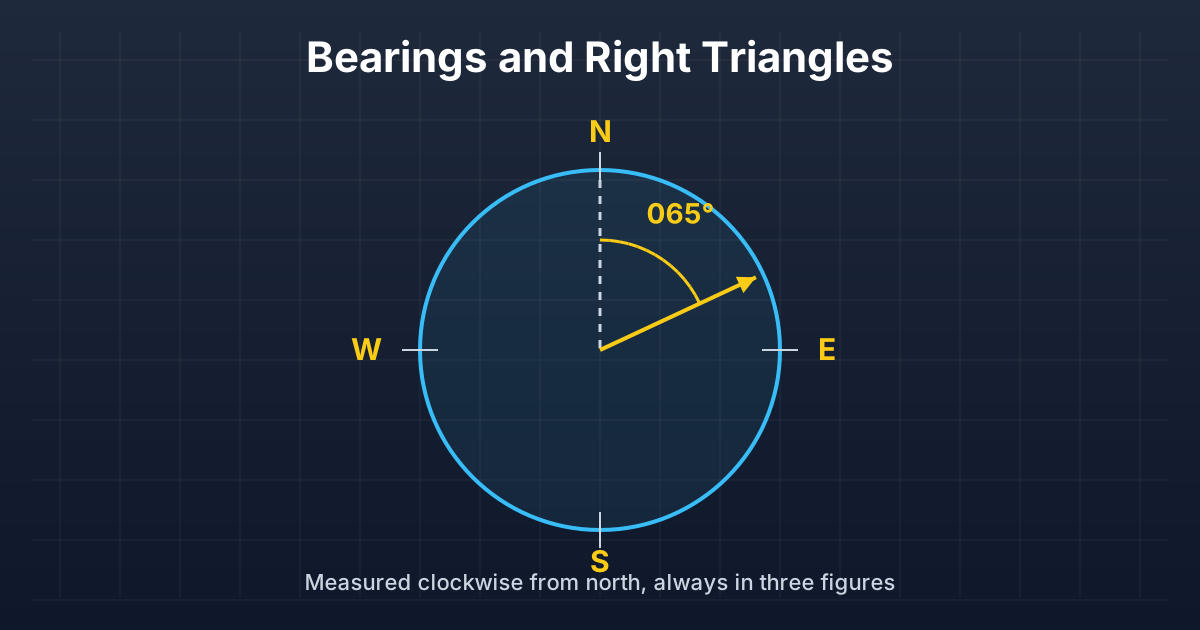
A bearing is an angle measured clockwise from north. A right triangle takes that angle, pairs it with a distance, and splits the journey into two perpendicular parts: one running north or south, the other running east or west. Bearings appear in navigation, aviation, surveying, and map reading, and this guide moves from compass directions and three-figure bearings through trigonometric ratios, worked examples, and practice problems, so you can solve bearings word problems on your own.
What Are Bearings in Mathematics?
Featured snippet answer: A bearing is an angle that describes direction, measured in degrees clockwise from north. Bearings in mathematics use three figures, from 000° to less than 360°, so north is 000°, east is 090°, south is 180°, and west is 270°. The leading zeros keep every bearing in the same three-digit form.
Every bearing starts at the north line. Stand at a starting point, point straight up on the map toward north, and rotate clockwise until you face the direction of travel. The angle you turned through is the bearing. A bearing of 000° means facing due north. A bearing of 090° means facing due east, after a quarter turn clockwise. A bearing of 180° means facing due south, and 270° means facing due west.
Bearings always use three digits. The number 45 is written as 045°, and the number 7 is written as 007°. The leading zeros are not decoration. They keep every bearing the same length, so a bearing can never be misread in a radio message, on a map, or in an exam answer. A full clockwise turn is 360°, which points north again, but the standard three-figure notation for north is 000°, not 360°.
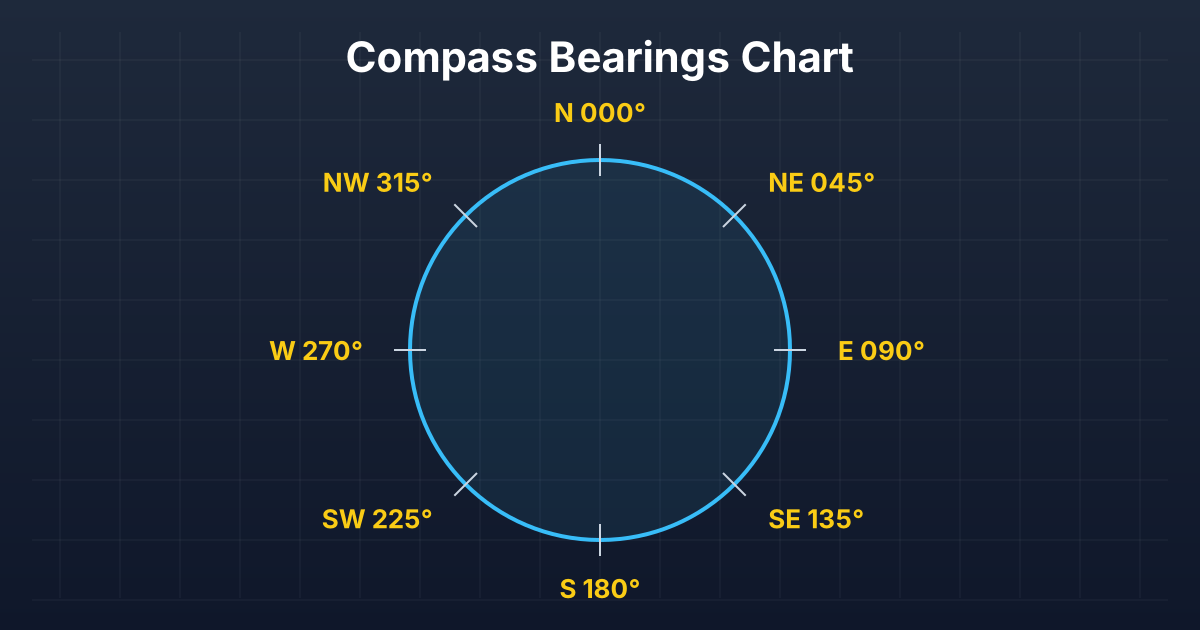
| Direction | Three-Figure Bearing |
|---|---|
| North | 000° |
| Northeast | 045° |
| East | 090° |
| Southeast | 135° |
| South | 180° |
| Southwest | 225° |
| West | 270° |
| Northwest | 315° |
Why Are Bearings Measured Clockwise From North?
Bearings follow a navigation convention that is older than school coordinate geometry. Sailors and map readers agreed to measure direction from north, turning clockwise, because a compass needle points north and a clock face turns clockwise. The convention stuck, and it is now the standard in mathematics exams, including GCSE mathematics.
This differs from conventional Cartesian angles, which are commonly measured counterclockwise from the positive x-axis (the east direction). A Cartesian angle of 45° points northeast, just like a bearing of 045°, but the two systems disagree everywhere else. A Cartesian angle of 90° points north, while a bearing of 090° points east. Mixing the two systems is a common source of errors, so always check which reference line and which rotation direction a problem uses.
What Are Three-Figure Bearings?
A three-figure bearing is simply a bearing written with exactly three digits, including leading zeros where needed. The direction 45° becomes 045°. The direction 7° becomes 007°. Larger bearings need no padding: 120° is already three figures, and so are 205° and 315°.
Three figures also mark the boundary of the system. Bearings run from 000° up to, but not including, 360°. A bearing of 360° would describe a full turn back to north, and the standard form for that direction is 000°. If a calculation ever produces 360° or more, subtract 360° to bring it back into range.
Bearings vs. Compass Directions
Three notations can describe the same direction, and students should be able to move between them. The direction northeast can be written as the three-figure bearing 045°, as the quadrant bearing N45°E, or simply as the compass point Northeast. All three point the same way.
The difference is in what each notation states. A three-figure bearing states one clockwise angle from north: 045°. A quadrant bearing states an angle from north or south toward east or west: N45°E means start at north and turn 45° toward east. A compass point names the direction in words, without a number. In bearings and trigonometry problems, the three-figure form is the standard, because it feeds directly into sine and cosine calculations.
Understanding Right Triangles in Bearing Problems
Bearings alone give direction. Right triangles turn direction into distance. Every journey on a bearing can be drawn as the hypotenuse of a right triangle, with the northward and eastward movements as the two legs. That triangle is the bridge between compass bearings and trigonometry.
What Is a Right Triangle?
A right triangle is a triangle with one angle of exactly 90°. Its three sides have special names. The hypotenuse is the longest side, opposite the right angle. The other two sides are called the opposite side and the adjacent side, but those names depend on which acute angle you choose as the reference angle.
Pick one acute angle of the triangle and call it θ. The side across from θ is the opposite side. The side next to θ, which is not the hypotenuse, is the adjacent side. Change the reference angle to the other acute angle, and the opposite and adjacent sides swap roles. Naming the sides correctly for the chosen angle is the key skill in every bearings problem. The angles in a right triangle guide explains these names in full, and the sides of a right triangle guide covers the hypotenuse and legs.
How Do Bearings Create Right Triangles?
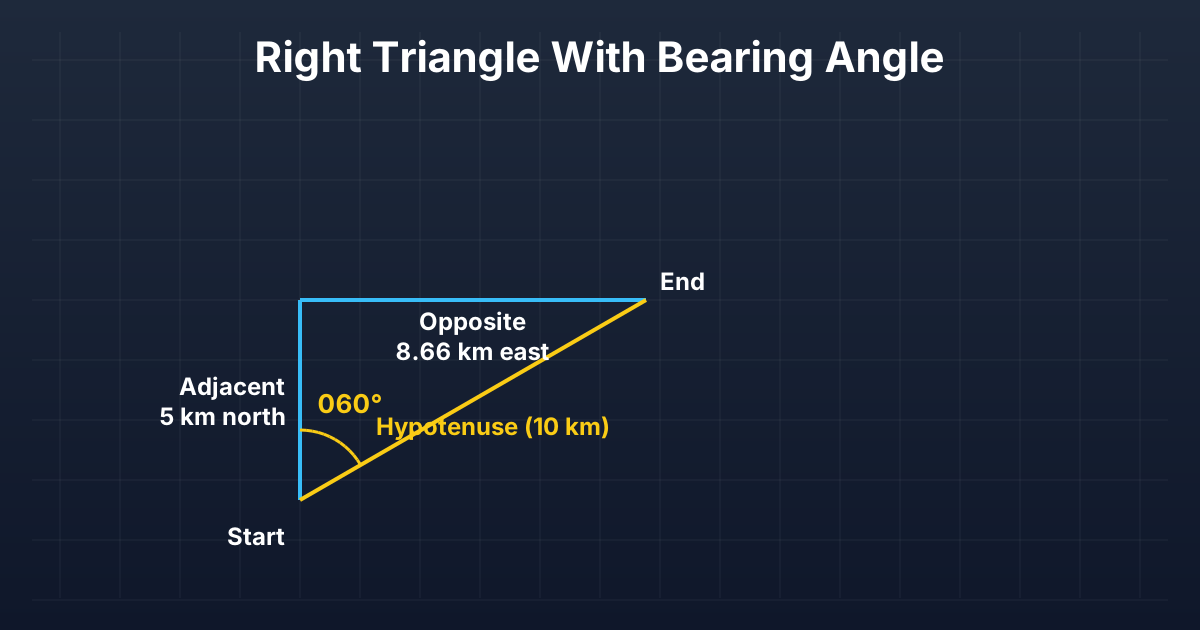
A journey on a bearing runs diagonally across the map. Its northward movement runs straight up or down, and its eastward movement runs straight left or right. North-south and east-west lines are perpendicular, so the two movements meet at a right angle. The journey itself becomes the hypotenuse, and the two movements become the legs.
Take a boat that travels 10 km on a bearing of 045°. The direction sits exactly halfway between north and east, so the northward and eastward legs are equal. Each leg is 10 × sin 45° = 10 × 0.7071 = 7.07 km, and the same result comes from cosine, since sin 45° equals cos 45°. The boat ends 7.07 km north and 7.07 km east of its start. Draw the north line at the start, the travel line at 45° from it, and drop perpendiculars to complete the triangle, and the whole journey becomes one right triangle.
Why Are Reference Angles Important?
A bearing is measured from north, but trigonometric ratios need an acute angle inside a right triangle. The reference angle is the acute angle between the direction of travel and the nearest north-south or east-west axis. It is always between 0° and 90°, and it is the angle that goes into the sine, cosine, or tangent calculation.
The reference angle depends on the quadrant of the bearing:
- Bearing 030° sits in the northeast quadrant. The direction is 30° away from north, so the reference angle is 30°.
- Bearing 120° sits in the southeast quadrant. The direction is 60° past east from the south line, because 180° − 120° = 60°, so the reference angle is 60°.
- Bearing 225° sits in the southwest quadrant. The direction is 45° past south, because 225° − 180° = 45°, so the reference angle is 45°.
- Bearing 300° sits in the northwest quadrant. The direction is 60° short of a full turn, because 360° − 300° = 60°, so the reference angle is 60°.
Once the reference angle is known, sine and cosine give the two legs. The signs of the legs then come from the quadrant: north is positive and south is negative for the northward leg, while east is positive and west is negative for the eastward leg.
Trigonometric Ratios Used in Bearings and Right Triangles
Three ratios connect the angles and sides of a right triangle. Each ratio divides one side by another, and each one answers a different question in bearings problems. The sine, cosine, and tangent guide covers these ratios in depth.
Sine (sin)
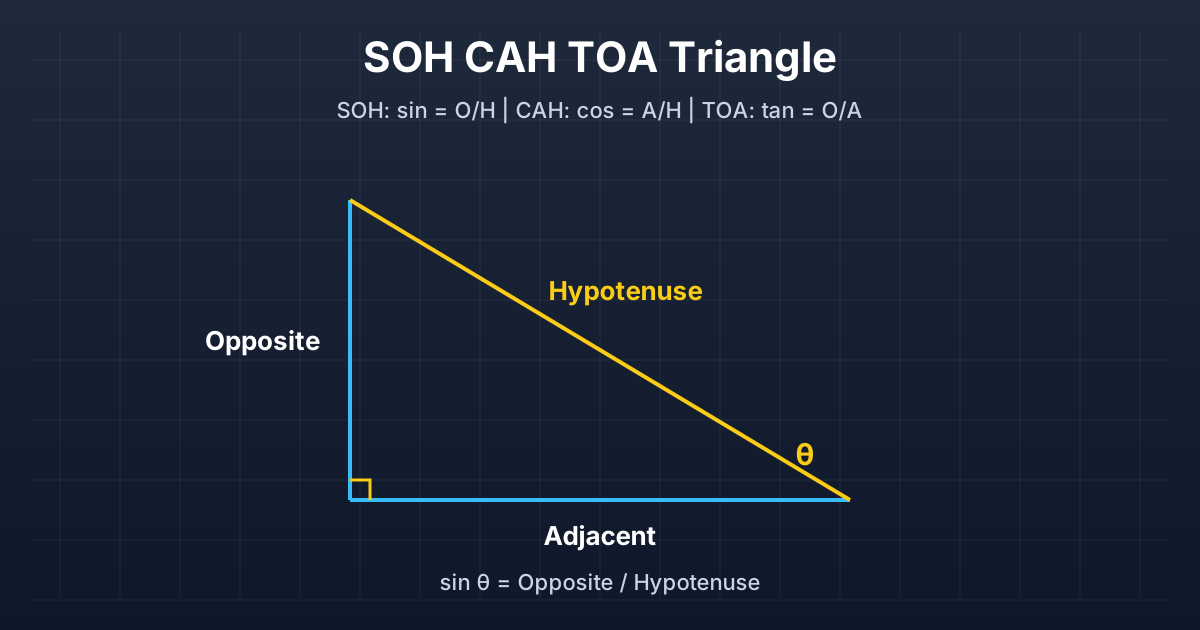
Sine compares the opposite side with the hypotenuse:
sin θ = Opposite / Hypotenuse
Sine is useful when the hypotenuse is known and a perpendicular displacement is needed. In bearings work, the eastward component often comes from sine, because the eastward leg sits opposite the angle measured from north. If a boat travels 10 km on a bearing of 030°, the eastward distance is 10 × sin 30° = 10 × 0.5 = 5 km.
Cosine (cos)
Cosine compares the adjacent side with the hypotenuse:
cos θ = Adjacent / Hypotenuse
Cosine is useful when the hypotenuse is known and a component along the reference axis is needed. In bearings work, the northward component often comes from cosine, because the northward leg sits next to the angle measured from north. For that same boat on a bearing of 030°, the northward distance is 10 × cos 30° = 10 × 0.8660 = 8.66 km.
Tangent (tan)
Tangent compares the opposite side with the adjacent side:
tan θ = Opposite / Adjacent
Tangent is useful when two legs are known and an angle is needed, or when one leg and an angle are known and the other leg is needed. If a walker goes 6 km east and 8 km north, the bearing comes from tan θ = 6 / 8 = 0.75, so θ = arctan 0.75 = 36.87°. Tangent needs no hypotenuse, which makes it the natural choice for bearing-from-components problems.
Remembering SOH CAH TOA
SOH CAH TOA is a mnemonic that packs all three ratios into three syllables:
- SOH: Sine = Opposite / Hypotenuse
- CAH: Cosine = Adjacent / Hypotenuse
- TOA: Tangent = Opposite / Adjacent
| Ratio | Formula | Typical application in bearings |
|---|---|---|
| Sine | Opposite / Hypotenuse | Finding a displacement perpendicular to the reference axis, often the eastward leg |
| Cosine | Adjacent / Hypotenuse | Finding a displacement along the reference axis, often the northward leg |
| Tangent | Opposite / Adjacent | Finding an angle from two legs, or a leg from an angle and the other leg |
Inverse trigonometric functions reverse the process. When an angle is unknown and two sides are known, use arcsine, arccosine, or arctangent to recover the angle. For example, tan θ = 0.75 gives θ = arctan 0.75 = 36.87°. The inverse function returns the acute reference angle, and the quadrant of the journey decides how that reference angle converts into a full bearing.
How to Solve Bearings and Right Triangles Problems Step by Step
A reliable method prevents most errors in bearings word problems. Work through these eight steps in order, and do not skip the diagram.
Step 1: Read the problem carefully. Identify the given bearing, the given distance, and the unknown. Note whether the question asks for a component, a distance, a bearing, or a return journey.
Step 2: Draw a compass diagram. Mark north, south, east, and west at the starting point. Draw the north arrow clearly, because every bearing is measured from it.
Step 3: Mark the bearing. Measure the angle clockwise from the north line and draw the direction of travel. Check the quadrant: northeast means both components positive, southeast means north negative, southwest means both negative, and northwest means east negative.
Step 4: Construct a right triangle. From the destination, drop perpendiculars to the north line and the east line. The journey becomes the hypotenuse, and the northward and eastward movements become the legs.
Step 5: Identify the reference angle. Find the acute angle between the travel direction and the nearest axis. For bearings under 90°, the reference angle is the bearing itself. For larger bearings, subtract from 180° or 360° as the quadrant requires.
Step 6: Label the triangle. Mark the hypotenuse, the opposite side, and the adjacent side relative to the reference angle. Label every known length and angle before choosing a formula.
Step 7: Choose the correct formula. Use sine or cosine when the hypotenuse is known and a leg is needed. Use tangent when two legs are known and an angle is needed. Use the Pythagorean theorem when two sides are known and the third side is needed. Use inverse trigonometry when an angle is the unknown.
Step 8: Calculate and verify. Show substitutions, keep units on every length, and round only at the final step. Then check the answer against the direction of travel: a northeast journey must give positive north and east components, and a bearing near east must give a much larger eastward leg than northward leg. If the check fails, the reference angle or the quadrant is wrong. The how to solve a right triangle guide covers the same triangle-solving steps in a general setting.
Bearings and Right Triangles Worked Examples
These six bearings and right triangles examples rise in difficulty. Each one shows every substitution, so you can follow the working without a teacher beside you.
Example 1: Finding Northward and Eastward Distances
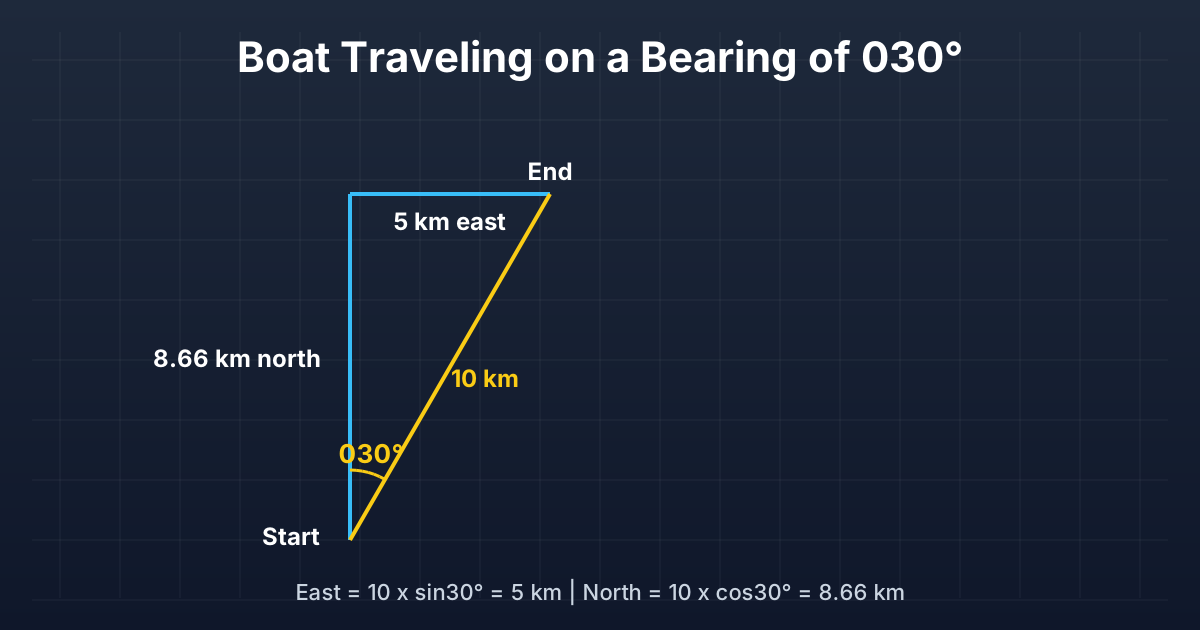
Problem: A boat travels 10 km on a bearing of 030°. Calculate how far north and east the boat travels.
The bearing sits in the northeast quadrant, so both components are positive. The angle at the start, between the north line and the travel line, is 30°. The eastward leg sits opposite that angle, so it uses sine. The northward leg sits next to that angle, so it uses cosine.
- Eastward distance = 10 × sin 30° = 10 × 0.5 = 5 km
- Northward distance = 10 × cos 30° = 10 × 0.8660 = 8.66 km
The boat ends 5 km east and 8.66 km north of its start. The northward leg is longer because 030° points closer to north than to east. Check with Pythagoras: √(5² + 8.66²) = √(25 + 75) = √100 = 10 km, which matches the distance sailed.
Example 2: Finding Displacement From a Bearing
Problem: An airplane travels 20 km on a bearing of 060°. Find its northward and eastward displacement.
The bearing is still northeast, so both components stay positive. The reference angle is 60°.
- Eastward displacement = 20 × sin 60° = 20 × 0.8660 = 17.32 km
- Northward displacement = 20 × cos 60° = 20 × 0.5 = 10 km
The plane ends 17.32 km east and 10 km north of its start. The eastward displacement is larger than the northward displacement because 060° points closer to east than to north. As the bearing grows from 000° toward 090°, sine grows and cosine shrinks, so the eastward leg grows while the northward leg shrinks. Check: √(17.32² + 10²) = √(300 + 100) = √400 = 20 km, which matches the distance flown.
Example 3: Calculating Distance Using the Pythagorean Theorem
Problem: A hiker travels 6 km east and then 8 km north. Find the straight-line distance from the starting point, and the bearing of the final position from the starting point.
The two legs are perpendicular, so the straight-line distance is the hypotenuse:
d² = 6² + 8² = 36 + 64 = 100, so d = 10 km.
The bearing comes from tangent, with east over north:
tan θ = 6 / 8 = 0.75, so θ = arctan 0.75 = 36.87°.
The position is northeast, so no quadrant adjustment is needed. Written in three figures, the bearing is 037°. The hiker is 10 km from the start on a bearing of 037°.
Example 4: Finding an Unknown Bearing
Problem: A rescue boat is located 12 km east and 5 km north of a harbor. Calculate its bearing from the harbor, to the nearest degree, in three-figure format.
The eastward and northward legs are known, and the bearing is the unknown angle at the harbor between the north line and the line to the boat. Tangent connects the two legs:
tan θ = east / north = 12 / 5 = 2.4, so θ = arctan 2.4 = 67.38°.
The boat is northeast of the harbor, so the reference angle is the bearing itself. Rounded to the nearest degree, the bearing is 067°. Note how a larger eastward leg than northward leg produces a bearing past 045°, closer to east than to north, which is exactly what the diagram should show.
Example 5: Calculating a Reverse Bearing
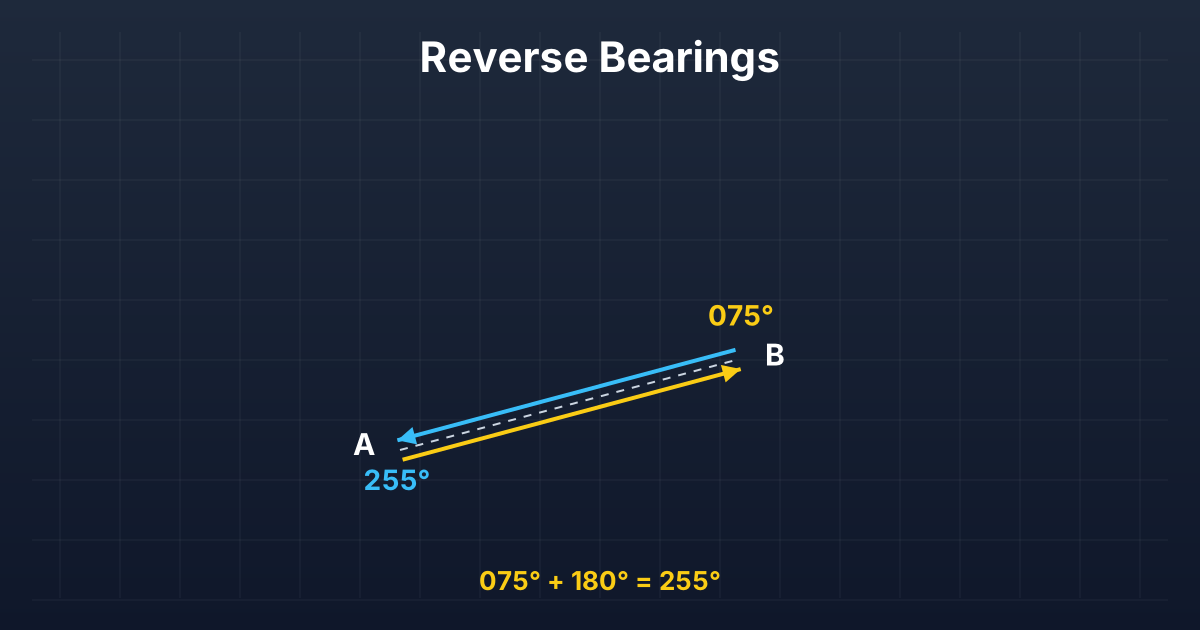
Problem: A ship travels from Port A to Port B on a bearing of 075°. Find the bearing from Port B back to Port A.
The return journey runs along the same straight line in the opposite direction. Opposite directions on a straight line differ by 180°, so the reverse bearing rule is simple: if the original bearing is less than 180°, add 180°. If it is 180° or more, subtract 180°.
075° + 180° = 255°.
The bearing from Port B back to Port A is 255°. A quick check confirms it: the reverse of 255° is 255° − 180° = 075°, which returns the original bearing. Use the same rule in the other direction: a forward bearing of 210° has a reverse bearing of 210° − 180° = 030°.
Example 6: Multi-Step Navigation Problem
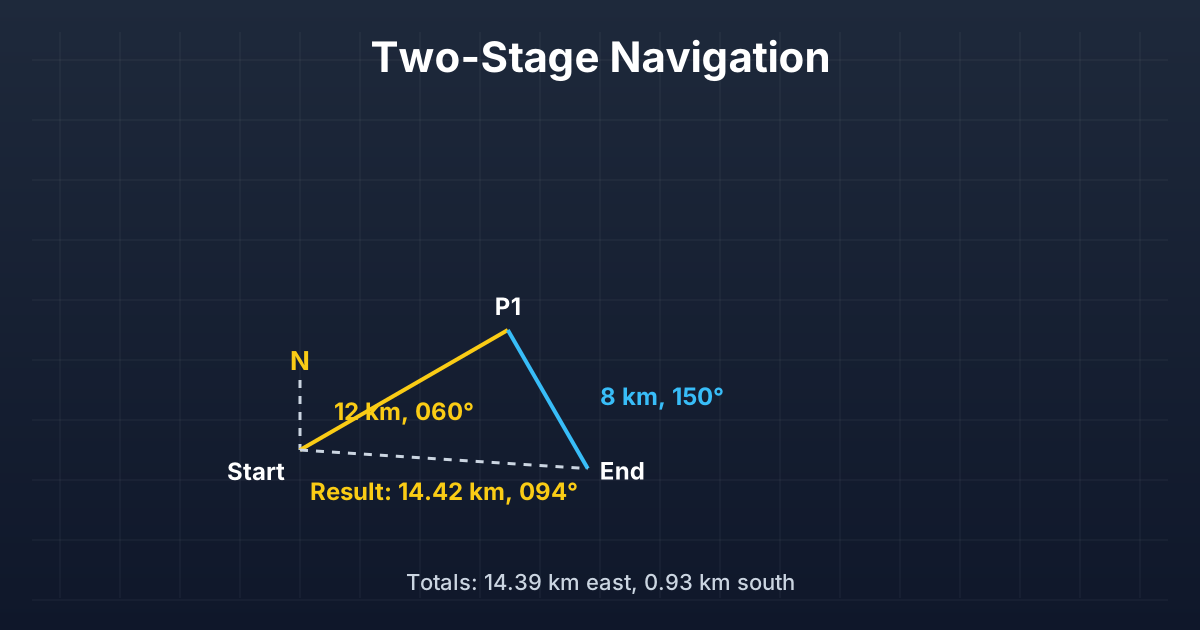
Problem: A boat travels 12 km on a bearing of 060° and then 8 km on a bearing of 150°. Calculate the total eastward displacement, the total northward displacement, the straight-line distance from the starting point, and the final bearing from the starting point.
Work leg by leg, keeping signs. The first leg points northeast, so both of its components are positive. The second leg points southeast, so its eastward component is positive but its northward component is negative, meaning southward movement.
First leg, 12 km on 060°:
- East = 12 × sin 60° = 12 × 0.8660 = 10.39 km
- North = 12 × cos 60° = 12 × 0.5 = 6 km
Second leg, 8 km on 150°:
- East = 8 × sin 150° = 8 × 0.5 = 4 km
- North = 8 × cos 150° = 8 × (−0.8660) = −6.93 km
Add the components, keeping the negative sign on the second northward value:
- Total east = 10.39 + 4 = 14.39 km
- Total north = 6 + (−6.93) = −0.93 km
The negative total north means the boat ends 0.93 km south of its start, while sitting 14.39 km east of it. The straight-line distance is:
d = √(14.39² + 0.93²) = √(207.07 + 0.86) = √207.93 = 14.42 km.
For the bearing, east is positive and north is negative, which places the final position just south of due east. The quadrant-aware calculation gives:
Bearing = atan2(14.39, −0.93) = 93.69°, written as 094° to the nearest degree.
The final position is 14.42 km from the start on a bearing of 094°. The bearing sits just past 090° because the southward drift is small compared with the eastward distance. If the southward total had been larger, the bearing would have moved further past east toward south.
How to Find a Bearing From Two Points
When the relative positions of two points are known, the bearing comes from the eastward and northward displacements between them. Call the eastward displacement ΔE and the northward displacement ΔN. Positive ΔE means east, negative means west. Positive ΔN means north, negative means south.
The quadrant-aware formula is:
Bearing = (atan2(ΔE, ΔN) converted to degrees + 360°) mod 360°
This form of atan2 takes eastward displacement as its first argument and northward displacement as its second. That order matters. Many calculators and programming languages define atan2 the other way round, with the vertical value first, so check the function definition before using it. Swapping the arguments gives the wrong angle, and it is a mistake that looks correct until the quadrant check fails.
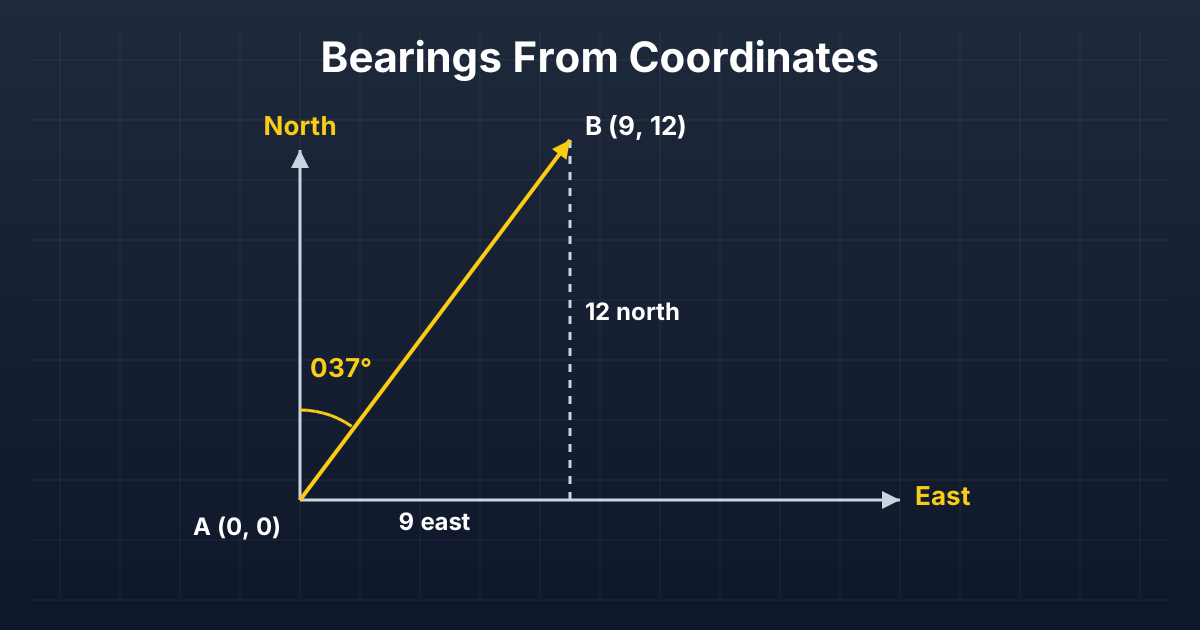
Worked example: A point sits 9 km east and 12 km north of a start. Then ΔE = 9 and ΔN = 12, both positive, so the point is northeast. The reference angle is arctan(9 / 12) = arctan 0.75 = 36.87°, and the bearing is 037°.
Worked example with a negative component: A point sits 5 km west and 12 km north of a start. Then ΔE = −5 and ΔN = 12. The reference angle is arctan(5 / 12) = 22.62°. The point is northwest, so the bearing is 360° − 22.62° = 337.38°, written as 337°.
A non-programming method gives the same answers without atan2. First find the reference angle with inverse tangent on the absolute values: arctan(|ΔE| / |ΔN|). Then place it in the correct quadrant: northeast uses the reference angle itself, southeast uses 180° minus the reference angle, southwest uses 180° plus the reference angle, and northwest uses 360° minus the reference angle. Finally, write the result in three figures.
Bearings and the Pythagorean Theorem
The Pythagorean theorem finds straight-line distances from northward and eastward components. For a right triangle with legs x and y and hypotenuse d:
d² = x² + y²
Here x is one perpendicular displacement, usually the eastward leg, y is the other, usually the northward leg, and d is the direct distance between the start and the end. The theorem works because the northward and eastward legs meet at a right angle. The Pythagorean theorem formula guide explains the theorem itself in full.
Example 1: Finding a distance. A drone flies 9 km east and 12 km north of its base. The direct distance is d² = 9² + 12² = 81 + 144 = 225, so d = 15 km. The position is 15 km away, and its bearing is arctan(9 / 12) = 36.87°, written as 037°.
Example 2: Finding an unknown component. A walker ends 25 km from camp on a bearing that gives a northward component of 7 km. The eastward component follows from the same theorem: east² + 7² = 25², so east² = 625 − 49 = 576, and east = 24 km. The walker is 24 km east and 7 km north of camp, which is a 7-24-25 triangle.
Pythagoras is more convenient than sine or cosine when two sides are already known and the third side is the unknown. Sine and cosine are the better choice when an angle and one side are known and a leg is needed. Choose the tool that matches the given information, and use Pythagoras as a check whenever a sine or cosine calculation produces two legs.
Bearings vs. Angles of Elevation and Depression
Bearings and angles of elevation both use right triangles, but they live in different planes and answer different questions. Confusing them is a common error, so the distinction deserves a clear statement.
A bearing works in the horizontal plane. It tells direction across the ground or across a map, measured clockwise from north, from 000° to less than 360°. It answers the question: which way across the map, and how far north and east?
An angle of elevation works in the vertical plane. It tells how steeply upward a line of sight rises from horizontal eye level, from 0° to 90°. An angle of depression is the matching downward angle, measured from horizontal down to an object below eye level. These angles answer a different question: how high or how low is the object?
| Feature | Bearing | Angle of elevation or depression |
|---|---|---|
| Plane | Horizontal (map view) | Vertical (side view) |
| Reference line | North line | Horizontal eye line |
| Measured | Clockwise from north | Up or down from horizontal |
| Range | 000° to less than 360° | 0° to 90° |
| Gives | North and east position | Height or depth of an object |
Right-triangle trigonometry serves both contexts, but the triangles are different. A bearing goes into the north and east triangle on the map. An elevation angle goes into the vertical height triangle. Never put a bearing into a height calculation, and never put an elevation angle into a north and east calculation. A single journey can involve both, for example a plane flying on a bearing of 060° while climbing, but the two angles belong in two separate triangles.
One more caution: a horizontal bearing alone does not determine a three-dimensional travel direction. It fixes the direction across the map, but height, climb angle, and vertical movement need their own measurements. Real navigation always pairs horizontal and vertical information separately.
Common Mistakes When Solving Bearings Problems
These eight errors appear in student work again and again. Each one shows the wrong approach, explains why it fails, and gives the correct method with a short example.
Mistake 1: Measuring Bearings Counterclockwise Instead of Clockwise
Incorrect approach: A student measures 060° counterclockwise from north and draws a direction pointing northwest.
Why it is incorrect: Bearings are defined clockwise from north. A counterclockwise turn of 60° from north points 60° toward west, which is a bearing of 300°, not 060°.
Correct method: Always rotate clockwise from the north line. A bearing of 060° points northeast, between north and east. Draw the north arrow first, then turn right, not left.
Mistake 2: Measuring From East Rather Than North
Incorrect approach: A student measures 060° from the east line toward north and calls the result a bearing of 060°.
Why it is incorrect: A bearing is defined from north, not from east. Measuring 60° from east toward north gives a direction 30° from north, which is a bearing of 030°, not 060°. Every component calculated from the wrong reference line is wrong too.
Correct method: Always draw the north line first, then rotate clockwise from it by the bearing. If a problem gives an angle from east or from another line, convert it to a bearing from north before using sine or cosine.
Mistake 3: Forgetting the Leading Zero in Three-Figure Bearings
Incorrect approach: A student writes the bearing as 65° and treats the answer as complete.
Why it is incorrect: Bearings follow a three-digit standard. In navigation messages and in exam marking, 65° is not the accepted form, and a bare two-digit number invites misreading. The value is the same, but the form is wrong, and form is part of the skill being tested.
Correct method: Pad with leading zeros so every bearing has three digits: 007°, 065°, 090°, 270°. Check the digit count before finishing any bearings answer.
Mistake 4: Confusing Sine and Cosine
Incorrect approach: A student calculates the eastward leg of a 10 km journey on a bearing of 030° as 10 × cos 30° = 8.66 km.
Why it is incorrect: The eastward leg sits opposite the 30° angle at the start, so it uses sine, giving 10 × sin 30° = 5 km. Cosine gives the northward leg, 8.66 km. Swapping the two ratios swaps the two legs.
Correct method: Identify opposite and adjacent relative to the angle at the start before choosing a ratio. The leg across from the angle uses sine. The leg next to the angle uses cosine. For bearings measured from north, east usually pairs with sine and north with cosine.
Mistake 5: Selecting the Wrong Reference Angle
Incorrect approach: A student uses 120° directly in sine and cosine for a bearing of 120°, computing east as 10 × sin 120° and north as 10 × cos 120° without thinking about the quadrant.
Why it is incorrect: The calculation itself happens to give the right magnitudes here, because sin 120° = sin 60° and cos 120° = −cos 60°, but the student who skips the reference angle has no way to check the signs or to explain the triangle. With a bearing of 200°, the same habit produces a northward sign error, because the student never identifies the 20° reference angle or the southwest quadrant.
Correct method: Find the acute reference angle first: 120° gives 60°, 200° gives 20°, 300° gives 60°. Then apply sine and cosine to the reference angle and assign signs from the quadrant.
Mistake 6: Ignoring Negative Northward or Eastward Components
Incorrect approach: A student adds the northward legs of a two-stage journey as 6 + 6.93 = 12.93 km, ignoring that the second leg runs south.
Why it is incorrect: A southward leg is a negative northward component. Adding it as a positive number invents distance that was never traveled north. In Example 6, the correct total is 6 + (−6.93) = −0.93 km, meaning the boat ends slightly south of its start.
Correct method: Give every leg a sign before adding: north positive, south negative, east positive, west negative. Only then add the components. The sign of the total decides the quadrant of the final bearing.
Mistake 7: Calculating the Correct Reference Angle but Selecting the Wrong Quadrant
Incorrect approach: A student finds a reference angle of 36.87° for a point 9 km west and 12 km north, and writes the bearing as 037°.
Why it is incorrect: The reference angle is right, but the point is northwest, not northeast. The bearing must be 360° − 36.87° = 323.13°, written as 323°. The northeast formula gives a direction on the wrong side of the map.
Correct method: After finding the reference angle, place it in the quadrant: northeast uses the angle itself, southeast uses 180° minus it, southwest uses 180° plus it, and northwest uses 360° minus it. Then check the result against the diagram.
Mistake 8: Confusing Forward Bearings With Reverse Bearings
Incorrect approach: A student is asked for the bearing from Port B back to Port A, where the outward bearing is 075°, and answers 075°.
Why it is incorrect: The outward bearing describes travel from A to B. The return journey points the opposite way, so it needs the reverse bearing: 075° + 180° = 255°.
Correct method: Ask which direction the question wants. If it wants the way back, add 180° when the outward bearing is under 180°, and subtract 180° when it is 180° or more. Then verify by reversing the result: the reverse of the reverse must return the original bearing.
Calculator warning: Set the calculator to degree mode before any bearings calculation. In radian mode, sin 30 returns −0.988 instead of 0.5, and every component after that is wrong. Check the mode display before the first calculation, and keep it in degrees throughout the problem.
Bearings and Right Triangles Practice Questions
Beginner Level
1. Convert these compass directions into three-figure bearings: North, Southeast, West, Northeast.
2. A compass diagram shows one arrow pointing due east and another pointing exactly halfway between north and west. State the bearing of each arrow.
3. Find the reverse bearings of 040°, 310°, and 200°.
4. State the reference angle for each of these bearings: 050°, 140°, 200°, 320°.
Intermediate Level
5. A cyclist rides 20 km on a bearing of 030°. Calculate the eastward and northward distances.
6. A drone flies 9 km east and 12 km north of its base. Find the direct distance from the base and the bearing of the drone from the base.
7. A ship sails 30 km on a bearing of 045°. Calculate its eastward and northward displacements.
8. A landmark sits 8 km east and 15 km north of a village. Find the direct distance from the village and the bearing of the landmark from the village.
Advanced Level
9. A walker goes 10 km east and then 10 km north. Find the straight-line distance from the start and the bearing of the final position from the start.
10. A boat sails 6 km south and then 8 km east. Find the straight-line distance from the start and the bearing of the final position from the start, to the nearest degree.
11. A plane flies 10 km on a bearing of 120° and then 10 km on a bearing of 030°. Find the total eastward and northward displacements, the straight-line distance from the start, and the final bearing from the start.
12. A yacht sails 20 km east and then 21 km north. Find the straight-line distance from the start and the bearing of the final position from the start, to the nearest degree.
Answer Key
1. North is 000°, Southeast is 135°, West is 270°, Northeast is 045°. Each direction comes from the eight-point compass table: the four cardinal directions sit 90° apart, and the four intercardinal directions sit halfway between them.
2. Due east is 090°, because east is a quarter turn clockwise from north. Halfway between north and west is northwest, which is 315°, because it sits 45° short of a full turn: 360° − 45° = 315°.
3. For 040°, which is under 180°, add 180°: 040° + 180° = 220°. For 310°, which is 180° or more, subtract 180°: 310° − 180° = 130°. For 200°, subtract 180°: 200° − 180° = 020°. Check each by reversing it: 220° − 180° = 040°, 130° + 180° = 310°, 020° + 180° = 200°.
4. For 050°, the bearing is under 90°, so the reference angle is 50°. For 140°, it is 180° − 140° = 40°. For 200°, it is 200° − 180° = 20°. For 320°, it is 360° − 320° = 40°.
5. The bearing is northeast, so both components are positive. East = 20 × sin 30° = 20 × 0.5 = 10 km. North = 20 × cos 30° = 20 × 0.8660 = 17.32 km. The cyclist ends 10 km east and 17.32 km north of the start.
6. The legs are 9 km east and 12 km north. Distance = √(9² + 12²) = √(81 + 144) = √225 = 15 km. Bearing = arctan(9 / 12) = arctan 0.75 = 36.87°, written as 037°. The drone is 15 km from the base on a bearing of 037°.
7. The bearing is exactly northeast, so the two components are equal. East = 30 × sin 45° = 30 × 0.7071 = 21.21 km. North = 30 × cos 45° = 30 × 0.7071 = 21.21 km. The ship ends 21.21 km east and 21.21 km north of its start.
8. The legs are 8 km east and 15 km north. Distance = √(8² + 15²) = √(64 + 225) = √289 = 17 km. Bearing = arctan(8 / 15) = arctan 0.5333 = 28.07°, written as 028°. The landmark is 17 km from the village on a bearing of 028°.
9. The legs are 10 km east and 10 km north. Distance = √(10² + 10²) = √200 = 14.14 km. Bearing = arctan(10 / 10) = arctan 1 = 45°, written as 045°. The walker is 14.14 km from the start on a bearing of 045°.
10. The legs are 8 km east and 6 km south, so the northward total is −6 km. Distance = √(8² + 6²) = √(64 + 36) = √100 = 10 km. The position is southeast, so the bearing is 180° − arctan(8 / 6) = 180° − 53.13° = 126.87°, written as 127°. The boat is 10 km from the start on a bearing of 127°.
11. First leg, 10 km on 120° (southeast): East = 10 × sin 120° = 8.66 km, North = 10 × cos 120° = −5 km. Second leg, 10 km on 030° (northeast): East = 10 × sin 30° = 5 km, North = 10 × cos 30° = 8.66 km. Totals: East = 8.66 + 5 = 13.66 km, North = −5 + 8.66 = 3.66 km. Distance = √(13.66² + 3.66²) = √(186.60 + 13.40) = √200 = 14.14 km. The position is northeast, so the bearing is arctan(13.66 / 3.66) = arctan 3.732 = 75°, written as 075°. The plane is 14.14 km from the start on a bearing of 075°.
12. The legs are 20 km east and 21 km north. Distance = √(20² + 21²) = √(400 + 441) = √841 = 29 km. Bearing = arctan(20 / 21) = arctan 0.9524 = 43.60°, written as 044°. The yacht is 29 km from the start on a bearing of 044°.
Real-World Applications of Bearings and Right Triangles
Marine Navigation
A ship’s course is a bearing, and its speed over time gives a distance. Multiplying the two through sine and cosine gives the ship’s eastward and northward progress, which the navigator plots on a chart. When a ship changes course, each leg contributes its own components, and the totals give the ship’s position relative to its departure point. Reverse bearings give the course home. This is the same mathematics as Example 6, applied to a real voyage.
Aviation
Aircraft routes are planned as a series of bearings and distances between waypoints. For each leg, the eastward and northward displacements tell controllers and pilots where the aircraft will be relative to its departure airport. Bearings describe horizontal movement only, so altitude and climb are tracked separately, but the horizontal plan is pure bearings and right triangles. Wind correction adds a further step, because the heading the pilot steers differs from the bearing of the ground track when wind pushes the aircraft sideways.
Land Surveying
Surveyors locate points by measuring a bearing and a distance from a known station, then converting that polar information into eastward and northward coordinates. Repeating the process across many stations builds a map of boundaries, roads, and construction sites. The right triangle sits at the heart of the conversion: the measured distance is the hypotenuse, and the coordinates are the legs. Accurate bearings matter here, because a small angular error grows into a large position error over a long distance.
Hiking and Outdoor Navigation
Hikers use a compass to follow a bearing across open ground, counting distance by pace or time. If a hiker walks 2 km on a bearing of 060°, the eastward progress is 2 × sin 60° = 1.73 km and the northward progress is 2 × cos 60° = 1 km. Knowing those components helps the hiker match position to map features, and a reverse bearing gives the way back to camp. Bearings also help when a landmark is visible but unreachable: the bearing to the landmark from two different positions can fix its location by triangulation.
Mapping and Geographic Information Systems
Maps store locations as coordinates, and bearings connect those coordinates to directions on the ground. Given two points with known coordinates, the eastward and northward differences give the bearing between them through inverse tangent, and the distance through Pythagoras. Simplified mapping problems use flat-plane geometry, which works well over short distances. Over long distances, Earth’s curvature matters, and professional systems use more advanced geometry.
Real-world navigation always involves more than the simplified model in this guide. Magnetic variation shifts compass readings away from true north, wind pushes aircraft off course, currents push ships sideways, terrain blocks direct routes, and Earth’s curvature bends long-distance paths. Simplified flat-plane right-triangle calculations are a starting point for learning, not a complete navigation system, and they are not sufficient for every real situation.
Tips for Solving Bearing Questions in Exams
Exam technique matters as much as mathematics in bearings questions. These habits prevent the most common lost marks:
- Always draw a north arrow at the starting point before doing anything else.
- Measure bearings clockwise from that north arrow, never counterclockwise.
- Write every bearing in three-figure notation, with leading zeros.
- Draw and label the right triangle, marking the hypotenuse, opposite side, and adjacent side.
- Identify the correct reference angle before choosing sine, cosine, or tangent.
- Check whether the direction is northeast, southeast, southwest, or northwest, and assign signs to match.
- Use degree mode on the calculator, and confirm the mode before the first calculation.
- Include correct units on every distance in the final answer.
- Round only at the final step, keeping full calculator precision through intermediate steps.
- Check the final bearing against the diagram: the quadrant and the relative size of the legs must agree with the picture.
Revision checklist: Can you state the three-figure bearings of all eight compass points? Can you find a reverse bearing in both directions? Can you find a reference angle in all four quadrants? Can you pick sine, cosine, or tangent for a given unknown? Can you convert east and north components into a distance and a bearing? If every answer is yes, the topic is ready for the exam.
Frequently Asked Questions
Answers to the most common student questions about bearings, right triangles, and trigonometry.
01 What are bearings in mathematics?
A bearing is an angle that describes direction, measured in degrees clockwise from north. Bearings use three figures, from 000° to less than 360°, so north is 000°, east is 090°, south is 180°, and west is 270°. A bearing plus a distance fixes a position exactly on a map.
02 How are bearings related to right triangles?
A journey on a bearing forms the hypotenuse of a right triangle. Its northward movement is one leg and its eastward movement is the other leg, and the two legs meet at a right angle. Sine, cosine, and tangent then connect the bearing angle to the two legs, turning direction and distance into exact northward and eastward positions.
03 How do you calculate a bearing using trigonometry?
Start with the eastward and northward displacements between two points. Divide east by north and take the inverse tangent to get the reference angle. Then place that angle in the correct quadrant: northeast uses it directly, southeast uses 180° minus it, southwest uses 180° plus it, and northwest uses 360° minus it.
04 Why are bearings measured clockwise from north?
Bearings follow a navigation convention agreed by sailors and map readers long ago. A compass needle points north, and a clock face turns clockwise, so measuring from north in a clockwise direction felt natural. The convention became standard in navigation, surveying, and school mathematics, including GCSE exams.
05 What is a three-figure bearing?
A three-figure bearing is a bearing written with exactly three digits, using leading zeros where needed. The direction 45° becomes 045°, and 7° becomes 007°. Bearings run from 000° to less than 360°, and the three-digit form keeps every bearing the same length so it cannot be misread.
06 How do you find a reverse bearing?
A reverse bearing points exactly opposite to the outward bearing, so the two differ by 180°. If the outward bearing is less than 180°, add 180°. If it is 180° or more, subtract 180°. For example, the reverse of 075° is 255°, and the reverse of 255° is 075°.
07 When should you use sine or cosine in bearings?
Use sine or cosine when a distance and a bearing are known and a leg is needed. For an angle measured from north, the eastward leg sits opposite the angle, so it uses sine, while the northward leg sits next to the angle, so it uses cosine. Identify opposite and adjacent first, then choose the ratio.
08 How do you calculate distance from a bearing?
A bearing alone gives direction, not distance, so pair it with a known distance first. If two legs are known, use the Pythagorean theorem: distance equals the square root of the sum of the squared legs. If one leg and the bearing are known, use sine or cosine to find the other leg, then check with Pythagoras.
09 Can you solve bearings problems using the Pythagorean theorem?
Yes, whenever two sides of the right triangle are known and the third side is needed. The northward and eastward legs are perpendicular, so the direct distance is the hypotenuse. For example, legs of 9 km and 12 km give a distance of 15 km. The theorem finds distances, but angles still need tangent or inverse trigonometry.
10 What is the difference between a bearing and a compass direction?
A bearing is a numbered direction, measured clockwise from north in three figures, such as 045°. A compass direction is the same direction named in words, such as Northeast. A quadrant bearing such as N45°E is a third notation for the same direction. Bearings suit calculations, while compass points suit plain descriptions.
11 How do you calculate bearings from coordinates?
Subtract the starting coordinates from the ending coordinates to get the eastward and northward differences. Divide east by north and take the inverse tangent for the reference angle. Then adjust for the quadrant and write the result in three figures. The atan2 formula does the quadrant step automatically when its arguments are ordered east first, north second.
12 What is the easiest way to solve bearings word problems?
Draw a diagram first, with a north arrow at the start and the bearing marked clockwise from it. Build the right triangle from the northward and eastward legs, label the hypotenuse, opposite, and adjacent sides, then pick sine, cosine, tangent, or Pythagoras to match the unknown. Finish by checking the answer against the diagram and the quadrant.
Conclusion
Bearings and right triangles turn direction and distance into exact positions. A bearing, measured clockwise from north in three figures, fixes the direction. A right triangle splits the journey into northward and eastward legs, and sine, cosine, tangent, and the Pythagorean theorem find any missing side or angle. Multi-step routes work the same way: split each leg into signed components, add them, and convert the totals back into a distance and a bearing. The habits that protect your marks are simple: draw the north arrow, find the reference angle, check the quadrant, keep the calculator in degree mode, and round only at the end. Practice drawing diagrams for every problem, and the method soon feels automatic. Try the practice questions above, then test yourself with new routes of your own.