
Sides of a Right Triangle: Names, Formulas, and Examples
Math Expert
Geometry
Lean a ladder against a wall and you have built a right triangle: the wall is one side, the ground is another, and the ladder is the third. The Sides of a Right Triangle each carry a name, and those names are not decoration. Call the hypotenuse, the two legs, and the angle-relative labels opposite and adjacent, and every formula in this corner of geometry suddenly has somewhere to plug in. Mix the names up and the same formulas return wrong answers. This guide names each side, shows how to identify them in any orientation, explains why two of the names move when the reference angle moves, and puts the names to work in formulas and solved problems.
What Are the Three Sides of a Right Triangle?
A right triangle is a triangle with one angle of exactly 90 degrees. It has three sides, and they split into two kinds:
- The hypotenuse: the single side opposite the 90-degree angle. It is always the longest side, and its identity never changes.
- The two legs: the sides that meet at the right angle and form it. In many diagrams they play the roles of base and height.
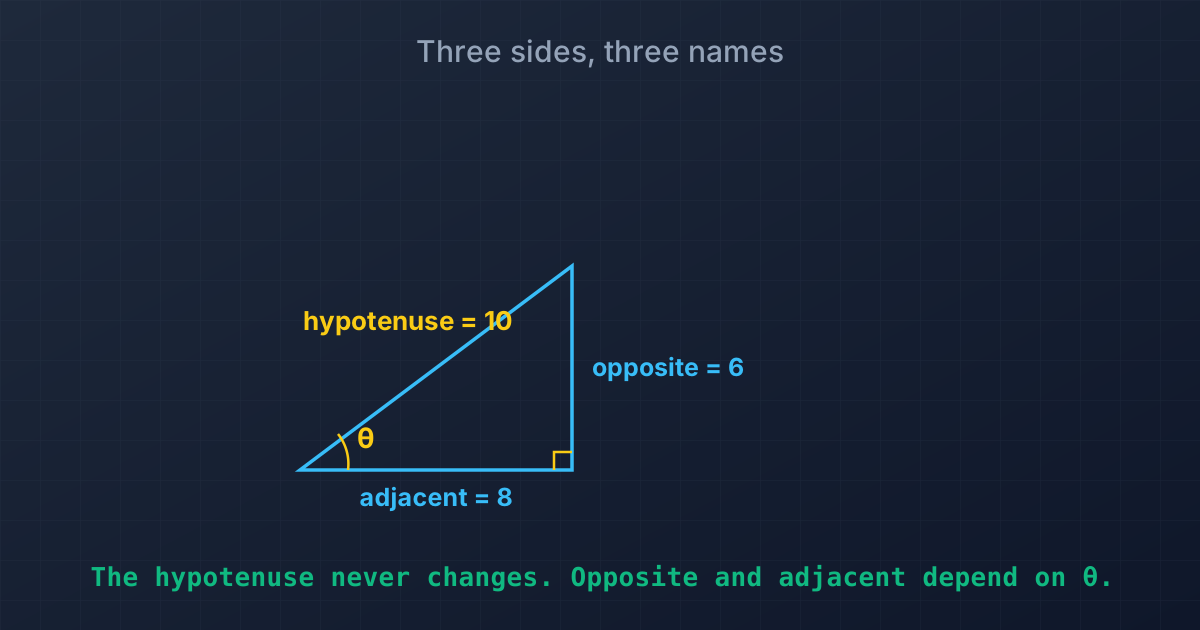
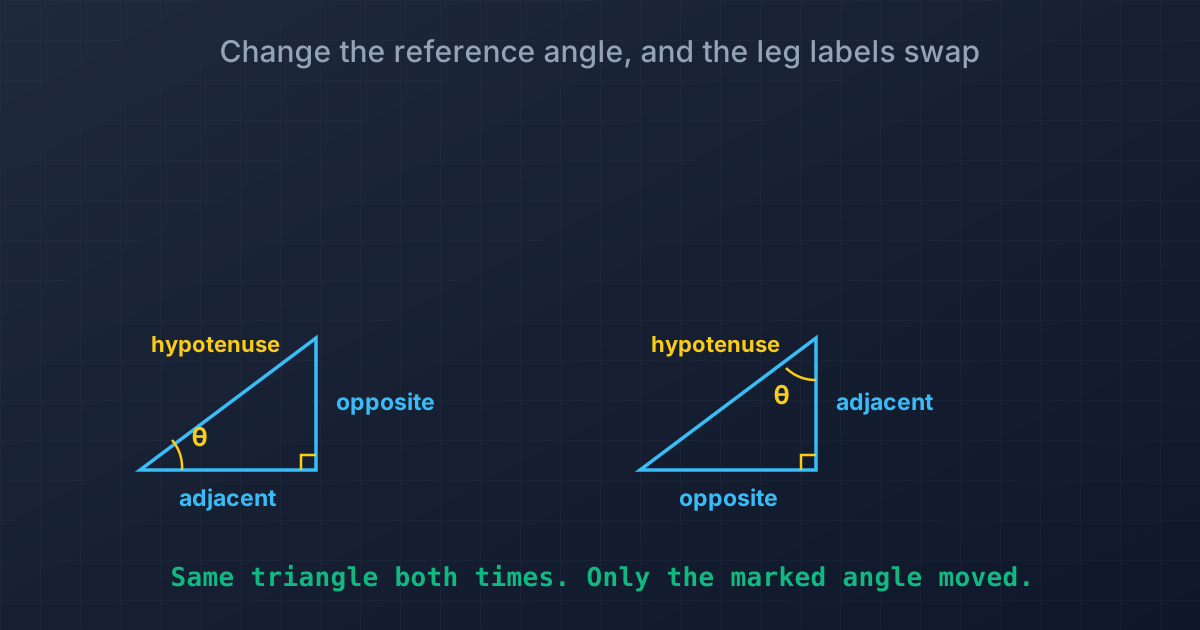
The legs also carry a second pair of names, opposite and adjacent, and these are not permanent properties of the legs. They are assigned relative to one of the acute angles, the one you choose as your reference angle. The leg across from that angle is its opposite side; the leg touching it, the one that is not the hypotenuse, is its adjacent side. Choose the other acute angle and the two legs trade names. Everything in this guide follows from that one paragraph.
The Hypotenuse of a Right Triangle
The hypotenuse is the side directly across from the right angle, and that position is the whole definition. It is the only side that does not touch the 90-degree corner. Because it faces the largest angle in the triangle, it is always the longest side, a fact worth using as a check: if your calculated hypotenuse comes out shorter than a leg, an error has already happened.
Recognizing it in rotated triangles trips students up, so use position, not appearance. Ignore which way the triangle leans. Find the small square marking the right angle, then look at the side that does not touch it. That side is the hypotenuse whether the triangle stands upright, lies on its side, or hangs upside down.
The hypotenuse also has a fixed identity. Switch your reference angle from one acute corner to the other and the legs trade their opposite and adjacent labels, but the hypotenuse stays the hypotenuse. It is named by the right angle, and the right angle does not move.
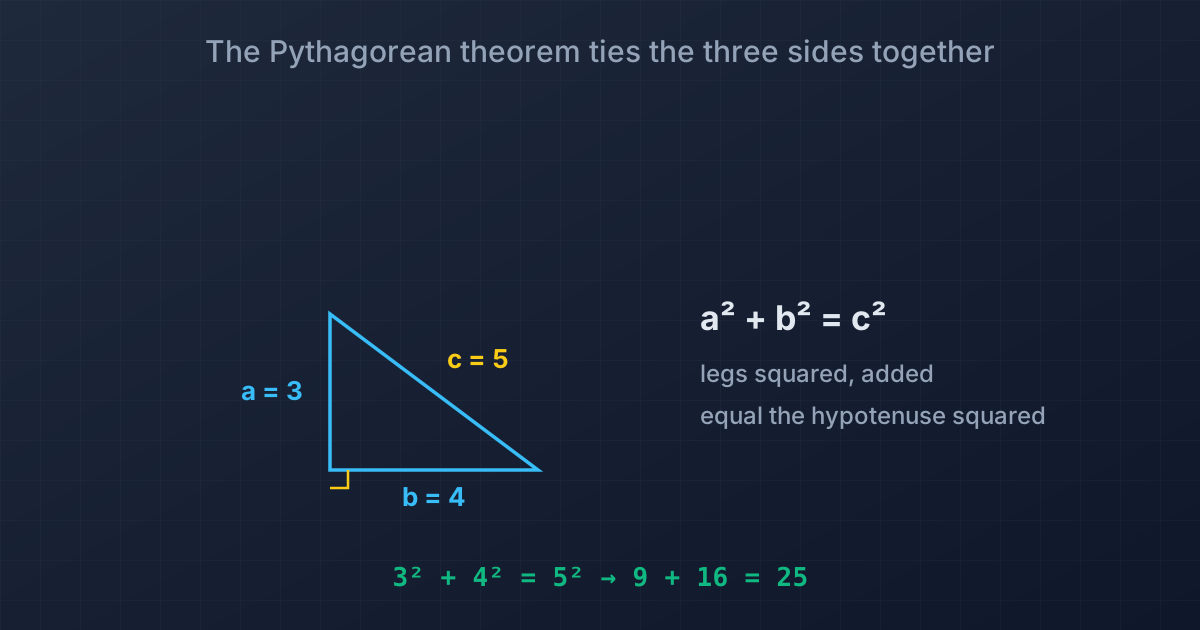
Demonstration: in the 3-4-5 triangle, the sides 3 and 4 meet at the right angle, so they are the legs. The side of length 5 sits across from that corner, touching neither end of it, so 5 is the hypotenuse. It is also the longest of the three, as it must be. Our hypotenuse formula guide is devoted to this one side.
What Is the Opposite Side of a Right Triangle?
Pick one acute angle and mark it as your reference angle, often labelled θ. The opposite side is the leg directly across from it, the side that does not touch the reference angle at all. A reliable way to find it: start at the reference angle and look straight across the triangle. The side your gaze lands on is the opposite side.
The opposite side is always a leg, never the hypotenuse, because the hypotenuse sits across from the 90-degree angle, not from an acute one. And because the label belongs to the angle rather than to the side, it is temporary. Move your reference to the other acute angle and a different leg becomes the opposite side.
Numerical example: take a 3-4-5 triangle and mark θ at the corner where the hypotenuse meets the leg of length 4. The side across from θ is the leg of length 3, so 3 is the opposite side, 4 is the adjacent side, and θ measures about 36.87 degrees. Now mark the other acute angle instead, about 53.13 degrees: the side across from it is the leg of length 4. Same triangle, same three sides, and the opposite label has moved house.
What Is the Adjacent Side of a Right Triangle?
The adjacent side is the leg that touches the reference angle and helps form it, running from the reference angle’s corner along to the right-angle corner. Together with the hypotenuse it frames the reference angle; of those two framing sides, only the leg counts as adjacent.
That last clause matters. Students regularly call the hypotenuse the adjacent side because it also touches the reference angle. In trigonometric ratios the hypotenuse has its own name and its own role, and it is never the adjacent side. Adjacent is a job reserved for a leg.
Like opposite, adjacent is a temporary assignment. In the 3-4-5 example above, with θ at the corner beside the leg of length 4, the adjacent side is 4. Move the reference angle to the other corner and the leg of length 3 becomes adjacent, while 4 becomes opposite. The two labels always swap as a pair.
Hypotenuse vs. Opposite vs. Adjacent Side
| Side name | Definition | Position relative to the reference angle | Changes with the reference angle? | Used for |
|---|---|---|---|---|
| Hypotenuse | Side opposite the 90-degree angle | Does not touch the right angle; touches both acute angles | No, fixed | c in a² + b² = c²; denominator in sine and cosine |
| Opposite | Leg across from the reference angle | Does not touch the reference angle | Yes | Numerator in sine and tangent |
| Adjacent | Leg touching the reference angle, other than the hypotenuse | Forms the reference angle with the hypotenuse | Yes | Denominator in tangent; numerator in cosine |
One line to remember it by: the hypotenuse is named by the right angle, the legs are named by whichever acute angle you are standing at.
How to Identify the Sides of a Right Triangle Step by Step
Step 1: Find the 90-degree angle. Look for the small square marker, or the corner where the two perpendicular sides meet.
Step 2: Identify the hypotenuse. It is the side across from that corner, the side that does not touch it. This label is now permanent for the problem.
Step 3: Select the acute reference angle. Problems mark it with an arc, a value, or the Greek letter θ. If none is marked and none is asked about, you may not need the opposite and adjacent labels at all.
Step 4: Identify the opposite side. Look across from the reference angle. The leg on the far side of the triangle is opposite.
Step 5: Identify the adjacent side. One leg remains. It touches the reference angle, and it is the adjacent side.
Step 6: Double-check the labels. The hypotenuse should be the longest side, the opposite side should not touch the reference angle, and the adjacent side should. All three checks take five seconds.
Orientation changes nothing in this procedure. Rotate the page 180 degrees and the right angle is still findable, the hypotenuse is still across from it, and the labels still follow the reference angle. The rules are tied to the angles, not to the drawing’s posture, which is why the same six steps work on a triangle standing on its hypotenuse, balanced on a leg, or drawn inside a word problem about a ramp.
The Pythagorean Theorem and Right Triangle Sides
Once the sides have names, the first great formula connects their lengths:
a² + b² = c²
Here a and b are the two legs, in either order, and c is the hypotenuse. The theorem holds for right triangles only, and it lets you compute any one side when the other two are known. Its full story, including why it works, is in our Pythagorean theorem formula guide.
How to Find the Hypotenuse
Rearrange the theorem with the hypotenuse as the subject:
c = √(a² + b²)
Example: a = 6 cm and b = 8 cm. Then c = √(36 + 64) = √100 = 10 cm. Verify: 6² + 8² = 36 + 64 = 100 = 10², and 10 is longer than both legs, as a hypotenuse must be.
How to Find a Missing Leg
Solve the same theorem for a leg instead:
a = √(c² − b²)
Example: c = 13 cm and b = 5 cm. Then a = √(169 − 25) = √144 = 12 cm. Verify: 12² + 5² = 144 + 25 = 169 = 13². Notice the subtraction: a leg is found by taking away, never by adding, and using c² − b² with the hypotenuse genuinely in the c slot is what makes it work. For a full set of these calculations, see how to find a missing side.
How to Find Right Triangle Sides Using SOH CAH TOA
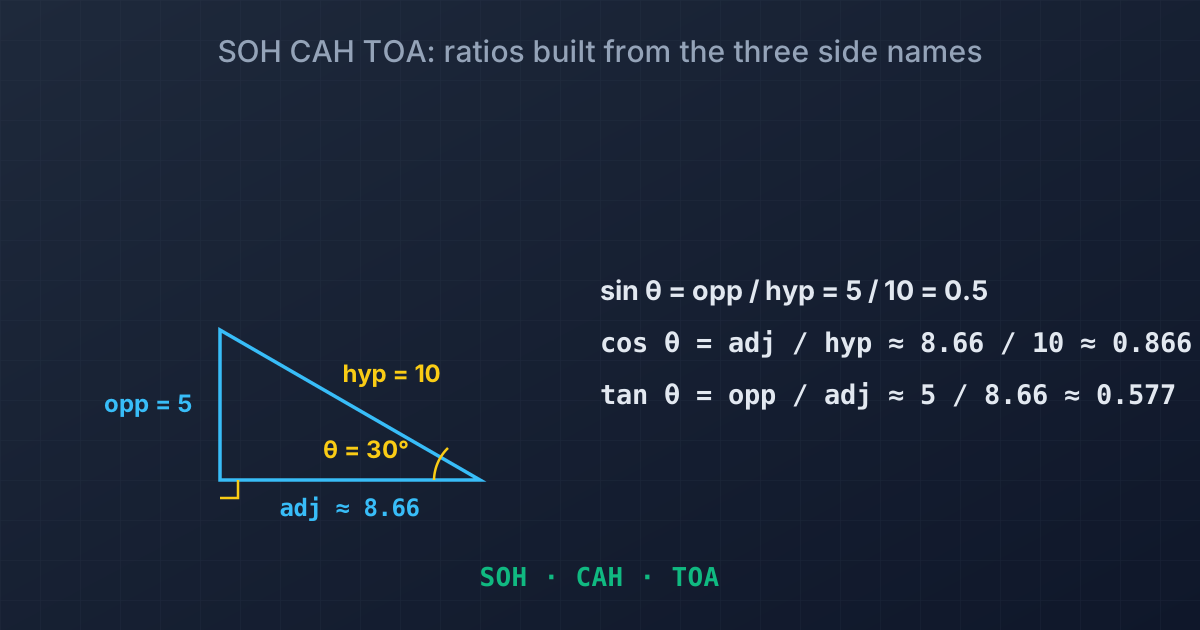
When a problem gives you an acute angle and one side instead of two sides, the Pythagorean theorem runs out of material and trigonometric ratios take over. Each ratio pairs two of the three side names, which is why the naming had to come first. The memory aid is SOH CAH TOA, and the deep treatment lives in our sine, cosine, and tangent guide.
Sine: Opposite Over Hypotenuse
sin(θ) = Opposite ÷ Hypotenuse. Use sine when the story involves the side across from your angle and the hypotenuse, one known and one wanted.
Cosine: Adjacent Over Hypotenuse
cos(θ) = Adjacent ÷ Hypotenuse. Use cosine when the leg touching your angle and the hypotenuse are the pair in play.
Tangent: Opposite Over Adjacent
tan(θ) = Opposite ÷ Adjacent. Use tangent when both legs are involved and the hypotenuse is not part of the question.
One triangle, all three ratios: let θ = 30 degrees with a hypotenuse of 10. The opposite side is 10 × sin(30°) = 10 × 0.5 = 5. The adjacent side is 10 × cos(30°) ≈ 10 × 0.866 = 8.66. Now check the third ratio from those two sides: tan(30°) = 5 ÷ 8.66 ≈ 0.577, which matches the tangent of 30 degrees exactly as it should. Three ratios, one triangle, and the side names did all the routing.
Special Right Triangles and Their Side Ratios
Two families of right triangles appear so often that their side ratios are worth memorizing outright.
45-45-90 Triangle Side Ratio
When both acute angles are 45 degrees, the legs facing them are equal, and the ratio of sides is:
1 : 1 : √2 (leg : leg : hypotenuse)
Example: legs of 5 cm give a hypotenuse of 5√2 ≈ 7.07 cm. The full treatment is in our isosceles right triangle guide.
30-60-90 Triangle Side Ratio
When the acute angles are 30 and 60 degrees, the ratio is:
1 : √3 : 2 (short leg : long leg : hypotenuse)
The short leg sits opposite the 30-degree angle, the long leg opposite the 60-degree angle, and the hypotenuse, twice the short leg, opposite the 90-degree angle.
Example: a short leg of 4 cm gives a long leg of 4√3 ≈ 6.93 cm and a hypotenuse of 8 cm. Verify with Pythagoras: 4² + 6.93² ≈ 16 + 48 = 64 = 8². More in our 30-60-90 triangle guide.
Solved Examples of Right Triangle Side Problems
Example 1: Identify All Three Side Labels
Given: a right triangle whose right angle sits at the bottom right corner. The marked reference angle θ is at the bottom left corner. The horizontal leg measures 8, the vertical leg measures 6, and the slanted side measures 10.
The slanted side does not touch the right angle, so it is the hypotenuse, 10. Across from θ is the vertical leg, so the opposite side is 6. The remaining leg touches θ, so the adjacent side is 8. θ itself measures about 36.87 degrees.
Verify: 6² + 8² = 36 + 64 = 100 = 10², and the hypotenuse is the longest side. Consistent.
Example 2: Find the Hypotenuse
Given: legs of 9 cm and 12 cm.
c = √(9² + 12²) = √(81 + 144) = √225 = 15 cm.
Verify: 9-12-15 is the 3-4-5 family scaled by 3, and 15 exceeds both legs. Correct.
Example 3: Find a Missing Leg
Given: a hypotenuse of 17 cm and one leg of 8 cm.
a = √(17² − 8²) = √(289 − 64) = √225 = 15 cm.
Verify: 8² + 15² = 64 + 225 = 289 = 17². Correct.
Example 4: Find the Opposite Side Using Sine
Given: a reference angle of 30 degrees and a hypotenuse of 10 cm.
sin(30°) = Opposite ÷ 10, so Opposite = 10 × 0.5 = 5 cm.
Verify: this is the 30-60-90 pattern, where the side opposite 30 degrees is always half the hypotenuse: 10 ÷ 2 = 5. Correct.
Example 5: Find the Adjacent Side Using Cosine
Given: a reference angle of 60 degrees and a hypotenuse of 14 cm.
cos(60°) = Adjacent ÷ 14, so Adjacent = 14 × 0.5 = 7 cm.
Verify: this triangle is the mirror of Example 4: the side adjacent to 60 degrees is the side opposite 30 degrees, and half of 14 is 7. Correct.
Example 6: Solve a Real-Life Ladder Problem
Given: a ladder 10 feet long leans against a vertical wall on level ground, its base 6 feet from the wall. How high does it reach?
The ladder is the hypotenuse (it joins the ends of the other two sides), the ground distance of 6 feet is one leg, and the wall height is the other. Height = √(10² − 6²) = √(100 − 36) = √64 = 8 feet.
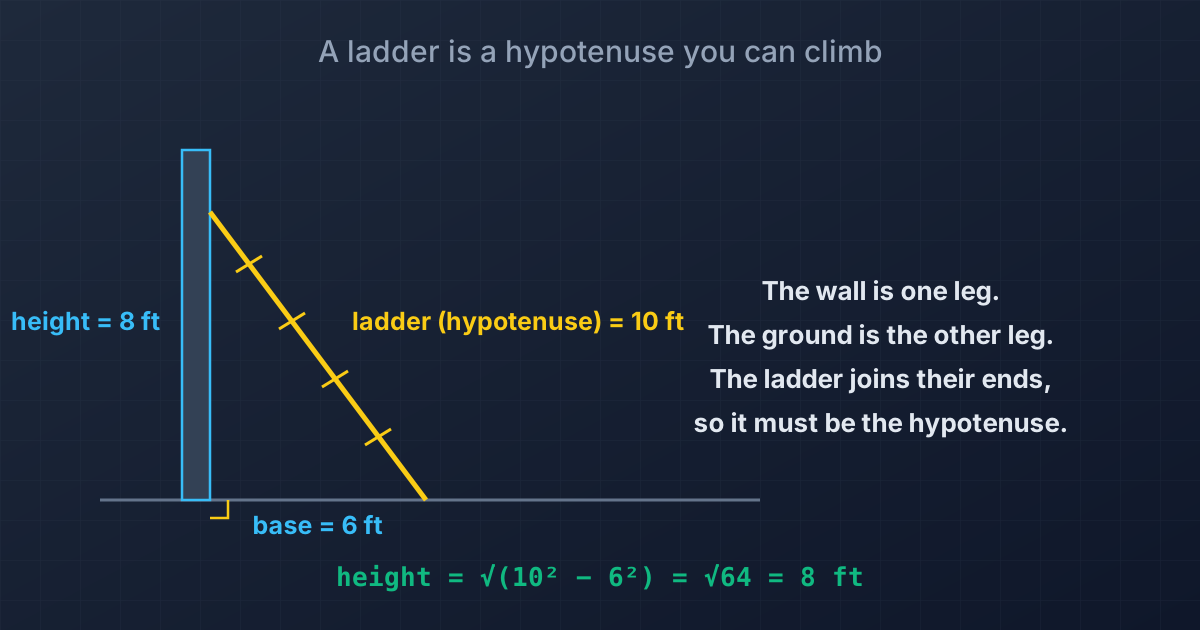
Verify: 6-8-10 is a Pythagorean triple, and the wall, ground, and ladder form a right angle at the wall’s base because the ground is level and the wall is vertical. Correct, under exactly those assumptions.
Real-Life Applications of Right Triangle Sides
Right triangle sides appear wherever something leans, rises, or is braced. Ladders against walls pair a hypotenuse with a height and a base distance. Wheelchair ramps trade in all three: the ramp surface is the hypotenuse, the rise is one leg, and the horizontal run is the other. Roof design sets rafter lengths, the hypotenuses, from the span and the pitch. Building heights are measured from a shadow or a line of sight, surveying lays out right triangles across land to carry measurements over ground that cannot be walked, and navigation treats east-west and north-south travel as legs with the direct route as the hypotenuse, the same geometry as our distance formula guide.
Scenario 1, a wheelchair ramp: a doorway threshold sits 1 foot above the pavement, and the ramp’s horizontal run is 12 feet. The ramp surface, the hypotenuse, measures √(1² + 12²) = √145 ≈ 12.04 feet of material. The shallow slant is why a ramp works: 12 feet of run buys 1 foot of rise.
Scenario 2, a guy wire: a 20-metre pole is steadied by a wire running from its top to an anchor 12 metres from its base. The wire, the hypotenuse, measures √(20² + 12²) = √(400 + 144) = √544 ≈ 23.32 metres. The pole is one leg, the ground distance the other, and the wire’s length follows from naming them correctly.
Common Mistakes When Identifying Right Triangle Sides
- Assuming the hypotenuse is whichever side looks slanted. In a triangle resting on its hypotenuse, both legs slant. Identify by the right angle, never by posture.
- Assuming the hypotenuse sits at the top. Diagrams rotate freely. The hypotenuse is across from the right angle in every orientation, including upside down.
- Confusing opposite and adjacent. Opposite never touches the reference angle; adjacent always does. Check contact before naming.
- Forgetting to mark the reference angle. Without a chosen acute angle, the words opposite and adjacent have no meaning. Decide which angle you are standing at before anything else.
- Calling the hypotenuse the adjacent leg. It touches the reference angle, but it already has its own name and is never counted as adjacent in the ratios.
- Using the wrong side as c. In a² + b² = c², c is the hypotenuse specifically. Putting a leg in that slot corrupts everything downstream.
- Using SOH CAH TOA from the wrong angle. Ratios computed from the other acute angle answer a different question. Confirm the reference angle matches the one the problem asks about.
- Mixing degrees and radians. A calculator in radian mode reads 30 as 30 radians and returns nonsense for school problems. Check the mode before trusting any sine or cosine.
Practice Problems: Sides of a Right Triangle
Beginner
- A right triangle has sides of 5 cm, 12 cm, and 13 cm. Which side is the hypotenuse?
- In a right triangle, the marked angle is at vertex A. The side directly across from A measures 9 cm, the hypotenuse measures 15 cm, and the remaining side measures 12 cm. Which side is the opposite side for angle A?
- Using the same triangle as question 2, which side is adjacent to angle A?
- Which two sides of a right triangle form the right angle?
Intermediate
- The legs of a right triangle measure 7 cm and 24 cm. Find the hypotenuse.
- A right triangle has a hypotenuse of 20 cm and one leg of 12 cm. Find the other leg.
- A right triangle has a 45-degree reference angle and a hypotenuse of 10 cm. Use sine to find the opposite side, to two decimal places.
- A right triangle has a 30-degree reference angle and a hypotenuse of 16 cm. Use cosine to find the adjacent side, to two decimal places.
Advanced
- In a 30-60-90 triangle, the short leg measures 7 cm. Find the long leg and the hypotenuse.
- A 13-foot ladder leans against a building and reaches a window 12 feet above level ground. How far is the ladder’s base from the wall?
Answer Key
- The 13 cm side: it is the longest and sits opposite the right angle.
- The 9 cm side: opposite means directly across from the marked angle.
- The 12 cm side: it touches angle A and is not the hypotenuse. (As a check, 9² + 12² = 81 + 144 = 225 = 15².)
- The two legs. The hypotenuse never touches the right angle.
- c = √(7² + 24²) = √(49 + 576) = √625 = 25 cm.
- a = √(20² − 12²) = √(400 − 144) = √256 = 16 cm.
- Opposite = 10 × sin(45°) ≈ 10 × 0.7071 = 7.07 cm.
- Adjacent = 16 × cos(30°) ≈ 16 × 0.8660 = 13.86 cm.
- Long leg = 7√3 ≈ 12.12 cm; hypotenuse = 2 × 7 = 14 cm.
- Base distance = √(13² − 12²) = √(169 − 144) = √25 = 5 feet.
Check Your Work
Name the sides on paper first, then test the numbers. Enter your two legs into the Right Triangle Calculator and compare its hypotenuse with yours, and when a problem turns on similarity rather than lengths, our similar right triangles guide covers how the same naming works across two triangles at once. Most disagreements trace back to one of two slips: c was not the hypotenuse, or the ratio was read from the wrong reference angle.
Frequently Asked Questions
Short answers to the questions students ask most about the sides of a right triangle.
01 What are the three sides of a right triangle called?
The side opposite the right angle is the hypotenuse, and the two sides forming the right angle are the legs. Relative to a chosen acute angle, the legs are further named opposite and adjacent: opposite for the leg across from the angle, adjacent for the leg touching it.
02 Which side is the hypotenuse?
The hypotenuse is the side directly across from the 90-degree angle, the one side that does not touch the right-angle corner. It is always the longest side of the triangle. Find the small square marking the right angle, then look at the side facing it: that is the hypotenuse, in any orientation.
03 Is the hypotenuse always the longest side?
Yes. The hypotenuse faces the largest angle in the triangle, the 90-degree angle, and the side facing the largest angle is always the longest. This gives a free check on calculations: if a computed hypotenuse is shorter than one of the legs, something upstream has gone wrong.
04 How do you identify the opposite side?
First choose your reference angle, one of the acute angles. Then look directly across the triangle from it. The leg on the far side, the one that does not touch the reference angle at all, is the opposite side. If the far side you find is the hypotenuse, the wrong angle is being used.
05 How do you identify the adjacent side?
Stand at the reference angle and look at the two sides that form it. One is the hypotenuse; the other, a leg running from the reference angle to the right-angle corner, is the adjacent side. Adjacent always touches the reference angle, and it is never the hypotenuse.
06 Can the opposite and adjacent sides switch?
Yes, and they always switch together. The labels belong to the reference angle, not to the sides themselves. Move the reference to the other acute angle and the leg that was opposite becomes adjacent, while the leg that was adjacent becomes opposite. The hypotenuse is the only label that never moves.
07 How do you find a missing side of a right triangle?
With two sides known, use the Pythagorean theorem: square the legs, add them for the hypotenuse, or subtract for a missing leg, then take the square root. With one side and an acute angle known, use a trigonometric ratio from SOH CAH TOA, chosen by which pair of sides the problem involves.
08 What is the Pythagorean theorem?
It states that in a right triangle, the squares of the two legs add up to the square of the hypotenuse: a squared plus b squared equals c squared. It applies only to right triangles, and it lets you calculate any one side of the triangle when the other two lengths are known.
09 What does SOH CAH TOA mean?
It is a memory aid for the three basic trigonometric ratios. SOH: sine equals opposite over hypotenuse. CAH: cosine equals adjacent over hypotenuse. TOA: tangent equals opposite over adjacent. Each ratio is named after the reference angle, which is why identifying the sides correctly comes before any calculation.
10 What are the side ratios of special right triangles?
A 45-45-90 triangle has sides in the ratio 1 to 1 to root 2, because its legs are equal. A 30-60-90 triangle has sides in the ratio 1 to root 3 to 2, read as short leg, long leg, hypotenuse. Knowing the ratio turns one known side into all three sides.
Conclusion
A right triangle is a 90-degree angle with three sides around it: a hypotenuse that never changes its name, and two legs whose names, opposite and adjacent, depend entirely on the acute angle you choose as your reference. Learn to identify the three sides in any orientation and the rest of the topic falls into place, because the Pythagorean theorem and SOH CAH TOA are both written in this vocabulary. Mark the reference angle first, every time, check that the hypotenuse is the longest side, and then calculate. Practice on rotated diagrams until the labels feel automatic.