
Reciprocal Trigonometric Ratios in Right Triangles
Math Expert
Trigonometry
Picture a ladder leaning against a wall. If you know the angle the ladder makes with the ground, the sine of that angle tells you the height the ladder reaches as a fraction of the ladder’s length. But what if you know the height and want the ladder’s length instead? You need the same relationship turned upside down. That flipped version is exactly what reciprocal trigonometric ratios are for.
Reciprocal trigonometric ratios are the three ratios formed by flipping sine, cosine, and tangent: cosecant (csc θ) equals hypotenuse divided by opposite, secant (sec θ) equals hypotenuse divided by adjacent, and cotangent (cot θ) equals adjacent divided by opposite. They describe the same triangle and the same angle as the ratios you already know, only with the fraction reversed. This guide explains each one, shows how to calculate them from side lengths, works through examples step by step, and finishes with practice questions and answers.
What Are Reciprocal Trigonometric Ratios?
A reciprocal is what you get when you turn a fraction upside down. The reciprocal of 3/4 is 4/3, and the reciprocal of 2 is 1/2. Reciprocal trigonometric ratios apply that same idea to trigonometry. Each basic ratio has one reciprocal partner:
- Cosecant (csc) is the reciprocal of sine.
- Secant (sec) is the reciprocal of cosine.
- Cotangent (cot) is the reciprocal of tangent.
The key point is that a reciprocal ratio does not describe a different triangle or a different angle. If sin θ comes from a particular right triangle and a particular acute angle θ, then csc θ comes from that same triangle and that same angle, with the numerator and denominator swapped. The pair always travels together, and that pairing is what makes reciprocal ratios easy to learn once the basic ratios are clear.
Definition to remember: Cosecant, secant, and cotangent are the reciprocals of sine, cosine, and tangent. They use the same three sides of the same right triangle, with each fraction flipped.
One condition matters: a reciprocal ratio is defined only where the ratio it flips is not zero. Since a real right triangle has three sides with positive lengths, all six ratios are defined for any acute angle inside it. Undefined cases appear only at boundary angles such as 0 degrees and 90 degrees, covered in the mistakes section and the FAQs.
Review of Basic Trigonometric Ratios
Before the reciprocal formulas, fix how the sides of a right triangle are named. The names depend on a chosen acute angle, so always start by picking the angle and marking it, usually with the symbol θ.
- Hypotenuse: the side opposite the right angle. It is the longest side, and its name never changes, no matter which acute angle you pick.
- Opposite side: the side directly across from the chosen acute angle. It does not touch the angle’s vertex.
- Adjacent side: the side next to the chosen acute angle that is not the hypotenuse. It forms one side of the angle itself.
The three basic ratios, covered in full in the guide to sine, cosine, and tangent, are:
- sin θ = Opposite / Hypotenuse
- cos θ = Adjacent / Hypotenuse
- tan θ = Opposite / Adjacent
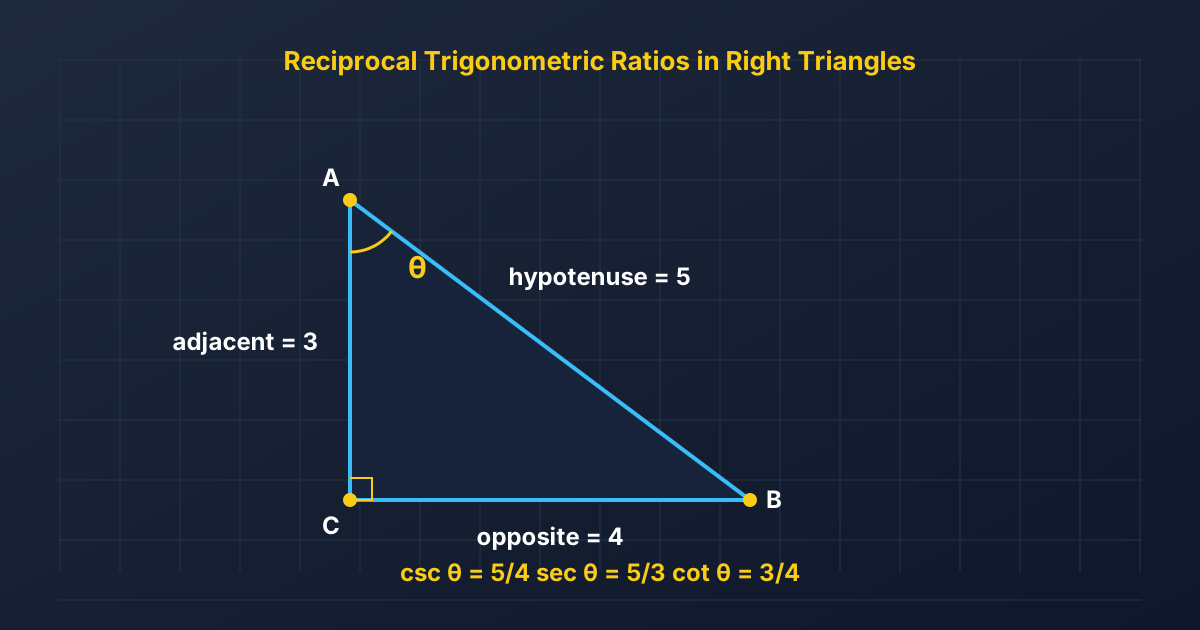
Use one triangle for the whole article so the numbers stay familiar. Take a right triangle with sides 3, 4, and 5, right-angled at C, with the marked acute angle θ at vertex A. For angle θ, the opposite side is BC = 4, the adjacent side is AC = 3, and the hypotenuse is AB = 5. Check that 3² + 4² = 9 + 16 = 25 = 5², so the sides genuinely form a right triangle. The basic ratios are:
- sin θ = Opposite / Hypotenuse = 4/5
- cos θ = Adjacent / Hypotenuse = 3/5
- tan θ = Opposite / Adjacent = 4/3
Notice what changes and what does not when you switch angles. If you picked the other acute angle at B instead, the opposite and adjacent sides would swap: the opposite would become 3 and the adjacent 4. The hypotenuse would still be 5. That swap is the single most common source of errors in this topic, and every worked example below names the angle first for exactly that reason.
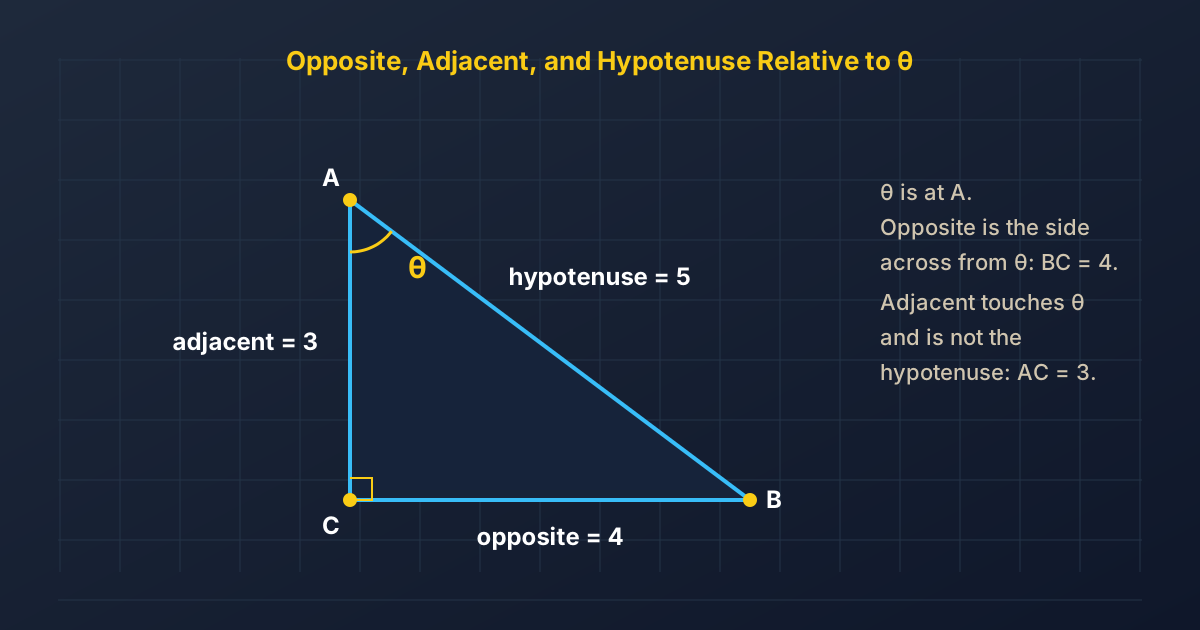
Caption: The 3-4-5 triangle used throughout this guide. For angle θ at A, the opposite side is 4, the adjacent side is 3, and the hypotenuse is 5.
The Three Reciprocal Trigonometric Ratios
Each reciprocal ratio flips one basic ratio. Work through all three with the same 3-4-5 triangle, so you can see the pattern: find the basic ratio first, then turn its fraction over.
1. Cosecant (csc)
Cosecant is the reciprocal of sine.
csc θ = 1 / sin θ = Hypotenuse / Opposite
For the triangle above, sin θ = 4/5, so csc θ = 1 / (4/5) = 5/4. Using the sides directly gives the same answer: csc θ = Hypotenuse / Opposite = 5/4. The two routes must agree, and checking one against the other is a good habit. Cosecant answers the question “how many times does the opposite side fit into the hypotenuse?” Here the hypotenuse is 5/4 times the opposite side.
2. Secant (sec)
Secant is the reciprocal of cosine.
sec θ = 1 / cos θ = Hypotenuse / Adjacent
For the same triangle, cos θ = 3/5, so sec θ = 1 / (3/5) = 5/3. From the sides: sec θ = Hypotenuse / Adjacent = 5/3. Note the pairing carefully: secant pairs with cosine, not with sine. The names sound alike, and mixing them up is the most common naming mistake in this topic. Secant uses the hypotenuse and the adjacent side, the same two sides as cosine, flipped.
3. Cotangent (cot)
Cotangent is the reciprocal of tangent.
cot θ = 1 / tan θ = Adjacent / Opposite
For the same triangle, tan θ = 4/3, so cot θ = 1 / (4/3) = 3/4. From the sides: cot θ = Adjacent / Opposite = 3/4. Cotangent is the only reciprocal ratio that does not use the hypotenuse at all. It compares the two legs, with the adjacent side on top. That is why its value behaves differently from the other two, as the FAQs explain.
Reciprocal Trigonometric Ratios Formula Table
| Ratio | Formula using sides | Relationship to basic ratio |
|---|---|---|
| Cosecant (csc θ) | Hypotenuse / Opposite | 1 / sin θ |
| Secant (sec θ) | Hypotenuse / Adjacent | 1 / cos θ |
| Cotangent (cot θ) | Adjacent / Opposite | 1 / tan θ |
Memory trick: flip the fraction, keep the angle. Sin flips to csc, cos flips to sec, tan flips to cot. The angle θ never changes, and the two sides stay the same; only the numerator and denominator trade places. If you can write the basic ratio, you can write its reciprocal by turning it over.
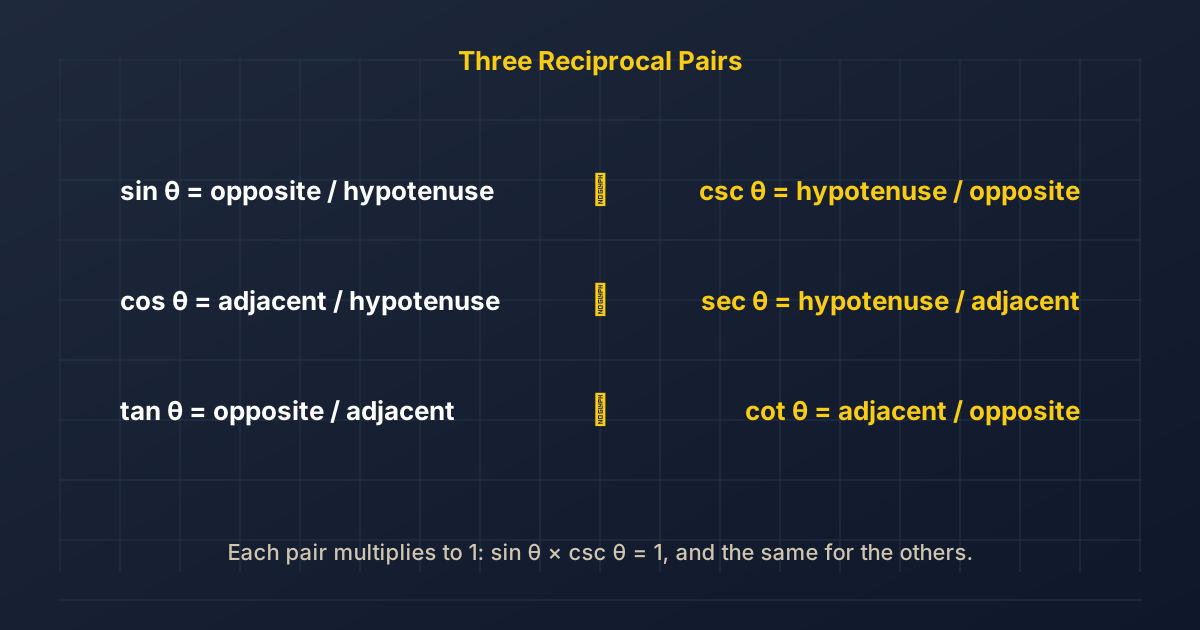
Caption: Each basic ratio and its reciprocal partner. Every pair multiplies to 1.
How to Find Reciprocal Trigonometric Ratios in a Right Triangle
Follow the same seven steps every time, and the problems become routine:
- Identify the reference acute angle.
- Label the opposite, adjacent, and hypotenuse sides for that angle.
- Determine which reciprocal ratio the question asks for.
- Select the correct formula.
- Substitute the known side lengths.
- Simplify the fraction and calculate the answer.
- Check that the selected sides match the formula.
Now the full method on the 3-4-5 triangle. The question: find csc θ, sec θ, and cot θ for the angle θ at A, where the opposite side is 4, the adjacent side is 3, and the hypotenuse is 5.
Cosecant: the question asks for csc, so the formula is Hypotenuse / Opposite. Substitute: 5/4. The fraction is already in lowest terms, so csc θ = 5/4. Check: sin θ = 4/5, and 1 / (4/5) = 5/4, which matches.
Secant: the formula is Hypotenuse / Adjacent. Substitute: 5/3. Already in lowest terms, so sec θ = 5/3. Check: cos θ = 3/5, and 1 / (3/5) = 5/3, which matches.
Cotangent: the formula is Adjacent / Opposite. Substitute: 3/4. Already in lowest terms, so cot θ = 3/4. Check: tan θ = 4/3, and 1 / (4/3) = 3/4, which matches.
Three habits make this reliable. First, label the sides before touching any formula. Second, write the basic ratio next to the reciprocal one, so a swapped pair shows up at once. Third, check the answer against the basic ratio: the two must multiply to 1, since (4/5) × (5/4) = 1, (3/5) × (5/3) = 1, and (4/3) × (3/4) = 1.
Worked Examples of Reciprocal Trigonometric Ratios
Each example states the question, the given information, the formula, the calculation step by step, the final answer, and a short check. Exact fractions are kept throughout, with no rounding.
Example 1: Find cosecant when the opposite side is 5 and the hypotenuse is 13
Question: In a right triangle, the side opposite θ is 5 and the hypotenuse is 13. Find csc θ.
Given: Opposite = 5, Hypotenuse = 13.
Formula: csc θ = Hypotenuse / Opposite.
Calculation: Substitute the values: csc θ = 13/5.
Final answer: csc θ = 13/5.
Why it is correct: The basic ratio is sin θ = 5/13, and its reciprocal is 13/5. The third side of this triangle would be 12, since 5² + 12² = 25 + 144 = 169 = 13², but it is not needed here: cosecant uses only the hypotenuse and the opposite side.
Example 2: Find secant when the adjacent side is 8 and the hypotenuse is 17
Question: In a right triangle, the side adjacent to θ is 8 and the hypotenuse is 17. Find sec θ.
Given: Adjacent = 8, Hypotenuse = 17.
Formula: sec θ = Hypotenuse / Adjacent.
Calculation: Substitute the values: sec θ = 17/8.
Final answer: sec θ = 17/8.
Why it is correct: The basic ratio is cos θ = 8/17, and its reciprocal is 17/8. The unused third side would be 15, since 8² + 15² = 64 + 225 = 289 = 17², but secant does not need it.
Example 3: Find cotangent when the opposite side is 7 and the adjacent side is 24
Question: In a right triangle, the side opposite θ is 7 and the side adjacent to θ is 24. Find cot θ.
Given: Opposite = 7, Adjacent = 24.
Formula: cot θ = Adjacent / Opposite.
Calculation: Substitute the values: cot θ = 24/7.
Final answer: cot θ = 24/7.
Why it is correct: The basic ratio is tan θ = 7/24, and its reciprocal is 24/7. Note the order: cotangent puts the adjacent side on top. Writing 7/24 would give tangent, not cotangent. The hypotenuse here would be 25, since 7² + 24² = 49 + 576 = 625 = 25², but cotangent never uses it.
Example 4: Given a basic ratio, determine its reciprocal
Question: If sin θ = 3/5, find csc θ.
Given: sin θ = 3/5.
Formula: csc θ = 1 / sin θ.
Calculation: Substitute: csc θ = 1 / (3/5) = 5/3. Dividing by a fraction means multiplying by its reciprocal, so 1 × 5/3 = 5/3.
Final answer: csc θ = 5/3.
Why it is correct: A ratio and its reciprocal multiply to 1, and (3/5) × (5/3) = 15/15 = 1. This route is often the fastest: when the basic ratio is already known, flip it instead of returning to the side lengths.
Reciprocal Trigonometric Identities
An identity is an equation that holds for every angle where the expressions are defined. The three reciprocal identities are:
csc θ = 1 / sin θ
sec θ = 1 / cos θ
cot θ = 1 / tan θ
Written as products, they say the same thing in a form that is handy for simplification:
sin θ × csc θ = 1
cos θ × sec θ = 1
tan θ × cot θ = 1
Do not confuse these with the Pythagorean identities, such as sin² θ + cos² θ = 1, which are covered in the guide to trigonometric identities in right triangles. Pythagorean identities relate squares of ratios that add to 1. Reciprocal identities relate a ratio to its flipped partner, and the two multiply to 1. Different structure, different job.
Short simplification example: Simplify sin θ × csc θ + cos θ × sec θ. Replace each product using the identities above: sin θ × csc θ = 1 and cos θ × sec θ = 1, so the expression becomes 1 + 1 = 2. Without the identities, the same expression would need a full expansion into side lengths. That shortcut is the main reason reciprocal identities appear so often in later trigonometry.
Common Mistakes to Avoid
- Confusing cosecant with cosine. Cosecant is csc, the reciprocal of sine. Cosine is cos, a basic ratio. The names share sounds, not meanings. Rule: csc pairs with sin, never with cos.
- Confusing secant with sine. Secant is sec, the reciprocal of cosine. Rule: sec pairs with cos, never with sin.
- Reversing the wrong pair of sides. Cotangent is Adjacent / Opposite. Writing Opposite / Adjacent gives tangent, not cotangent. Rule: name the ratio first, then read its formula from the table before substituting.
- Forgetting that opposite and adjacent depend on the reference angle. Switching from one acute angle to the other swaps opposite and adjacent, which changes every ratio except those using the hypotenuse alone in a symmetric way. Rule: mark the angle on the diagram before labeling any side.
- Taking the reciprocal incorrectly. The reciprocal of 4/5 is 5/4, not 1/4 or 4/5 with a sign change. Rule: swap numerator and denominator, and nothing else.
- Assuming that a reciprocal ratio always has a value between 0 and 1. For an acute angle, sine and cosine are between 0 and 1, so their reciprocals, csc and sec, are always greater than 1. Cotangent is different: it is greater than 1 when the adjacent side is longer than the opposite side, equal to 1 when the legs are equal, and less than 1 when the opposite side is longer. Rule: check the size against the sides, never against a habit.
- Dividing by zero or using a ratio when it is undefined. A reciprocal is undefined when the ratio it flips equals zero. Csc is undefined when sin θ = 0 (θ = 0 degrees), sec is undefined when cos θ = 0 (θ = 90 degrees), and cot is undefined when tan θ = 0 (θ = 0 degrees). Inside a genuine right triangle, θ is acute and all three are defined, because every side has a positive length. Rule: if a denominator is zero, stop and state that the ratio is undefined.
When Are Reciprocal Trigonometric Ratios Useful?
- Solving right-triangle problems. Some problems give a side and ask for a length that falls out directly from a reciprocal ratio, such as finding a hypotenuse from an opposite side and an angle using csc, without rearranging sine first.
- Simplifying trigonometric expressions. As the identities example showed, products like sin θ × csc θ collapse to 1, which shortens algebra in later trigonometry and calculus preparation.
- Finding unknown side relationships. When two sides are known but the needed ratio is the flipped one, the reciprocal form reads the answer straight off the triangle.
- Studying more advanced trigonometry. Graphs of cosecant, secant, and cotangent, and equations involving them, all build on these definitions. Students who meet them first as simple flips of familiar ratios find the advanced material far less strange.
- Working with angles and distances in geometry and applied mathematics. Surveying, construction, and navigation problems often phrase a known length as a fraction of an unknown one, which is naturally a reciprocal ratio. Nothing here needs exaggerated claims: the value is convenience and clarity, not magic.
One honest limit: for most everyday right-triangle problems, the basic ratios do the job on their own, and reciprocal ratios are a convenience rather than a necessity. Their real payoff comes in simplification and in later topics, where the flipped form is the natural language.
Practice Questions
Try these in order. They rise in difficulty, and each one has enough information to be solved exactly.
- In a right triangle, the side opposite θ is 12 and the hypotenuse is 13. Find csc θ.
- In a right triangle, the side adjacent to θ is 15 and the hypotenuse is 17. Find sec θ.
- In a right triangle, the side opposite θ is 9 and the side adjacent to θ is 40. Find cot θ.
- If cos θ = 12/13, find sec θ without returning to side lengths.
- Explain why sec θ is undefined when θ = 90 degrees.
Answer Key
1. csc θ = Hypotenuse / Opposite = 13/12. Check: sin θ = 12/13, and 1 / (12/13) = 13/12.
2. sec θ = Hypotenuse / Adjacent = 17/15. Check: cos θ = 15/17, and 1 / (15/17) = 17/15.
3. cot θ = Adjacent / Opposite = 40/9. Check: tan θ = 9/40, and 1 / (9/40) = 40/9. Note that the hypotenuse, 41, is not needed.
4. sec θ = 1 / cos θ = 1 / (12/13) = 13/12. Flipping the given ratio is faster than rebuilding the triangle.
5. Secant is the reciprocal of cosine, so sec θ = 1 / cos θ. At 90 degrees, cos θ = 0, and division by zero is undefined. So sec 90 degrees has no value. Inside a genuine right triangle this case never arises, because θ is acute there.
Frequently Asked Questions
Frequently Asked Questions
Common questions about reciprocal trigonometric ratios, answered briefly.
01 What are the three reciprocal trigonometric ratios?
Cosecant (csc), secant (sec), and cotangent (cot). They are the reciprocals of sine, cosine, and tangent: csc θ = Hypotenuse / Opposite, sec θ = Hypotenuse / Adjacent, and cot θ = Adjacent / Opposite.
02 What is the reciprocal of sine?
Cosecant. csc θ = 1 / sin θ = Hypotenuse / Opposite.
03 What is the reciprocal of cosine?
Secant. sec θ = 1 / cos θ = Hypotenuse / Adjacent.
04 What is the reciprocal of tangent?
Cotangent. cot θ = 1 / tan θ = Adjacent / Opposite.
05 How do you calculate cosecant in a right triangle?
Identify the angle, find the hypotenuse and the side opposite that angle, then divide: csc θ = Hypotenuse / Opposite. Equivalently, find sin θ first and flip the fraction.
06 Can reciprocal trigonometric ratios be greater than 1?
Yes. For an acute angle, csc and sec are always greater than 1, because the hypotenuse is the longest side. Cotangent can be greater than, equal to, or less than 1, depending on which leg is longer.
07 Are reciprocal identities the same as Pythagorean identities?
No. Reciprocal identities flip a ratio, such as csc θ = 1 / sin θ, and each pair multiplies to 1. Pythagorean identities, such as sin² θ + cos² θ = 1, relate squares of ratios that add to 1.
08 When is cosecant, secant, or cotangent undefined?
When the ratio it flips equals zero. Csc is undefined when sin θ = 0 (θ = 0 degrees), sec is undefined when cos θ = 0 (θ = 90 degrees), and cot is undefined when tan θ = 0 (θ = 0 degrees). For acute angles inside a right triangle, all three are defined.
09 What is the easiest way to remember reciprocal trigonometric ratios?
Flip the fraction, keep the angle. Sin flips to csc, cos flips to sec, and tan flips to cot. If you can write the basic ratio, its reciprocal is the same fraction turned over.
Conclusion
Reciprocal trigonometric ratios are simpler than their names suggest. Sine and cosecant are partners, cosine and secant are partners, and tangent and cotangent are partners, and in each pair one fraction is the other turned upside down: csc θ = Hypotenuse / Opposite, sec θ = Hypotenuse / Adjacent, and cot θ = Adjacent / Opposite. The whole topic rests on three habits: identify the angle first, label opposite, adjacent, and hypotenuse for that angle, and check every answer by multiplying the pair to 1.
Now practise deliberately. Rework the 3-4-5 example without looking, then try the five practice questions, and check each answer against its explanation rather than just its value. The first few will feel slow, because labeling the sides takes care. Then the pattern will click, and flipping a ratio will feel as natural as writing the ratio itself. For the next step, the guide to the Pythagorean theorem formula shows where the side lengths in these examples come from, and the guide to trigonometric identities builds the reciprocal identities into the full identity toolkit.