
Trigonometric Identities in Right Triangles: Formulas, Proofs, and Examples
Math Expert
Trigonometry
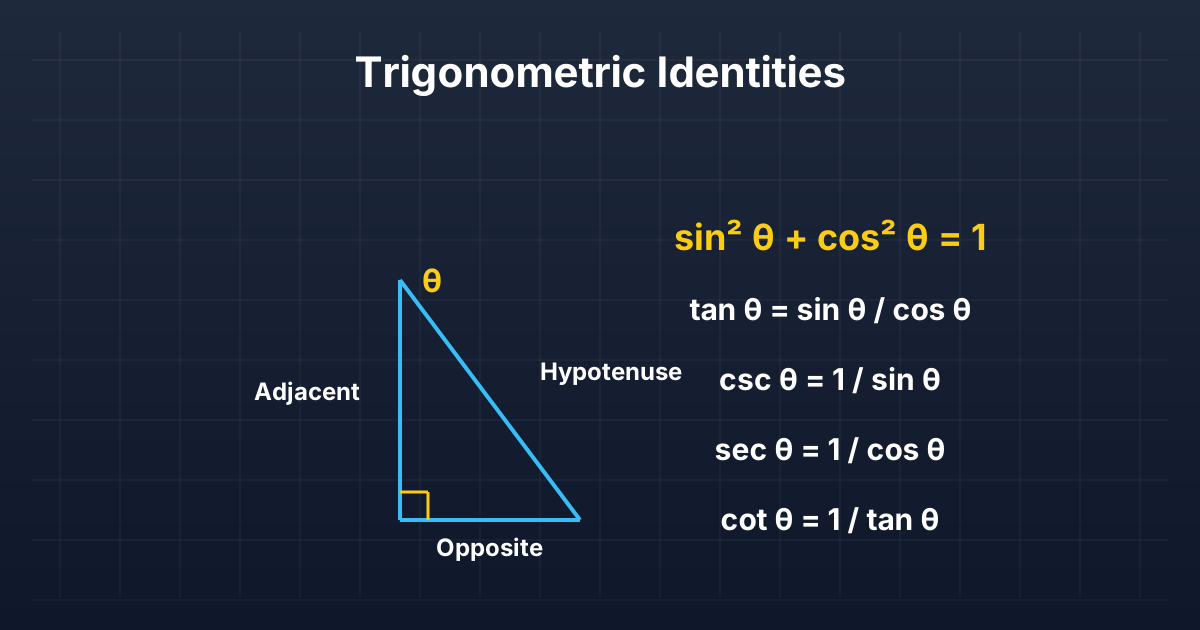
How can you find the value of cosine when you only know sine? Or prove that two complicated-looking trigonometric expressions are actually equal? The answer lies in a few powerful relationships hidden inside every right triangle. These relationships, called trigonometric identities in right triangles, turn difficult-looking equations into simple calculations. An identity is not a problem to solve. It is a fact that is always true, like a shortcut built into the triangle itself. Once you know that sine squared plus cosine squared always equals 1, you can find a missing ratio without measuring a single side. By the end of this guide, you will know how to derive the most important identities, recognize when to use them, and solve right-triangle problems with confidence. You will see every identity proved from the sides of one labeled triangle, worked through eight solved examples, and tested with fifteen practice questions.
What Are Trigonometric Identities in Right Triangles?
Featured snippet answer: Trigonometric identities in right triangles are equations that are true for every acute angle where both sides are defined. They come from the side ratios of a right triangle: the reciprocal identities pair each function with its reciprocal, the quotient identities connect tangent and cotangent to sine and cosine, and the Pythagorean identities follow from the Pythagorean theorem.
An identity is a statement that holds for every allowed value of the variable. That is what makes it different from an ordinary equation, which is usually true only for specific values. For example, sin θ = 1/2 is an equation: it is true when θ is 30 degrees (and for a few other angles), but false for most angles. By contrast, sin² θ + cos² θ = 1 is an identity: pick any acute angle, compute both squares, and the sum is 1 every time.
Right-triangle definitions start with acute angles, because a right triangle has two acute angles. The ratios opposite, adjacent, and hypotenuse only make sense for those angles. Many identities extend to wider angle domains through the unit circle, where sine and cosine are defined for any angle. This article proves everything inside right triangles first, then notes where an identity reaches further, so you always know exactly which setting a result belongs to.
Trigonometric Identity vs. Trigonometric Equation
| Trigonometric identity | Trigonometric equation | |
|---|---|---|
| Meaning | A statement that is true for every allowed value of the angle | A statement that is true only for specific values of the angle |
| Validity | Holds wherever both sides are defined | Holds only at its solutions |
| Example | sin² θ + cos² θ = 1 | sin θ = 1/2 |
| Typical purpose | Simplify expressions, prove other results, find missing ratios | Solve for unknown angles |
The practical difference matters when you work. If you replace an expression using an identity, the replacement is safe for every allowed angle. If you solve an equation, you must check which angles actually satisfy it.
Understanding the Parts of a Right Triangle
Every identity in this article comes from one triangle, so label it carefully first. Take triangle ABC with the right angle at C and call one acute angle θ. Place θ at vertex A. Then the sides get their names from θ, not from the triangle alone:
Hypotenuse
The hypotenuse is the side opposite the right angle. In triangle ABC it is AB. It is always the longest side, and its label never changes, no matter which acute angle you pick as θ.
Opposite Side
The opposite side is the side across from the reference angle, not touching it. With θ at A, the opposite side is BC.
Adjacent Side
The adjacent side is the leg that touches the reference angle but is not the hypotenuse. With θ at A, the adjacent side is AC.
Reference Angle
The reference angle is the acute angle you measure your ratios from. It decides which leg is opposite and which is adjacent. Change the reference angle and the labels swap: with θ at B instead of A, the opposite side becomes AC and the adjacent side becomes BC, while the hypotenuse stays AB. Most labeling mistakes in trigonometry come from forgetting this swap, so always ask first: which angle is θ?
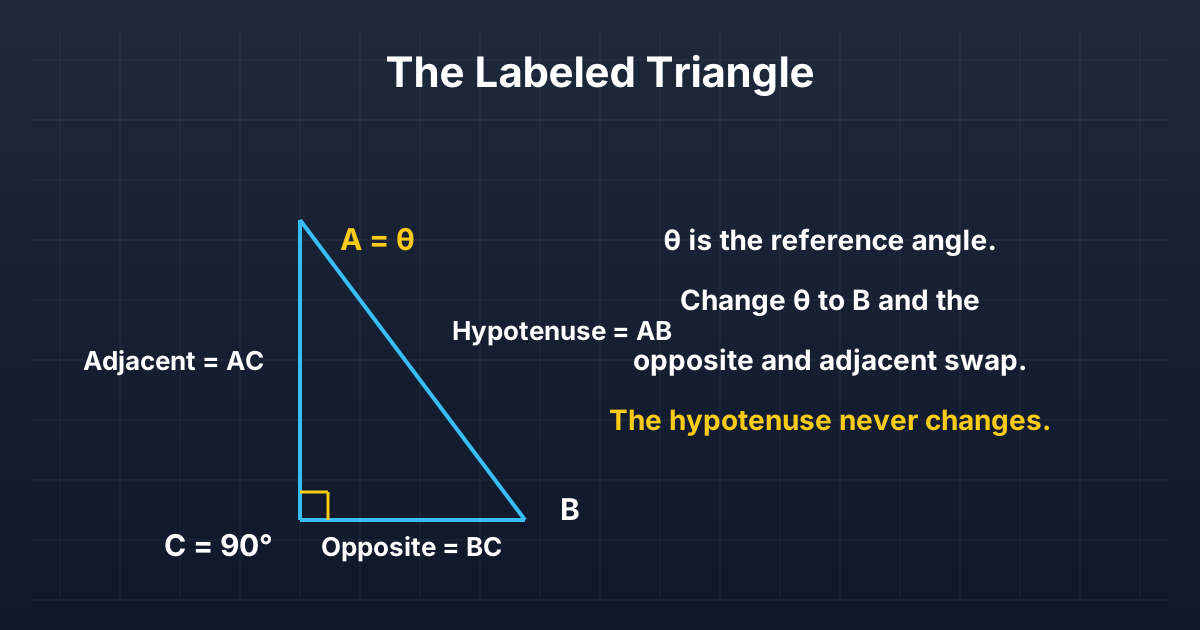
Caption: The labeled triangle used throughout this article. Angle C is 90 degrees, angle A is θ, the opposite side is BC, the adjacent side is AC, and the hypotenuse is AB.
The Six Trigonometric Ratios in a Right Triangle
With the labels fixed, each ratio is one division of two sides. All six ratios below use the same triangle and the same reference angle θ at A.
Sine (sin θ)
sin θ = Opposite / Hypotenuse = BC / AB
Sine compares the side across from θ with the longest side. It answers: how tall is the triangle, relative to its slant?
Cosine (cos θ)
cos θ = Adjacent / Hypotenuse = AC / AB
Cosine compares the side next to θ with the longest side. It answers: how wide is the triangle, relative to its slant?
Tangent (tan θ)
tan θ = Opposite / Adjacent = BC / AC
Tangent compares the two legs directly, without the hypotenuse. It answers: how steep is the triangle?
Cosecant (csc θ)
csc θ = Hypotenuse / Opposite = AB / BC
Cosecant is sine flipped upside down. It is the reciprocal of sine, and it is defined only when the opposite side is nonzero, which it always is in a real triangle.
Secant (sec θ)
sec θ = Hypotenuse / Adjacent = AB / AC
Secant is cosine flipped upside down. It is the reciprocal of cosine.
Cotangent (cot θ)
cot θ = Adjacent / Opposite = AC / BC
Cotangent is tangent flipped upside down. It is the reciprocal of tangent.
| Function | Formula | In words |
|---|---|---|
| sin θ | Opposite / Hypotenuse | BC / AB |
| cos θ | Adjacent / Hypotenuse | AC / AB |
| tan θ | Opposite / Adjacent | BC / AC |
| csc θ | Hypotenuse / Opposite | AB / BC |
| sec θ | Hypotenuse / Adjacent | AB / AC |
| cot θ | Adjacent / Opposite | AC / BC |
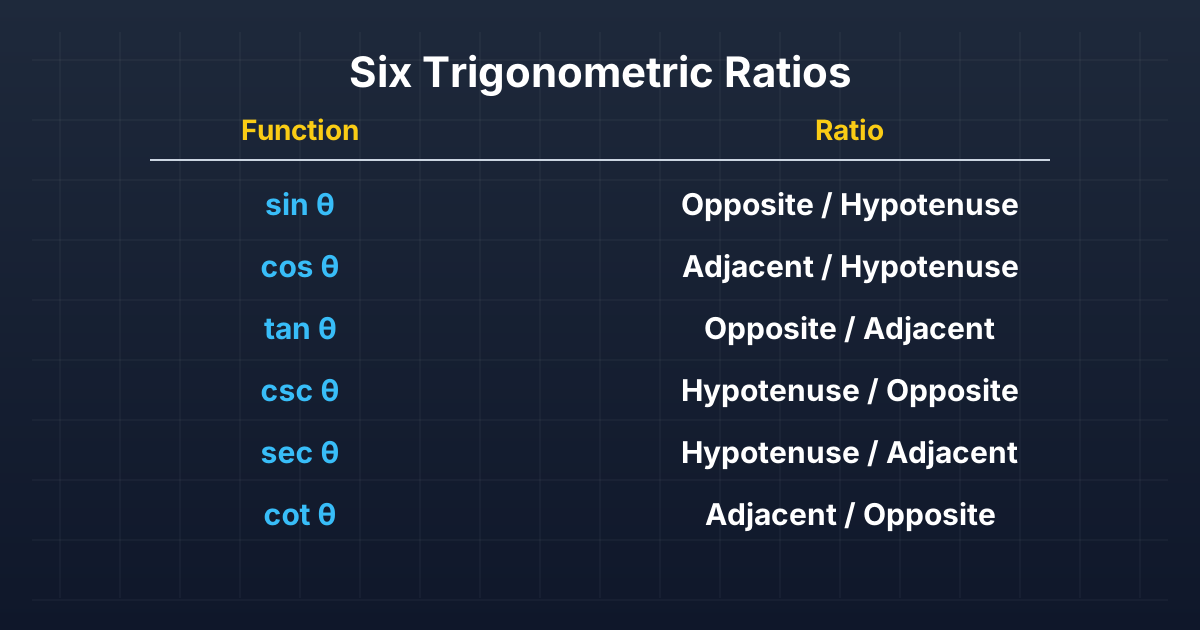
Caption: All six ratios from one triangle. The first three use the hypotenuse or the two legs; the last three are the same fractions flipped.
Remembering SOH CAH TOA
SOH CAH TOA is a memory aid for the first three ratios only:
- SOH: Sine = Opposite / Hypotenuse
- CAH: Cosine = Adjacent / Hypotenuse
- TOA: Tangent = Opposite / Adjacent
Say the syllables slowly while pointing at each side, and the three formulas stick. One caution: SOH CAH TOA describes ratios, not identities by itself. It tells you what sine, cosine, and tangent equal. An identity, like sin² θ + cos² θ = 1, is a further fact about how those ratios relate to each other. For a full beginner treatment of the three main ratios, see the sine, cosine, and tangent guide, and for the names and roles of the sides, see the sides of a right triangle guide.
What Are the Main Types of Trigonometric Identities?
Three groups cover nearly everything a beginner needs. Each group is derived from the same side ratios, so none of them is a new fact to memorize blindly. Learn how each group is derived and the formulas follow.
- Reciprocal identities: each function paired with its flipped fraction.
- Quotient identities: tangent and cotangent written through sine and cosine.
- Pythagorean identities: the three equations that come from the Pythagorean theorem.
Here is the concise chart. Each group gets a full section with proofs and examples after it.
| Group | Identities |
|---|---|
| Reciprocal | csc θ = 1 / sin θ, sec θ = 1 / cos θ, cot θ = 1 / tan θ |
| Quotient | tan θ = sin θ / cos θ, cot θ = cos θ / sin θ |
| Pythagorean | sin² θ + cos² θ = 1, 1 + tan² θ = sec² θ, 1 + cot² θ = csc² θ |
Reciprocal Trigonometric Identities
A reciprocal relationship pairs a function with the fraction flipped upside down. Since sine is opposite over hypotenuse, its reciprocal is hypotenuse over opposite, which is exactly cosecant. The same flip gives the other two pairs:
csc θ = 1 / sin θ
sec θ = 1 / cos θ
cot θ = 1 / tan θ
The reverse forms are equally useful:
sin θ = 1 / csc θ
cos θ = 1 / sec θ
tan θ = 1 / cot θ
Domain restrictions matter here. A reciprocal is defined only when the original function is nonzero, because division by zero is not allowed. In a right triangle with an acute angle, sine, cosine, and tangent are all positive and nonzero, so all six functions are defined. Outside the acute setting, watch for zeros: cosecant fails where sine is zero, secant fails where cosine is zero, and cotangent fails where tangent is zero.
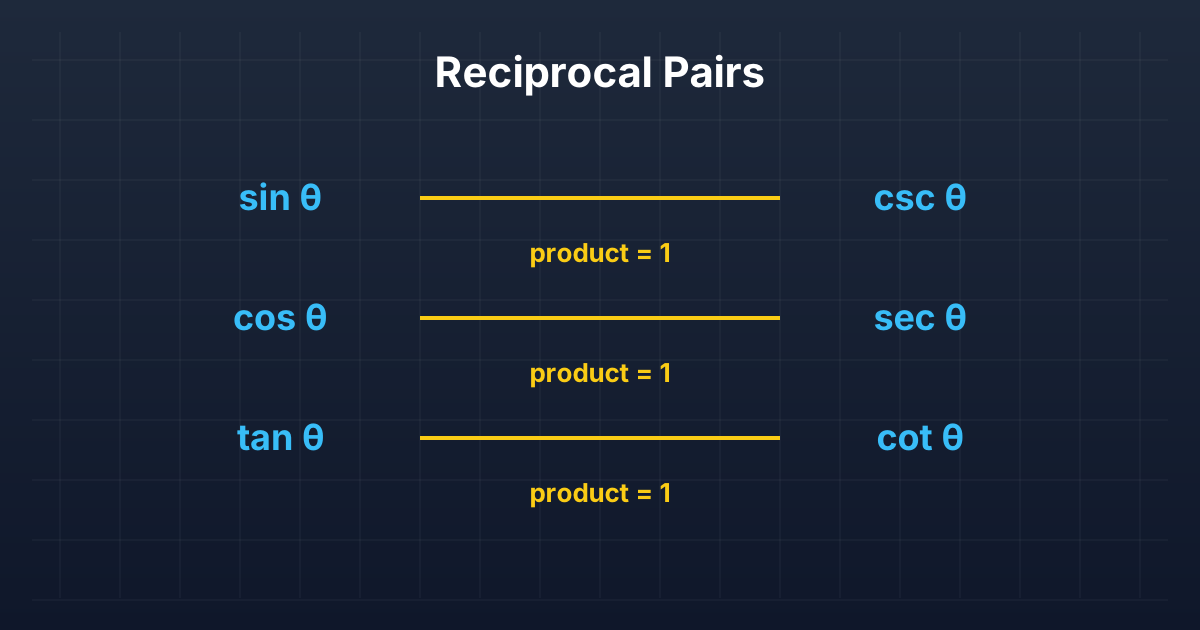
Caption: Reciprocal pairs. Each pair multiplies to 1: sin θ × csc θ = 1, cos θ × sec θ = 1, and tan θ × cot θ = 1.
Proof of Reciprocal Identities
Derive them from the side ratios directly. For sine and cosecant:
sin θ = Opposite / Hypotenuse
csc θ = Hypotenuse / Opposite
Multiply them: sin θ × csc θ = (Opposite / Hypotenuse) × (Hypotenuse / Opposite) = 1. The opposite and hypotenuse cancel, leaving 1. That cancellation is the whole proof: a fraction times its reciprocal is 1.
Repeat the reasoning for the other pairs. Cosine is adjacent over hypotenuse and secant is hypotenuse over adjacent, so cos θ × sec θ = 1. Tangent is opposite over adjacent and cotangent is adjacent over opposite, so tan θ × cot θ = 1. Every reciprocal identity is just a fraction meeting its flip.
Solved Examples
Example R1. Given sin θ = 3/5 with θ acute, find csc θ.
Solution. Use csc θ = 1 / sin θ. So csc θ = 1 / (3/5) = 5/3. Check: sin θ × csc θ = (3/5) × (5/3) = 1, as required.
Answer. csc θ = 5/3.
Example R2. Given sec θ = 13/5, find cos θ.
Solution. Use cos θ = 1 / sec θ. So cos θ = 1 / (13/5) = 5/13. Check: this matches a 5-12-13 triangle, where cos θ = 5/13 gives sin θ = 12/13, and (5/13) × (13/5) = 1.
Answer. cos θ = 5/13.
Example R3. Given tan θ = 2/3, find cot θ, and verify with a triangle.
Solution. Use cot θ = 1 / tan θ = 3/2. For the triangle check, take opposite 2 and adjacent 3. The hypotenuse is √(2² + 3²) = √13. Then tan θ = 2/3 and cot θ = 3/2, and their product is 1, as required.
Answer. cot θ = 3/2.
Quotient Trigonometric Identities
Quotient identities write tangent and cotangent through sine and cosine:
tan θ = sin θ / cos θ
cot θ = cos θ / sin θ
They explain why tangent behaves like a slope built from sine and cosine: tangent compares the two legs, and dividing sine by cosine cancels the shared hypotenuse, leaving exactly that leg comparison.
Step-by-Step Proof
Start with the ratio definitions:
sin θ = Opposite / Hypotenuse
cos θ = Adjacent / Hypotenuse
Now divide sine by cosine:
sin θ / cos θ = (Opposite / Hypotenuse) / (Adjacent / Hypotenuse)
Dividing by a fraction means multiplying by its flip, and the hypotenuse cancels:
= (Opposite / Hypotenuse) × (Hypotenuse / Adjacent) = Opposite / Adjacent = tan θ
So tan θ = sin θ / cos θ. The cotangent identity follows the same way in reverse: cos θ / sin θ = (Adjacent / Hypotenuse) / (Opposite / Hypotenuse) = Adjacent / Opposite = cot θ.
The denominators must be nonzero. The tangent form needs cos θ ≠ 0, and the cotangent form needs sin θ ≠ 0. In an acute right triangle both are positive, so both forms are safe there.
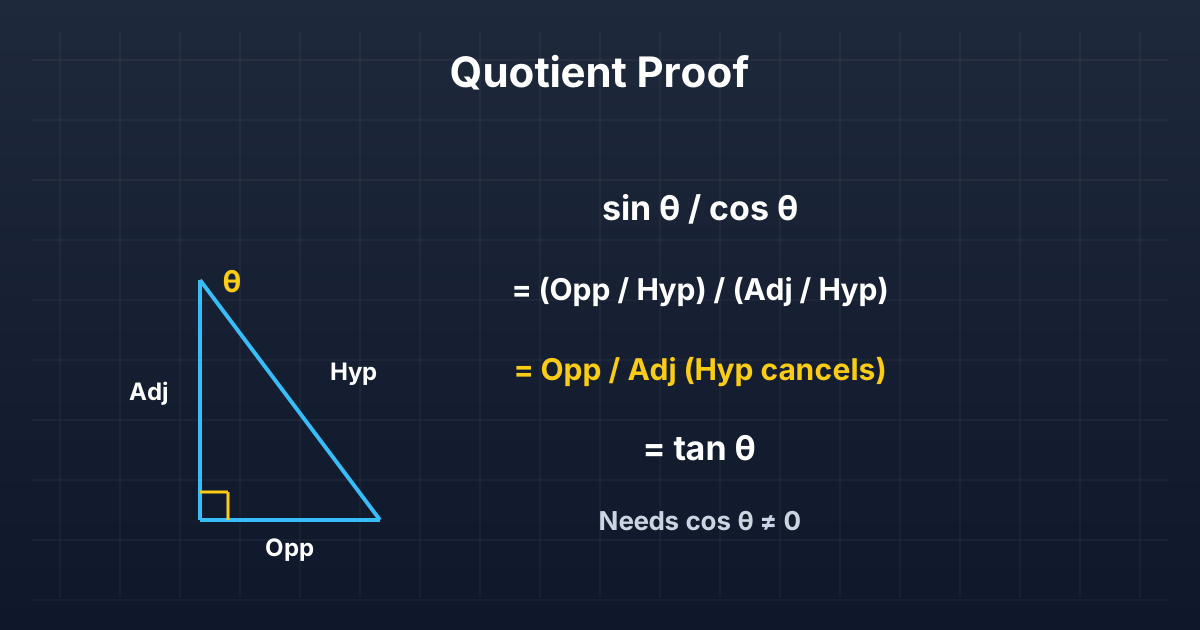
Caption: The quotient proof in one picture. Sine and cosine share the hypotenuse, so dividing them cancels it and leaves opposite over adjacent, which is tangent.
Worked Examples
Example Q1. Given sin θ = 8/17 and cos θ = 15/17, find tan θ.
Solution. Use tan θ = sin θ / cos θ = (8/17) / (15/17) = 8/15. The 17 cancels. Check: this matches an 8-15-17 triangle, since 8² + 15² = 64 + 225 = 289 = 17².
Answer. tan θ = 8/15.
Example Q2. Given sin θ = 40/41 and cos θ = 9/41, find cot θ.
Solution. Use cot θ = cos θ / sin θ = (9/41) / (40/41) = 9/40. Check: this matches a 9-40-41 triangle, since 9² + 40² = 81 + 1600 = 1681 = 41².
Answer. cot θ = 9/40.
Example Q3. Given tan θ = 7/24 with θ acute, find sin θ and cos θ.
Solution. Write tan θ = sin θ / cos θ = 7/24, and use sin² θ + cos² θ = 1. Let sin θ = 7k and cos θ = 24k for some number k. Then (7k)² + (24k)² = 1, so 49k² + 576k² = 625k² = 1, giving k² = 1/625 and k = 1/25 (positive since θ is acute). Therefore sin θ = 7/25 and cos θ = 24/25. Check: (7/25) / (24/25) = 7/24, as given, and 7² + 24² = 49 + 576 = 625 = 25².
Answer. sin θ = 7/25, cos θ = 24/25.
Pythagorean Trigonometric Identities
These identities follow from the Pythagorean theorem, and they are the most used identities in trigonometry. The three main forms are:
sin² θ + cos² θ = 1
1 + tan² θ = sec² θ
1 + cot² θ = csc² θ
First, a notation warning that prevents a common error. The symbol sin² θ means (sin θ)², the sine value squared. It is not sin(2θ), the sine of twice the angle. For example, if sin θ = 3/5, then sin² θ = 9/25, while sin(2θ) is a different number entirely. Always square the value, never double the angle.
Proof of sin² θ + cos² θ = 1
Begin with the Pythagorean relation for the labeled triangle:
Opposite² + Adjacent² = Hypotenuse²
Divide every term by Hypotenuse²:
(Opposite² / Hypotenuse²) + (Adjacent² / Hypotenuse²) = Hypotenuse² / Hypotenuse²
Each fraction is a squared ratio: Opposite / Hypotenuse is sin θ, and Adjacent / Hypotenuse is cos θ. The right side is 1. So:
sin² θ + cos² θ = 1
That is the whole proof: Pythagoras, divided by the square of the hypotenuse.
Proof of 1 + tan² θ = sec² θ
Start again from Opposite² + Adjacent² = Hypotenuse², but this time divide every term by Adjacent²:
(Opposite² / Adjacent²) + (Adjacent² / Adjacent²) = Hypotenuse² / Adjacent²
Opposite / Adjacent is tan θ, Adjacent / Adjacent is 1, and Hypotenuse / Adjacent is sec θ. So:
tan² θ + 1 = sec² θ, or written in the usual order, 1 + tan² θ = sec² θ
This form needs Adjacent ≠ 0, which holds for acute angles. Where cosine is zero, secant is undefined and the identity does not apply.
Proof of 1 + cot² θ = csc² θ
Divide the same Pythagorean relation by Opposite²:
(Opposite² / Opposite²) + (Adjacent² / Opposite²) = Hypotenuse² / Opposite²
That gives 1 + cot² θ = csc² θ, since Adjacent / Opposite is cot θ and Hypotenuse / Opposite is csc θ. This form needs Opposite ≠ 0, which holds for acute angles.
All three proofs are one idea: take Pythagoras and divide by the square of one side. Dividing by the hypotenuse gives the sine-cosine form, dividing by the adjacent side gives the tangent-secant form, and dividing by the opposite side gives the cotangent-cosecant form.
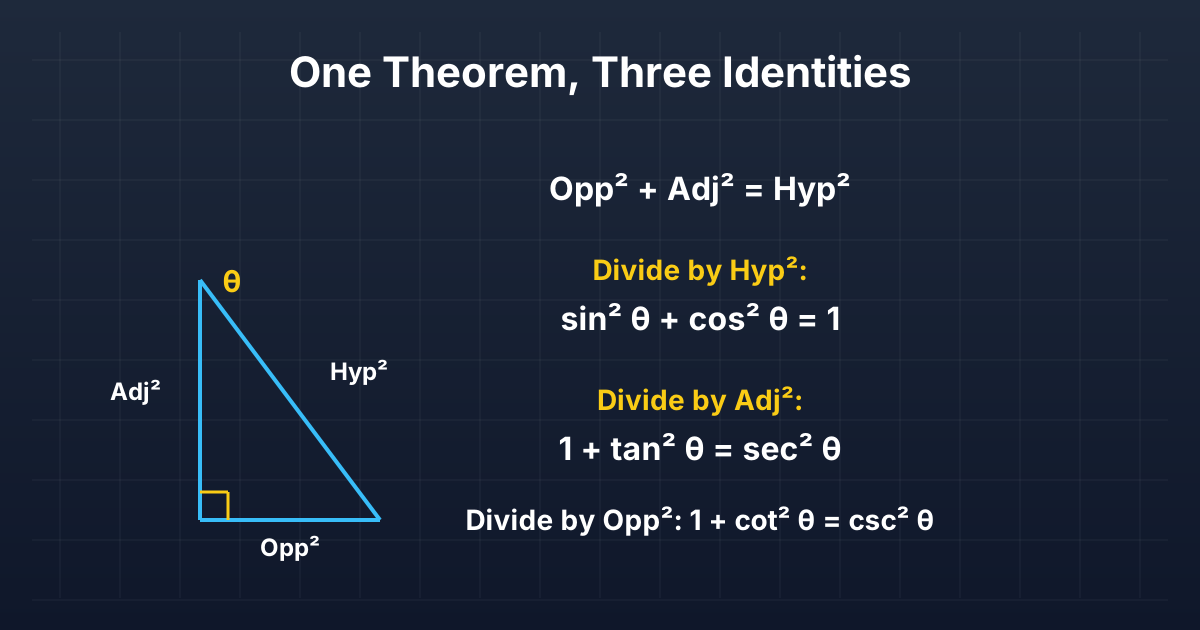
Caption: One theorem, three identities. Divide Opposite² + Adjacent² = Hypotenuse² by the square of the hypotenuse, the adjacent side, or the opposite side to get each Pythagorean identity.
Rearranging Pythagorean Identities
Rearranged forms are often more useful than the originals:
cos² θ = 1 - sin² θ
sin² θ = 1 - cos² θ
tan² θ = sec² θ - 1
cot² θ = csc² θ - 1
These rearrangements explain how to find one squared ratio from another. One caution about square roots: taking a square root gives two possibilities, positive and negative. Inside an acute right triangle, sine and cosine are positive, so you take the positive root. Outside the acute setting, use the quadrant or the problem statement to pick the sign. A bare square root never decides the sign for you.
Complementary Angle Identities in Right Triangles
The two acute angles of a right triangle sum to 90 degrees. If one acute angle is θ, the other is 90° - θ. The sides swap roles between the two angles: the side opposite θ is adjacent to 90° - θ, and the side adjacent to θ is opposite 90° - θ. That swap produces six complementary identities:
sin(90° - θ) = cos θ
cos(90° - θ) = sin θ
tan(90° - θ) = cot θ
sec(90° - θ) = csc θ
csc(90° - θ) = sec θ
cot(90° - θ) = tan θ
The geometric meaning is simple: sine of one acute angle equals cosine of the other, because both ratios use the same two sides, just in swapped roles.
A visual example makes it concrete. Take a 30°-60°-90° triangle with sides 1, √3, and 2, where the hypotenuse is 2. For the 30° angle, the opposite side is 1 and the adjacent side is √3, so sin 30° = 1/2 and cos 30° = √3/2. For the 60° angle, the roles swap: the opposite side is √3 and the adjacent side is 1, so sin 60° = √3/2 and cos 60° = 1/2. Notice that sin 30° = cos 60° = 1/2 and cos 30° = sin 60° = √3/2, exactly as the complementary identities predict. For more on complementary pairs, see the angles in a right triangle guide.
Complete Trigonometric Identities Formula Chart
Keep this table as a revision reference. It contains only the identities proved in this article, organized by group.
| Group | Identity | Brief usage note |
|---|---|---|
| Reciprocal | csc θ = 1 / sin θ | Flip sine to get cosecant |
| Reciprocal | sec θ = 1 / cos θ | Flip cosine to get secant |
| Reciprocal | cot θ = 1 / tan θ | Flip tangent to get cotangent |
| Quotient | tan θ = sin θ / cos θ | Build tangent from sine and cosine |
| Quotient | cot θ = cos θ / sin θ | Build cotangent from cosine and sine |
| Pythagorean | sin² θ + cos² θ = 1 | Find one of sine, cosine from the other |
| Pythagorean | 1 + tan² θ = sec² θ | Find secant from tangent |
| Pythagorean | 1 + cot² θ = csc² θ | Find cosecant from cotangent |
| Complementary | sin(90° - θ) = cos θ | Sine of one acute angle equals cosine of the other |
| Complementary | cos(90° - θ) = sin θ | Cosine of one acute angle equals sine of the other |
| Complementary | tan(90° - θ) = cot θ | Tangent and cotangent swap for complements |
| Complementary | sec(90° - θ) = csc θ | Secant and cosecant swap for complements |
| Complementary | csc(90° - θ) = sec θ | Cosecant and secant swap for complements |
| Complementary | cot(90° - θ) = tan θ | Cotangent and tangent swap for complements |
How to Prove Trigonometric Identities Step by Step
Proving an identity means showing that two expressions are equal for every allowed angle. Follow this method in order.
Step 1: Understand the Expression
Read both sides and identify every function involved. Note any denominators, because they set the domain restrictions.
Step 2: Start With One Side
Usually simplify the more complicated side. Keep the simpler side as your target, so you always know what you are working toward.
Step 3: Rewrite Using Sine and Cosine
Convert tangent, cotangent, secant, and cosecant into sine and cosine where useful. Most proofs become easier once only two functions remain.
Step 4: Apply Known Identities
Use reciprocal, quotient, and Pythagorean relationships to replace pieces. Replace 1 - sin² θ with cos² θ, or tan θ with sin θ / cos θ, whenever the replacement simplifies the expression.
Step 5: Simplify Algebraically
Combine fractions over a common denominator, factor expressions, or cancel valid common factors. Cancel only factors that are nonzero, and keep track of the domain as you go.
Step 6: Verify Domain Restrictions
Check that no step divided by zero. State the restrictions at the end: for example, cos θ ≠ 0 for a proof that uses secant or tangent.
Step 7: Reach the Other Side
Stop when your working side exactly matches the target side. Write the final line as an equality of the two original expressions.
One warning: testing one numerical angle does not constitute a general proof. Checking θ = 30° shows the identity holds at 30°, but an identity claims the result for every allowed angle. A numerical check is a good way to catch an error in your algebra, but it never replaces the algebraic proof.
Trigonometric Identities Solved Examples
Each example states the problem, lists what is given, names the identity, shows every step, and ends with the answer, a verification, and a common mistake to avoid.
Example 1: Finding Cosine From Sine
Problem. Given sin θ = 3/5 with θ acute, find cos θ.
Given. sin θ = 3/5, θ is acute, so cos θ is positive.
Relevant identity. sin² θ + cos² θ = 1, rearranged as cos² θ = 1 - sin² θ.
Solution. Substitute: cos² θ = 1 - (3/5)² = 1 - 9/25 = 16/25. Take the square root: cos θ = 4/5. The negative root is discarded because θ is acute.
Answer. cos θ = 4/5.
Verification. (3/5)² + (4/5)² = 9/25 + 16/25 = 25/25 = 1, as required.
Common mistake to avoid. Forgetting the acute condition and writing cos θ = ±4/5. The identity alone gives two signs; the problem statement picks the positive one.
Example 2: Finding Tangent From Sine and Cosine
Problem. Given sin θ = 5/13 and cos θ = 12/13, find tan θ.
Given. sin θ = 5/13, cos θ = 12/13.
Relevant identity. tan θ = sin θ / cos θ.
Solution. Divide: tan θ = (5/13) / (12/13) = 5/12. The 13 cancels.
Answer. tan θ = 5/12.
Verification. This matches a 5-12-13 triangle, since 5² + 12² = 25 + 144 = 169 = 13², and opposite over adjacent is 5/12.
Common mistake to avoid. Dividing in the wrong order and answering 12/5. Tangent is sine over cosine, not cosine over sine. That swapped fraction is cotangent.
Example 3: Using a Reciprocal Identity
Problem. Given cos θ = 4/5, find sec θ.
Given. cos θ = 4/5.
Relevant identity. sec θ = 1 / cos θ.
Solution. Take the reciprocal: sec θ = 1 / (4/5) = 5/4.
Answer. sec θ = 5/4.
Verification. cos θ × sec θ = (4/5) × (5/4) = 1, as required for a reciprocal pair.
Common mistake to avoid. Writing sec θ = 4/5 as well, confusing a function with its reciprocal. Secant is the flipped fraction, not the same fraction.
Example 4: Verifying a Pythagorean Identity
Problem. Use a 3-4-5 right triangle to verify sin² θ + cos² θ = 1.
Given. A right triangle with opposite 3, adjacent 4, and hypotenuse 5, with θ at the angle opposite the side of length 3.
Relevant identity. sin² θ + cos² θ = 1.
Solution. Compute the ratios: sin θ = 3/5 and cos θ = 4/5. Square them: sin² θ = 9/25 and cos² θ = 16/25. Add: 9/25 + 16/25 = 25/25 = 1.
Answer. The identity holds: sin² θ + cos² θ = 1.
Verification. The check is the addition itself: the two squared fractions share the denominator 25, and their numerators 9 and 16 add to 25.
Common mistake to avoid. Squaring the angle instead of the value, writing sin(2θ) in place of sin² θ. The identity squares 3/5 to get 9/25; it never doubles the angle.
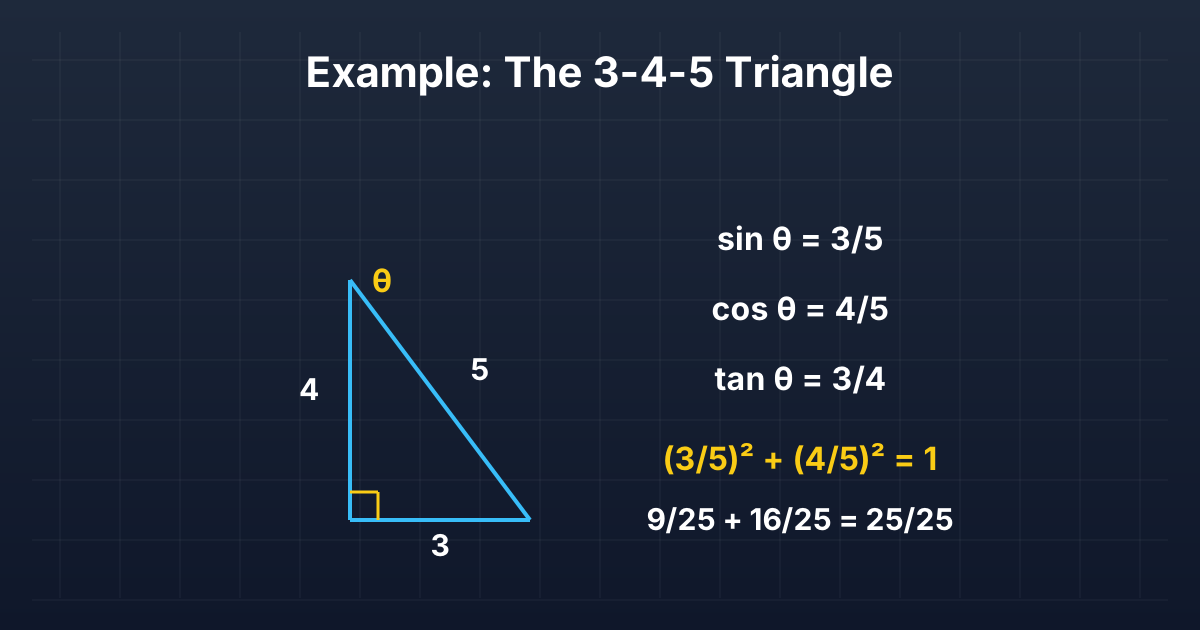
Caption: The 3-4-5 triangle from Example 4, drawn to scale. Sine is 3/5, cosine is 4/5, and 9/25 + 16/25 = 1.
Example 5: Finding Secant From Tangent
Problem. Given tan θ = 3/4 with θ acute, find sec θ.
Given. tan θ = 3/4, θ is acute, so sec θ is positive.
Relevant identity. 1 + tan² θ = sec² θ.
Solution. Substitute: sec² θ = 1 + (3/4)² = 1 + 9/16 = 25/16. Take the square root: sec θ = 5/4. The negative root is discarded because θ is acute.
Answer. sec θ = 5/4.
Verification. This matches a 3-4-5 triangle: tan θ = 3/4 means opposite 3 and adjacent 4, so the hypotenuse is 5 and sec θ = 5/4.
Common mistake to avoid. Answering 4/3, which is the reciprocal of tangent, namely cotangent. Secant comes from the Pythagorean identity, not from flipping tangent.
Example 6: Proving a Quotient Identity
Problem. Prove tan θ × cos θ = sin θ.
Given. The identity must hold wherever cos θ ≠ 0, since tangent needs a nonzero cosine.
Relevant identity. tan θ = sin θ / cos θ.
Solution. Start with the left side and replace tangent: tan θ × cos θ = (sin θ / cos θ) × cos θ. The cos θ factors cancel, leaving sin θ, which is the right side.
Answer. tan θ × cos θ = sin θ, for cos θ ≠ 0.
Verification. Test with a 3-4-5 triangle: tan θ = 3/4 and cos θ = 4/5, so tan θ × cos θ = (3/4) × (4/5) = 12/20 = 3/5 = sin θ.
Common mistake to avoid. Canceling cos θ without noting the domain. The cancellation is valid only where cos θ ≠ 0, so state the restriction.
Example 7: Simplifying an Expression
Problem. Simplify (1 - cos² θ) / sin θ, and state the domain restriction.
Given. An expression in sine and cosine, with sin θ in the denominator.
Relevant identity. sin² θ + cos² θ = 1, rearranged as 1 - cos² θ = sin² θ.
Solution. Replace the numerator: (1 - cos² θ) / sin θ = sin² θ / sin θ = sin θ. One factor of sin θ cancels.
Answer. sin θ, for sin θ ≠ 0.
Verification. Test with a 3-4-5 triangle where sin θ = 3/5 and cos θ = 4/5: (1 - 16/25) / (3/5) = (9/25) / (3/5) = (9/25) × (5/3) = 45/75 = 3/5 = sin θ.
Common mistake to avoid. Canceling sin θ without stating sin θ ≠ 0. The simplified form hides the original denominator, but the restriction stays.
Example 8: Multi-Step Identity Proof
Problem. Prove (1 - sin² θ) × sec² θ = 1, stating the domain restrictions and explaining every step.
Given. An expression mixing a Pythagorean form with a reciprocal function.
Relevant identities. 1 - sin² θ = cos² θ, and sec θ = 1 / cos θ.
Solution. Step 1: replace 1 - sin² θ with cos² θ using the rearranged Pythagorean identity, giving cos² θ × sec² θ. Step 2: replace sec θ with 1 / cos θ, giving cos² θ × (1 / cos θ)² = cos² θ × (1 / cos² θ). Step 3: cancel cos² θ with 1 / cos² θ, leaving 1.
Answer. (1 - sin² θ) × sec² θ = 1, for cos θ ≠ 0.
Verification. Test with a 3-4-5 triangle where sin θ = 3/5 and cos θ = 4/5: 1 - sin² θ = 1 - 9/25 = 16/25, and sec² θ = (5/4)² = 25/16. Their product is (16/25) × (25/16) = 1.
Common mistake to avoid. Forgetting that secant needs cos θ ≠ 0. The proof divides by cos² θ in the last step, so the domain restriction is part of the answer, not an optional extra.
Special Right Triangles and Trigonometric Values
Two special triangles give exact values that appear constantly in identity problems. Both are derived from their side ratios, not memorized as magic numbers.
30°-60°-90° Triangle
The side ratio is 1 : √3 : 2, where the shortest side (1) sits opposite the 30° angle, the longer leg (√3) sits opposite the 60° angle, and the hypotenuse is 2. Derive the values for 30°: the opposite side is 1 and the adjacent side is √3, so sin 30° = 1/2, cos 30° = √3/2, and tan 30° = 1/√3. For 60° the roles swap: sin 60° = √3/2, cos 60° = 1/2, and tan 60° = √3. For a full guide to this triangle, see the 30-60-90 triangle post, and for its equal-legged cousin, see the isosceles right triangle post.
45°-45°-90° Triangle
The side ratio is 1 : 1 : √2, where the two legs are equal and the hypotenuse is √2 times a leg. For 45°, the opposite and adjacent sides are equal, so sin 45° = 1/√2 = √2/2, cos 45° = 1/√2 = √2/2, and tan 45° = 1. The equality of sine and cosine at 45° is exactly what the complementary identities predict, since 45° is its own complement.
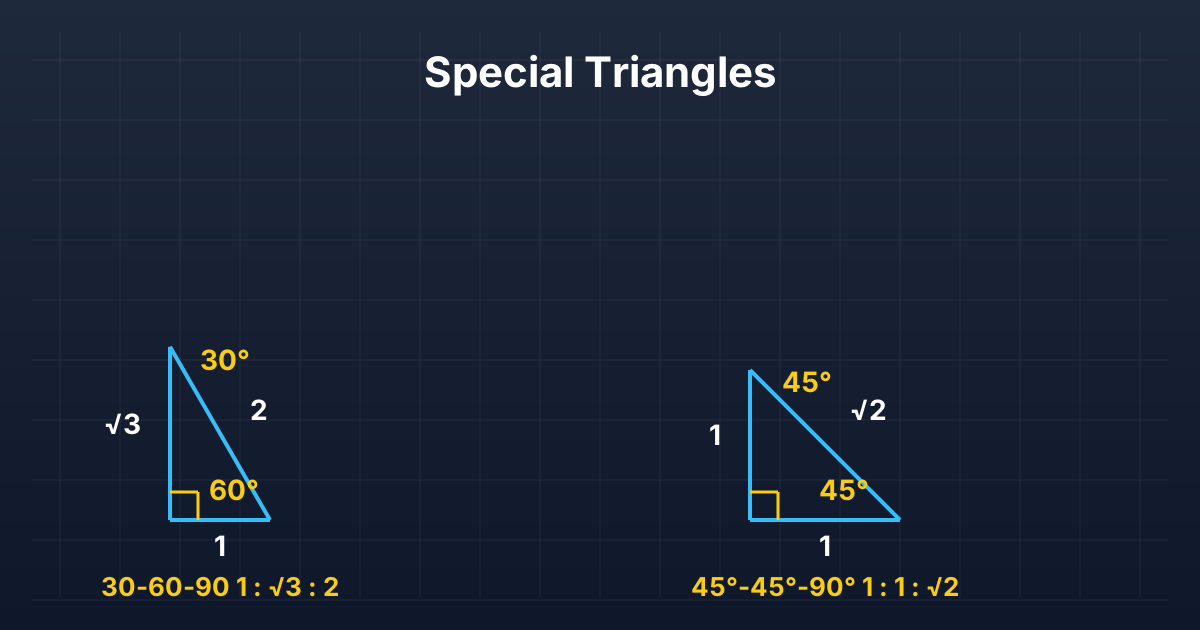
Caption: The two special triangles, drawn to scale. The 30°-60°-90° triangle uses sides 1, √3, and 2; the 45°-45°-90° triangle uses sides 1, 1, and √2.
Trigonometric Values Table
| Angle | sin | cos | tan |
|---|---|---|---|
| 0° | 0 | 1 | 0 |
| 30° | 1/2 | √3/2 | 1/√3 |
| 45° | √2/2 | √2/2 | 1 |
| 60° | √3/2 | 1/2 | √3 |
| 90° | 1 | 0 | Undefined |
The 0° and 90° rows need a note. They are understood through the extended definitions or limiting cases, not as the two acute angles of a nondegenerate right triangle. A real right triangle has no 0° or 90° acute angle. The value tan 90° is undefined because it would require dividing by cos 90° = 0, which is not allowed.
Trigonometric Ratios vs. Trigonometric Identities
Three terms get mixed up constantly. Keep them separate:
- A trigonometric ratio is a single division of two sides, like sin θ = Opposite / Hypotenuse.
- A trigonometric identity is an equation between functions that holds for every allowed angle, like sin² θ + cos² θ = 1.
- A trigonometric equation is an equation that holds only for specific angles, like sin θ = 1/2.
| Concept | Definition | Example | Practical use |
|---|---|---|---|
| Ratio | One function value from two sides | sin θ = Opposite / Hypotenuse | Find a ratio from known sides |
| Identity | An equation true for every allowed angle | sin² θ + cos² θ = 1 | Simplify expressions, prove results, find missing ratios |
| Equation | An equation true only at its solutions | sin θ = 1/2 | Solve for unknown angles |
Ratios are used to derive identities: the ratio definitions give the reciprocal and quotient identities directly, and the Pythagorean theorem applied to the ratio definitions gives the Pythagorean identities. For a step-by-step guide to solving whole triangles from these ratios, see the how to solve a right triangle guide.
Real-Life Applications of Trigonometric Identities
Identities are used directly less often than ratios, so keep the distinction honest. Ratios measure things. Identities simplify the algebra that surrounds those measurements. The applications below respect that line.
Architecture and Construction
Roof pitches, stair slopes, and ramp gradients are all tangent values in disguise. If a roof plan gives cos θ = 4/5 for the rafter angle, the Pythagorean identity gives sin θ = 3/5 without measuring the rise, and the quotient identity gives tan θ = 3/4, the slope itself. The identities turn one measured ratio into the full set.
Engineering
In design and analysis, expressions involving several trigonometric functions appear in load and stress calculations. Identities reduce those expressions to simpler forms before any numbers are plugged in, which lowers the chance of arithmetic error.
Surveying
Surveyors measure angles and one distance, then compute the rest. When a measured sine must become a cosine or a tangent for the next step of a traverse, the identities do the conversion exactly, with no extra field measurement.
Physics
Vector components, forces on slopes, and periodic motion all use sine and cosine. Identities simplify component expressions: a force split into horizontal and vertical parts obeys the same Pythagorean identity as the triangle it came from.
Computer Graphics
Directions, rotations, and camera angles in graphics are stored as sines and cosines. Identities keep those values consistent: if a rotation routine updates one component, the Pythagorean identity checks the other, and complementary identities handle 90-degree rotations.
Navigation
Bearings and course plots use right-triangle geometry to turn an angle and a distance into north and east components. When only one component ratio is known, the identities recover the other without a second measurement.
Practical numerical example. A roof rafter makes an angle θ with the horizontal, and the plan gives cos θ = 4/5. Find sin θ and the roof slope. Since θ is acute, sin² θ = 1 - cos² θ = 1 - 16/25 = 9/25, so sin θ = 3/5. The slope is tan θ = sin θ / cos θ = (3/5) / (4/5) = 3/4. So the roof rises 3 units for every 4 units of horizontal run, found entirely through identities, with no extra measurement.
Common Mistakes Students Make With Trigonometric Identities
Mistake 1: Confusing Opposite and Adjacent Sides
Incorrect approach. In a triangle with θ at A, a student calls AC the opposite side and BC the adjacent side.
Why it is wrong. The opposite side is across from θ, and the adjacent side touches θ. With θ at A, BC is across from A and AC touches A, so the labels are the other way around.
Correct approach. Point at θ first, then name: across from it is opposite, next to it (and not the hypotenuse) is adjacent.
Short example. With θ at A, opposite 3, adjacent 4, hypotenuse 5: sin θ = 3/5, not 4/5.
Mistake 2: Forgetting That the Hypotenuse Is Opposite the Right Angle
Incorrect approach. A student picks the longest side by eye and calls a leg the hypotenuse.
Why it is wrong. The hypotenuse is defined by position, not by appearance: it is the side opposite the 90-degree angle, and it is always the longest side as a consequence.
Correct approach. Find the right angle first. The side across from it is the hypotenuse, every time.
Short example. In a 3-4-5 triangle, the side of length 5 is the hypotenuse because it sits across from the right angle.
Mistake 3: Mixing Up Sine and Cosine
Incorrect approach. A student writes sin θ = Adjacent / Hypotenuse.
Why it is wrong. Sine uses the opposite side and cosine uses the adjacent side. Swapping them swaps every value that follows.
Correct approach. Use SOH CAH TOA as a check before writing any ratio: sine is opposite over hypotenuse, cosine is adjacent over hypotenuse.
Short example. With opposite 3, adjacent 4, hypotenuse 5: sin θ = 3/5 and cos θ = 4/5, not the reverse.
Mistake 4: Writing Incorrect Reciprocal Formulas
Incorrect approach. A student writes sec θ = 1 / sin θ.
Why it is wrong. Secant is the reciprocal of cosine, not sine. Each function has exactly one reciprocal partner: sine with cosecant, cosine with secant, tangent with cotangent.
Correct approach. Pair them by their fractions: sine is opposite over hypotenuse, so its flip, hypotenuse over opposite, is cosecant. Cosine flips to secant, tangent flips to cotangent.
Short example. If sin θ = 3/5, then csc θ = 5/3, while sec θ comes from cos θ = 4/5, giving sec θ = 5/4.
Mistake 5: Confusing tan θ With sin θ × cos θ
Incorrect approach. A student writes tan θ = sin θ × cos θ.
Why it is wrong. Tangent is sine divided by cosine, not multiplied. Multiplication gives a different number: with sin θ = 3/5 and cos θ = 4/5, sin θ × cos θ = 12/25, while tan θ = (3/5) / (4/5) = 3/4.
Correct approach. Use the quotient identity: tan θ = sin θ / cos θ. Division cancels the shared hypotenuse and leaves opposite over adjacent.
Short example. sin θ = 3/5, cos θ = 4/5 gives tan θ = 3/4, not 12/25.
Mistake 6: Treating sin² θ as sin(2θ)
Incorrect approach. A student reads sin² θ as the sine of twice the angle.
Why it is wrong. The superscript 2 squares the function value: sin² θ = (sin θ)². Doubling the angle is a different operation with a different result.
Correct approach. Read sin² θ as “sine, then square the answer.” If sin θ = 3/5, then sin² θ = 9/25.
Short example. sin² θ = 9/25 when sin θ = 3/5, while sin(2θ) for the same angle is 24/25, a different value.
Mistake 7: Forgetting Denominator Restrictions
Incorrect approach. A student simplifies (1 - cos² θ) / sin θ to sin θ without comment.
Why it is wrong. The simplification cancels sin θ, which is valid only where sin θ ≠ 0. The original expression is undefined at sin θ = 0, and the simplified form hides that fact.
Correct approach. State the restriction with the answer: sin θ, for sin θ ≠ 0. The restriction is part of the result.
Short example. (1 - cos² θ) / sin θ = sin θ, for sin θ ≠ 0. Without the restriction, the answer claims more than the algebra proved.
Mistake 8: Incorrectly Applying Pythagorean Identities
Incorrect approach. A student writes 1 + sin² θ = cos² θ.
Why it is wrong. The Pythagorean identity is sin² θ + cos² θ = 1. Moving terms carelessly flips signs and roles: the correct rearrangements are cos² θ = 1 - sin² θ and sin² θ = 1 - cos² θ.
Correct approach. Start from sin² θ + cos² θ = 1 and subtract one term at a time. To isolate cos² θ, subtract sin² θ from both sides.
Short example. With sin θ = 3/5: cos² θ = 1 - 9/25 = 16/25, so cos θ = 4/5 for an acute angle.
Mistake 9: Losing the Negative Sign When Taking Square Roots
Incorrect approach. A student solves cos² θ = 16/25 and writes cos θ = 4/5 without qualification.
Why it is wrong. A squared equation has two roots, 4/5 and -4/5. The problem must pick one. Inside an acute right triangle the positive root is correct, but outside that setting the sign depends on the quadrant.
Correct approach. Write cos θ = ±4/5 first, then use the given information (acute angle, quadrant, or sign condition) to choose.
Short example. If sin θ = 3/5 and θ is in Quadrant II, then cos θ = -4/5, not 4/5, because cosine is negative there.
Mistake 10: Trying to Prove Identities Using Only One Numerical Example
Incorrect approach. A student checks sin² θ + cos² θ = 1 at θ = 30° and declares the identity proved.
Why it is wrong. One angle shows the identity holds at that angle. An identity claims the result for every allowed angle, and no finite set of checks covers all of them.
Correct approach. Prove algebraically from the ratio definitions and the Pythagorean theorem, as in the proof sections above. Use a numerical check only to catch algebra errors, never as the proof itself.
Short example. Checking 30° gives (1/2)² + (√3/2)² = 1/4 + 3/4 = 1, which confirms the arithmetic at 30° but proves nothing about 40° or 50°.
Tips and Tricks for Memorizing Trigonometric Identities
- Remember SOH CAH TOA for the three main ratios, and let the reciprocal pairs follow by flipping each fraction.
- Learn reciprocal pairs together, never alone: sine with cosecant, cosine with secant, tangent with cotangent.
- Derive tangent from sine and cosine whenever you forget it: tan θ = sin θ / cos θ.
- Memorize the main Pythagorean identity, sin² θ + cos² θ = 1, and derive the other two by dividing by cos² θ and sin² θ.
- Practice using special triangles, especially 3-4-5, 5-12-13, and the 30°-60°-90° triangle, so the numbers become familiar.
- Organize formulas into groups: reciprocal, quotient, Pythagorean, complementary. A grouped chart is easier to recall than a flat list.
- Check your answers through substitution where appropriate: pick a known triangle, like 3-4-5, and test your simplified result against it.
- Understand first, then memorize. Every identity in this article is derived from side ratios and one theorem, so a forgotten formula can always be rebuilt from the triangle.
Practice Questions on Trigonometric Identities
Try these before looking at the answer key. The key is in the next section, kept separate so you can work honestly.
Beginner Level
Question 1. Given sin θ = 7/25 with θ acute, find cos θ and tan θ.
Question 2. Given cos θ = 8/17, find sec θ.
Question 3. Given tan θ = 5/12, find cot θ.
Question 4. Write down the three Pythagorean identities from memory, then check them against the formula chart.
Question 5. In a 3-4-5 right triangle, let θ be the angle opposite the side of length 3. Find all six trigonometric ratios for θ.
Intermediate Level
Question 6. Given sin θ = 12/37 with θ acute, find cos θ and tan θ.
Question 7. Given tan θ = 8/15 with θ acute, find sec θ.
Question 8. Simplify (1 - sin² θ) / cos θ, and state the domain restriction.
Question 9. Given cos θ = 15/17, find sin θ (for θ acute) and tan θ.
Question 10. Prove sin θ × sec θ = tan θ, and state the domain restriction.
Advanced Level
Question 11. Prove (sec θ - cos θ) = sin θ × tan θ, and state the domain restriction.
Question 12. Prove (tan θ + cot θ)² = sec² θ + csc² θ, and state the domain restrictions.
Question 13. A 13 m ladder leans against a wall with its foot 5 m from the wall. Find sin, cos, and tan of the angle between the ladder and the ground, then verify sin² θ + cos² θ = 1.
Question 14. Prove (1 + tan² θ)(1 - sin² θ) = 1, and state the domain restriction.
Question 15. In a right triangle, the hypotenuse is 25 and one leg is 7. Find all six ratios for the angle opposite the leg of length 7, then verify tan θ × cos θ = sin θ.
Answer Key
Answer 1. cos² θ = 1 - sin² θ = 1 - 49/625 = 576/625, so cos θ = 24/25 (positive since θ is acute). Then tan θ = sin θ / cos θ = (7/25) / (24/25) = 7/24.
Answer 2. sec θ = 1 / cos θ = 1 / (8/17) = 17/8. Check: (8/17) × (17/8) = 1.
Answer 3. cot θ = 1 / tan θ = 1 / (5/12) = 12/5. Check: (5/12) × (12/5) = 1.
Answer 4. sin² θ + cos² θ = 1; 1 + tan² θ = sec² θ; 1 + cot² θ = csc² θ. These are the three forms obtained by dividing the Pythagorean relation by the hypotenuse squared, the adjacent squared, and the opposite squared.
Answer 5. Opposite 3, adjacent 4, hypotenuse 5: sin θ = 3/5, cos θ = 4/5, tan θ = 3/4, csc θ = 5/3, sec θ = 5/4, cot θ = 4/3. Check: (3/5)² + (4/5)² = 9/25 + 16/25 = 1.
Answer 6. cos² θ = 1 - (12/37)² = 1 - 144/1369 = 1225/1369, so cos θ = 35/37 (positive since θ is acute). Then tan θ = (12/37) / (35/37) = 12/35. This matches a 12-35-37 triangle, since 12² + 35² = 144 + 1225 = 1369 = 37².
Answer 7. sec² θ = 1 + tan² θ = 1 + (8/15)² = 1 + 64/225 = 289/225, so sec θ = 17/15 (positive since θ is acute). This matches an 8-15-17 triangle, where sec θ = hypotenuse / adjacent = 17/15.
Answer 8. 1 - sin² θ = cos² θ, so the expression becomes cos² θ / cos θ = cos θ, for cos θ ≠ 0. The restriction stays because the original expression divided by cos θ.
Answer 9. sin² θ = 1 - cos² θ = 1 - 225/289 = 64/289, so sin θ = 8/17 (positive since θ is acute). Then tan θ = sin θ / cos θ = (8/17) / (15/17) = 8/15. This matches an 8-15-17 triangle.
Answer 10. Replace sec θ with 1 / cos θ: sin θ × sec θ = sin θ × (1 / cos θ) = sin θ / cos θ = tan θ, for cos θ ≠ 0. The restriction is needed because secant is undefined where cosine is zero.
Answer 11. Write sec θ as 1 / cos θ: sec θ - cos θ = (1 / cos θ) - cos θ = (1 - cos² θ) / cos θ = sin² θ / cos θ = sin θ × (sin θ / cos θ) = sin θ × tan θ, for cos θ ≠ 0.
Answer 12. Expand the square: (tan θ + cot θ)² = tan² θ + 2 × tan θ × cot θ + cot² θ. Since tan θ × cot θ = 1, this equals tan² θ + 2 + cot² θ. Now replace tan² θ with sec² θ - 1 and cot² θ with csc² θ - 1: (sec² θ - 1) + 2 + (csc² θ - 1) = sec² θ + csc² θ. Restrictions: sin θ ≠ 0 and cos θ ≠ 0, since tangent, cotangent, secant, and cosecant all appear.
Answer 13. The height reached is √(13² - 5²) = √(169 - 25) = √144 = 12 m. The angle with the ground has opposite 12, adjacent 5, and hypotenuse 13, so sin θ = 12/13, cos θ = 5/13, and tan θ = 12/5. Verification: sin² θ + cos² θ = 144/169 + 25/169 = 169/169 = 1.
Answer 14. Replace 1 + tan² θ with sec² θ and 1 - sin² θ with cos² θ: (sec² θ)(cos² θ) = (1 / cos² θ)(cos² θ) = 1, for cos θ ≠ 0. The restriction is needed because secant is undefined where cosine is zero.
Answer 15. The other leg is √(25² - 7²) = √(625 - 49) = √576 = 24. For the angle opposite the leg of length 7: sin θ = 7/25, cos θ = 24/25, tan θ = 7/24, csc θ = 25/7, sec θ = 25/24, cot θ = 24/7. Verification: tan θ × cos θ = (7/24) × (24/25) = 7/25 = sin θ.
Frequently Asked Questions About Trigonometric Identities in Right Triangles
Frequently Asked Questions
Common questions about trigonometric identities in right triangles, answered briefly.
01 What are trigonometric identities in right triangles?
They are equations built from the side ratios of a right triangle that hold for every acute angle where both sides are defined. The three groups are reciprocal identities, quotient identities, and Pythagorean identities, and each one is derived from the ratios opposite, adjacent, and hypotenuse rather than memorized blindly.
02 What are the three main types of trigonometric identities?
Reciprocal identities pair each function with its flipped fraction: cosecant with sine, secant with cosine, and cotangent with tangent. Quotient identities write tangent as sine over cosine and cotangent as cosine over sine. Pythagorean identities come from the Pythagorean theorem and relate squared functions.
03 What is the most important trigonometric identity?
The identity sin² θ + cos² θ = 1 is the most important, because the other two Pythagorean identities are derived from it by division, and it finds a missing ratio from a known one. If you know sine, it gives cosine, and if you know cosine, it gives sine, for any acute angle.
04 How do you derive identities from a right triangle?
Label the triangle with the right angle at C and the reference angle θ at A, so opposite is BC, adjacent is AC, and hypotenuse is AB. Write the six ratios from those sides. Reciprocal and quotient identities follow by flipping and dividing the ratios, and Pythagorean identities follow by dividing the Pythagorean relation by each squared side.
05 What is the difference between trigonometric ratios and identities?
A ratio is a single division of two sides, like sin θ = Opposite / Hypotenuse. An identity is an equation between functions that holds for every allowed angle, like sin² θ + cos² θ = 1. An equation like sin θ = 1/2 is different again: it holds only at its solutions, such as 30 degrees.
06 What are reciprocal identities?
Reciprocal identities pair each trigonometric function with its reciprocal: csc θ = 1 / sin θ, sec θ = 1 / cos θ, and cot θ = 1 / tan θ. Each pair multiplies to 1, because a fraction times its flip is 1. They are defined only where the original function is nonzero, since division by zero is not allowed.
07 What are quotient identities?
Quotient identities write tangent and cotangent through sine and cosine: tan θ = sin θ / cos θ and cot θ = cos θ / sin θ. They work because sine and cosine share the hypotenuse, which cancels on division and leaves opposite over adjacent for tangent and adjacent over opposite for cotangent.
08 What are Pythagorean identities?
Pythagorean identities are the three equations obtained by dividing the Pythagorean relation by each squared side: sin² θ + cos² θ = 1, 1 + tan² θ = sec² θ, and 1 + cot² θ = csc² θ. They are the most used identities in trigonometry, because they convert between squared functions in a single step.
09 How do you prove sin² θ + cos² θ = 1?
Start with the Pythagorean relation for a right triangle: Opposite² + Adjacent² = Hypotenuse². Divide every term by Hypotenuse². The first fraction becomes sin² θ, the second becomes cos² θ, and the right side becomes 1. That gives sin² θ + cos² θ = 1, proved from the triangle itself.
10 How do you memorize trigonometric identities?
Memorize as little as possible and derive the rest. Learn SOH CAH TOA for the three main ratios, pair each function with its reciprocal, and memorize only sin² θ + cos² θ = 1. Derive the other two Pythagorean identities by dividing by cos² θ and sin² θ, and keep the grouped formula chart nearby for revision.
11 Can trigonometric identities be used to find missing sides?
Identities alone find missing ratios, not missing lengths. If you know one ratio, an identity gives you the others, but turning a ratio into a side length needs one known side to scale from. Combine an identity with a known side, or with the Pythagorean theorem, and the missing side follows.
12 Are trigonometric identities true for all angles?
They are true for every angle where both sides are defined. Inside right triangles, that means acute angles. Through the unit circle, most identities extend to wider angles, but domain restrictions stay: secant fails where cosine is zero, cosecant fails where sine is zero, and tangent fails where cosine is zero.
13 What is SOH CAH TOA?
SOH CAH TOA is a memory aid for the three main ratios: Sine = Opposite / Hypotenuse, Cosine = Adjacent / Hypotenuse, and Tangent = Opposite / Adjacent. It describes ratios, not identities. Identities like sin² θ + cos² θ = 1 are further facts about how those ratios relate to each other.
14 Why are trigonometric identities important?
Identities simplify expressions, prove other results, and convert one function into another without new measurements. A surveyor who knows sine can get cosine and tangent through identities, and an engineer can reduce a complicated expression to a simple one before plugging in numbers. They turn knowledge of one ratio into knowledge of all six.
15 What is the easiest way to solve trigonometric identity problems?
Convert everything to sine and cosine first, since most proofs become easier with only two functions. Then apply the main Pythagorean identity and the reciprocal and quotient identities, working from the more complicated side toward the simpler side. State the domain restrictions, and check your result against a known triangle like 3-4-5.
Key Takeaways
- The six trigonometric ratios come from one labeled triangle: sine, cosine, and tangent from the sides, and cosecant, secant, and cotangent as their reciprocals.
- Reciprocal identities pair each function with its flipped fraction, and each pair multiplies to 1 wherever both sides are defined.
- Quotient identities write tangent as sine over cosine and cotangent as cosine over sine, because the shared hypotenuse cancels.
- Pythagorean identities come from dividing the Pythagorean relation by each squared side, and sin² θ + cos² θ = 1 is the one to memorize first.
- Complementary angle relationships swap the roles of the two acute angles: sine of one equals cosine of the other.
- To prove an identity, convert to sine and cosine, work from the complicated side, apply known identities, state the domain restrictions, and never mistake one numerical check for a proof.
Conclusion
Trigonometric identities stop feeling like a list to memorize once you see where they come from. Every identity in this guide grew out of one labeled right triangle: flip a fraction for a reciprocal identity, divide two ratios for a quotient identity, and divide the Pythagorean relation for a Pythagorean identity. That single origin is what makes the whole set manageable. Learn the six ratios, keep sin² θ + cos² θ = 1 close, and rebuild anything you forget from the triangle itself. Now try the fifteen practice questions without looking at the key, then return to the formula chart and check your work. Regular practice with these proofs is what turns recognition into confidence. If one identity slips your memory later, draw the triangle, write the three ratios, and derive it again instead of guessing.