
Unit Circle and Right Triangles: How Sine and Cosine Work Beyond 90 Degrees
Math Expert
Trigonometry
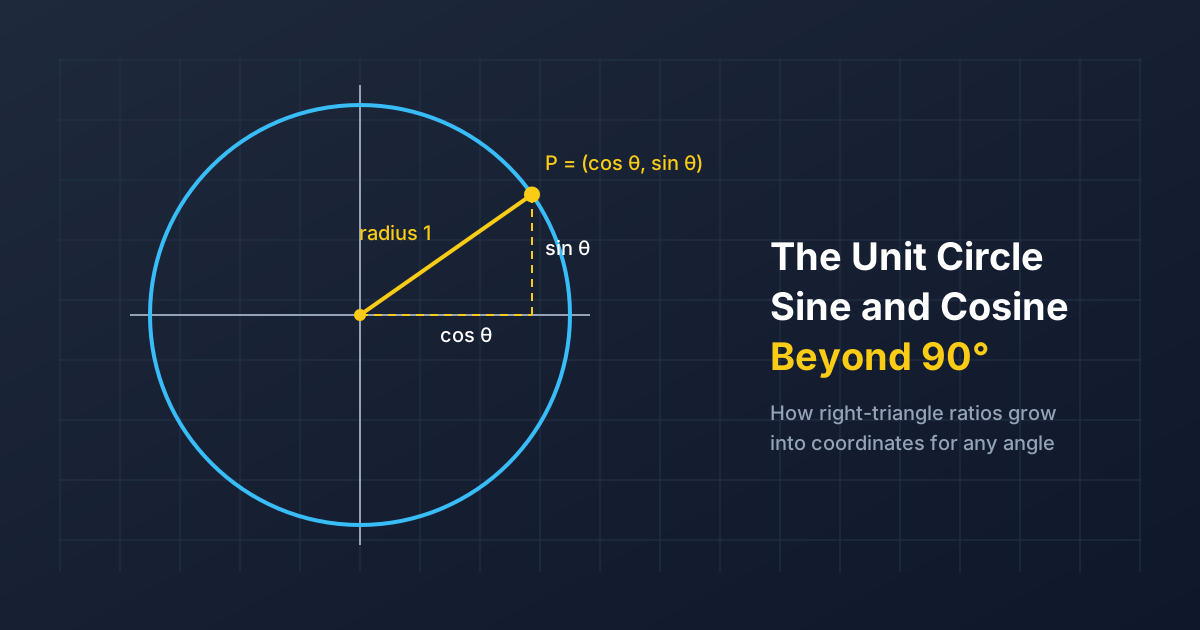
What happens to sine and cosine when an angle grows larger than 90 degrees? A right triangle cannot hold a 120-degree angle, because its three angles must add to 180 degrees and one of them is already 90 degrees. Yet sin 120° and cos 120° still have exact values. The unit circle and right triangles belong together, and the unit circle explains how: it keeps the same ratios you learned from right triangles and extends them to angles of any size. In this guide you will see how a right triangle fits inside a circle of radius 1, why the coordinates of a point on that circle are (cos θ, sin θ), and how reference angles and quadrant signs let you find exact values in all four quadrants. By the end, you will be able to find sine and cosine for angles beyond 90 degrees, negative angles, and angles past a full turn, and you will understand why the values work instead of just memorizing them.
What Is the Unit Circle?
The unit circle is a circle of radius 1 centered at the origin, and every angle points to a location on it. The coordinates of that point are (cos θ, sin θ), so sine and cosine stay defined for angles of any size, including angles beyond 90 degrees, negative angles, and angles past one full turn.
The unit circle lives on the coordinate plane. Its center is the origin (0, 0), and its radius is 1 unit, so every point on it sits exactly 1 unit from the origin. Its equation is x² + y² = 1, which is the Pythagorean theorem with the hypotenuse replaced by the radius: any point (x, y) on the circle satisfies x² + y² = 1² = 1. Its circumference is 2π units, since circumference equals 2π times the radius and the radius is 1.
Angles on the unit circle are drawn in standard position. The vertex sits at the origin, the initial side lies along the positive x-axis, and the terminal side is the ray you reach after rotating counterclockwise from the initial side by the angle. Positive angles rotate counterclockwise, and the terminal side meets the circle at exactly one point. That point is the whole story of the unit circle: its coordinates are the sine and cosine of the angle.
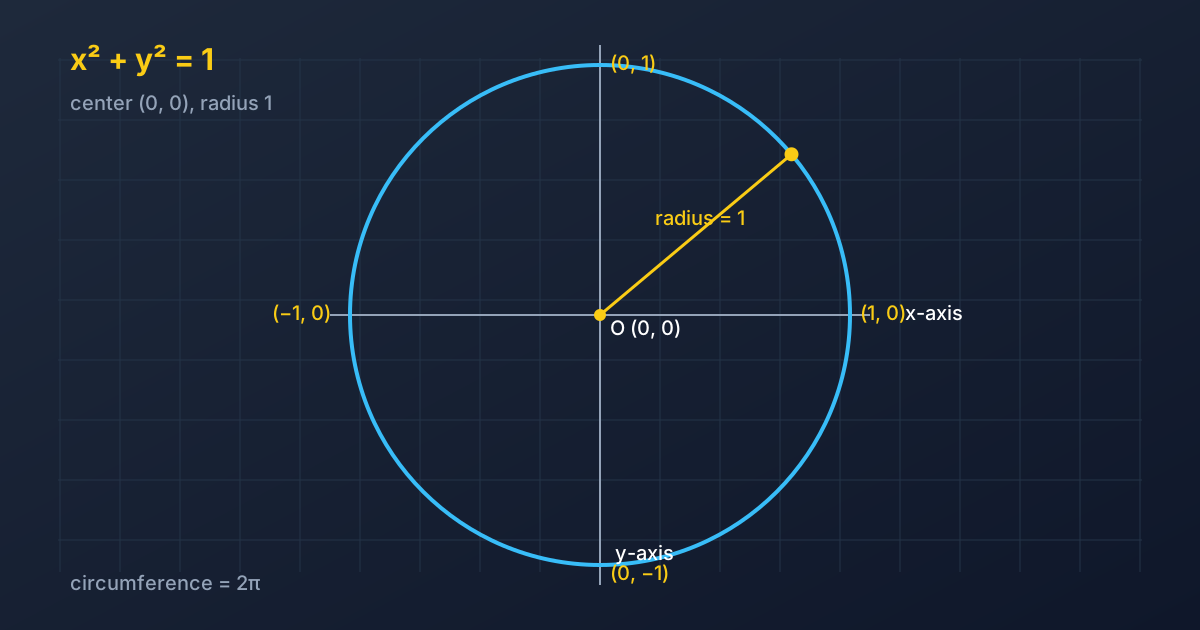
Caption: The unit circle on the coordinate plane. Its center is (0, 0), its radius is 1, and its equation is x² + y² = 1.
Why Is It Called a Unit Circle?
It is called a unit circle because its radius measures one unit. The word unit here means 1, nothing more. Every radius drawn from the center to the circle has length 1, which is what makes the trigonometry so clean: dividing by a hypotenuse of 1 changes nothing, so the side lengths and the ratios become the same numbers.
What Makes the Unit Circle Important?
Right-triangle definitions only cover acute angles, because a triangle cannot contain an angle of 90 degrees or more alongside a right angle. The unit circle removes that restriction. By defining sine and cosine as coordinates, it gives every angle a sine and a cosine: obtuse angles, angles past 180 degrees, negative angles, and angles past a full turn. It is the bridge from the right-triangle trigonometry you already know to the trigonometry used in precalculus, physics, and calculus.
How Are Right Triangles Connected to the Unit Circle?
Start with a right triangle containing an acute angle θ. You already know its ratios from sine, cosine, and tangent:
sin θ = Opposite / Hypotenuse
cos θ = Adjacent / Hypotenuse
Now place that triangle inside the first quadrant of the unit circle, with the angle θ at the origin, one leg along the positive x-axis, and the hypotenuse drawn as a radius. The hypotenuse is a radius of the unit circle, so its length is 1. The triangle now looks like this: the horizontal leg runs from the origin to a point on the x-axis, the vertical leg rises from there to a point P on the circle, and the hypotenuse connects the origin to P.
Because the hypotenuse equals 1, the ratios simplify:
sin θ = Opposite / 1 = Opposite
cos θ = Adjacent / 1 = Adjacent
The opposite leg is vertical, so its length equals the y-coordinate of P. The adjacent leg is horizontal, so its length equals the x-coordinate of P. Therefore the point on the circle has coordinates:
P = (cos θ, sin θ)
This is the central fact of the unit circle. The x-coordinate represents cosine, the y-coordinate represents sine, and the radius acts as the hypotenuse. The horizontal and vertical segments form the legs of a right triangle, exactly the triangle you started with.
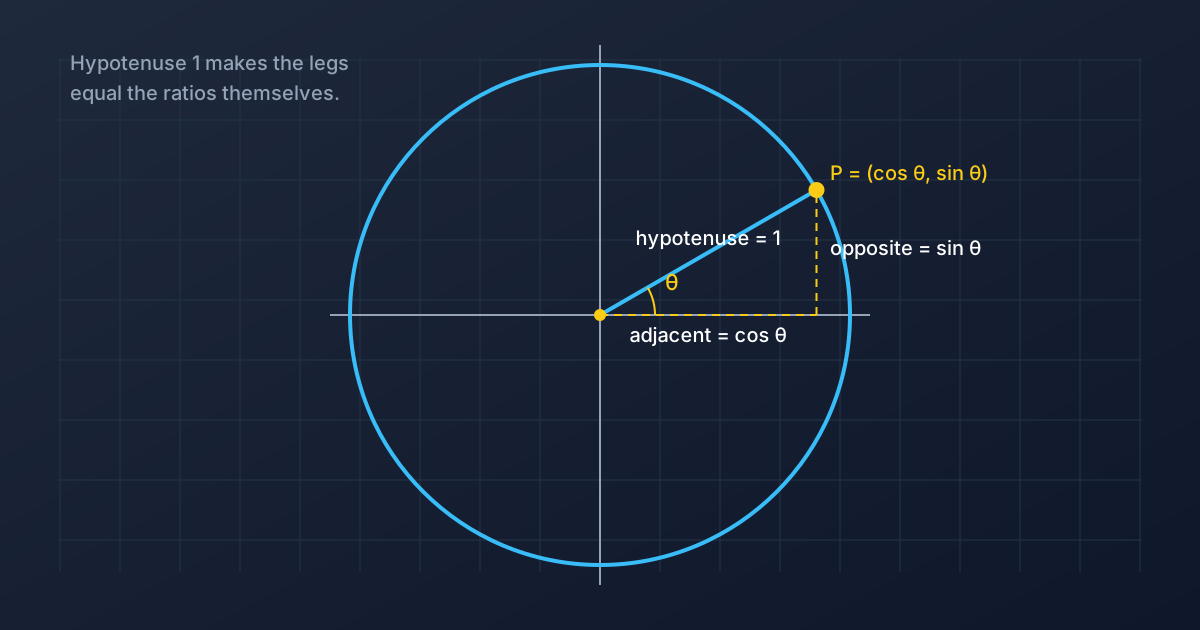
Caption: A right triangle inside the unit circle. The hypotenuse is the radius, so it equals 1, and the legs equal cos θ and sin θ.
Why Does Cosine Represent the x-Coordinate?
The adjacent side of the angle θ lies along the x-axis. Its length is measured horizontally from the origin, and a horizontal distance from the y-axis is exactly what an x-coordinate measures. Since cos θ equals Adjacent / Hypotenuse and the hypotenuse is 1, cos θ equals the adjacent length, which equals the x-coordinate of P.
Why Does Sine Represent the y-Coordinate?
The opposite side of the angle θ stands vertically against the terminal side. Its length is measured vertically from the x-axis, and a vertical distance from the x-axis is exactly what a y-coordinate measures. Since sin θ equals Opposite / Hypotenuse and the hypotenuse is 1, sin θ equals the opposite length, which equals the y-coordinate of P.
Why Does the Hypotenuse Equal 1?
The hypotenuse of the triangle is drawn as a radius of the unit circle, and every radius of the unit circle has length 1 by definition. That is the whole reason the unit circle is so convenient: with a hypotenuse of 1, the ratios stop being divisions and become the side lengths themselves. In a right triangle with a different hypotenuse, say 5, the same angle would give legs of 5 sin θ and 5 cos θ. The unit circle is simply the case where the scale factor is 1.
Why Do Sine and Cosine Work Beyond 90 Degrees?
This is the central idea of the article, so take it slowly. An ordinary right triangle cannot contain a 120-degree interior angle, because its angles must add to 180 degrees and one of them is already 90 degrees. There is no room left for 120 degrees. But an angle in standard position is not trapped inside a triangle. It is a rotation on the coordinate plane, and a rotation can be as large as you like: past 90 degrees, past 180 degrees, past 360 degrees, or in the negative direction for clockwise rotation.
The unit circle defines sine and cosine using coordinates, and coordinates exist for every point on the circle. For any real angle, the terminal side meets the circle at one point, and that point has an x-coordinate and a y-coordinate. Those two numbers are cos θ and sin θ. That is why sine and cosine work for angles of any size, and why they can be negative: coordinates can be negative, while the side lengths of a triangle cannot.
A reference triangle still helps, but it changes its role. For an angle like 120 degrees, drop a perpendicular from the terminal point to the x-axis. You get a right triangle with an acute angle of 60 degrees at the origin, because 180 degrees minus 120 degrees equals 60 degrees. That 60-degree angle is the reference angle. The triangle gives you the sizes of the values: the reference triangle has legs 1/2 and √3/2, since it is a 30-60-90 triangle scaled to hypotenuse 1. The coordinates supply the signs: the point sits in Quadrant II, where x is negative and y is positive. So:
sin 120° = √3/2
cos 120° = −1/2
Cosine is negative in Quadrant II because the point lies to the left of the y-axis, where every x-coordinate is negative. Sine stays positive because the point lies above the x-axis, where every y-coordinate is positive. The reference triangle never carries a sign: its side lengths are nonnegative, and the quadrant decides the signs.
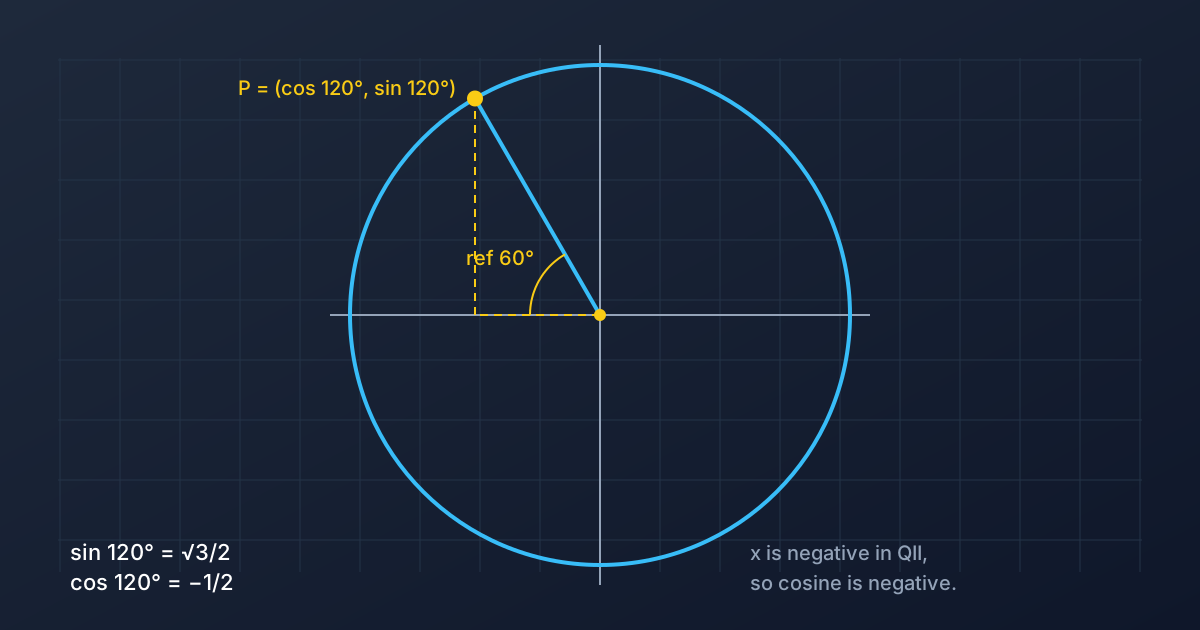
Caption: The 120-degree angle in Quadrant II. Its reference triangle has a 60-degree angle at the origin, and the point has coordinates (−1/2, √3/2).
Understanding the Four Quadrants of the Unit Circle
The coordinate plane divides into four quadrants, numbered counterclockwise starting from the upper right. Quadrant I holds angles from 0 degrees to 90 degrees, Quadrant II from 90 degrees to 180 degrees, Quadrant III from 180 degrees to 270 degrees, and Quadrant IV from 270 degrees to 360 degrees. These intervals exclude the axis angles: an angle of exactly 90 degrees, 180 degrees, 270 degrees, or 360 degrees sits on an axis, not inside a quadrant, and it has no reference angle. Axis angles take their sine and cosine directly from their axis coordinates.
Quadrant I: 0° to 90°
Both coordinates are positive, so sine is positive and cosine is positive. This is the home of right-triangle trigonometry: every angle here fits inside a right triangle in the usual way.
Quadrant II: 90° to 180°
The x-coordinate is negative and the y-coordinate is positive, so sine is positive and cosine is negative. The 120-degree example lives here.
Quadrant III: 180° to 270°
Both coordinates are negative, so sine is negative and cosine is negative.
Quadrant IV: 270° to 360°
The x-coordinate is positive and the y-coordinate is negative, so sine is negative and cosine is positive.
Unit Circle Sign Chart
| Quadrant | Degree interval | Sine sign | Cosine sign | Tangent sign | Example angle |
|---|---|---|---|---|---|
| I | 0° to 90° | Positive | Positive | Positive | 30° |
| II | 90° to 180° | Positive | Negative | Negative | 120° |
| III | 180° to 270° | Negative | Negative | Positive | 225° |
| IV | 270° to 360° | Negative | Positive | Negative | 300° |
The signs change because the coordinates change. Tangent equals sine divided by cosine, so its sign follows from the other two: positive when sine and cosine share a sign, negative when they differ. That is why tangent is positive in Quadrants I and III and negative in Quadrants II and IV.
As an optional memory aid, the letters ASTC run counterclockwise from Quadrant I: All functions positive in Quadrant I, Sine positive in Quadrant II, Tangent positive in Quadrant III, Cosine positive in Quadrant IV. Use it only after you understand why the signs work: the letters summarize the coordinates, they do not explain them.
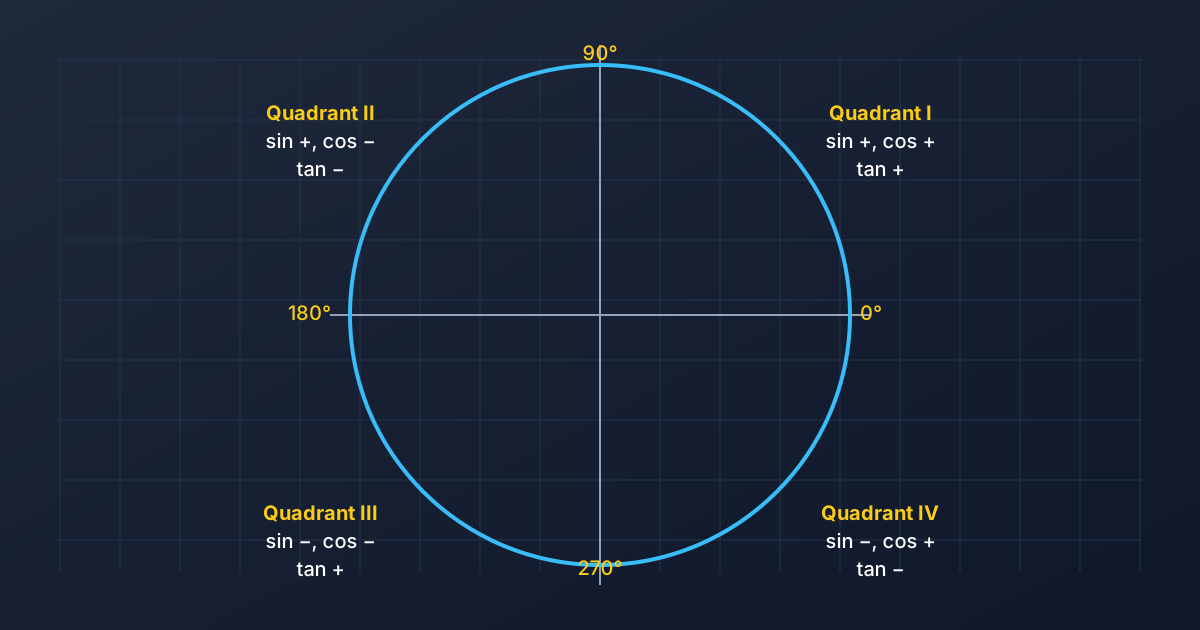
Caption: The four quadrants and their signs. Axis angles sit on the axes, not inside any quadrant.
What Are Reference Angles on the Unit Circle?
A reference angle is the positive acute angle between the terminal side of a nonquadrantal angle and the x-axis. The word nonquadrantal matters: axis angles have no reference angle, because their terminal sides lie on the x-axis itself. For every other angle, the reference angle is the small acute angle you see when you drop a perpendicular from the terminal point to the x-axis.
Reference angles help because they reduce every angle to a first-quadrant problem. The reference triangle always has an acute angle of 30 degrees, 45 degrees, or 60 degrees for the standard angles, and you already know the exact values for those. You take the size of the value from the reference angle and the sign from the quadrant.
For angles θ between 0 degrees and 360 degrees, the formulas are:
Quadrant I: α = θ
Quadrant II: α = 180° − θ
Quadrant III: α = θ − 180°
Quadrant IV: α = 360° − θ
These forms apply only inside the open quadrant intervals, meaning θ strictly between the axis angles. For any other angle, first find a coterminal angle inside the standard 0-degree to 360-degree range, then apply the formula for its quadrant.
Finding the Reference Angle of 120°
The angle 120 degrees lies in Quadrant II, so α = 180° − 120° = 60°. The reference triangle is a 30-60-90 triangle, and the quadrant sign step gives sin 120° = √3/2 and cos 120° = −1/2.
Finding the Reference Angle of 225°
The angle 225 degrees lies in Quadrant III, so α = 225° − 180° = 45°. The reference triangle is a 45-45-90 triangle, and both coordinates are negative in Quadrant III, giving sin 225° = −√2/2 and cos 225° = −√2/2.
Finding the Reference Angle of 300°
The angle 300 degrees lies in Quadrant IV, so α = 360° − 300° = 60°. The reference triangle is a 30-60-90 triangle, and Quadrant IV has a positive x-coordinate and a negative y-coordinate, giving sin 300° = −√3/2 and cos 300° = 1/2.
Reference angles and quadrant signs always work as a pair. The reference angle gives the size, the quadrant gives the sign, and neither step works alone.
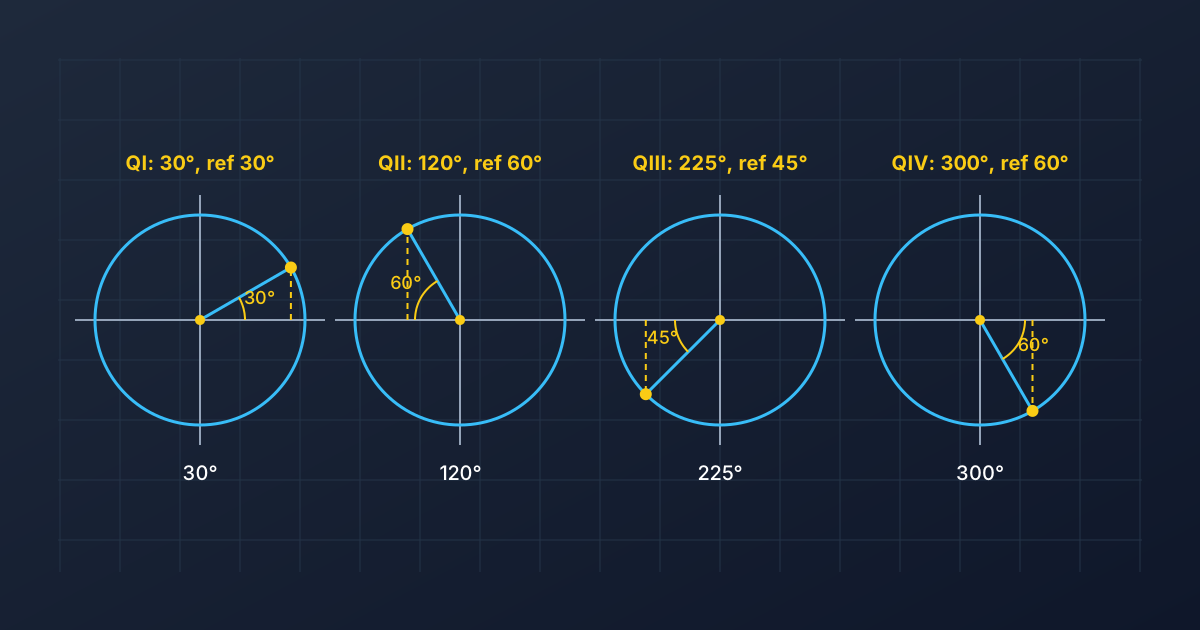
Caption: Reference angles in all four quadrants. Each reference angle is the acute angle between the terminal side and the x-axis.
Unit Circle Values for Common Angles
The most important angles on the unit circle are the multiples of 30 degrees and 45 degrees, plus the axis angles. The table below lists all of them with degrees, radians, cosine, sine, and the coordinate pair. Every value is exact: no rounded decimals appear, because the values come from the two special triangles.
| Angle in degrees | Angle in radians | Cosine value | Sine value | Coordinate pair |
|---|---|---|---|---|
| 0° | 0 | 1 | 0 | (1, 0) |
| 30° | π/6 | √3/2 | 1/2 | (√3/2, 1/2) |
| 45° | π/4 | √2/2 | √2/2 | (√2/2, √2/2) |
| 60° | π/3 | 1/2 | √3/2 | (1/2, √3/2) |
| 90° | π/2 | 0 | 1 | (0, 1) |
| 120° | 2π/3 | −1/2 | √3/2 | (−1/2, √3/2) |
| 135° | 3π/4 | −√2/2 | √2/2 | (−√2/2, √2/2) |
| 150° | 5π/6 | −√3/2 | 1/2 | (−√3/2, 1/2) |
| 180° | π | −1 | 0 | (−1, 0) |
| 210° | 7π/6 | −√3/2 | −1/2 | (−√3/2, −1/2) |
| 225° | 5π/4 | −√2/2 | −√2/2 | (−√2/2, −√2/2) |
| 240° | 4π/3 | −1/2 | −√3/2 | (−1/2, −√3/2) |
| 270° | 3π/2 | 0 | −1 | (0, −1) |
| 300° | 5π/3 | 1/2 | −√3/2 | (1/2, −√3/2) |
| 315° | 7π/4 | √2/2 | −√2/2 | (√2/2, −√2/2) |
| 330° | 11π/6 | √3/2 | −1/2 | (√3/2, −1/2) |
| 360° | 2π | 1 | 0 | (1, 0) |
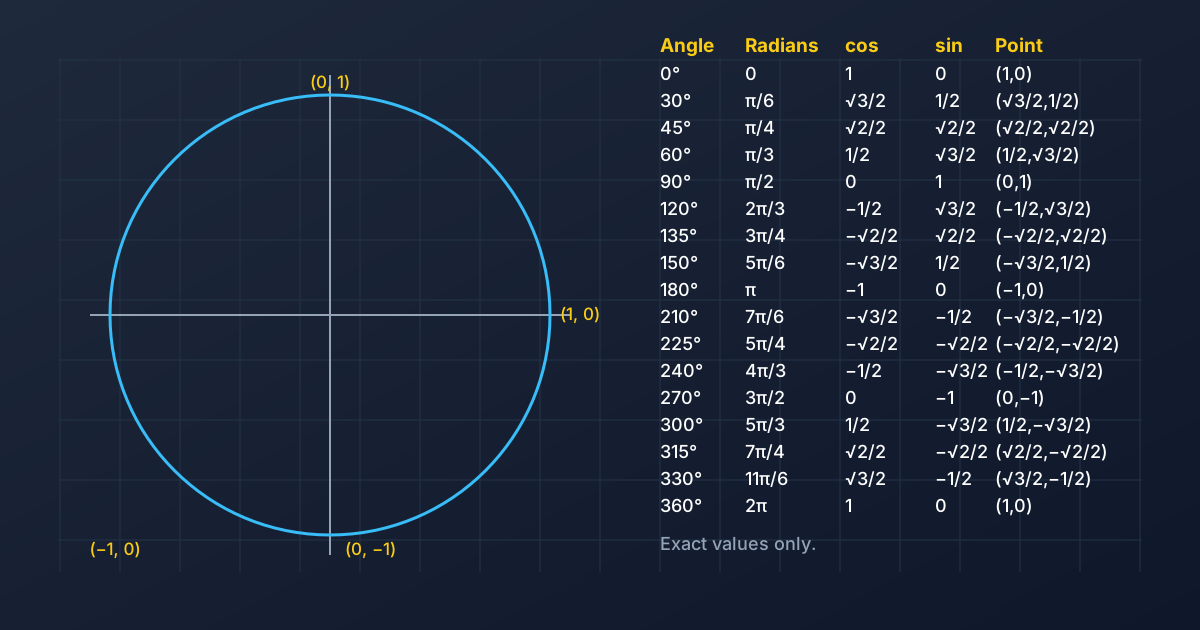
Caption: The complete unit circle chart. Every coordinate pair reads as (cos θ, sin θ).
Special Right Triangle Values
All of these values come from two triangles. The 30-60-90 triangle has side ratio 1 : √3 : 2. With the hypotenuse scaled to 1, the short leg becomes 1/2 and the long leg becomes √3/2, which gives sin 30° = 1/2, cos 30° = √3/2, sin 60° = √3/2, and cos 60° = 1/2. The 45-45-90 triangle has side ratio 1 : 1 : √2. With the hypotenuse scaled to 1, each leg becomes √2/2, which gives sin 45° = √2/2 and cos 45° = √2/2.
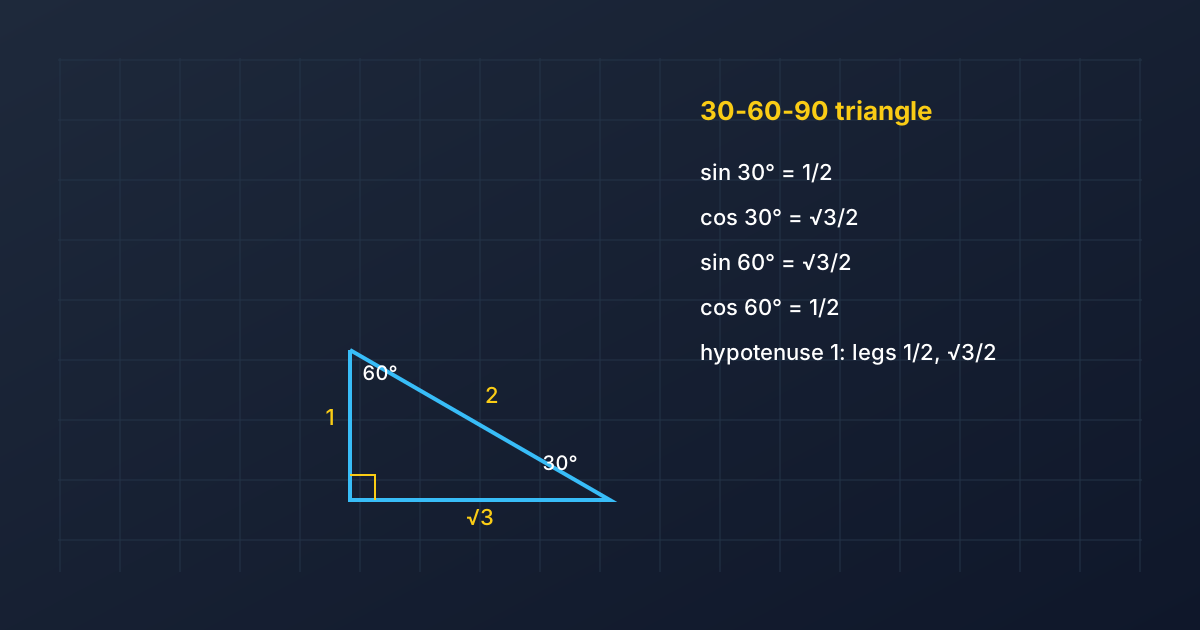
Caption: The 30-60-90 triangle. Scaling the hypotenuse to 1 gives legs of 1/2 and √3/2.
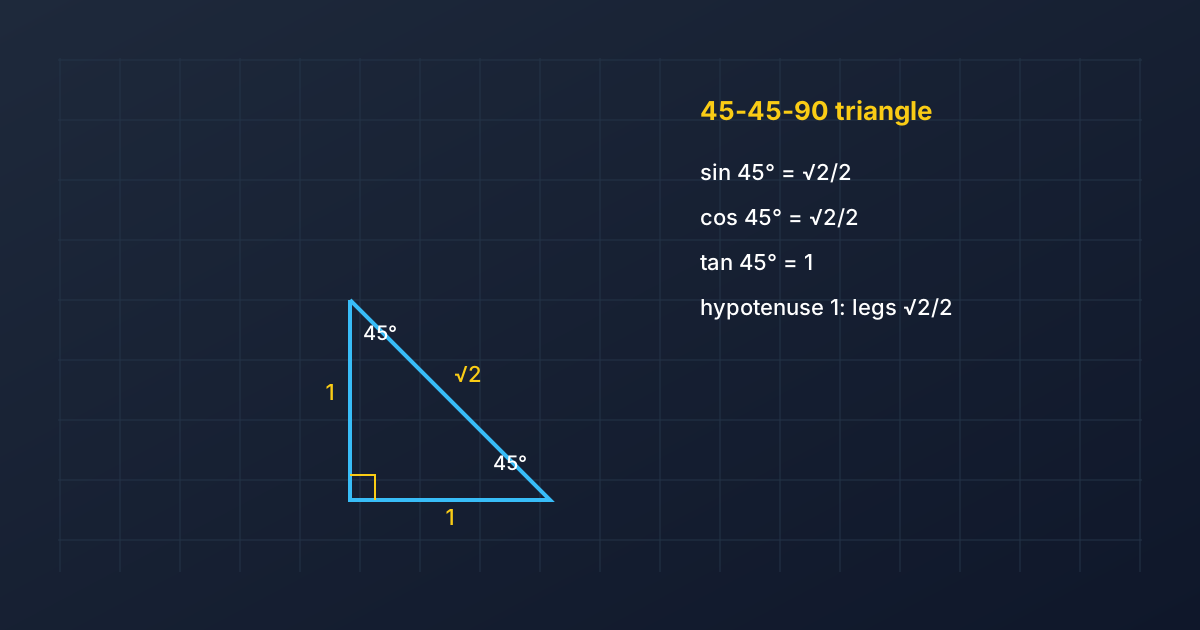
Caption: The 45-45-90 triangle. Scaling the hypotenuse to 1 gives two legs of √2/2.
Why Do the Same Values Repeat?
The same values repeat because the circle is symmetric. Reflect a first-quadrant point across the y-axis and you get the Quadrant II point with the same y-coordinate and the opposite x-coordinate. Reflect it across the x-axis and you get the Quadrant IV point with the same x-coordinate and the opposite y-coordinate. Reflect it through the origin and you get the Quadrant III point with both coordinates flipped. That is why you only need to learn the first quadrant: the other three quadrants are mirror images of it, with signs chosen by position. The same symmetry also explains periodicity: after a full turn of 360 degrees, the terminal side returns to the same point, so sine and cosine repeat exactly.
Degrees vs. Radians on the Unit Circle
Degrees and radians are two units for measuring the same rotation. Degrees divide a full turn into 360 parts, which is convenient for everyday use. Radians measure rotation by arc length on the unit circle: since the radius is 1, the arc length of a rotation equals the angle in radians. A full turn traces the whole circumference, 2π units, so:
180° = π radians
360° = 2π radians
Converting Degrees to Radians
Radians = Degrees × π/180
Worked conversions:
30° × π/180 = π/6 radians
45° × π/180 = π/4 radians
60° × π/180 = π/3 radians
90° × π/180 = π/2 radians
120° × π/180 = 2π/3 radians
180° × π/180 = π radians
270° × π/180 = 3π/2 radians
360° × π/180 = 2π radians
Converting Radians to Degrees
Degrees = Radians × 180/π
For example, 5π/6 radians × 180/π = 150 degrees, and 7π/4 radians × 180/π = 315 degrees. In each conversion, the π symbols cancel and leave a plain number of degrees.
Radians are widely used in higher mathematics, physics, and calculus because they simplify the formulas: arc length becomes radius times angle, and the calculus of sine and cosine works cleanly only in radians. Degrees remain common in school geometry and navigation. The two units describe the same angles, so always label which unit you are using, and never mix them inside one calculation without converting first.
How to Find Sine and Cosine Using the Unit Circle
Use this seven-step method for any angle. It works for degrees and radians, for negative angles, and for angles past a full turn.
Step 1: Identify the Angle
Determine whether the angle is given in degrees or radians. Write the unit down next to every number you use, so a radian measure never slips into a degree formula.
Step 2: Find a Coterminal Angle
If necessary, reduce the angle to one full rotation. Add or subtract multiples of 360 degrees, or 2π radians, until the angle lies between 0 degrees and 360 degrees. The coterminal angle points to the same place on the circle.
Step 3: Identify the Quadrant or Axis
Determine where the terminal side sits. Check the axis angles first: 0 degrees, 90 degrees, 180 degrees, 270 degrees, and 360 degrees are axis angles, not quadrant angles, and they take their values straight from their axis coordinates. Otherwise, place the angle in Quadrant I, II, III, or IV.
Step 4: Find the Reference Angle
Use the rule for the quadrant: Quadrant I uses the angle itself, Quadrant II uses 180 degrees minus the angle, Quadrant III uses the angle minus 180 degrees, and Quadrant IV uses 360 degrees minus the angle. In radians, replace 180 degrees with π and 360 degrees with 2π.
Step 5: Determine the Exact Value
Use a special triangle or a known unit circle coordinate. A reference angle of 30 degrees, 45 degrees, or 60 degrees gives exact values from the 30-60-90 or 45-45-90 triangle.
Step 6: Apply the Correct Sign
Use the signs of x and y in the quadrant. Cosine takes the sign of x, sine takes the sign of y. Reference triangles never supply signs, because their side lengths are nonnegative.
Step 7: Write the Final Answer
State the cosine as the x-coordinate and the sine as the y-coordinate, with the unit labeled. Then check the answer against the Pythagorean identity: sin² θ + cos² θ must equal 1.
Worked Examples of Sine and Cosine Beyond 90 Degrees
Each example follows the seven steps. Watch for the two traps the method is built to catch: axis angles, which have no reference angle, and signs, which come from the quadrant, never from the triangle.
Example 1: Find sin 120°
Given angle: 120 degrees. Quadrant: Quadrant II, since 90 degrees < 120 degrees < 180 degrees. Reference angle: 180° − 120° = 60°. Special triangle: 30-60-90, giving sin 60° = √3/2. Sign: sine is positive in Quadrant II. Step-by-step: the terminal point is (−1/2, √3/2), and sine is the y-coordinate. Exact final answer: sin 120° = √3/2. Verification: (√3/2)² + (−1/2)² = 3/4 + 1/4 = 1.
Example 2: Find cos 120°
Given angle: 120 degrees. Quadrant: Quadrant II. Reference angle: 60°. Special triangle: 30-60-90, giving cos 60° = 1/2. Sign: cosine is negative in Quadrant II, because the x-coordinate is negative. Step-by-step: the terminal point is (−1/2, √3/2), and cosine is the x-coordinate. Exact final answer: cos 120° = −1/2. Verification: the point (−1/2, √3/2) satisfies (−1/2)² + (√3/2)² = 1, so it lies on the unit circle.
Example 3: Find sin 135°
Given angle: 135 degrees. Quadrant: Quadrant II. Reference angle: 180° − 135° = 45°. Special triangle: 45-45-90, giving sin 45° = √2/2. Sign: sine is positive in Quadrant II. Exact final answer: sin 135° = √2/2. Verification: sin 135° equals sin 45°, which matches the reflection symmetry across the y-axis.
Example 4: Find cos 150°
Given angle: 150 degrees. Quadrant: Quadrant II. Reference angle: 180° − 150° = 30°. Special triangle: 30-60-90, giving cos 30° = √3/2. Sign: cosine is negative in Quadrant II. Exact final answer: cos 150° = −√3/2. Verification: the terminal point is (−√3/2, 1/2), and (−√3/2)² + (1/2)² = 3/4 + 1/4 = 1.
Example 5: Find sin 210°
Given angle: 210 degrees. Quadrant: Quadrant III, since 180 degrees < 210 degrees < 270 degrees. Reference angle: 210° − 180° = 30°. Special triangle: 30-60-90, giving sin 30° = 1/2. Sign: sine is negative in Quadrant III. Exact final answer: sin 210° = −1/2. Verification: the terminal point is (−√3/2, −1/2), and both coordinates are negative, as Quadrant III requires.
Example 6: Find cos 225°
Given angle: 225 degrees. Quadrant: Quadrant III. Reference angle: 225° − 180° = 45°. Special triangle: 45-45-90, giving cos 45° = √2/2. Sign: cosine is negative in Quadrant III. Exact final answer: cos 225° = −√2/2. Verification: (−√2/2)² + (−√2/2)² = 1/2 + 1/2 = 1.
Example 7: Find sin 300°
Given angle: 300 degrees. Quadrant: Quadrant IV, since 270 degrees < 300 degrees < 360 degrees. Reference angle: 360° − 300° = 60°. Special triangle: 30-60-90, giving sin 60° = √3/2. Sign: sine is negative in Quadrant IV. Exact final answer: sin 300° = −√3/2. Verification: the terminal point is (1/2, −√3/2), with a positive x-coordinate and a negative y-coordinate, as Quadrant IV requires.
Example 8: Find cos 330°
Given angle: 330 degrees. Quadrant: Quadrant IV. Reference angle: 360° − 330° = 30°. Special triangle: 30-60-90, giving cos 30° = √3/2. Sign: cosine is positive in Quadrant IV. Exact final answer: cos 330° = √3/2. Verification: the terminal point is (√3/2, −1/2), and (√3/2)² + (−1/2)² = 3/4 + 1/4 = 1.
Example 9: Find sin(−45°)
Given angle: −45 degrees. Quadrant or axis: negative angles rotate clockwise, so −45 degrees lands in Quadrant IV, coterminal with 315 degrees. Reference angle: 360° − 315° = 45°. Special triangle: 45-45-90, giving sin 45° = √2/2. Sign: sine is negative in Quadrant IV. Step-by-step: the clockwise rotation flips the y-coordinate relative to positive 45 degrees, while the x-coordinate stays the same. Exact final answer: sin(−45°) = −√2/2. Verification: sin(−45°) = −sin 45° by the odd symmetry of sine, and −√2/2 matches.
Example 10: Find cos 450°
Given angle: 450 degrees. Coterminal angle: 450° − 360° = 90°. Quadrant or axis: 90 degrees is an axis angle, not a quadrant angle, so there is no reference angle here. Axis coordinates: the point for 90 degrees is (0, 1). Step-by-step: cosine is the x-coordinate, which is 0. Exact final answer: cos 450° = 0, and for completeness sin 450° = 1. Verification: the terminal side points straight up the y-axis, where every x-coordinate is 0.
Positive, Negative, and Coterminal Angles
Positive Angles
Positive angles rotate counterclockwise from the positive x-axis. This is the default direction on the unit circle, and every standard angle you meet first is measured this way.
Negative Angles
Negative angles rotate clockwise from the positive x-axis. A negative angle of −45 degrees ends at the same point as a positive angle of 315 degrees, because clockwise 45 degrees and counterclockwise 315 degrees land on the same terminal side.
Coterminal Angles
Coterminal angles share the same terminal side. They are found with:
θ + 360°k
where k is any integer. In radians, the same idea reads θ + 2πk.
Examples:
30° and 390° are coterminal, since 30° + 360° = 390°.
90° and 450° are coterminal, since 90° + 360° = 450°.
−45° and 315° are coterminal, since −45° + 360° = 315°.
Coterminal angles have the same sine and cosine values because they point to the same point on the circle. If two angles land on the same point, they share that point’s coordinates, and the coordinates are the sine and cosine.
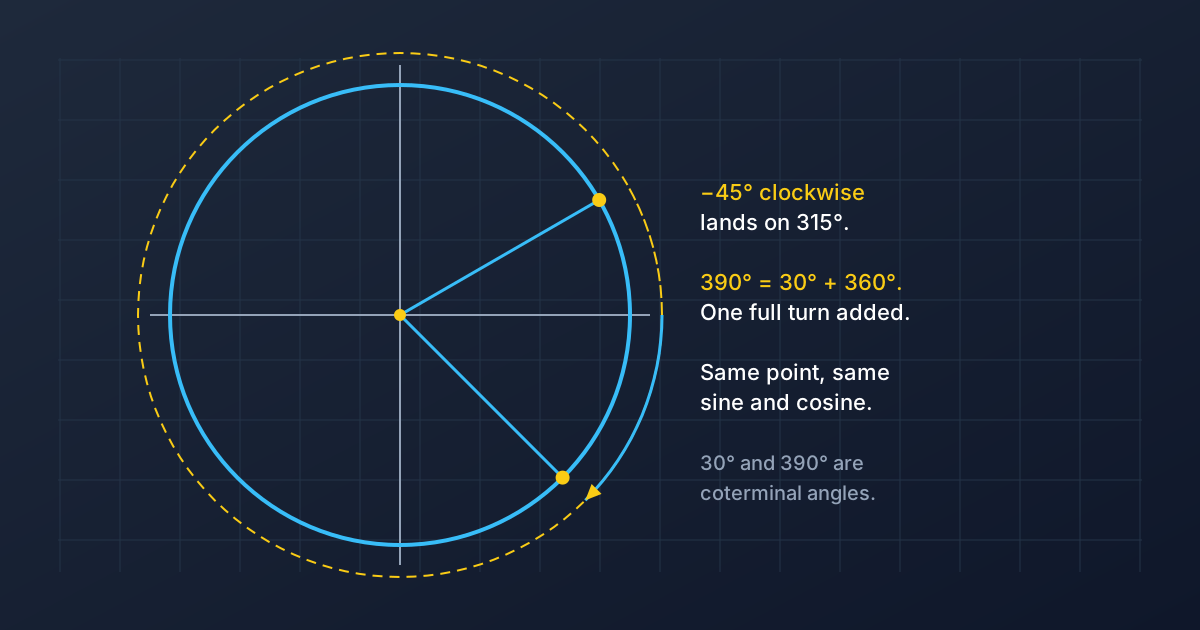
Caption: Negative and coterminal angles. A clockwise turn of 45 degrees lands on 315 degrees, and adding a full turn to 30 degrees gives 390 degrees.
Important Sine and Cosine Identities on the Unit Circle
Each identity below follows from the geometry of the circle, and each holds for all real angles, not just acute ones.
sin² θ + cos² θ = 1
This is the unit circle equation itself: the point (cos θ, sin θ) lies on the circle x² + y² = 1, so its coordinates satisfy cos² θ + sin² θ = 1. See the trigonometric identities guide for the right-triangle version of this identity.
sin(−θ) = −sin θ
Reflect the terminal point across the x-axis and the y-coordinate flips sign while the x-coordinate stays put. A clockwise rotation of θ lands at the mirror image of the counterclockwise rotation, so the sine changes sign. Sine is an odd function.
cos(−θ) = cos θ
The same reflection leaves the x-coordinate unchanged, so cosine ignores the sign of the angle. Cosine is an even function.
sin(θ + 360°) = sin θ
cos(θ + 360°) = cos θ
Adding a full turn returns the terminal side to the same point, so both coordinates repeat. In radians, the same identities read sin(θ + 2π) = sin θ and cos(θ + 2π) = cos θ.
sin(180° − θ) = sin θ
Reflect the terminal point across the y-axis and the y-coordinate stays the same while the x-coordinate flips. The angle 180° − θ is the mirror image of θ across the y-axis, so their sines match. This is why sin 120° equals sin 60°.
cos(180° − θ) = −cos θ
The same y-axis reflection flips the x-coordinate, so the cosines are opposites. This is why cos 120° equals −cos 60°.
Unit Circle vs. Right Triangle Trigonometry
| Feature | Right triangle trigonometry | Unit circle trigonometry |
|---|---|---|
| Definition | Ratios of sides in a right triangle | Coordinates of a point on a circle of radius 1 |
| Angle restrictions | Acute angles only, between 0 degrees and 90 degrees | Any real angle, positive, negative, or past a full turn |
| Main mathematical approach | Opposite, adjacent, and hypotenuse of a fixed triangle | Terminal point (cos θ, sin θ) reached by rotation |
| Sine interpretation | Opposite divided by hypotenuse | The y-coordinate of the terminal point |
| Cosine interpretation | Adjacent divided by hypotenuse | The x-coordinate of the terminal point |
| Coordinate signs | Side lengths are always nonnegative | Signs follow the quadrant of the terminal point |
| Negative angles | Not defined | Clockwise rotation, handled naturally |
| Angles greater than 90 degrees | Not defined | Defined by coordinates in any quadrant |
| Common applications | Finding sides and angles of right triangles | Periodic motion, waves, rotations, and general angles |
Right-triangle trigonometry is the foundation for unit circle trigonometry, not a competing system. The unit circle agrees with the right-triangle definitions for every acute angle, and then extends them. Learn the triangle first, and the circle becomes a natural next step rather than a replacement.
How the Unit Circle Connects to Sine and Cosine Graphs
Picture the terminal point moving around the circle. As the angle grows, the point rises and falls, and its y-coordinate traces a wave. That wave is the graph of y = sin θ. The x-coordinate traces a second wave, the graph of y = cos θ. The two waves have the same shape, shifted by 90 degrees, because the x and y coordinates of a rotating point follow the same up-and-down pattern out of step with each other.
Both graphs share these features:
- Period of 360 degrees, or 2π radians: the pattern repeats after one full turn.
- Amplitude of 1: the waves rise to 1 and fall to −1, because no coordinate on the unit circle exceeds 1 in size.
- Maximum value of 1 and minimum value of −1.
- Zeros of sine at 0 degrees, 180 degrees, and 360 degrees, where the point sits on the x-axis and the y-coordinate is 0.
- Zeros of cosine at 90 degrees and 270 degrees, where the point sits on the y-axis and the x-coordinate is 0.
- Sine positive in Quadrants I and II, negative in Quadrants III and IV.
- Cosine positive in Quadrants I and IV, negative in Quadrants II and III.
The graph connection explains why sine and cosine model repeating phenomena: anything that rotates or oscillates, from a wheel to a sound wave, follows the same pattern as the coordinates of a point moving around a circle.
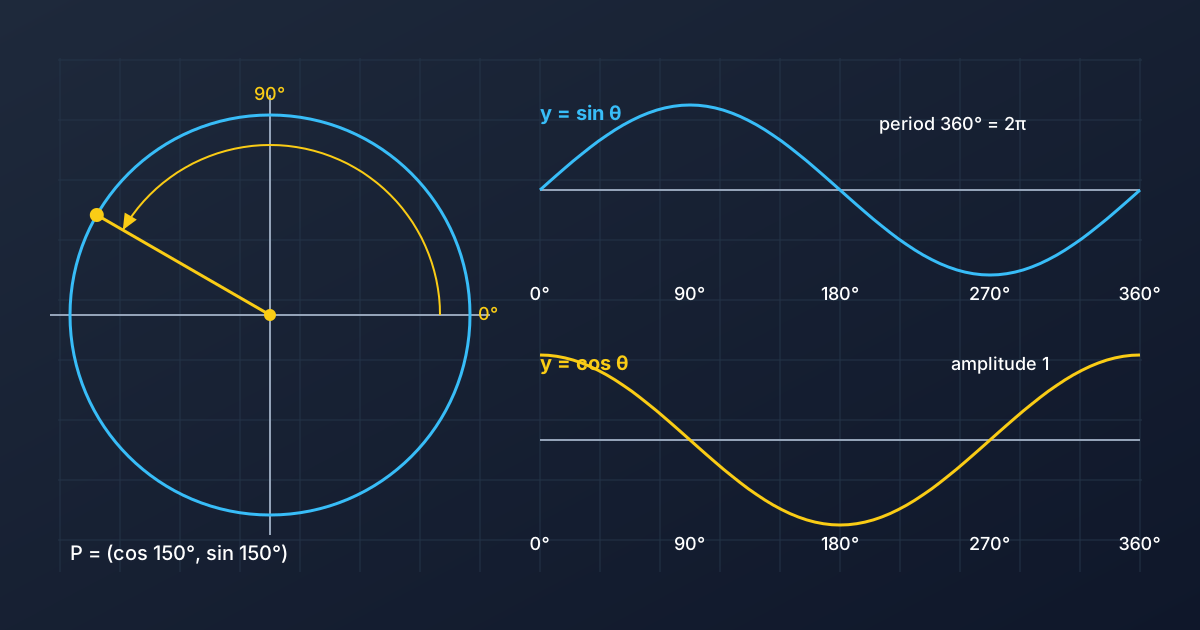
Caption: The rotating point traces the graphs. Its y-coordinate draws the sine wave, and its x-coordinate draws the cosine wave.
Real-Life Applications of the Unit Circle
Physics
Circular motion, waves, and oscillations all follow sine and cosine. A pendulum, a vibrating string, and an alternating current each repeat a pattern that the unit circle describes exactly.
Engineering
Rotational systems and periodic signals use the same mathematics. A spinning shaft, a gear, and an electrical signal all have positions and values that vary as sine and cosine of a rotating angle.
Computer Graphics
Positioning and rotating objects on a screen relies on unit circle coordinates. To rotate a point around a center, graphics code multiplies by cosines and sines of the rotation angle.
Animation
Circular movement and repeating motion, from a walking cycle to an orbiting planet in a game, are built by stepping an angle around the circle and reading off the coordinates.
Navigation
Directions and coordinate components come from the same idea. A bearing and a distance give north and east components through cosine and sine, exactly as a terminal point gives x and y coordinates.
Mathematics
Trigonometric functions, precalculus, and calculus all rest on the unit circle definitions. The graphs, the identities, and the calculus of sine and cosine all start from the point (cos θ, sin θ).
Numerical example. A rotating arm of length 5 units sits at an angle of 30 degrees. Its tip is not on the unit circle, because the radius is 5, not 1, so the coordinates scale up: x = r cos θ and y = r sin θ. That gives x = 5 × cos 30° = 5 × √3/2 ≈ 4.33 units and y = 5 × sin 30° = 5 × 1/2 = 2.5 units. Check: 4.33² + 2.5² ≈ 18.75 + 6.25 = 25, which equals 5², so the tip sits exactly 5 units from the origin, as it must. Actual physical applications almost always use a radius other than 1, and this scaling step is how the unit circle handles them.
Common Mistakes Students Make With the Unit Circle
1. Confusing sine with the x-coordinate
Incorrect reasoning: sine is the first thing listed, so it must go with x, the first coordinate. Explanation of the error: the order of the words does not set the pairing. Correct approach: sine is the y-coordinate, because sine comes from the opposite side, which stands vertically. Short example: for 30 degrees, the point is (√3/2, 1/2), so sin 30° = 1/2, the y-coordinate, not √3/2.
2. Confusing cosine with the y-coordinate
Incorrect reasoning: cosine pairs with y because both come second in some lists. Explanation of the error: the pairing comes from geometry, not list order. Correct approach: cosine is the x-coordinate, because cosine comes from the adjacent side, which lies horizontally. Short example: for 60 degrees, the point is (1/2, √3/2), so cos 60° = 1/2, the x-coordinate.
3. Forgetting quadrant signs
Incorrect reasoning: the reference triangle gives sin 210° = 1/2, so the answer is 1/2. Explanation of the error: the reference triangle gives sizes only, and 210 degrees sits in Quadrant III, where sine is negative. Correct approach: take the size from the reference angle, then apply the quadrant sign. Short example: sin 210° = −1/2, not 1/2.
4. Using an incorrect reference angle
Incorrect reasoning: the reference angle of 300 degrees is 300° − 270° = 30°. Explanation of the error: reference angles are measured to the x-axis, and for Quadrant IV the rule is 360 degrees minus the angle, not the angle minus 270 degrees. Correct approach: 360° − 300° = 60°. Short example: sin 300° = −√3/2, from a 60-degree reference angle, not −1/2.
5. Confusing degrees and radians
Incorrect reasoning: sin(π/6) is treated as sin 6 degrees, or 30 degrees is plugged into a radian formula. Explanation of the error: π/6 radians equals 30 degrees, and the two units measure the same angle with different numbers. Correct approach: label the unit every time, and convert before calculating: 30° × π/180 = π/6 radians. Short example: sin(π/6) = 1/2, because π/6 radians is 30 degrees.
6. Assuming sine and cosine are always positive
Incorrect reasoning: sine and cosine are lengths, and lengths cannot be negative. Explanation of the error: in right triangles the values are ratios of lengths, but on the unit circle they are coordinates, and coordinates can be negative. Correct approach: let the quadrant set the sign. Short example: cos 180° = −1, a negative value from a point on the negative x-axis.
7. Applying acute-angle triangle ratios directly to obtuse angles without considering coordinates
Incorrect reasoning: sin 120° must equal sin 60° and cos 120° must equal cos 60°, because both use the same triangle. Explanation of the error: the triangle gives the sizes, but 120 degrees sits in Quadrant II, where the x-coordinate is negative. Correct approach: keep the sine, flip the cosine. Short example: sin 120° = √3/2, but cos 120° = −1/2, not 1/2.
8. Forgetting coterminal angles
Incorrect reasoning: an angle of 450 degrees is invalid because it exceeds 360 degrees. Explanation of the error: angles can exceed a full turn, and each extra turn returns to the same point. Correct approach: subtract 360 degrees to find the coterminal angle. Short example: cos 450° = cos 90° = 0.
9. Mixing up 30° and 60° values
Incorrect reasoning: sin 30° = √3/2, because √3/2 is the larger value and 30 feels like the larger angle in some orderings. Explanation of the error: sine grows as the angle grows toward 90 degrees, so the smaller angle has the smaller sine. Correct approach: the short leg sits opposite 30 degrees, so sin 30° = 1/2, and the long leg sits opposite 60 degrees, so sin 60° = √3/2. Short example: the point for 30 degrees is (√3/2, 1/2), with the smaller coordinate second.
10. Treating the unit circle as having a radius other than 1
Incorrect reasoning: a circle of radius 5 is used with the unit circle table directly. Explanation of the error: the table values assume a radius of 1, so they give directions, not positions, for a larger circle. Correct approach: scale by the radius with x = r cos θ and y = r sin θ. Short example: for r = 5 and θ = 30 degrees, the point is (5√3/2, 5/2), not (√3/2, 1/2).
11. Misidentifying axis angles as quadrant angles
Incorrect reasoning: 90 degrees is treated as a Quadrant I angle with a reference angle of 90 degrees. Explanation of the error: axis angles sit on the axes, not inside quadrants, and reference angles are defined only for nonquadrantal angles. Correct approach: read axis values straight from the axis coordinates. Short example: sin 90° = 1 and cos 90° = 0 come from the point (0, 1), with no reference angle involved.
12. Assuming angles greater than 360° are invalid
Incorrect reasoning: an angle of 600 degrees cannot be evaluated, because the circle ends at 360 degrees. Explanation of the error: the circle does not end; rotation continues past a full turn and returns to earlier points. Correct approach: subtract multiples of 360 degrees to find the coterminal angle. Short example: sin 600° = sin 240° = −√3/2, since 600° − 360° = 240°.
Easy Ways to Remember the Unit Circle
- Understand coordinates rather than memorizing everything. If you know why the point is (cos θ, sin θ), the rest follows.
- Learn the first quadrant. Every other quadrant is a mirror image of it with signs changed.
- Use reference angles. Reduce any angle to 30 degrees, 45 degrees, or 60 degrees, then fix the sign.
- Remember quadrant signs by position: right means x positive, up means y positive.
- Practice the 30-60-90 triangle until its legs, 1/2 and √3/2, feel automatic.
- Practice the 45-45-90 triangle until its legs, both √2/2, feel automatic.
- Recognize symmetry. One first-quadrant point generates four points, one per quadrant.
- Use exact values. Fractions and radicals keep the patterns visible, while decimals hide them.
- Practice degree-radian conversions both ways until π/6, π/4, π/3, and π/2 feel like 30, 45, 60, and 90 degrees.
- Draw the unit circle from memory. A blank circle with the four axis points and the first-quadrant values is the fastest self-test in trigonometry.
Beginner study strategy. Draw the circle once a day for a week. First mark the axis points (1, 0), (0, 1), (−1, 0), and (0, −1). Then add the first-quadrant points for 30, 45, and 60 degrees. Then mirror them into the other quadrants, flipping signs by position. Check your drawing against the chart, fix what was wrong, and repeat. After a week, the circle stops being something you memorize and becomes something you can rebuild.
Unit Circle Practice Questions
Beginner Level
Question 1. What are the coordinates of the point on the unit circle for an angle of 30 degrees?
Question 2. Find sin 90° and cos 90°. Is 90 degrees a quadrant angle or an axis angle?
Question 3. What are the coordinates of the point on the unit circle for an angle of 0 degrees?
Question 4. An angle of 200 degrees sits in which quadrant, and what are the signs of its sine and cosine?
Question 5. Convert 60 degrees to radians.
Question 6. What is the radius of the unit circle, and what is its equation?
Intermediate Level
Question 7. Find sin 150°.
Question 8. Find cos 240°.
Question 9. Find the reference angle of 200 degrees.
Question 10. Convert 5π/6 radians to degrees.
Question 11. Find sin 315°.
Question 12. Find sin(−30°).
Question 13. Find cos 135°.
Question 14. What are the coordinates of the point on the unit circle for an angle of 270 degrees?
Advanced Level
Question 15. Find sin 750°.
Question 16. Find sin(−210°).
Question 17. Verify that sin² 210° + cos² 210° = 1 using exact values.
Question 18. You know sin 40° ≈ 0.643. Use an identity to find sin 140°.
Question 19. Find sin(7π/6 radians).
Question 20. Find both sin 600° and cos 600°.
Answer Key
Answer 1. The point is (cos 30°, sin 30°) = (√3/2, 1/2). The angle sits in Quadrant I, so both coordinates are positive.
Answer 2. sin 90° = 1 and cos 90° = 0. The angle 90 degrees is an axis angle, not a quadrant angle, so it has no reference angle. Its point is (0, 1), read straight from the positive y-axis.
Answer 3. The point is (1, 0). An angle of 0 degrees has not rotated at all, so its terminal side still points along the positive x-axis.
Answer 4. Quadrant III, since 180 degrees < 200 degrees < 270 degrees. Both coordinates are negative there, so sine is negative and cosine is negative.
Answer 5. 60° × π/180 = π/3 radians. The 60 cancels with 180 to leave 1/3, giving π/3.
Answer 6. The radius is 1 unit, and the equation is x² + y² = 1. Every point on the circle satisfies it, since every radius has length 1.
Answer 7. Quadrant II, reference angle 180° − 150° = 30°, sine positive in Quadrant II. So sin 150° = sin 30° = 1/2.
Answer 8. Quadrant III, reference angle 240° − 180° = 60°, cosine negative in Quadrant III. So cos 240° = −cos 60° = −1/2.
Answer 9. The angle 200 degrees sits in Quadrant III, so the reference angle is 200° − 180° = 20°.
Answer 10. 5π/6 × 180/π = 5 × 180/6 = 5 × 30 = 150 degrees. The π symbols cancel, leaving a plain degree measure.
Answer 11. Quadrant IV, reference angle 360° − 315° = 45°, sine negative in Quadrant IV. So sin 315° = −sin 45° = −√2/2.
Answer 12. The angle −30 degrees rotates clockwise and lands on 330 degrees, in Quadrant IV, with reference angle 30 degrees. Sine is negative in Quadrant IV, so sin(−30°) = −1/2. This also follows from sin(−θ) = −sin θ.
Answer 13. Quadrant II, reference angle 180° − 135° = 45°, cosine negative in Quadrant II. So cos 135° = −cos 45° = −√2/2.
Answer 14. The point is (0, −1). The angle 270 degrees is an axis angle pointing straight down the y-axis, so it has no reference angle and its coordinates come from the axis itself.
Answer 15. Subtract two full turns: 750° − 720° = 30°. The angle 750 degrees is coterminal with 30 degrees, so sin 750° = sin 30° = 1/2.
Answer 16. Add one full turn: −210° + 360° = 150°. The angle sits in Quadrant II with reference angle 30 degrees, and sine is positive there, so sin(−210°) = sin 150° = 1/2.
Answer 17. sin 210° = −1/2 and cos 210° = −√3/2. Squaring gives (−1/2)² + (−√3/2)² = 1/4 + 3/4 = 1, which confirms the Pythagorean identity for this angle.
Answer 18. sin 140° = sin(180° − 140°) = sin 40° ≈ 0.643, by the identity sin(180° − θ) = sin θ. The angles 40 degrees and 140 degrees are mirror images across the y-axis, so they share the same y-coordinate.
Answer 19. Convert first: 7π/6 radians × 180/π = 210 degrees. That sits in Quadrant III with reference angle 30 degrees, and sine is negative there, so sin(7π/6) = −1/2.
Answer 20. Subtract one full turn: 600° − 360° = 240°. The angle 240 degrees sits in Quadrant III with reference angle 60 degrees, and both coordinates are negative there, so sin 600° = −√3/2 and cos 600° = −1/2.
Frequently Asked Questions About the Unit Circle and Right Triangles
Frequently Asked Questions
Common questions about the unit circle and right triangles, answered briefly.
01 What is the unit circle in trigonometry?
A unit circle is a circle of radius 1 centered at the origin (0, 0) on the coordinate plane. Its equation is x² + y² = 1. Every angle in standard position meets the circle at one point, and that point's coordinates are (cos θ, sin θ), which is how sine and cosine stay defined for angles of any size.
02 How is the unit circle related to right triangles?
Place a right triangle inside the first quadrant with its hypotenuse drawn as a radius. Since the radius is 1, the hypotenuse is 1, so sin θ equals the opposite leg and cos θ equals the adjacent leg. The legs become the coordinates of the point on the circle, giving (cos θ, sin θ). Right-triangle ratios are the first-quadrant case of the unit circle definitions.
03 Why does sine work beyond 90 degrees?
A right triangle cannot hold an angle past 90 degrees, but the unit circle defines sine as a y-coordinate, and y-coordinates exist everywhere on the circle. For an angle like 120 degrees, the terminal point sits in Quadrant II with a positive y-coordinate, so sin 120° = √3/2. The reference triangle supplies the size, and the quadrant supplies the sign.
04 Why does cosine become negative after 90 degrees?
Cosine is the x-coordinate of the terminal point. Past 90 degrees, the terminal side moves into Quadrant II, to the left of the y-axis, where every x-coordinate is negative. The reference triangle still gives the size of the value, but the position flips the sign. That is why cos 120° = −1/2 while cos 60° = 1/2.
05 Can a right triangle contain a 120-degree angle?
No. A triangle's angles add to 180 degrees, and a right triangle already uses 90 degrees on its right angle, leaving only 90 degrees for the other two angles together. A 120-degree angle cannot fit. That limitation is exactly why the unit circle matters: it defines sine and cosine through coordinates, which work for angles of any size.
06 What are the coordinates on the unit circle?
Every point on the unit circle has coordinates (cos θ, sin θ) for the angle θ that points to it. For example, 30 degrees gives (√3/2, 1/2), 120 degrees gives (−1/2, √3/2), and 270 degrees gives (0, −1). The coordinates always satisfy x² + y² = 1, which is the circle's equation and the source of the Pythagorean identity.
07 Why is cosine the x-coordinate?
Cosine comes from the adjacent side, which lies along the x-axis when the triangle sits inside the unit circle. The adjacent length is measured horizontally from the origin, and a horizontal distance is exactly what an x-coordinate measures. With a hypotenuse of 1, cos θ equals that adjacent length, so it equals the x-coordinate.
08 Why is sine the y-coordinate?
Sine comes from the opposite side, which stands vertically when the triangle sits inside the unit circle. The opposite length is measured vertically from the x-axis, and a vertical distance is exactly what a y-coordinate measures. With a hypotenuse of 1, sin θ equals that opposite length, so it equals the y-coordinate.
09 How do you find sine and cosine in Quadrant II?
Find the reference angle with 180 degrees minus the angle, then take the value from the matching special triangle. Sine stays positive in Quadrant II, because the y-coordinate is positive there, while cosine turns negative, because the x-coordinate is negative. For example, sin 150° = 1/2 and cos 150° = −√3/2.
10 What is a reference angle?
A reference angle is the positive acute angle between an angle's terminal side and the x-axis. It is defined only for nonquadrantal angles, since axis angles lie on the x-axis itself. Reference angles let you reuse first-quadrant values everywhere: take the size from the reference angle and the sign from the quadrant.
11 How do you find the reference angle of 240°?
The angle 240 degrees sits in Quadrant III, where the rule is the angle minus 180 degrees. So the reference angle is 240° − 180° = 60°. The reference triangle is a 30-60-90 triangle, and since both coordinates are negative in Quadrant III, sin 240° = −√3/2 and cos 240° = −1/2.
12 What is the difference between degrees and radians?
Degrees and radians are two units for the same rotation. Degrees split a full turn into 360 parts, while radians measure rotation by arc length on a circle of radius 1, so a full turn equals 2π radians. Convert with radians = degrees × π/180 or degrees = radians × 180/π, and always label which unit you are using.
13 How do negative angles work on the unit circle?
Negative angles rotate clockwise from the positive x-axis instead of counterclockwise. A negative angle lands on the same point as a positive angle found by adding 360 degrees: −45 degrees lands on 315 degrees, and −210 degrees lands on 150 degrees. Sine flips sign under this reflection, while cosine stays the same.
14 What happens after a full 360-degree rotation?
After a full turn, the terminal side returns to the same point it started from, so sine and cosine repeat exactly. An angle of 390 degrees has the same values as 30 degrees, and 450 degrees matches 90 degrees. This repetition is called periodicity, and it is why sine and cosine are periodic functions with period 360 degrees.
15 How do you memorize the unit circle?
Do not try to memorize all sixteen points at once. Learn the first quadrant: the axis points and the values for 30, 45, and 60 degrees from the two special triangles. Then mirror those points into the other quadrants, flipping signs by position. Drawing the circle from memory once a day turns the chart into something you can rebuild.
16 What is the Pythagorean identity?
The Pythagorean identity states that sin² θ + cos² θ = 1 for every angle θ. It comes straight from the unit circle equation x² + y² = 1, since the point for any angle is (cos θ, sin θ). It lets you find one function from the other, and it is the check that every worked value in this guide satisfies.
17 How does the unit circle relate to sine waves?
As the terminal point travels around the circle, its y-coordinate rises and falls in a repeating wave, and that wave is the graph of y = sin θ. The x-coordinate traces the cosine wave the same way. Both waves have period 360 degrees and amplitude 1, because the point moves on a circle of radius 1 and returns to its start each turn.
18 Why is the unit circle important in precalculus?
The unit circle is the foundation of precalculus trigonometry because it defines sine and cosine for every angle, not just acute ones. It explains quadrant signs, reference angles, identities, periodicity, and the sine and cosine graphs from one picture. Nearly every trigonometry topic after right triangles builds on the coordinates (cos θ, sin θ).
Key Takeaways
- The unit circle has radius 1 and center (0, 0), with equation x² + y² = 1.
- Its coordinates are (cos θ, sin θ) for every angle θ.
- Right-triangle ratios explain first-quadrant values, where the hypotenuse is the radius.
- The unit circle extends sine and cosine to all real angles, including negative angles and angles past a full turn.
- Reference angles help find exact values by reducing any angle to 30, 45, or 60 degrees.
- Quadrants determine signs: cosine follows x, sine follows y.
- Coterminal angles have equal sine and cosine values, because they share a terminal point.
- The Pythagorean identity connects sine and cosine: sin² θ + cos² θ = 1.
Conclusion
The unit circle turns a familiar idea into a far larger one. You started with sine and cosine as ratios of sides in a right triangle, and you end with the same two functions defined for every angle: acute, obtuse, negative, and past a full turn. The circle of radius 1 makes the connection visible, because the point for any angle is (cos θ, sin θ), and the quadrant tells you the signs. Reference angles keep the work simple, since every value comes from a 30, 45, or 60 degree triangle with a sign chosen by position. Keep practicing the first quadrant values, the quadrant signs, and the degree to radian conversions, and the rest of the circle will follow from symmetry. Try the practice questions next, then draw the unit circle from memory and check it against the chart. That drawing, done on your own, is the surest sign the ideas have stuck.
Where to Learn More
For a second explanation of the same ideas, the trigonometry sections of OpenStax, Khan Academy, and CK-12 all cover the unit circle, reference angles, and radian measure at a beginner level. Use them to check your understanding after working through the practice questions above.