
The Story of Pythagoras and the Pythagorean Theorem
Math Expert
Geometry
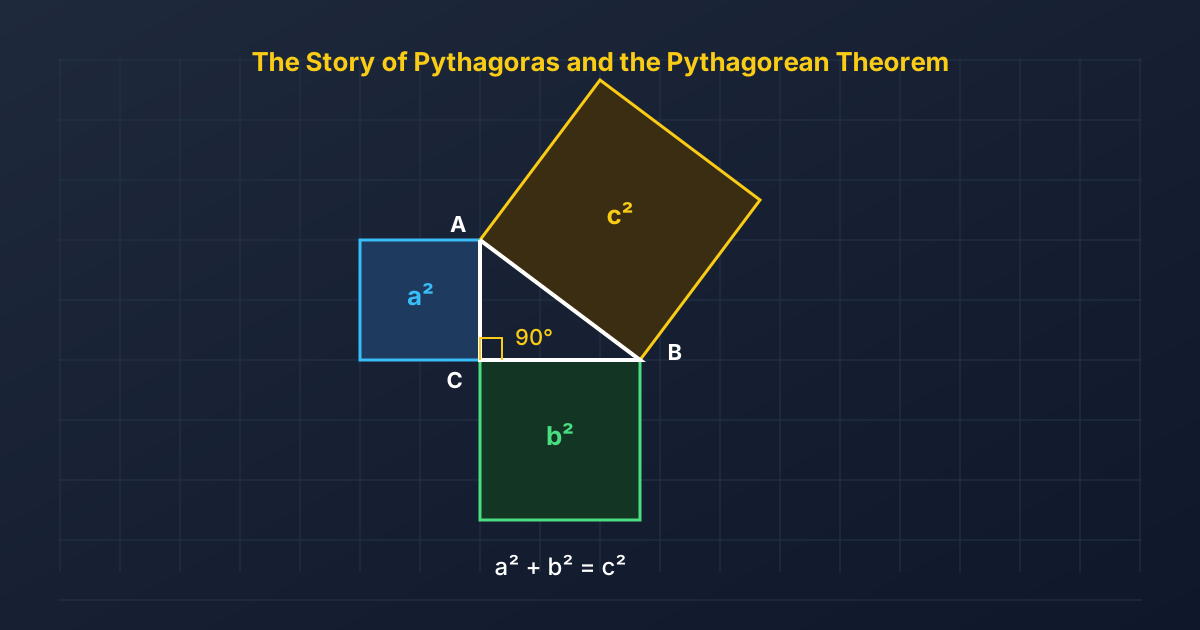
What if the most famous theorem in geometry was known long before the mathematician whose name it carries? That question sits at the heart of the story of Pythagoras and the Pythagorean theorem. Pythagoras lived more than 2,500 years ago, yet the relationship between the sides of a right triangle appears in older records from Babylon and in traditions from India and China. His story blends mathematics, philosophy, and historical mystery, and it ends with an idea that still shapes geometry classes, building sites, and computer screens today. In this guide you will meet the man, or at least the figure the surviving evidence allows us to see, and you will learn what his school taught, what the theorem actually says, and how to prove it two different ways. You will also see why the familiar formula a² + b² = c² was not a single discovery by one person, but knowledge built across civilizations. By the end, you will be able to state the theorem, prove it, use it on real problems, and explain which parts of the Pythagoras story are solid history and which parts are legend.
Who Was Pythagoras?
Pythagoras was an ancient Greek philosopher and religious thinker associated with mathematics, born around 570 BCE on the island of Samos. He later founded a community in Croton, in southern Italy, where his followers studied numbers, music, and philosophy as parts of one way of life. No writings by Pythagoras survive, so many details of his life remain uncertain, and his name is attached to traditions that later followers developed.
Caption: A stylized scene evoking ancient Greek mathematics. This is an artistic reconstruction, not an authenticated portrait. No genuine portrait of Pythagoras survives.
That short biography is about as firm as the evidence allows, and the rest of this section explains why. Pythagoras is one of the most famous names in mathematics, yet he is also one of the hardest ancient figures to pin down. He wrote nothing that survives, if he wrote at all. Everything known about him comes from writers who lived centuries after his death, and those writers often mixed biography with admiration, philosophy, and legend. The result is a figure who is part history and part tradition. Separating the two is not a side issue in this story. It is the story, because the same problem applies to the theorem itself: the name on the theorem and the history behind it are two different things.
Where Was Pythagoras Born?
Tradition places the birth of Pythagoras on Samos, a Greek island in the eastern Aegean Sea, close to the coast of what is now Turkey. In the sixth century BCE, Samos was a busy trading island with links across the Greek world and to Egypt and the Near East. That setting matters, because it makes the later stories of travel and foreign learning at least plausible as a pattern: a curious person from a trading island could hear ideas from many cultures. Plausible, however, is not the same as proven. The island birthplace is the standard account in ancient sources, and it is widely repeated by modern reference works, but it rests on tradition rather than on any document from Pythagoras himself.
When Did Pythagoras Live?
Pythagoras is usually dated to around 570 BCE to around 495 BCE, and both dates should be read as approximations. Ancient writers did not leave birth certificates, and the dates come from later chronologies that worked backward from events and generations. The “around” matters. A date given as c. 570 BCE means “roughly the 570s BCE, as best as later writers could place him,” not “born in the year 570 BCE, as recorded at the time.” His active years fall in the second half of the sixth century BCE, and his community at Croton belongs to that period. Any biography that gives exact years without qualification is overstating what the evidence supports.
What Was Pythagoras Famous For?
Pythagoras is famous for three connected things: the theorem that carries his name, the community he founded, and a way of thinking that treated numbers as deeply meaningful. The theorem is the most famous of the three, and it is the focus of this guide. The community, often called the Pythagorean school or brotherhood, studied mathematics, music, and philosophy together, and it kept its teachings partly within the group. That secrecy is one reason later writers struggled to tell which ideas came from Pythagoras himself and which came from his followers. His fame, in short, rests on a mixture: a real community, a real mathematical tradition, and a name that later generations attached to results the community valued.
The Early Life of Pythagoras
What do ancient sources claim about the young Pythagoras? The accounts say he grew up on Samos, received an education in the Greek intellectual traditions of his day, and later traveled. The travel stories are the most colorful part of the early biography, and they are also the least secure. Later writers report journeys to Egypt and to Babylon, where he supposedly learned priestly knowledge, geometry, and astronomy. Some accounts add even longer journeys. These stories should be read as later traditions, not as verified facts. They were written centuries after his death, by authors who wanted to explain where a wise man got his wisdom, and a journey to an older civilization was a natural explanation.
That caution does not mean the travel stories are worthless. They tell us something real about how later Greeks viewed knowledge: Egypt and Babylon were older centers of learning, and Greek writers respected them. A young man from a trading island like Samos could plausibly have met Egyptian and Babylonian ideas through trade, migration, and ordinary contact, without any grand study tour. What cannot be shown from surviving evidence is a specific itinerary, a specific teacher, or a specific course of study abroad. So this guide states the position plainly: the travels are tradition, the contact between cultures was real, and the details are unknown.
The same caution applies to stories about his teachers. Ancient accounts name various early Greek thinkers as influences, but the lists differ between sources, and none can be confirmed. What can be said with confidence is narrower: Pythagoras grew up in a Greek world where geometry was already practical, where trade linked the Aegean to Egypt and Mesopotamia, and where a thoughtful person could encounter ideas from several traditions. He then moved west to southern Italy, where he founded the community that made his name last.
One tradition says he left Samos during the rule of Polycrates, the tyrant who held the island in the later sixth century BCE. Like the travel stories, that detail comes from later writers, and it fits a wider pattern: Greek thinkers of the period often moved west to the cities of southern Italy and Sicily, where Greek communities were thriving and a new school could take root.
The Pythagorean School and Its Beliefs
Around the later part of the sixth century BCE, Pythagoras settled in Croton, a Greek city in southern Italy, and gathered followers into a community. The group studied mathematics and philosophy together, and it also followed shared rules for daily life. Ancient writers describe the community as close-knit and partly secretive, with teachings passed on within the group rather than published openly. Because nothing from Pythagoras himself survives, modern historians cannot draw a clean line between what he taught and what later members of the school added. That blend is why the word “Pythagorean” often means “from the Pythagorean tradition” rather than “from Pythagoras personally.”
Mathematics and Numbers
For the Pythagoreans, numbers were more than counting tools. The school treated numerical relationships as a key to understanding order in the world, and it studied ratios, patterns, and geometric relationships with unusual seriousness. The right triangle relationship fit this outlook perfectly: a simple pattern in whole numbers, like 3, 4, and 5, pointed to a general rule that held for every right triangle. Whether Pythagoras himself proved that general rule is a separate question, covered later in this guide, but the school’s interest in the pattern is well attested as a tradition. Numbers, for this community, were something to study, respect, and live by, not only something to calculate with.
Music and Harmony
The Pythagorean tradition is also famous for connecting music with numbers. Pluck a string, then halve its length, and the note rises by an octave. The ratio of the lengths is 2:1. Other pleasing intervals match other simple ratios: the perfect fifth corresponds to 3:2, and the perfect fourth to 4:3. The tradition credits this discovery to Pythagoras, and the ratios themselves are real and easy to test on any stringed instrument. One popular story, though, should be labeled as legend: the tale that Pythagoras heard hammers of different weights in a blacksmith’s shop and derived the ratios from their sounds. The physics does not work that way, since hammer weight does not set pitch in the way the story implies, and the tale appears in later sources. Keep the ratios, which are genuine mathematics, and set the hammer story aside as legend.
Philosophy and Daily Life
The community combined study with a shared way of life. Ancient accounts describe rules about diet, behavior, and ritual purity, along with beliefs about the soul and the order of the universe. The exact rules are hard to pin down, because different sources give different lists, and some rules may belong to later members rather than to the founder. What is clear is the general shape: this was not a modern university department. It was a community that treated learning as part of a moral and religious life. That shape helps explain why the school guarded its teachings and why its ideas spread through followers rather than through books by Pythagoras himself.
Secrecy and Historical Uncertainty
Secrecy is both a fact about the school and a problem for historians. If teachings were shared within the group and attributed to the founder, then later writers had no reliable way to sort founder from follower. Add to this that the earliest surviving accounts come from centuries later, and the result is a fog that no amount of enthusiasm can clear. This guide therefore uses careful language throughout: “the Pythagorean tradition” for ideas from the school, “tradition says” for stories that cannot be verified, and “evidence shows” only where the evidence actually reaches. That discipline is not pedantry. It is what keeps a history article honest, and it is the same discipline that lets the mathematical sections of this guide be exact where the history must stay cautious.
What Is the Pythagorean Theorem?
The Pythagorean theorem states that in a right triangle, the square of the hypotenuse equals the sum of the squares of the other two sides. In symbols, with legs a and b and hypotenuse c:
a² + b² = c²
The hypotenuse is the side opposite the 90-degree angle, and it is always the longest side of a right triangle. The legs are the two sides that meet at the right angle. If you know any two sides of a right triangle, the theorem lets you find the third. That is the whole engine of the theorem, and everything else in this guide, from proofs to ladders to computer graphics, is an application of it. Readers who want a dedicated treatment of the theorem itself can read the Pythagorean theorem proof guide, and readers who want the basics of the triangle can start with what a right triangle is.
Understanding the Formula
Squaring a side length has a geometric meaning, not just an arithmetic one. The square of a length is the area of a square built on that length as its side. So a² is the area of the square on leg a, b² is the area of the square on leg b, and c² is the area of the square on the hypotenuse. The theorem says the two smaller squares, added together, exactly fill the largest square. That picture is worth holding in mind, because both proofs later in this guide are built on it. The formula is also a warning: a² + b² = c² is a statement about areas, so it only makes sense when the three lengths belong to one right triangle, with c as the hypotenuse. The formula also tells you at a glance that the hypotenuse is the longest side. Since c² = a² + b², and both a² and b² are positive, c² is greater than a² alone and greater than b² alone, so c is greater than a and greater than b. That is a useful sanity check on any answer: if a computed hypotenuse comes out shorter than a leg, something went wrong.
Why Does the Theorem Work Only for Right Triangles?
The right angle is a condition of the theorem, not decoration. If the angle between the two sides is not 90 degrees, the relationship changes. The general rule for any triangle is the law of cosines: c² = a² + b² − 2ab cos C, where C is the angle between sides a and b. When C is 90 degrees, cos C equals 0, the last term vanishes, and the law of cosines becomes the Pythagorean theorem. When C is anything else, that term matters, and a² + b² no longer equals c². This is why checking the right angle comes first in every honest application: no right angle, no Pythagorean theorem. The converse of the theorem runs the other way, letting you test whether a triangle is right-angled by checking whether its sides satisfy a² + b² = c², but that is a different statement with its own conditions.
A Simple 3-4-5 Example
Take a triangle with legs 3 and 4 and hypotenuse 5. The theorem predicts:
3² + 4² = 5²
Work out each square: 3² = 9, 4² = 16, and 5² = 25. Then add the two smaller squares: 9 + 16 = 25. The two sides match, so the triangle satisfies the theorem, and the angle opposite the side of length 5 is a right angle. The 3-4-5 triangle is the smallest example with whole-number sides, and it appears again and again in this guide, because builders, students, and ancient scribes all used it.
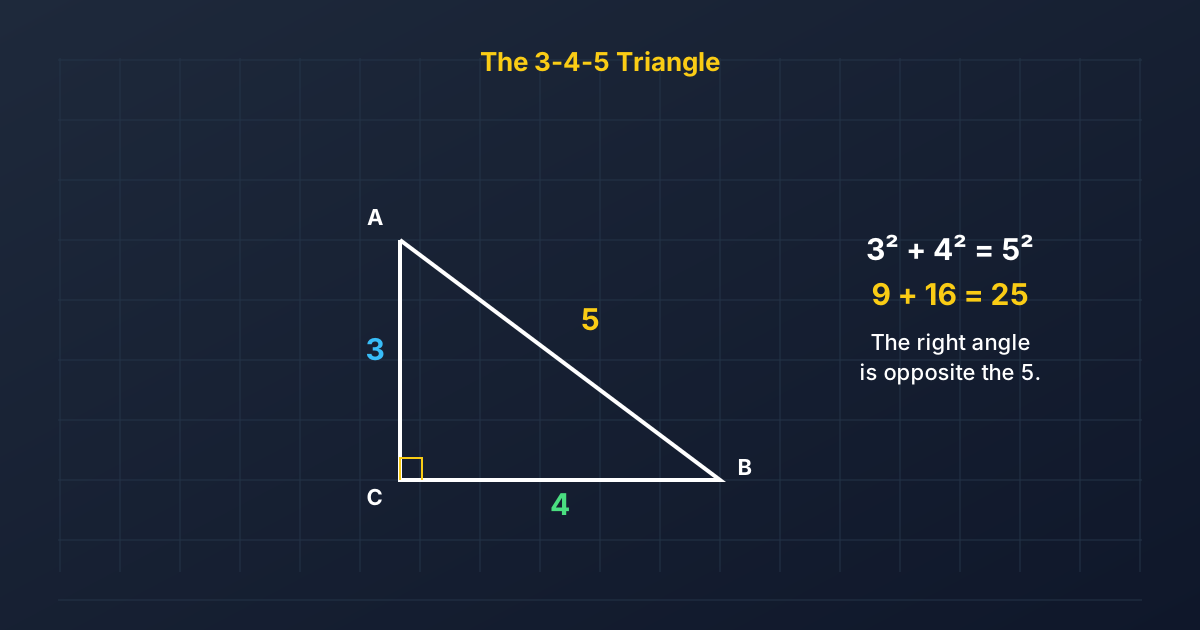
Caption: The 3-4-5 triangle. The squares of the legs, 9 and 16, add to 25, the square of the hypotenuse.
Did Pythagoras Actually Discover the Pythagorean Theorem?
This is one of the most important sections in this guide, because the honest answer is less tidy than the famous name suggests. The theorem carries the name of Pythagoras, but evidence of the same relationship reaches back to civilizations that lived centuries before him. That does not mean the name is a fraud, and it does not mean Pythagoras contributed nothing. It means the history needs five distinctions, and most popular accounts blur them.
First, knowing numerical relationships: a scribe can list triples like 3, 4, 5 or 5, 12, 13 without stating any general rule. Second, using right-triangle calculations: a builder can check a corner with a 3-4-5 rope and get a right angle without proving anything. Third, stating a general theorem: saying that the rule holds for every right triangle, not just the measured ones, is a bigger claim than listing examples. Fourth, producing a rigorous proof: showing why the rule must hold, from accepted starting points, is bigger still. Fifth, historical attribution: the name a later age attaches to a result may honor a school, a tradition, or a guess, rather than record who first did any of the previous four things.
Where does Pythagoras stand on those five rungs? The surviving evidence does not let historians place him with confidence on any of them. There is no surviving proof written by Pythagoras himself, and no surviving text in which he states the general theorem. The first surviving rigorous proof in the Greek tradition appears much later, in Euclid’s Elements, around 300 BCE, in Book I, Proposition 47. That proof belongs to Euclid’s tradition, not to a document by Pythagoras. It is possible that Pythagoras or his school knew the relationship and even argued for it, and the tradition that credits him may preserve a real memory of the school’s work. But possibility is not evidence, and this guide does not claim with certainty that Pythagoras discovered or first proved the theorem. The fair statement is this: the theorem is named after Pythagoras because the Greek tradition attached his name to it, while the knowledge itself came from many hands across many centuries. Euclid’s proof, the one that survives, is a good example of what a Greek proof looked like. Euclid built squares on all three sides, then showed, through congruent triangles and equal areas, that the square on the hypotenuse equals the two smaller squares combined. The argument is geometric rather than numerical: it never measures a particular triangle, and it works for every right triangle. That style of proof, general and built from earlier results, is what later ages meant by rigor, and it arrived centuries after Pythagoras.
Thales of Miletus, an earlier Greek thinker, shows the same pattern of naming: his own theorem about angles in a semicircle carries his name through tradition, not through a surviving text by his hand.
The Pythagorean Theorem Before Pythagoras
Long before the sixth century BCE, people who built, surveyed, and kept records already worked with right-triangle relationships. The evidence differs in kind from civilization to civilization: a clay tablet here, a practical tradition there, a later text preserving older material somewhere else. Each case below states what the evidence actually supports and where scholars disagree, because the gaps between those things are where popular accounts usually go wrong.
Ancient Babylonian Mathematics
The strongest early evidence comes from Babylon, in Mesopotamia. A clay tablet known as Plimpton 322, from the Old Babylonian period around 1800 BCE, lists columns of numbers that match Pythagorean triples. The tablet is about a thousand years older than Pythagoras. Its rows include number sets that satisfy a² + b² = c², which shows that Babylonian scribes knew and could generate such relationships. What the tablet was for is debated. Some scholars read it as a table with trigonometric meaning, an early way of organizing ratios. Others read it as a teacher’s list of problems, a set of worked examples for students. The debate is genuine, and this guide does not settle it, because settling it is not necessary for the main point. On either reading, the tablet shows numerical knowledge of the right-triangle relationship long before Pythagoras. It does not show a general theorem stated in words, and it does not show a proof in the Greek sense. It shows a working tradition of numbers, and that is already enough to break the idea of a single inventor.
Caption: A schematic representation of a Babylonian tablet with rows of numbers, not a photograph of Plimpton 322. The real tablet is in the Columbia University collection.
Ancient Indian Mathematics
Indian tradition contributes the Śulba Sūtras, texts connected with the construction of altars, which include a rule for the diagonal of a rectangle: the square on the diagonal equals the sum of the squares on the length and the breadth. In modern symbols, that is the Pythagorean theorem applied to a rectangle, whose diagonal splits it into two right triangles. The tradition associated with this rule is often linked to the name Baudhayana, and the dating is usually given as around 800 to 500 BCE, though the dating is debated and the surviving manuscripts are later than the traditions they preserve. That distinction matters: an old tradition preserved in a later text is not the same as a dated document from the early period. What the Śulba Sūtras show, on a careful reading, is a working knowledge of the diagonal rule for rectangles, stated as a practical rule for builders of sacred spaces. Whether the authors framed it as a general theorem with proof is a further question, and the texts, as practical manuals, do not answer it in the Greek style. The contribution is real, and its exact form is a matter of scholarly care, not slogan.
Ancient Chinese Mathematics
Chinese tradition contributes the gougu relationship, named for the two legs of a right triangle: gou, the shorter leg, and gu, the longer leg. The relationship appears in the Zhoubi Suanjing tradition, which includes the famous 3-4-5 example and a diagram-based discussion of the right-triangle relationship. Here the dating trap is the sharpest in this whole section. The Zhoubi Suanjing as a surviving text was compiled over a long period, and its compilation date is debated, with some material plausibly older and some clearly later. The commentary by Zhao Shuang, which contains a well-known diagram for the theorem, dates to the third century CE, long after Pythagoras. So it would be wrong to say that a Chinese text predating Pythagoras proves the theorem in full. The honest statement is narrower: the gougu tradition preserves right-triangle knowledge, including the 3-4-5 relationship, and parts of that tradition may reach back to early periods, but the surviving text cannot be dated as a whole to before Pythagoras. Chinese mathematics made its own contribution, on its own timeline, and forcing it into a race for first place distorts it.
Ancient Egyptian Mathematics
Egyptian mathematics is the case where popular accounts most often overreach. Egyptians certainly practiced geometry. They surveyed fields, built on rectangular plans, and used ropes for measuring, and later Greek writers mention Egyptian rope stretchers, measurers who worked with cords. What has no solid ancient evidence is the specific story repeated all over the internet: that Egyptians used a knotted rope with lengths 3, 4, and 5 to lay out perfect right angles. No Egyptian text or image clearly shows that method, and the story seems to be a later reconstruction that got repeated until it sounded like fact. This guide says so plainly. Egyptian practical geometry is real, and it belongs in this history. The 3-4-5 rope story, as a specific Egyptian practice, does not have the evidence to support it, and repeating it as fact would be exactly the kind of legend this guide is trying to separate from history.
A Historical Comparison Timeline
The table below gathers the evidence with dates qualified and claims kept to what each source actually supports. Read it as a picture of knowledge growing across cultures, not as a contest with one winner.
| Civilization or figure | Approximate date | Evidence | What it actually shows |
|---|---|---|---|
| Babylon | c. 1800 BCE | Plimpton 322 | Number sets matching Pythagorean triples; purpose debated |
| Egypt | 2nd millennium BCE | Surveying and measuring practice | Practical geometry; no solid evidence for a 3-4-5 rope method |
| India | c. 800-500 BCE, dating debated | Śulba Sūtras, diagonal rule | Working rule for rectangle diagonals; surviving texts later |
| China | Gougu tradition, compilation debated | Zhoubi Suanjing tradition, 3-4-5 example | Right-triangle relationship; Zhao Shuang commentary is 3rd century CE |
| Pythagoras | c. 570-c. 495 BCE | Later tradition, no surviving writings | School and attribution; no surviving proof by him |
| Euclid | c. 300 BCE | Elements, Book I, Proposition 47 | First surviving rigorous proof in the Greek tradition |
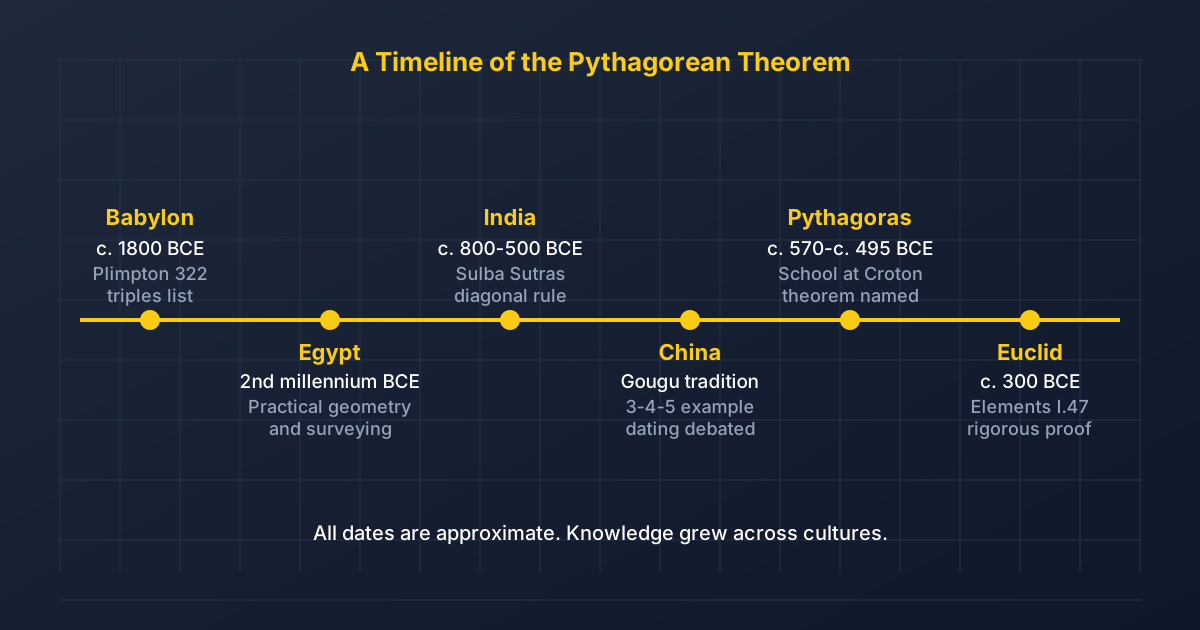
Caption: The timeline of right-triangle knowledge. All dates are approximate, and the Chinese and Indian entries carry dating debates noted in the text.
The pattern is the point. Babylonian scribes listed triples. Indian builders used a diagonal rule. Chinese scholars worked with the gougu relationship. Greek tradition named the theorem for Pythagoras. Euclid proved it in a form that survives. No single civilization owns the whole story, and that shared history is more interesting than any single inventor myth.
How Does the Pythagorean Theorem Work?
Picture a right triangle, then build a square outward on each of its three sides. The square on one leg has area a². The square on the other leg has area b². The square on the hypotenuse has area c². The theorem says the first two areas add up to the third: a² + b² = c². Try it with the 3-4-5 triangle. The square on the leg of 3 has area 9. The square on the leg of 4 has area 16. Together they cover 25 units of area, which is exactly the area of the square on the hypotenuse of 5. The picture works for any right triangle, not just whole-number ones. With legs of 2 and 3, the squares have areas 4 and 9, adding to 13, so the hypotenuse is √13, about 3.61. The areas still balance, even though the hypotenuse is not a whole number. That is why the theorem is a statement about geometry, not about neat numbers: the areas balance because of the shape, and the numbers follow. Scaling shows the same balance at any size. Double every side of the 3-4-5 triangle and you get 6, 8, 10. The squares now have areas 36, 64, and 100, and 36 + 64 still equals 100. The areas grew fourfold, since doubling a length quadruples its square, but the balance is untouched. That is why the theorem is about shape, not size: stretch a right triangle and the relationship stretches with it, unchanged.
A Simple Visual Proof of the Pythagorean Theorem
The area picture also gives a proof, and it is one of the most satisfying arguments in school mathematics. Start with four copies of the same right triangle, with legs a and b and hypotenuse c. Arrange them inside a larger square whose side is a + b, one triangle tucked into each corner, with each triangle’s legs along the outer edges. The four hypotenuses now form a tilted shape in the middle. That middle shape is a square, and the reason is worth stating carefully. Each of its sides is a hypotenuse, so all four sides have length c. Each of its angles is what remains when you subtract the two acute angles of a right triangle from a straight angle: 180 degrees minus 90 degrees, which is 90 degrees, since the two acute angles of any right triangle add to 90 degrees. Four equal sides and four right angles make a square, with area c².
Now count the area of the big square two ways. By its side, the area is (a + b)². By its parts, the area is the four triangles plus the central square. Each triangle has area ab/2, so four of them have area 4(ab/2), which is 2ab. Add the central square, and the total is 2ab + c². Set the two counts equal:
(a + b)² = 4(ab/2) + c²
Expand the left side: a² + 2ab + b². Simplify the right side: 2ab + c². So:
a² + 2ab + b² = 2ab + c²
Subtract 2ab from both sides, and the result is the theorem:
a² + b² = c²
No step in this argument depends on measuring a particular triangle. It works for any legs a and b, because the area count works for any size. That generality is what separates a proof from a check: checking 3-4-5 shows one case, while this argument covers all cases at once.
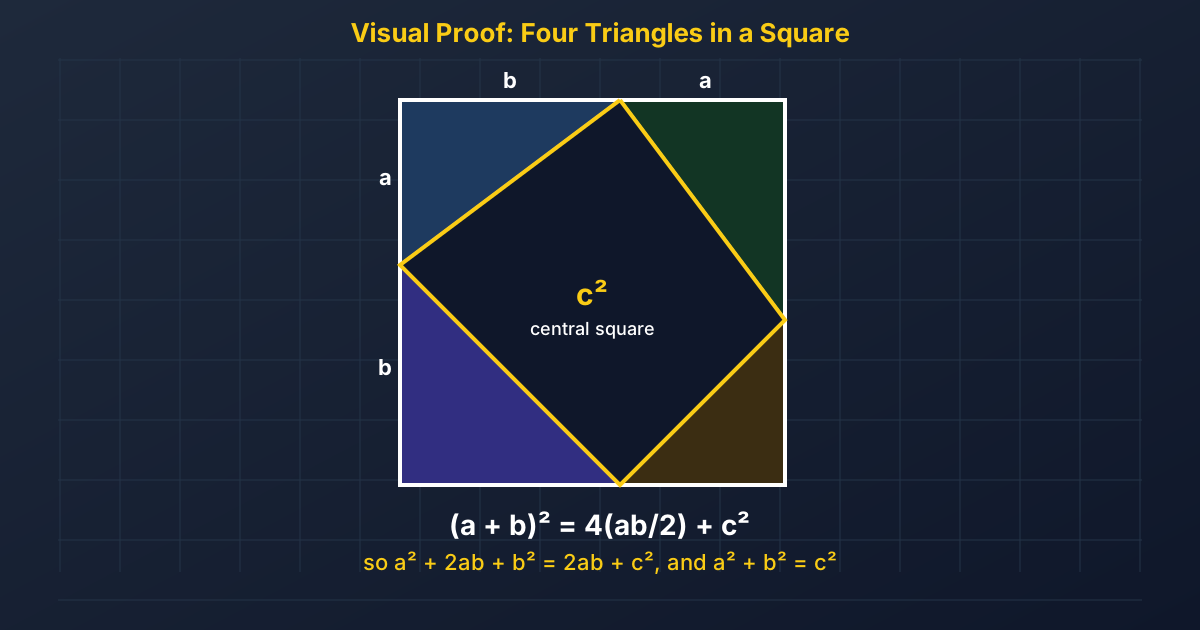
Caption: The area-rearrangement proof. The big square has area (a + b)², counted as four triangles plus the central square c².
Another Proof Using Similar Triangles
A second proof uses similarity, and it is the proof many geometry courses teach because it connects the theorem to the rest of triangle geometry. Start with a right triangle ABC, right-angled at C, with legs a and b and hypotenuse c. In this proof, let a be the leg BC, opposite vertex A, and let b be the leg AC, opposite vertex B. Now draw the altitude from the right-angle vertex C down to the hypotenuse AB, meeting it at a point D. The altitude splits the hypotenuse into two segments: call m the segment next to vertex B, so m is adjacent to leg a, and call n the segment next to vertex A, so n is adjacent to leg b. The two segments add to the whole hypotenuse, so m + n = c.
The altitude also creates two smaller triangles, ACD and BCD, and each one is similar to the original triangle ABC. Why? Each small triangle shares one acute angle with the original, and each has a right angle, so by angle-angle similarity all three triangles have the same shape. Similarity gives proportions. In the original triangle, the ratio of leg a to hypotenuse c is a/c. In the small triangle BCD, the corresponding ratio is m/a, because the side of length m sits in the same position relative to the shared angle as leg a does in the original. Setting those ratios equal, a/c = m/a, and cross-multiplying gives a² = cm. The same reasoning for the other side gives b² = cn, since leg b stands to the hypotenuse as segment n stands to leg b. Now add the two equations:
a² + b² = cm + cn = c(m + n)
Since m + n = c, the right side becomes c times c, which is c². So a² + b² = c². The proof is complete, and every label in it matches the diagram below: a next to segment m, b next to segment n, and the altitude drawn dashed from C to D. Readers who want the altitude idea in more depth can read the guide to the altitude to the hypotenuse, and the full treatment of the theorem’s proofs is in the Pythagorean theorem proof guide.
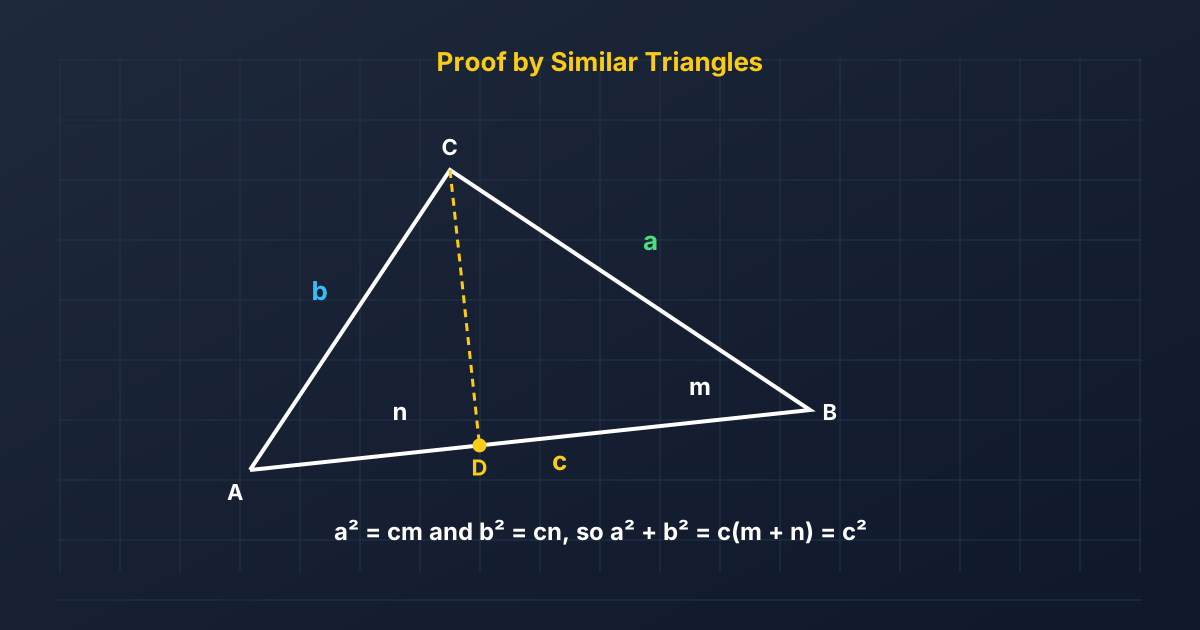
Caption: The similar-triangle proof. The altitude from C to D splits the hypotenuse c into segments m and n, with a² = cm and b² = cn.
What Are Pythagorean Triples?
A Pythagorean triple is a set of three positive integers that satisfies the theorem: three whole numbers a, b, and c with a² + b² = c². The most famous is 3, 4, 5. Others include 5, 12, 13; 8, 15, 17; and 7, 24, 25. Check each one: 25 + 144 = 169, which is 13²; 64 + 225 = 289, which is 17²; and 49 + 576 = 625, which is 25². Every check works, which is why these sets are useful: a triangle built with those side lengths is guaranteed to be right-angled, by the converse of the theorem.
Triples come in two kinds. A primitive triple is one whose three numbers share no common factor greater than 1: 3, 4, 5 is primitive, and so are 5, 12, 13 and 8, 15, 17. A nonprimitive triple is a multiple of a primitive one: multiply every number in 3, 4, 5 by 2 and you get 6, 8, 10, which still works, since 36 + 64 = 100. Multiply by 3 and you get 9, 12, 15, since 81 + 144 = 225. Multiply by 4 and you get 12, 16, 20, since 144 + 256 = 400. Scaling a triple always gives another triple, because multiplying every side by the same factor multiplies every square by the square of that factor, and the equation still balances. There is also a formula that generates primitive triples directly, going back to Euclid. Pick two positive integers m and n, with m greater than n, and form the three numbers m² − n², 2mn, and m² + n². With m = 2 and n = 1, you get 3, 4, and 5. With m = 3 and n = 2, you get 5, 12, and 13. Every primitive triple arises this way, which is one reason mathematicians are sure the list never ends.
Two special right triangles deserve a mention alongside triples, because students meet them constantly. The isosceles right triangle has legs of equal length, so its sides follow the ratio 1, 1, √2. The 30-60-90 triangle has sides in the ratio 1, √3, 2. Neither is a triple, since √2 and √3 are irrational, but both are exact, and both come straight from the theorem: 1² + 1² = 2 for the first, and 1² + (√3)² = 4 = 2² for the second. The full catalog of triples, with the rule that generates them, is in the Pythagorean triples guide.
| Triple | Check | Kind |
|---|---|---|
| 3, 4, 5 | 9 + 16 = 25 | Primitive |
| 5, 12, 13 | 25 + 144 = 169 | Primitive |
| 8, 15, 17 | 64 + 225 = 289 | Primitive |
| 7, 24, 25 | 49 + 576 = 625 | Primitive |
| 6, 8, 10 | 36 + 64 = 100 | Multiple of 3, 4, 5 |
| 9, 12, 15 | 81 + 144 = 225 | Multiple of 3, 4, 5 |
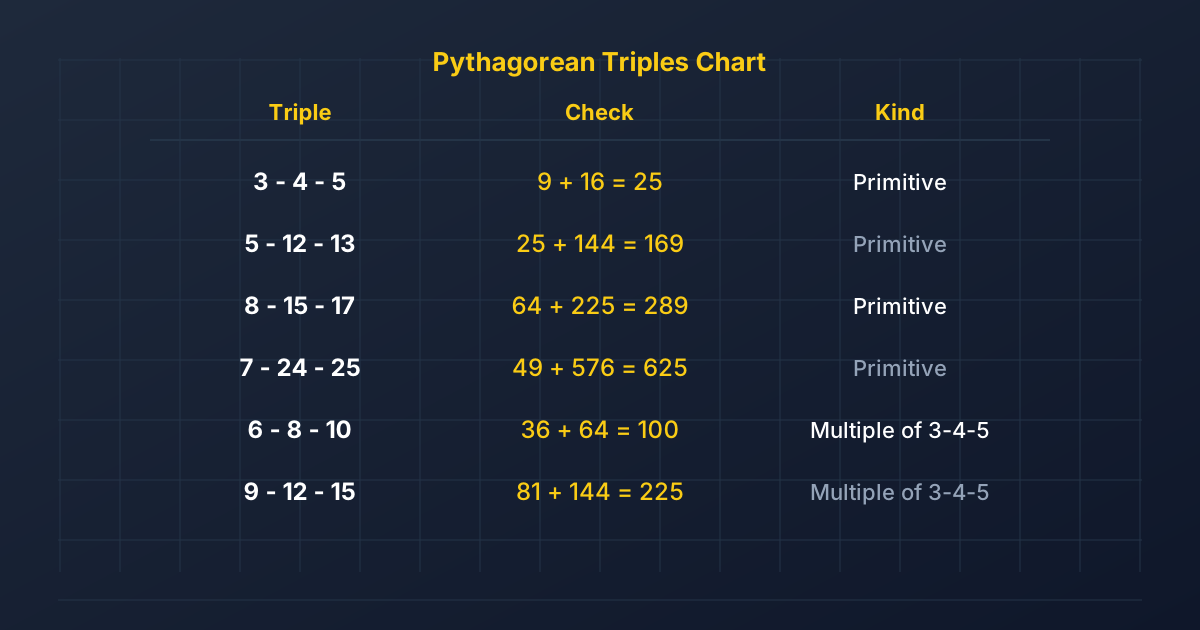
Caption: Six Pythagorean triples. The first four are primitive, and the last two are multiples of 3, 4, 5.
Solved Pythagorean Theorem Examples
Each example below gives the problem, the known information, the formula, the steps, the answer with units, and a quick verification. Work through them in order: the first ones are single-step, and the last one chains two calculations together. For a compact reference to every formula used in this section, see the right triangle formulas guide.
Example 1: Finding a Hypotenuse
Problem: A right triangle has legs of 6 cm and 8 cm. Find the hypotenuse.
Given: a = 6 cm, b = 8 cm, right angle between them. Formula: c² = a² + b².
Solution: c² = 6² + 8² = 36 + 64 = 100. Take the positive square root, since a length is positive: c = 10 cm.
Answer: 10 cm. Verification: 6² + 8² = 100 = 10², and 6, 8, 10 is a multiple of the 3, 4, 5 triple, so the answer is consistent twice over.
Example 2: Finding a Missing Leg
Problem: A right triangle has a hypotenuse of 13 cm and one leg of 5 cm. Find the other leg.
Given: c = 13 cm, a = 5 cm. Formula: a² + b² = c², rearranged to b² = c² − a².
Solution: b² = 13² − 5² = 169 − 25 = 144. Take the positive square root: b = 12 cm.
Answer: 12 cm. Verification: 5² + 12² = 25 + 144 = 169 = 13², matching the 5, 12, 13 triple.
Example 3: Finding a Square’s Diagonal
Problem: A square has side length 4 cm. Find its diagonal.
Given: The diagonal splits the square into two right triangles with legs 4 cm and 4 cm. Formula: d² = 4² + 4².
Solution: d² = 16 + 16 = 32, so d = √32 = 4√2 cm, since √32 = √(16 × 2) = 4√2. As a decimal, 4√2 is about 5.66 cm.
Answer: 4√2 cm, about 5.66 cm. Verification: (4√2)² = 16 × 2 = 32, which matches 4² + 4².
Example 4: Checking a Right Triangle
Problem: Are side lengths 7, 24, and 25 the sides of a right triangle?
Given: Three lengths, with 25 the longest, so it would be the hypotenuse if the triangle is right-angled. Test: does 7² + 24² equal 25²?
Solution: 7² + 24² = 49 + 576 = 625, and 25² = 625. The two sides match.
Answer: Yes, the triangle is right-angled, with the right angle opposite the side of length 25. Verification: the check is the verification, and 7, 24, 25 is a known primitive triple.
Example 5: Ladder Against a Wall
Problem: A ladder 10 ft long leans against a vertical wall, with its base 6 ft from the wall. How high up the wall does it reach?
Given: Hypotenuse 10 ft, horizontal leg 6 ft, wall vertical so the angle at the ground is a right angle. Formula: height² = 10² − 6².
Solution: height² = 100 − 36 = 64, so height = 8 ft.
Answer: 8 ft. Verification: 6² + 8² = 36 + 64 = 100 = 10², and the ladder, wall, and ground form a 6, 8, 10 triangle.
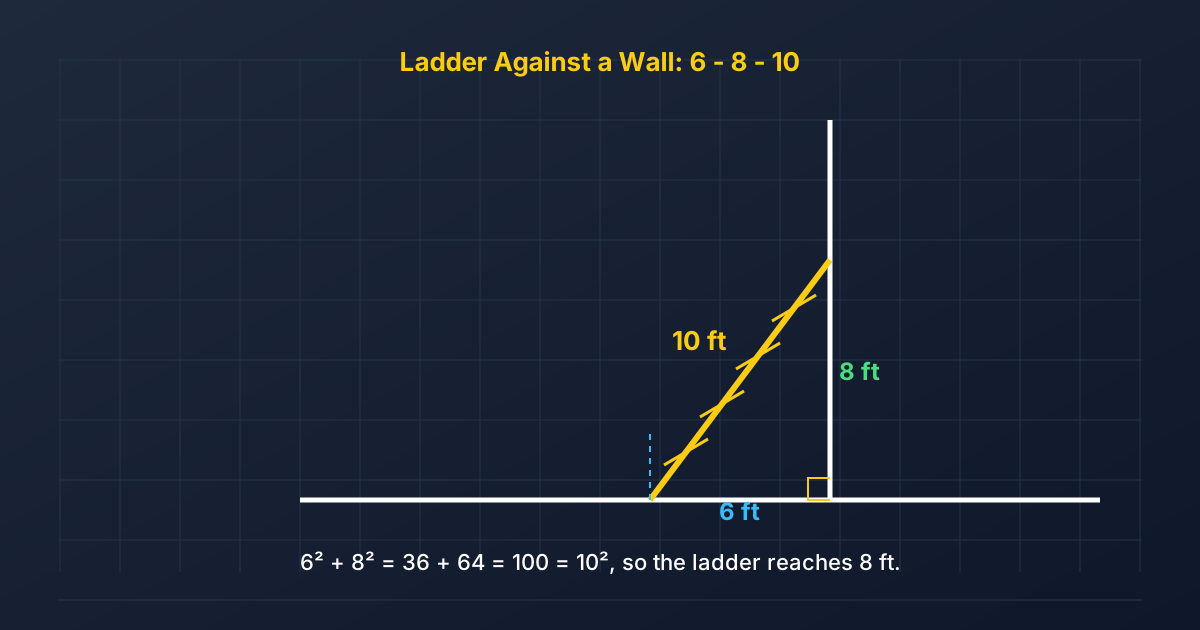
Caption: The ladder problem. A 10 ft ladder with its base 6 ft from the wall reaches 8 ft up the wall.
Example 6: Rectangle Diagonal
Problem: A rectangle measures 9 m by 12 m. Find its diagonal.
Given: The diagonal splits the rectangle into two right triangles with legs 9 m and 12 m. Formula: d² = 9² + 12².
Solution: d² = 81 + 144 = 225, so d = 15 m.
Answer: 15 m. Verification: 9² + 12² = 225 = 15², and 9, 12, 15 is three times the 3, 4, 5 triple.
Example 7: Distance Between Two Points
Problem: Find the distance between the points (1, 2) and (4, 6) on a coordinate grid.
Given: The horizontal difference is 4 − 1 = 3 units, and the vertical difference is 6 − 2 = 4 units. Those differences are the legs of a right triangle whose hypotenuse is the distance. Formula: d² = 3² + 4².
Solution: d² = 9 + 16 = 25, so d = 5 units.
Answer: 5 units. Verification: 3² + 4² = 25 = 5², the 3, 4, 5 triangle again. The same idea, applied to any two points, is the distance formula, covered in the distance formula guide.
Example 8: Multi-Step Geometry Problem
Problem: A right triangle has a hypotenuse of 25 cm and one leg of 7 cm. Find the other leg, then find the area of the triangle.
Given: c = 25 cm, a = 7 cm. Step 1 uses the theorem; step 2 uses the area formula for a right triangle, (1/2) × leg × leg.
Solution, step 1: b² = 25² − 7² = 625 − 49 = 576, so b = 24 cm. Step 2: area = (1/2) × 7 × 24 = (1/2) × 168 = 84 cm².
Answer: The missing leg is 24 cm, and the area is 84 cm². Verification: 7² + 24² = 49 + 576 = 625 = 25², confirming the leg, and (1/2) × 7 × 24 = 84, confirming the area. Both steps check out.
The Pythagorean Theorem and Irrational Numbers
Take a right triangle with legs 1 and 1. By the theorem, the hypotenuse c satisfies c² = 1² + 1² = 2, so c = √2, about 1.414. That length is the diagonal of a unit square, and it is an exact geometric length: you can draw it, measure a segment of that length, and mark it on a number line with a compass. Yet no fraction of two integers equals it. That is what “irrational” means: a real number that cannot be written as a fraction a/b with integers a and b. Irrational does not mean imaginary or unreal. √2 sits on the ordinary number line between 1 and 2, exactly where the compass puts it.
Two jobs must be kept apart here. Geometry gives the length: the theorem shows the diagonal of a unit square is √2. Logic gives the irrationality: a separate proof by contradiction shows no fraction can equal √2. The triangle alone does not prove irrationality, and the contradiction proof alone does not produce the length. The full proof that √2 is irrational is in the guide on why the square root of 2 is irrational, which works through the parity argument step by step. This section does not repeat that proof, because the point here is the connection: the theorem creates a length that fractions cannot measure, and that discovery changed how mathematics thought about number itself.
One famous story belongs here with a clear warning label. Tradition says a Pythagorean named Hippasus revealed irrational numbers and was drowned at sea for it, either by the gods or by his fellow Pythagoreans. That story is legend, not verified history. No contemporary source records it, and the tale appears in later writers who loved a dramatic story about a secret revealed. The discovery of incommensurable lengths, lengths with no common measuring unit, is genuinely associated with the Pythagorean tradition, but the drowning story should never be presented as fact. Keep the mathematics, which is certain, and the legend, which is not, in separate boxes.
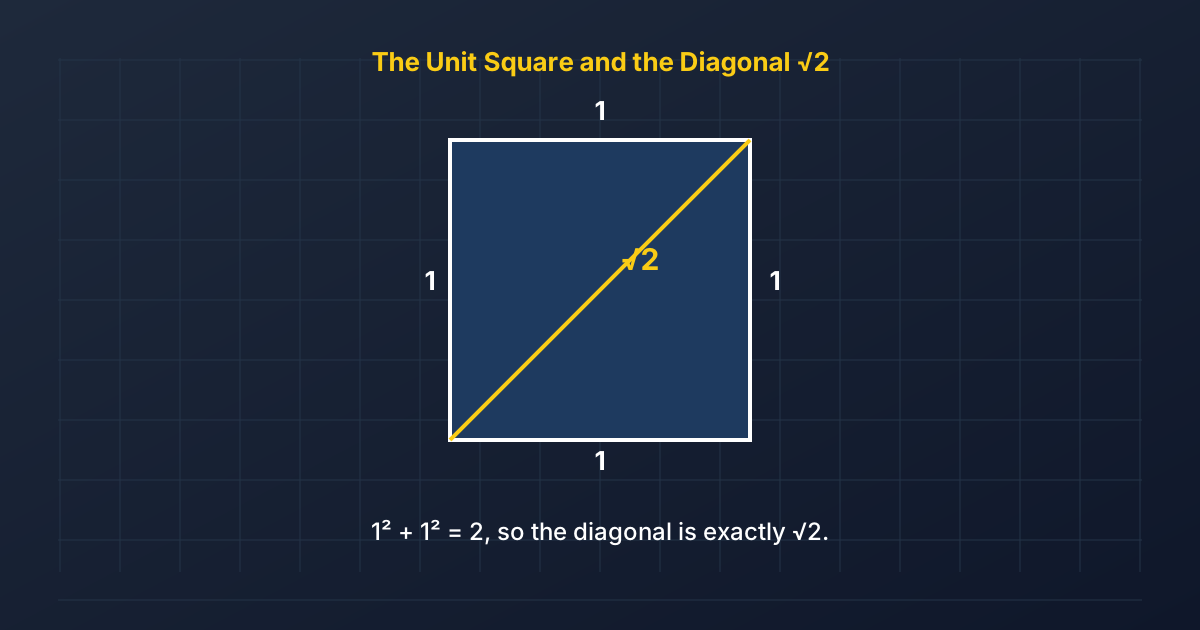
Caption: The unit square. Its diagonal is exactly √2, a length no fraction can equal.
Real-Life Applications of the Pythagorean Theorem
The theorem survives because it keeps solving real problems. The applications below are grouped by field, and each one includes a concrete case rather than a vague claim.
Construction
Builders check right angles with the 3-4-5 method: measure 3 units along one edge, 4 units along the other, and confirm the diagonal between those marks is 5 units. Scaled up, a 6, 8, 10 check works for larger corners, since 36 + 64 = 100. If the diagonal is off, the corner is not square, and the builder adjusts before the error spreads through the whole structure. The same check works for laying out foundations, fences, and decks. Readers who want to build a right triangle from scratch can follow the guide to constructing a right triangle.
Architecture
Architects work with rectangular plans, and every rectangle hides two right triangles. A room 9 m by 12 m has a diagonal of 15 m, as Example 6 showed, and that diagonal matters for placing beams, checking that a frame is square, and sizing materials that span corners. Roof design uses the same idea: the horizontal run and the vertical rise of a roof are legs, and the rafter length is the hypotenuse. A roof with a run of 12 ft and a rise of 5 ft needs rafters of 13 ft, since 144 + 25 = 169.
Engineering
Engineers split forces and motions into perpendicular components, then recombine them with the theorem. A force pulling partly sideways and partly upward can be treated as two legs, and the total force is the hypotenuse. The same pattern appears in surveying instruments, robot arms, and bridge design, wherever a diagonal result comes from two perpendicular inputs. The theorem is the tool that turns two one-dimensional measurements into one true magnitude.
Navigation
Navigation estimates straight-line distance from perpendicular displacements. Walk 30 km east and 40 km north, and the straight-line distance from your start is 50 km, since 900 + 1600 = 2500 = 50². Pilots, sailors, and hikers use the same idea with map coordinates: the east-west and north-south differences are legs, and the direct distance is the hypotenuse. GPS systems do the same calculation in three dimensions, adding a vertical component to the same principle. When an angle is known as well as a side, the sine, cosine, and tangent ratios extend the same triangle to give bearings and directions, not just distances.
Computer Graphics
Screens are coordinate grids, and the distance between two points on a screen is a hypotenuse. A game character moving 6 pixels right and 8 pixels up has traveled 10 pixels in a straight line, since 36 + 64 = 100. Collision detection, animation paths, and camera distances all run on that calculation, millions of times per second. The theorem is invisible to the player, but the movement on screen would be wrong without it.
Surveying
Surveyors measure land with right triangles. A baseline and a perpendicular offset give two legs, and the theorem gives the distance to a point that cannot be measured directly, across a river or a ravine, for example. A surveyor who measures a baseline of 30 m and an offset of 40 m knows the direct distance is 50 m without crossing the ground in between. The method is the same one the Babylonian and Egyptian measurers used in practical form, now carried out with lasers and total stations. The instrument changed; the geometry did not.
Everyday Mathematics
The theorem shows up in ordinary objects. A television screen 24 inches wide and 18 inches tall has a diagonal of 30 inches, since 576 + 324 = 900. A rectangular garden 5 m by 12 m has a diagonal path of 13 m. A bookshelf diagonal brace, a ramp, a kite string with height and horizontal distance, all reduce to legs and a hypotenuse. Once you see the pattern, right triangles appear everywhere, and the theorem turns guessing into measuring.
Interesting Facts About Pythagoras and His Theorem
- The theorem is named after Pythagoras, but the numerical relationship was known in Babylon around 1800 BCE, roughly a thousand years before his lifetime. The name honors a tradition, not a single documented discovery.
- No writings by Pythagoras survive. Everything attributed to him comes from later writers, some writing centuries after his death, which is why his biography stays approximate.
- The Pythagorean school connected music with ratios: the octave 2:1, the fifth 3:2, and the fourth 4:3. Those ratios are real and testable, unlike the hammer legend discussed earlier.
- There are infinitely many primitive Pythagorean triples. A formula going back to Euclid generates them, so the list never runs out: 3, 4, 5 is only the first.
- The theorem has hundreds of known proofs. Elisha Scott Loomis collected 370 of them in his 1940 book “The Pythagorean Proposition,” and more have been found since.
- A United States president proved the theorem. James Garfield, before becoming president, published a proof in 1876 using a trapezoid made of two copies of a right triangle plus a third triangle.
- Euclid’s Elements, around 300 BCE, contains the first surviving rigorous proof in the Greek tradition, as Book I, Proposition 47. It is a geometric proof built on squares and areas.
- The theorem creates irrational numbers. The diagonal of a unit square is exactly √2, a length no fraction equals, so geometry forced mathematics beyond whole numbers and fractions.
- The theorem powers coordinate geometry. The distance between two points is a hypotenuse, which is why the distance formula looks like the theorem with coordinates in place of side lengths.
- The theorem extends to three dimensions. The diagonal of a box with sides a, b, and c is √(a² + b² + c²), the same idea applied twice, first across the base and then upward.
Common Misconceptions About Pythagoras
- Pythagoras definitely invented the theorem. Correction: the relationship was known in Babylon, India, and Chinese tradition in various forms before or around his time, and no surviving document shows him stating or proving the general theorem. The name is an attribution by later tradition, not a documented invention.
- No one understood the relationship before ancient Greece. Correction: Plimpton 322 from Babylon, around 1800 BCE, lists number sets matching triples, and the Śulba Sūtras give a diagonal rule for rectangles. Understanding took different forms in different cultures, but it was not absent.
- Pythagoras personally wrote the surviving proofs. Correction: Pythagoras wrote nothing that survives. The surviving proofs, including Euclid’s, come from later authors. Attributing them to Pythagoras confuses a school with its founder.
- The theorem works for every triangle. Correction: it works only for right triangles. For other triangles, the law of cosines applies, and a² + b² equals c² only when the angle between a and b is 90 degrees.
- All Pythagorean triples are multiples of 3, 4, 5. Correction: 5, 12, 13 and 8, 15, 17 are primitive triples, sharing no common factor, and they are not multiples of 3, 4, 5. Multiples form only one family among many.
- Every story about Pythagoras is historically verified. Correction: the travels, the hammer story, and the Hippasus drowning are later traditions or legends, not verified facts. The verified core is smaller: a philosopher from Samos, a community at Croton, and a tradition that valued numbers.
- The theorem is only useful in school. Correction: builders square corners with it, engineers combine force components with it, navigators estimate direct distances with it, and graphics software computes screen distances with it, every day.
- The theorem and its converse are identical statements. Correction: the theorem says that if a triangle is right-angled, then a² + b² = c². The converse says that if a² + b² = c², then the triangle is right-angled. They are two directions of one relationship, and each needs its own justification. Using one when you need the other is a logical error, and exam questions test exactly that distinction.
Pythagoras vs. the Pythagorean Theorem
The name “Pythagoras” covers several different things, and keeping them apart prevents most of the confusion in this topic. The table below separates them.
| Topic | What it is | What it is not |
|---|---|---|
| The historical person | A Greek philosopher from Samos, active around the later sixth century BCE | A well-documented biography with exact dates and writings |
| The philosophical community | The Pythagorean school at Croton, studying numbers, music, and philosophy | A modern university, or a group with fully known rules |
| The mathematical theorem | The statement a² + b² = c² for right triangles | A rule for all triangles, or a single person’s invention |
| The history of the theorem | Knowledge built across Babylon, India, China, Egypt, Greece, and later Europe | A straight line from one discoverer to the modern formula |
| Modern applications | Building, navigation, engineering, graphics, and surveying uses | A school-only exercise with no life outside exams |
The person, the school, the theorem, its history, and its uses are related, but they are not interchangeable. Saying “Pythagoras proved the theorem” compresses all five rows into one claim, and that compression is where the history goes wrong. Saying “the Pythagorean tradition is associated with the theorem, which earlier cultures also knew and Euclid later proved” is longer, but it is true.
Practice Questions on the Pythagorean Theorem
Beginner Level
- In a right triangle, what is the hypotenuse, and how can you recognize it?
- A right triangle has legs of 9 cm and 12 cm. Find the hypotenuse.
- A right triangle has legs of 5 cm and 12 cm. Find the hypotenuse.
- A right triangle has legs of 8 cm and 15 cm. Find the hypotenuse.
- A right triangle has a hypotenuse of 25 cm and one leg of 7 cm. Find the other leg.
Intermediate Level
- A rectangle measures 5 m by 12 m. Find its diagonal.
- Do side lengths 9, 40, and 41 form a right triangle? Show your check.
- A square has side length 6 cm. Find its diagonal, exactly and to two decimal places.
- A ladder 13 ft long leans against a wall with its base 5 ft from the wall. How high does it reach?
- A right triangle has a hypotenuse of 20 cm and one leg of 12 cm. Find the other leg.
Advanced Level
- A right triangle has legs 9 cm and 12 cm, giving a hypotenuse of 15 cm. That hypotenuse becomes one leg of a second right triangle whose other leg is 8 cm. Find the second hypotenuse, showing both steps.
- A triangle has sides 10, 24, and 26. Is it right-angled? Identify the hypotenuse and the right angle, and explain which statement, the theorem or its converse, justifies your answer.
- A clay tablet lists sets of numbers that satisfy a² + b² = c². Does that tablet, by itself, prove that its writers stated the general Pythagorean theorem? Explain the distinction involved.
- Find the distance between the points (2, 3) and (5, 7) on a coordinate grid.
- A square has a diagonal of 10 cm. Find its side length, exactly and to two decimal places, and verify your answer.
Answer Key
- The hypotenuse is the side opposite the right angle. Recognize it as the longest side of a right triangle, and the only side that does not touch the right angle.
- c² = 9² + 12² = 81 + 144 = 225, so c = 15 cm.
- c² = 5² + 12² = 25 + 144 = 169, so c = 13 cm.
- c² = 8² + 15² = 64 + 225 = 289, so c = 17 cm.
- b² = 25² − 7² = 625 − 49 = 576, so b = 24 cm.
- d² = 5² + 12² = 25 + 144 = 169, so d = 13 m.
- Yes. 9² + 40² = 81 + 1600 = 1681, and 41² = 1681, so the sides satisfy the converse, and the triangle is right-angled.
- d² = 6² + 6² = 72, so d = √72 = 6√2 cm, about 8.49 cm.
- height² = 13² − 5² = 169 − 25 = 144, so height = 12 ft.
- b² = 20² − 12² = 400 − 144 = 256, so b = 16 cm.
- Step 1: 9² + 12² = 81 + 144 = 225, so the first hypotenuse is 15 cm. Step 2: 15² + 8² = 225 + 64 = 289, so the second hypotenuse is 17 cm.
- Yes, it is right-angled. 10² + 24² = 100 + 576 = 676 = 26², so the hypotenuse is 26 and the right angle is opposite it. The converse justifies this, because the argument runs from the side relationship to the right angle, not the other way.
- No. A list of examples shows knowledge of numerical relationships, which is the first of the five distinctions in the discovery section. Stating a general theorem means claiming the rule for every right triangle, and proving it means showing why it must hold. The tablet shows the first level, not the third or fourth.
- The horizontal difference is 5 − 2 = 3, and the vertical difference is 7 − 3 = 4, so d² = 3² + 4² = 25, and d = 5 units.
- If the side is s, then s² + s² = 10², so 2s² = 100, s² = 50, and s = √50 = 5√2 cm, about 7.07 cm. Verification: (5√2)² + (5√2)² = 50 + 50 = 100 = 10².
Frequently Asked Questions
Frequently Asked Questions
Common questions about Pythagoras and the Pythagorean theorem, answered briefly.
01 Who was Pythagoras?
Pythagoras was an ancient Greek philosopher and religious thinker from Samos, active around the later sixth century BCE. He founded a community at Croton in southern Italy where followers studied numbers, music, and philosophy together. No writings by him survive, so his biography rests on later tradition, and many details remain uncertain.
02 When was Pythagoras born?
Around 570 BCE, as best as later chronologies can place him. The date is approximate, not a recorded birth year, because no document from his lifetime survives. Ancient writers worked backward from events and generations, so modern reference works give his life as roughly 570 to 495 BCE, with both ends qualified.
03 Where did Pythagoras live?
Tradition places his birth on Samos, a Greek island in the eastern Aegean Sea. He later moved west and founded his community at Croton, a Greek city in southern Italy, where he spent his active years. The Samos birthplace and the Croton community are the standard account, though both rest on later tradition rather than his own writings.
04 What is the Pythagorean theorem?
It states that in a right triangle, the square of the hypotenuse equals the sum of the squares of the other two sides: a² + b² = c². The hypotenuse is the side opposite the 90-degree angle, and it is the longest side. If you know two sides of a right triangle, the theorem finds the third.
05 Did Pythagoras invent the theorem?
Not as far as surviving evidence shows. Babylonian tablets from around 1800 BCE list number sets matching the theorem, and Indian and Chinese traditions knew related rules. No proof or statement by Pythagoras himself survives. The theorem carries his name because later Greek tradition attached it to him and his school.
06 Who knew the theorem before Pythagoras?
Babylonian scribes knew number sets matching the theorem by around 1800 BCE, as Plimpton 322 shows. Indian tradition gave a diagonal rule for rectangles in the Śulba Sūtras, and Chinese tradition worked with the gougu relationship. Egyptian surveyors practiced geometry, though the popular 3-4-5 rope story lacks solid evidence.
07 What is the Pythagorean theorem formula?
The formula is a² + b² = c², where a and b are the legs meeting at the right angle and c is the hypotenuse opposite it. Squaring a side gives the area of the square built on that side, so the formula says the two smaller squares add up to the largest square.
08 How do you prove the Pythagorean theorem?
One proof arranges four copies of a right triangle inside a square of side a + b, leaving a central square of side c, then counts the area two ways to get a² + b² = c². Another proof drops an altitude to the hypotenuse and uses similar triangles to show a² = cm and b² = cn, which add to c².
09 What is a 3-4-5 triangle?
It is a right triangle with sides 3, 4, and 5, the smallest triple with whole-number sides. It satisfies the theorem because 3² + 4² = 9 + 16 = 25 = 5². Builders use it to check right angles, since a triangle with those sides must have its right angle opposite the side of length 5.
10 What are Pythagorean triples?
Three positive integers a, b, and c with a² + b² = c². Examples include 3, 4, 5; 5, 12, 13; 8, 15, 17; and 7, 24, 25. A triple is primitive when its numbers share no common factor, like 3, 4, 5, and nonprimitive when it is a multiple of another triple, like 6, 8, 10.
11 Why is the Pythagorean theorem important?
It connects side lengths to angles, turning a shape question into an equation. It lets you find missing sides, check right angles, and compute distances between points. Beyond school, it underlies building, navigation, engineering, and computer graphics, anywhere a diagonal comes from two perpendicular measurements.
12 How is the theorem used in real life?
Builders check square corners with 3, 4, 5 measurements, and architects size diagonals of rooms and rafters. Navigators estimate direct distances from east-west and north-south differences. Graphics software computes distances between screen points the same way. Any job with two perpendicular measurements and one diagonal uses it.
13 What did the Pythagorean school believe?
The school treated numbers as a key to order in the world and studied mathematics, music, and philosophy as one pursuit. It linked musical intervals to simple ratios like 2:1 and 3:2. It also followed shared rules for daily life, though exact rules differ between sources and may belong to later members.
14 What is the connection between Pythagoras and music?
The Pythagorean tradition linked pleasing musical intervals to simple number ratios: the octave is 2:1, the fifth 3:2, and the fourth 4:3. Halving a string raises its note by an octave, which you can test on any stringed instrument. The hammer story is legend, but the ratios themselves are genuine mathematics.
15 What is the connection between the theorem and irrational numbers?
A right triangle with legs 1 and 1 has hypotenuse √2, since 1² + 1² = 2. That length is the diagonal of a unit square, yet no fraction equals it, so √2 is irrational. Geometry produces the length, while a separate proof by contradiction shows no fraction can equal it.
16 Are all historical stories about Pythagoras true?
No. His birthplace on Samos and his community at Croton are the standard account, but many colorful stories are later traditions. The travels to Egypt and Babylon, the hammer discovery, and the drowning of Hippasus lack contemporary evidence. Treat them as legends that reveal how later writers admired him, not as verified facts.
17 Can the theorem be used for non-right triangles?
No, not directly. For a triangle without a right angle, use the law of cosines: c² = a² + b² − 2ab cos C, where C is the angle between sides a and b. Only when C is 90 degrees does cos C equal 0, making the last term vanish and leaving a² + b² = c².
18 Why is the theorem named after Pythagoras?
Because later Greek tradition attached his name to it, and the name stuck through Euclid and the centuries after. The school he founded valued the relationship, and ancient writers credited their founder with the school's teachings. The naming honors that tradition, even though earlier cultures knew the relationship and no proof by Pythagoras survives.
Key Takeaways
- Pythagoras was a Greek philosopher from Samos, active around the later sixth century BCE, who founded a community at Croton. No writings by him survive, so his biography stays approximate.
- The Pythagorean theorem states a² + b² = c² for right triangles only, with c as the hypotenuse opposite the 90-degree angle.
- The relationship was known before Pythagoras: Babylonian tablets list triples around 1800 BCE, Indian tradition gives a diagonal rule, and Chinese tradition works with the gougu relationship.
- Knowing examples, using a rule, stating a general theorem, and proving it are four different levels. The evidence supports the early levels for older cultures and a surviving proof only with Euclid, around 300 BCE.
- The theorem is proved by area rearrangement and by similar triangles, and both proofs work for every right triangle, not just measured cases.
- The theorem produces irrational lengths, like the diagonal √2 of a unit square, and it powers distance calculations in building, navigation, engineering, and computer graphics.
Conclusion
The story of Pythagoras is really two stories woven together. One is the life of a philosopher from Samos who founded a community at Croton and left no writings behind, a figure half history and half legend. The other is the journey of a mathematical idea, from Babylonian tablets and Indian altar builders to Chinese gougu scholars, Greek geometers, and Euclid’s proof, an idea that belongs to no single civilization. The theorem itself is beautifully simple: the squares on the legs add to the square on the hypotenuse, and that balance holds for every right triangle. It also reaches further than its inventor myth suggests, producing irrational lengths, powering coordinates, and solving problems from ladders to screens. Keep the history honest and the mathematics exact, and both stories reward the effort. Now try the practice questions above, and explore the proof and triples guides to go deeper.
Sources and Further Reading
- Encyclopaedia Britannica, entry on Pythagoras, for the standard biographical account and its uncertainties.
- MacTutor History of Mathematics, entries on Pythagoras and on Babylonian mathematics, for the historical timeline and the Plimpton 322 evidence.
- Euclid’s Elements, Book I, Proposition 47, for the first surviving rigorous proof in the Greek tradition.
- Elisha Scott Loomis, “The Pythagorean Proposition” (1940), for the collection of 370 proofs of the theorem.